Yale Admission Requirements: 2026 Complete Guide

Yale admission requirements are the set of academic and personal credentials Yale University uses to evaluate applicants for undergraduate admission. These requirements span academic transcripts, standardized test scores, recommendation letters, personal essays, and extracurricular involvement. Yale’s acceptance rate sits among the most selective in the country, making every component of your application count. Understanding what Yale actually looks for, and how each piece fits into its holistic review, gives you a real advantage before you write a single word of your application.
What are the Yale admission requirements for academics?
Academic strength is Yale’s primary consideration. Yale does not publish a required course list, but the expectation is clear: four years of English, mathematics through calculus or statistics, laboratory sciences, a foreign language, and history or social studies. Students who take the most rigorous courses available at their school, including AP or IB classes, signal that they are ready for Yale’s academic pace.

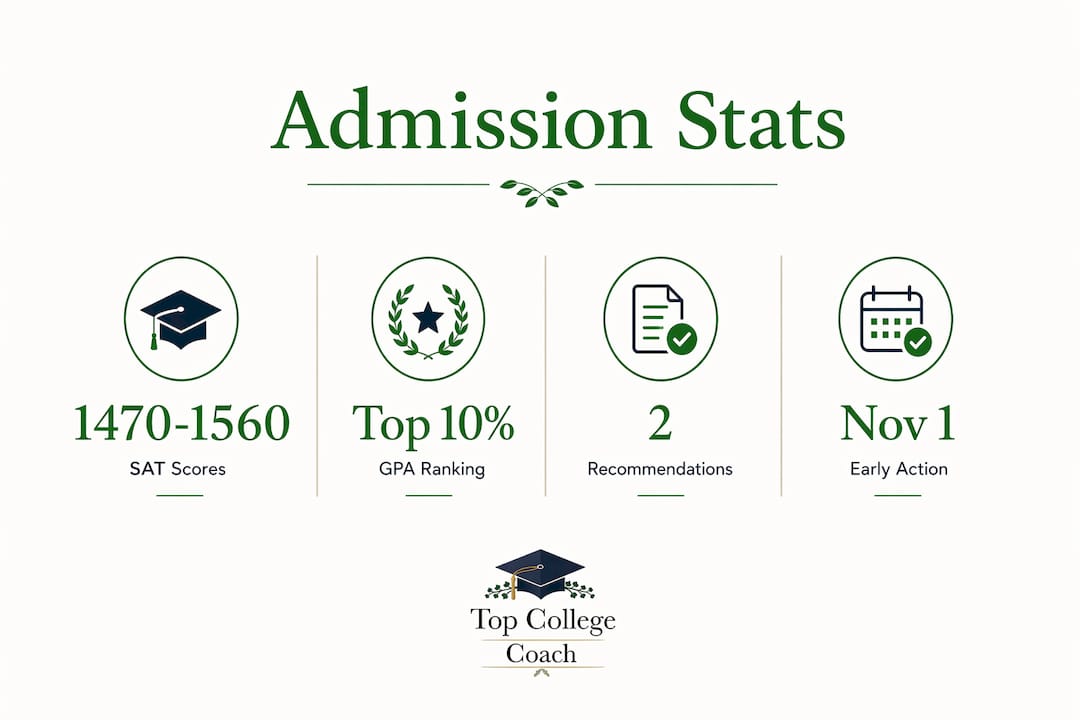
96% of enrolled first-year students ranked in the top 10% of their high school class. That figure tells you the floor, not the ceiling. A strong GPA matters, but Yale reads it in context. A student at a school that offers 15 AP courses is evaluated differently than one at a school that offers three.
Grade trends also carry weight. A student who struggled in ninth grade but posted strong junior and senior year results shows growth and resilience. Yale’s admissions officers look for an upward trajectory, not a perfect record from day one.
English: Four years, with emphasis on writing and analysis
Mathematics: Through precalculus at minimum; calculus or statistics preferred
Science: At least two laboratory sciences
Foreign language: Three or more years in one language
History/social studies: Two or more years
Pro Tip: Request your school counselor to write a detailed school profile that explains your school’s grading scale and course offerings. Yale readers use this document to contextualize your GPA and course rigor.
How do standardized tests factor into Yale’s admissions criteria?
Yale reinstated a mandatory SAT or ACT policy for all first-year and transfer applicants starting in 2026. This ends the test-flexible period that followed the pandemic. Every applicant must now submit scores from one of these two exams.
The score ranges for admitted students reflect the school’s selectivity. Most admitted students score above the 95th percentile on the SAT or ACT. In practical terms, that means SAT scores in the 1470–1560 range and ACT scores of 33–35 are typical for admitted students. Scoring below these ranges does not disqualify an applicant, but it places more pressure on other parts of the application to compensate.
Dean Pericles Lewis explained that the return to mandatory testing reflects the SAT and ACT’s predictive value for academic success. He also noted that test scores help Yale identify talented students from disadvantaged backgrounds who might otherwise be overlooked in a purely subjective review.
Yale no longer accepts AP or IB scores as substitutes for the SAT or ACT. SAT Subject Tests are also not required, though they may be submitted if they demonstrate mastery in a specific area. The priority should always be the main exam, not supplemental scores.
Exam | Typical admitted range | Percentile benchmark |
SAT | 1470–1560 | Above 95th percentile |
ACT | 33–35 | Above 95th percentile |
AP/IB (as SAT substitute) | Not accepted | N/A |
Pro Tip: Take both the SAT and ACT once each in your junior year. Many students perform significantly better on one format than the other. Submit only your stronger score.
What recommendation letters and essays does Yale require?
Yale requires two teacher recommendation letters, both from teachers in core academic subjects. Core subjects include English, mathematics, science, foreign language, and history. Teachers from elective or non-academic courses do not fulfill this requirement.
Yale values letters that discuss intellectual curiosity, resilience, and character rather than generic praise. A letter that says “she always turned in her homework on time” adds nothing. A letter that describes how a student challenged a class assumption with a well-researched counterargument tells Yale exactly what it wants to know. Teachers from junior or senior year courses tend to provide the most relevant insight into a student’s current academic readiness.
The essay components of the Yale application process include the Common App personal statement and Yale-specific supplemental essays. These essays are where your authentic story lives. Yale’s readers are looking for evidence of intellectual vitality, leadership, and the kind of character that contributes to a campus community.
Choose recommenders who know you well in an academic setting, not just teachers who gave you an A
Brief your recommenders on specific moments, projects, or conversations they can reference
Write supplemental essays that answer Yale’s actual questions, not generic Ivy League responses
Use your personal statement to reveal something no other part of your application shows
Pro Tip: Give your recommenders a one-page document listing your key academic achievements, a project you are proud of, and a personal quality you hope they highlight. This makes their letter more specific and more useful to Yale.
How does Yale evaluate extracurricular activities and personal qualities?
Depth beats breadth at Yale. Applicants who show deep commitment and leadership in one or two areas consistently outperform those with long lists of superficial club memberships. Yale wants to see that you have made a real impact somewhere, not that you joined every organization available.
Personal qualities carry significant weight in Yale’s holistic review. Resilience, intellectual curiosity, and genuine kindness are traits Yale’s admissions officers describe as central to the kind of student body they build. These qualities show up in how you write about your experiences, how your recommenders describe you, and what your activity list reveals about your priorities.
Here is what a compelling extracurricular profile looks like in practice:
Sustained commitment: Three or more years in one activity, not one year in five activities
Leadership with evidence: A title is less important than a specific outcome you drove
Intellectual extension: Research, independent projects, or creative work that goes beyond school requirements
Community impact: Volunteer work or initiatives that show you think beyond yourself
Authenticity: Activities you pursued because they matter to you, not because they look good on paper
Geographic and demographic diversity also factor into Yale’s decisions. Yale actively builds a class that represents different regions, backgrounds, and perspectives. This does not mean you can predict your odds based on your zip code, but it does mean that your unique background is an asset, not a liability. Learning more about what top colleges look for can help you frame your profile with this in mind.
What are the key deadlines and strategic tips for Yale applicants?
Yale offers two application pathways. Single-Choice Early Action has a November 1 deadline, with decisions released by December 15. Regular Decision has a January 2 deadline, with decisions released by March 31. Yale does not offer rolling admissions, so these dates are fixed.
Early Action applicants see a roughly 10–11% acceptance rate compared to Regular Decision’s 3–4%. That gap is real, but so is the caveat: around 50% of Early Action applicants are deferred to Regular Decision rather than admitted outright. Applying early is an advantage only if your application is genuinely ready by November 1.
The full application checklist includes:
Official high school transcript
SAT or ACT scores (mandatory as of 2026)
Two teacher recommendation letters from core subject teachers
One school counselor recommendation
Yale supplemental essays
Common App personal statement
Extracurricular activity list
Strategic preparation makes a measurable difference. Students who start their essays in the summer before senior year consistently produce stronger work than those who rush in October. Reviewing the Ivy League application guide for 2026 can help you map out a realistic timeline.
Pro Tip: Do not apply Early Action just to apply early. If your test scores are below the typical admitted range or your essays need more work, use the extra time and apply Regular Decision with a polished application.
Key Takeaways
Yale’s holistic review rewards applicants who combine academic excellence, strong test scores, authentic personal narratives, and deep extracurricular commitment across every component of the application.
Point | Details |
Mandatory testing in 2026 | SAT or ACT scores are required for all applicants; AP/IB scores are not accepted as substitutes. |
Academic rigor matters most | 96% of enrolled students ranked in the top 10% of their class; course difficulty is evaluated in context. |
Depth over breadth | Sustained leadership in one or two activities outperforms a long list of surface-level involvement. |
Early Action advantage is conditional | EA acceptance rates are higher, but roughly 50% of EA applicants are deferred to Regular Decision. |
Recommendations require specificity | Letters that describe intellectual curiosity and character carry far more weight than generic praise. |
What I have learned after years of watching students apply to Yale
After working with students through the Yale application process year after year, one pattern stands out above all others: the students who get in are not always the most decorated. They are the most self-aware.
Yale’s admissions team reads thousands of applications from students with perfect GPAs and near-perfect test scores. What separates the admitted students is not another AP class or another club presidency. It is the ability to tell a true, specific, and compelling story about who they are and why Yale is the right place for them to grow.
The return to mandatory testing in 2026 is not a reason to panic. It is a reason to prepare early and strategically. Students who treat test prep as one part of a larger preparation plan, rather than the whole plan, tend to perform better and feel less anxious about the process.
Parents play a real role here too. The most helpful thing a parent can do is create space for their student to reflect honestly on what they care about. Authenticity in essays is not a soft concept. It is the difference between an essay that reads like a college brochure and one that makes an admissions officer stop scrolling.
Start early. Be honest. Know your story before you try to tell it.
— Randy Pryor, Founder of Top College Coach
How Top College Coach can support your Yale application
Understanding Yale’s requirements is the first step. Building an application that meets them is where the real work begins.
Top College Coach works with students and families to build applications that reflect genuine academic strength and personal authenticity. From Ivy League admissions strategy to essay development and test prep planning, every session is focused on your specific profile and goals. Yale’s holistic review rewards preparation, and that preparation is exactly what Top College Coach provides. Schedule a free admissions strategy session and get a clear, personalized plan for your Yale application.
FAQ
What GPA do you need for Yale?
Yale does not publish a minimum GPA, but 96% of enrolled students ranked in the top 10% of their high school class. Course rigor is evaluated alongside GPA.
Is the SAT required for Yale in 2026?
Yes. Yale reinstated mandatory SAT or ACT submission for all first-year applicants starting in 2026. Test-optional policies no longer apply.
When is the Yale application deadline?
Yale’s Single-Choice Early Action deadline is November 1, with decisions by December 15. The Regular Decision deadline is January 2, with decisions by March 31.
How many recommendation letters does Yale require?
Yale requires two teacher recommendations from core academic subject teachers, plus one letter from your school counselor.
Does applying Early Action improve your chances at Yale?
Early Action acceptance rates are higher than Regular Decision rates, but around 50% of EA applicants are deferred rather than admitted. A strong, complete application matters more than timing alone.
Recommended
Comments