Cornell Admissions Requirements: 2026 Complete Guide

Cornell admissions requirements are defined by a combination of standardized test scores, rigorous high school coursework, application materials, and a holistic review process conducted by each of Cornell’s seven undergraduate colleges. Understanding these criteria is the first step toward building a strong, focused application. Cornell’s overall admission rate sits at approximately 7% for the 2025/2026 cycle, with wide variation across colleges. That number tells you one thing clearly: preparation and specificity matter more than hope.
What are the Cornell admissions requirements for academics and testing?
Cornell’s academic expectations are high, and they vary by college. Every applicant should plan a high school curriculum that includes four years of English, three to four years of mathematics, two to three years of a foreign language, two to three years of science, and two to three years of social studies. Students applying to the College of Engineering face stricter prerequisites, including calculus and physics before enrollment.

Cornell reinstated SAT/ACT requirements starting with the 2025/2026 cycle after a period of test-optional admissions. This reversal is significant. Students who planned to apply without scores now need to submit them. The median SAT score for admitted students is approximately 1510 out of 1600, with the middle 50% scoring between 1450 and 1560. That range signals that Cornell expects academic strength, but a score alone does not guarantee admission.
Cornell uses a holistic review, meaning no single number defines your candidacy. A 1560 SAT paired with a thin extracurricular record will not outperform a 1480 paired with genuine intellectual depth and leadership. Admissions committees look at your full academic trajectory, including grade trends, course rigor, and class rank where available.
English: Four years, including composition and literature
Mathematics: Three to four years, through pre-calculus at minimum; calculus required for Engineering
Science: Two to three years with lab components; three to four years for science-focused colleges
Foreign language: Two to three years of the same language
Social studies: Two to three years, including history
Pro Tip: If you are applying to the College of Engineering or the College of Agriculture and Life Sciences, take AP Chemistry, AP Biology, or AP Calculus BC in high school. These courses signal readiness for Cornell’s demanding first-year curriculum.
How does the Cornell application process work?
The Cornell application process runs through the Common Application, supplemented by Cornell-specific essays and materials unique to each undergraduate college. Applicants must choose one of the seven colleges at the time of application. That choice shapes every supplemental essay you write and every piece of supporting material you submit.
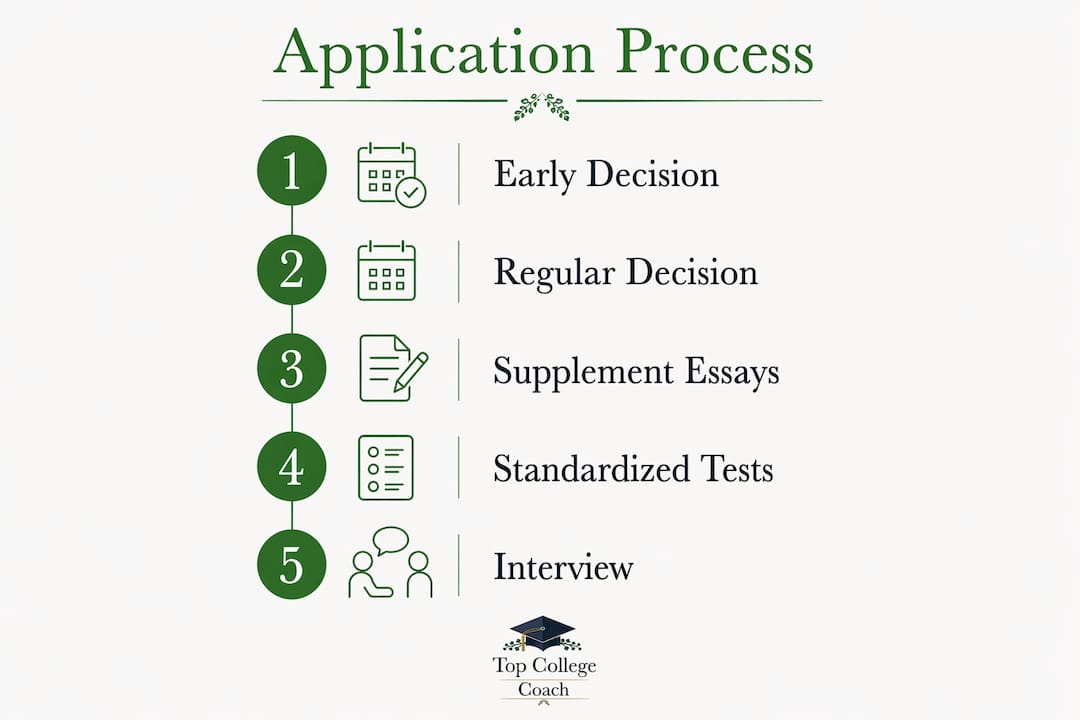
Here is how the process works, step by step:
Choose your college. Select one of Cornell’s seven undergraduate colleges based on your academic interests. This decision affects your essay prompts, evaluation criteria, and admission odds.
Complete the Common Application. Fill out personal information, academic history, activities, and the personal essay.
Write Cornell’s supplemental essays. Each college requires at least one college-specific essay. Some require additional short responses or creative submissions.
Submit recommendations. Cornell requires two teacher recommendations and one counselor recommendation. Some colleges also accept or require additional materials like portfolios or interview responses.
Request your school profile. Your counselor submits this automatically through the Common Application, but confirm it is complete.
Submit test scores. Send official SAT or ACT scores directly from College Board or ACT to Cornell.
Meet your deadline. Early Decision closes november 1, with decisions released in mid-december. Regular Decision closes January 2, with decisions in late March.
The Early Decision deadline carries a strategic advantage. ED admit rates historically run higher than Regular Decision rates, approximately 17–22% versus the overall 7%. ED is binding, meaning you commit to attend if accepted. Regular Decision gives you time to compare financial aid offers from multiple schools.
Pro Tip: Do not treat the supplemental essay as an afterthought. Cornell’s admissions committees read these essays to assess fit with their specific college. A generic essay about “wanting to help people” will not move the needle. Write about a specific intellectual experience that connects directly to your chosen college’s curriculum.
What are the admission rates across Cornell’s seven colleges?
Applicants must apply to one of seven undergraduate colleges, each with its own admissions committee, requirements, and acceptance rate. This structure means your admission odds depend heavily on which college you choose, not just on your overall qualifications.
Cornell Undergraduate College | Approximate Admit Rate |
SC Johnson College of Business | ~6% |
College of Engineering | ~9% |
College of Arts and Sciences | ~9% |
College of Architecture, Art, and Planning | ~10% |
College of Agriculture and Life Sciences | ~11% |
School of Industrial and Labor Relations | ~13% |
School of Hotel Administration | ~25% |
These figures reflect the 2025/2026 cycle and show meaningful differences across programs. The School of Hotel Administration admits roughly four times more applicants than the SC Johnson College of Business. That gap does not mean Hotel Administration is easier academically. It means the applicant pool is smaller and the program is more specialized.
Cornell’s holistic review process evaluates extracurricular involvement, leadership, intellectual curiosity, and demonstrated alignment with the chosen college. Financial need is also a factor for international applicants, as Cornell uses need-aware admissions for students outside the United States.
A few distinctions worth knowing:
Endowed colleges (Arts and Sciences, Engineering, Architecture, Business, Hotel Administration) are privately funded and charge higher tuition.
Statutory colleges (Agriculture and Life Sciences, Industrial and Labor Relations, and Human Ecology) receive partial New York State funding and charge lower tuition for New York residents.
Tuition differences do not affect admissions standards. Both tracks are equally competitive.
Understanding Ivy League acceptance rates across all eight schools helps you put Cornell’s numbers in context and plan your college list wisely.
What do international applicants need to know about Cornell?
International applicants face the same academic standards as domestic students, but with additional documentation requirements. Cornell accepts a wide range of international credentials, including A-Levels, the International Baccalaureate, the Chinese Gaokao, and national leaving certificates from most countries. Admissions committees evaluate these credentials in context, comparing your results to the grading norms of your country and school.
English proficiency is a separate requirement for non-native speakers. Cornell requires a minimum TOEFL iBT score of 100, an IELTS score of 7.0, or a Duolingo English Test score of 120. Many applicants underestimate the listening and writing sections of these exams. Strong reading skills alone will not carry you to a passing score.
Key points for international applicants:
Submit official transcripts with certified English translations where required.
Send standardized test scores (SAT or ACT) directly from the testing agency.
Apply Early Decision only if Cornell is your clear first choice and you do not need to compare financial aid packages. Cornell meets 100% of demonstrated financial need for admitted students, but need-aware admissions means financial circumstances can affect admission decisions for international students.
Confirm that your school profile and grading scale are clearly explained in your counselor’s letter.
Pro Tip: If your country’s curriculum does not include AP or IB courses, explain this in your application. Cornell’s admissions readers are trained to evaluate course rigor in context. A top result in your national system carries real weight.
How can you strengthen your application for Cornell’s holistic review?
Cornell’s holistic review means your application is a complete picture, not a checklist. Academics open the door, but the rest of your application determines whether you walk through it. The factors top colleges weigh beyond grades include demonstrated passion, leadership, and authentic fit with the program you are applying to.
Here is how to build a stronger application:
Align your activities with your chosen college. A student applying to the College of Engineering who has led a robotics team, completed a research internship, and taken advanced math courses tells a coherent story. Admissions readers notice that alignment.
Write essays that are specific, not general. Name the professor whose research interests you. Reference a specific course in Cornell’s catalog. Show that you have done real research into the program.
Choose recommenders who know your intellectual work. A teacher who watched you struggle with a hard problem and persist is more valuable than a teacher who simply gave you an A.
Address financial need early. If you are applying for financial aid, submit the CSS Profile and FAFSA as soon as they open. Cornell meets full demonstrated need, but late submissions can complicate the process.
Use the additional information section wisely. If your grades dipped one semester due to a family situation or illness, explain it briefly and factually. Admissions readers appreciate context.
The Ivy League admissions process rewards students who present a clear, consistent identity across every part of their application. Cornell is no different.
Key Takeaways
Cornell admissions requirements demand academic rigor, standardized test scores, college-specific essays, and a clear fit with one of seven undergraduate colleges, all evaluated through a holistic review process.
Point | Details |
Testing is required | Cornell reinstated SAT/ACT requirements for the 2025/2026 cycle; aim for a score near the 1510 median. |
College choice shapes everything | Each of Cornell’s seven colleges has its own admit rate, essay prompts, and evaluation criteria. |
Early Decision has an advantage | ED admit rates run approximately 17–22%, significantly higher than the overall 7% rate. |
Holistic review goes beyond grades | Leadership, intellectual curiosity, and essay quality all influence admission decisions. |
International applicants face extra steps | English proficiency scores (TOEFL 100+, IELTS 7.0+) and need-aware admissions apply to non-U.S. students. |
What I have learned from watching students apply to Cornell
The single biggest mistake I see students make is treating Cornell as one school. It is not. It is seven schools sharing a campus and a name. When a student applies to the College of Arts and Sciences with an essay that would fit any Ivy League school, they have already lost ground to the student who wrote specifically about Cornell’s College Scholar Program or a particular faculty member’s research.
The second mistake is underestimating the reinstated testing requirement. After several test-optional years, many families assumed that trend would continue. It did not. Students who spent junior year focused entirely on grades and activities without preparing for the SAT or ACT are now scrambling. Start test prep early, take the exam more than once, and treat the score as one piece of a larger puzzle.
The third thing I want families to understand is that the holistic review is real, not a marketing phrase. I have seen students with 1580 SAT scores get denied and students with 1460 scores get admitted to the same college. The difference was always in the essays, the recommendations, and the clarity of purpose. A student who knows exactly why they want Cornell’s School of Industrial and Labor Relations and can articulate that in 650 words is a far more compelling candidate than a student with perfect scores and a vague interest in “business.”
Apply to the right college within Cornell. Write essays that are specific to that college. Prepare for standardized tests seriously. Those three actions do more for your chances than any other variable you can control.
— Randy Pryor, Founder of Top College Coach
How Top College Coach supports your Cornell application
Applying to Cornell is a detailed, high-stakes process that rewards preparation and specificity. Top College Coach works directly with students and parents to build applications that reflect genuine academic strength and clear college fit.
Top College Coach offers personalized counseling that covers college selection within Cornell’s seven schools, supplemental essay development, test prep strategy, and deadline management. With a proven track record of helping students gain admission to Ivy League and Top 20 universities, the team brings real experience to every application. Families in Orlando and across the country have trusted Top College Coach with their most important decisions. If you are ready to build a Cornell application that stands out, start with expert guidance from a team that knows exactly what Cornell’s admissions committees want to see.
FAQ
What GPA do you need for Cornell University?
Cornell does not publish a minimum GPA, but admitted students typically rank in the top 10% of their high school class. Course rigor matters as much as the GPA number itself.
Is the SAT required for Cornell in 2026?
Yes. Cornell reinstated standardized testing requirements for the 2025/2026 admissions cycle. Applicants must submit SAT or ACT scores as part of a complete application.
What is Cornell’s acceptance rate for 2025/2026?
Cornell’s overall acceptance rate is approximately 7% for the 2025/2026 cycle. Rates vary by college, from roughly 6% for the SC Johnson College of Business to approximately 25% for the School of Hotel Administration.
When is the Cornell application deadline?
The Early Decision deadline is November 1, with decisions released in mid-December. The Regular Decision deadline is January 2, with decisions in late March.
Can international students apply Early Decision to Cornell?
Yes, but international students should apply Early Decision only if Cornell is their definitive first choice. ED is binding, and it limits your ability to compare financial aid offers from other schools.
Recommended
Comments