Are Ivy League Schools Worth It in 2026?

An Ivy League education is defined by three measurable advantages: income premium, elite recruiting access, and alumni networks that compound over decades. Students who ask whether Ivy League schools are worth it deserve a clear answer grounded in data, not prestige mythology. Ivy Plus graduates earn significantly more and are three times as likely to work at prestigious firms compared to public university peers. The question is not whether the advantage exists. The question is whether it applies to your specific goals, finances, and career path.
What are the measurable benefits of Ivy League schools?
The income premium is real and well documented. Students at Ivy Plus universities are 50% more likely to land in the top 1% of earners by age 33, and they earn on average $101,000 more a decade after graduation than peers from flagship public universities. That gap does not appear by accident. It reflects structured access to recruiting pipelines, alumni referrals, and graduate program preferences that non-Ivy graduates rarely encounter.
The alumni network is the most underrated Ivy League benefit. Alumni networks at Ivy schools are densely interconnected and actively provide referrals, which compounds career progression over decades. A Harvard or Penn graduate calling a fellow alum is not a social courtesy. It is a career mechanism that opens doors before a job is ever posted publicly.

The credential also functions as a screening tool. The elite credential works as a screening function and opens access to recruiting channels and graduate programs that are difficult to replicate elsewhere. Investment banks, top consulting firms, and elite law schools actively recruit on Ivy campuses in ways they simply do not at most other schools.
The leadership pipeline data reinforces this picture. Ivy schools represent under 0.5% of undergraduates but produce 12% of Fortune 500 CEOs and 13% of the wealthiest 0.1%. That concentration of outcomes is not coincidental. It reflects the peer environment, the network architecture, and the signaling power of the degree itself.
Key Ivy League advantages at a glance:
Finance and consulting firms run structured on-campus recruiting exclusively at select schools
Alumni referral networks provide access to unadvertised roles at top employers
Ivy credentials carry strong weight in law school and MBA admissions
Peer cohorts of highly motivated students shape leadership and collaboration skills
First-generation and lower-income students gain credibility and networks they could not otherwise access, as prestige benefits are especially pronounced for this group
How does financial aid change the cost calculation?
The sticker price of an Ivy League school looks alarming. The net price after financial aid often tells a completely different story. Generous endowment-funded aid makes Ivy League education affordable or debt-free for families earning under $65,000 to $100,000. Princeton’s no-loan policy, for example, produces an average net price of $6,128 per year. That figure is lower than many state schools charge students who do not qualify for aid.
Financial aid policies like Princeton’s no-loan approach have made Ivy League education cost-competitive with public universities for many families earning under $100,000. Yale, Harvard, and Columbia operate similar programs. For families in that income range, the ROI calculation shifts dramatically in favor of the Ivy option.
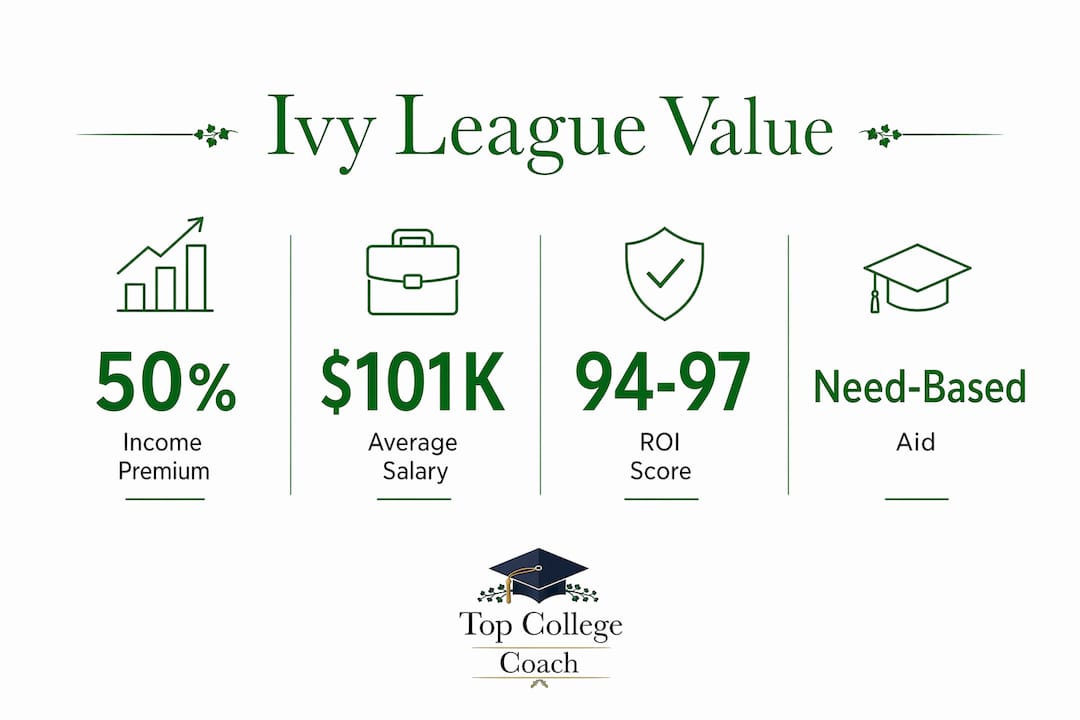
Families paying full price face a different calculation. Ivy League schools score 94–97 on ROI scales, with graduates earning $93,000 to $111,000 ten years after enrollment. But a family paying $80,000 per year in full tuition and fees needs to weigh that premium carefully against the career path their student is pursuing. A student entering a field where the Ivy premium is weak may find a well-funded public university delivers comparable outcomes at a fraction of the cost.
Pro Tip: Use the net price calculator on each school’s website before drawing any conclusions about affordability. The sticker price and the actual cost your family pays can differ by $50,000 or more per year.
Understanding the net cost after financial aid is the single most important step families can take before ruling an Ivy school in or out. Many families eliminate Ivy schools from consideration based on the published price alone, which is a costly mistake.
Which careers benefit most from an Ivy League degree?
The Ivy premium is not uniform across all fields. In careers like finance and consulting, Ivy League recruiting pipelines and networks provide substantial advantages that non-Ivy graduates find difficult to replicate. Goldman Sachs, McKinsey, and Bain recruit heavily on Ivy campuses through structured programs that give Ivy students a first-mover advantage.
Law and politics follow a similar pattern. Careers in law, politics, and finance see stronger Ivy credentialing effects compared to healthcare and manufacturing, where practical skills overshadow prestige. A student aiming for a federal clerkship or a top-five law school will find the Ivy credential carries significant weight in those selection processes.
Tech and STEM tell a different story. STEM and tech employers focus heavily on demonstrated technical skills and portfolios rather than school prestige, reducing the Ivy advantage in those fields. Georgia Tech, Carnegie Mellon, and strong state engineering programs produce graduates who compete directly with Ivy engineers at major tech firms. The portfolio matters more than the diploma in those hiring rooms.
Regional employers add another layer of nuance. A student planning to work in a specific region may find that a well-regarded local flagship university carries more name recognition with regional employers than a distant Ivy school. Knowing your intended market matters as much as knowing your intended field. You can explore how Ivy League engineering programs compare if STEM is your path.
What personal factors should students weigh before choosing an Ivy?
The academic environment at Ivy schools is genuinely demanding, and not every student thrives in it. The “big fish in a small pond” effect can impact students’ confidence and academic performance negatively in ultra-competitive Ivy environments. Top STEM students sometimes abandon their majors or choose less selective schools specifically to maintain the academic standing they need for graduate school.
The psychological impact of competition can affect student success metrics such as GPA, which in turn influences graduate school admissions and career outcomes. A student who earns a 3.4 GPA at Harvard may face harder odds at top medical schools than a student who earns a 3.9 at a strong state university. That tradeoff deserves honest consideration before committing.
Purpose and preparation matter more than ambition alone. Research shows that the core value of elite schools lies in the network, screening, and peer environment rather than purely academic instruction. Students who arrive with clear goals and the resilience to compete in a high-pressure environment extract far more value than students who attend for prestige alone.
Pro Tip: Before applying, ask yourself honestly: Do I have a specific reason to attend this school beyond its name? Students with a clear answer to that question consistently outperform those who cannot articulate one.
You can also review Ivy League admissions requirements to assess whether your academic profile aligns with what these schools expect before investing time and energy in the application process.
Key Takeaways
An Ivy League education delivers measurable career and income advantages, but the return depends heavily on field of study, financial aid eligibility, and student readiness to compete in a demanding environment.
Point | Details |
Income premium is real | Ivy Plus graduates earn an average of $101,000 more a decade after graduation than public university peers. |
Financial aid changes everything | Families earning under $100,000 often pay less at Ivy schools than at many state universities after need-based aid. |
Career field determines value | Finance, consulting, and law see the strongest Ivy premium; STEM and tech hiring focuses on skills over school name. |
Peer environment carries risk | Highly competitive settings can lower GPA and confidence, which affects graduate school outcomes for some students. |
Purpose drives outcomes | Students with clear goals extract far more value from an Ivy education than those attending for prestige alone. |
The honest truth about prestige and fit
I have worked with hundreds of families navigating this exact question, and the pattern I see most often is this: families fixate on the name and skip the analysis. They assume Harvard is always better than their state flagship, and they assume the price is always prohibitive. Both assumptions are wrong in ways that cost students real opportunities.
The families who make the best decisions are the ones who run the numbers first. They use net price calculators. They map the student’s intended career against the schools where that career pipeline is strongest. They ask whether their student is the kind of person who thrives under pressure or the kind who needs room to be the best in the room.
I have seen students turn down Ivy acceptances for well-funded honors programs at state schools and go on to outstanding careers. I have also seen students attend Ivy schools on full financial aid and access opportunities they could not have found anywhere else. The school is not the whole story. The fit, the funding, and the intention behind the choice are what determine the outcome.
What I tell every family is this: do not chase prestige at emotional and financial cost. Chase the school that aligns with your student’s goals, your family’s financial reality, and your student’s genuine readiness to compete. That school might be an Ivy. It might not be. Either answer is the right one when it comes from honest analysis rather than anxiety.
— Randy Pryor, College Admissions Coach
How Top College Coach helps families make the right call
Choosing between an Ivy League school and other top universities is one of the most consequential decisions a family makes. Top College Coach specializes in exactly this kind of analysis, helping students and parents cut through the prestige noise and focus on what actually drives outcomes.
Top College Coach has a proven track record of helping students gain admission to Ivy League and Top 20 universities, with 5-star reviews from families across the country. Whether you are weighing the value of Ivy League admissions or trying to build the strongest possible application, our counselors provide the personalized guidance that makes the difference between a good choice and the right one. Connect with Top College Coach to get expert advice tailored to your student’s goals, timeline, and financial situation.
FAQ
Are Ivy League schools worth it financially?
For families earning under $100,000, Ivy League schools often cost less than state universities after need-based aid. Graduates also earn significantly more over their careers, making the ROI strong for most students.
Do Ivy League degrees matter in tech and STEM?
The Ivy premium is weaker in tech and STEM, where employers prioritize demonstrated skills and portfolios. Strong public programs like Georgia Tech produce graduates who compete directly with Ivy peers at top firms.
What is the biggest non-academic benefit of an Ivy League school?
The alumni network is the most powerful non-academic benefit. Ivy alumni networks actively provide referrals and open access to roles and programs that are difficult to reach through other channels.
Can attending an Ivy League hurt a student’s GPA?
Yes. The highly competitive environment can lower GPA relative to what a student might achieve at a less selective school. A lower GPA can affect medical school and law school admissions, so students should weigh this tradeoff carefully.
How do I know if an Ivy League school is the right fit for my student?
Assess your student’s resilience, clarity of purpose, and intended career field. Students with specific goals and strong preparation tend to thrive. Use the school’s net price calculator to confirm the cost is manageable before making any final decisions.
Recommended
Comments