Brown Admissions Requirements: What You Need to Know
- 3 days ago
- 7 min read

Brown University admissions requirements are defined by rigorous coursework expectations, standardized test submission, and a holistic review process that centers on intellectual curiosity and authentic personal expression. Brown is a member of the Ivy League, and its Office of College Admission evaluates every application through a human-centered process with no artificial intelligence involved in sorting or ranking. Understanding the full picture of Brown’s application criteria gives students and families a real advantage when preparing. This guide breaks down exactly what Brown expects, from academic preparation to essays, so you can approach the process with clarity and confidence.
What are Brown admissions requirements for academics?
Brown’s academic expectations are high, but they are not defined by a rigid checklist. The university does not mandate specific courses, but it expects applicants to take a minimum of four academically rigorous courses each year of high school. That distinction matters. Brown wants to see that you challenged yourself within the opportunities your school offered, not that you followed a prescribed formula.
Competitive applicants typically build their transcripts around advanced coursework. The most common patterns include:
Honors courses in core subjects like English, history, and science from 9th or 10th grade onward
AP or IB courses in areas of genuine interest, ideally with strong exam scores to match
Consistent rigor across all four years, not just a spike in senior year
Depth in a subject area that aligns with your intended academic focus at Brown
Brown’s admissions officers receive a school profile alongside each transcript. That profile tells them what courses your school actually offers. A student from a rural school with no AP program is evaluated differently than a student from a school with 30 AP options. The counselor’s school report provides this context, which means your GPA is never read in isolation.
Pro Tip: Ask your school counselor to review your course selection each spring. If your school offers AP or IB courses you have not taken, be ready to explain why. Admissions officers notice gaps in rigor.

How do standardized tests factor into Brown’s application?
Brown requires SAT or ACT scores for first-year applicants beginning with the 2024–25 admission cycle. The university returned to a test-required policy after a period of test-optional review, signaling that scores carry real weight in the evaluation process.
Typical admitted applicants score in these ranges:
Test | 50th Percentile | 75th Percentile |
SAT | 1510 | 1580 |
ACT | 34 | 35 |
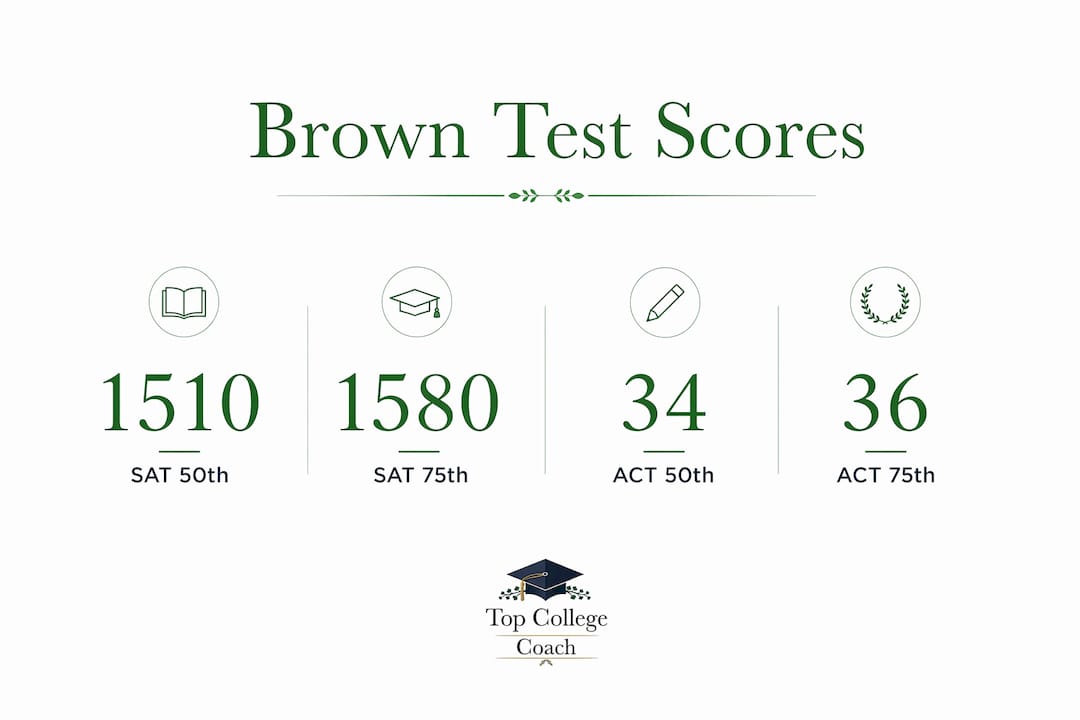
These numbers reflect the middle range of admitted students, not a cutoff. Scoring at the 50th percentile does not disqualify you. Scoring above the 75th percentile does not guarantee admission either. Brown reads test scores alongside every other part of your application, including your transcript, essays, and recommendations.
What the score ranges do tell you is that Brown’s admitted class is academically strong across the board. A score below 1500 on the SAT or below 33 on the ACT places you outside the typical range, which means the rest of your application needs to be exceptionally compelling. Understanding where you stand relative to Ivy League admissions standards helps you plan your testing timeline and retake strategy.
Pro Tip: Take the SAT or ACT for the first time no later than the spring of your junior year. That gives you time to retake in the fall of senior year if needed, well before Brown’s early decision deadline.
What does the Brown application checklist include?
The Brown University application checklist covers several required and optional components. Submitting a complete, polished application is the baseline. Missing or weak elements create gaps that admissions officers notice immediately.
Here is what every applicant must submit:
The Common Application with all required sections completed, including the personal essay
The Brown Member Section, which includes Brown-specific supplemental essays
Official high school transcript sent directly from your school
School counselor recommendation and the official school profile
Two teacher recommendations from teachers in core academic subjects
SAT or ACT scores submitted directly from College Board or ACT
Application fee or fee waiver
Beyond the required materials, Brown offers an optional supplemental video introduction. Some admissions officers review this video as a way to better understand an applicant’s personality and communication style. It is not required, but it adds a personal dimension that written materials cannot replicate. Think of it as a brief, authentic introduction, not a performance.
The supplemental essays deserve particular attention. Brown’s essay prompts ask about your intellectual interests, your reasons for choosing Brown specifically, and something that brings you genuine joy. That last prompt is not a trick. Essays help admissions officers see who you are beyond grades and scores. Answering authentically, with specific detail, is far more effective than a polished but generic response. For guidance on crafting these essays, the Ivy League personal statement tips from Top College Coach offer a strong starting point.
How does Brown’s holistic review shape the process?
Brown’s holistic review is genuinely human. Every application page is read by a human admissions officer, starting with a geographic specialist who knows your region’s schools and opportunities. No algorithm filters applications before a person sees them. That is a meaningful commitment in an era when many institutions rely on automated screening.
The geographic officer reads your full file first, then brings it to a broader committee for final decisions. That committee weighs your academic record, test scores, essays, recommendations, and extracurricular involvement together. No single factor predicts admission. Brown looks for diversity of talents and genuine community engagement alongside strong academics.
“Brown values applicants who demonstrate intellectual curiosity and would thrive in its Open Curriculum, which gives students the freedom to design their own academic path without distributional requirements. The committee is not looking for a perfect checklist. They are looking for students who will contribute to and grow within Brown’s academic community.”
The counselor recommendation plays a specific role in this process. The counselor letter is often the starting point for contextualizing a student’s achievements relative to their school’s resources. A strong counselor letter explains who you are as a learner and a community member, not just what grades you earned. Students who invest in that relationship with their counselor give admissions officers a richer picture to evaluate.
Deferred applicants also deserve reassurance here. Deferrals are not rejections. They reflect the competitiveness of the early decision pool and signal that Brown sees you as a strong candidate worth reevaluating in the regular decision round. Understanding the full Ivy League admissions process helps families interpret these outcomes without panic.
Key Takeaways
Brown admissions requirements extend well beyond grades and test scores, centering on a human-reviewed, holistic process that rewards intellectual curiosity, authentic expression, and contextual academic achievement.
Point | Details |
Academic rigor over checklists | Brown expects four rigorous courses per year but sets no mandatory subject requirements. |
Test scores matter again | SAT scores of 1510–1580 and ACT scores of 34–35 reflect the typical admitted applicant range. |
Counselor context is critical | The school report and counselor letter help officers evaluate grades relative to available opportunities. |
Essays reveal who you are | Supplemental essays, especially the joy prompt, show personality and values beyond academic metrics. |
Every application is human-read | No AI filters applications; geographic specialists and committees review each file personally. |
What families consistently underestimate about Brown admissions
After working with students applying to Brown and other Ivy League schools, I keep seeing the same blind spot. Families spend months obsessing over SAT prep and GPA, then submit a counselor recommendation that was written in 15 minutes by someone who barely knows the student. That is a serious mistake.
The counselor recommendation is not a formality. At Brown, it is the document that frames everything else. If your counselor cannot speak specifically to your intellectual curiosity, your growth over four years, and your contributions to your school community, the admissions committee loses the context they need to advocate for you. I tell every family I work with: build that relationship early, share your story with your counselor, and give them the material they need to write something real.
The optional video introduction is another underused opportunity. Students either skip it entirely or overthink it into something stiff and rehearsed. The best videos I have seen are simple. A student talking about a research project they love, or explaining why Brown’s Open Curriculum fits the way they think, in a natural and unscripted way, leaves a stronger impression than a polished production. Authenticity reads clearly on camera.
My honest advice to applicants: stop treating Brown’s application as a checklist to complete and start treating it as a conversation to have. Every component, from your course selection to your essays to your optional video, is a chance to show Brown who you actually are. The students who get in are not the ones with the most impressive resumes. They are the ones who make admissions officers genuinely excited to have them on campus.
— Randy Pryor, Founder of Top College Coach
How Top College Coach supports your Brown University application
Preparing a competitive application to Brown requires more than good grades. It requires a clear strategy, strong essays, and a deep understanding of what the admissions committee actually values.
Top College Coach works with students and families to align every part of the application with Brown’s expectations, from course selection and testing timelines to counselor relationships and supplemental essays. With a proven track record helping students gain admission to Ivy League and Top 20 universities, Top College Coach brings the expertise and personalized attention that make a real difference. If you are ready to build a stronger application, schedule a free strategy session or visit Top College Coach to learn how expert guidance can support your path to Brown.
FAQ
What GPA do you need for Brown University?
Brown does not publish a minimum GPA requirement. Competitive applicants typically present high GPAs with rigorous coursework, and admissions officers evaluate grades in the context of each student’s school profile and available courses.
Is Brown University test optional in 2026?
Brown requires SAT or ACT scores for first-year applicants starting with the 2024–25 cycle. The university is no longer test optional for domestic first-year applicants.
How many recommendation letters does Brown require?
Brown requires one counselor recommendation and two teacher recommendations from core academic subject teachers. Additional letters of recommendation are not encouraged and may not be reviewed.
What makes Brown’s admissions process different from other Ivy League schools?
Brown’s Open Curriculum is central to its identity, and admissions officers specifically look for students who will thrive with academic freedom and self-direction. Every application is read by a human officer with no AI involvement in the review process.
Can a deferral from Brown early decision lead to admission?
Yes. Deferred applicants are strong candidates who are reevaluated in the regular decision pool. A deferral reflects the competitiveness of the early decision round, not a final judgment on the applicant’s qualifications.
Recommended