Why College Essays Matter in Admissions: 2026 Guide

College essays are the single component of your application that lets admissions officers hear your actual voice. Your GPA shows what you achieved. Your essays show who you are. At Top College Coach, we work with students every year who have strong transcripts but underestimate how much the personal statement and supplemental essays shape final decisions. Understanding why college essays matter in admissions is not just reassuring. It is the foundation of a smarter application strategy.
Why college essays matter in admissions decisions
A strong college essay reveals character, experiences, and motivations in ways that no transcript or test score can. Admissions officers read thousands of applications with nearly identical GPAs and course rigor. The essay is where one student separates from another.
Think of your application as a puzzle. Grades and scores fill in the academic corners. The essay fills in the center, the part that makes the whole picture make sense. Without it, admissions officers are left guessing about the person behind the numbers.

The Common App personal statement is the most familiar essay format, giving students 650 words to tell their story. But the personal statement is only one piece. Supplemental essays, which are shorter college-specific prompts, carry enormous weight at selective schools. Together, these two formats form the qualitative core of your application.
Admissions officers at schools like Harvard, Princeton, and Vanderbilt are not just checking boxes. They are building a class. Essays help them understand how you think, what you value, and whether you will contribute something meaningful to their campus community.
What do essays reveal that grades cannot?
Grades measure academic performance. Essays measure the person behind that performance. Here is what a well-written essay communicates that no GPA ever could:
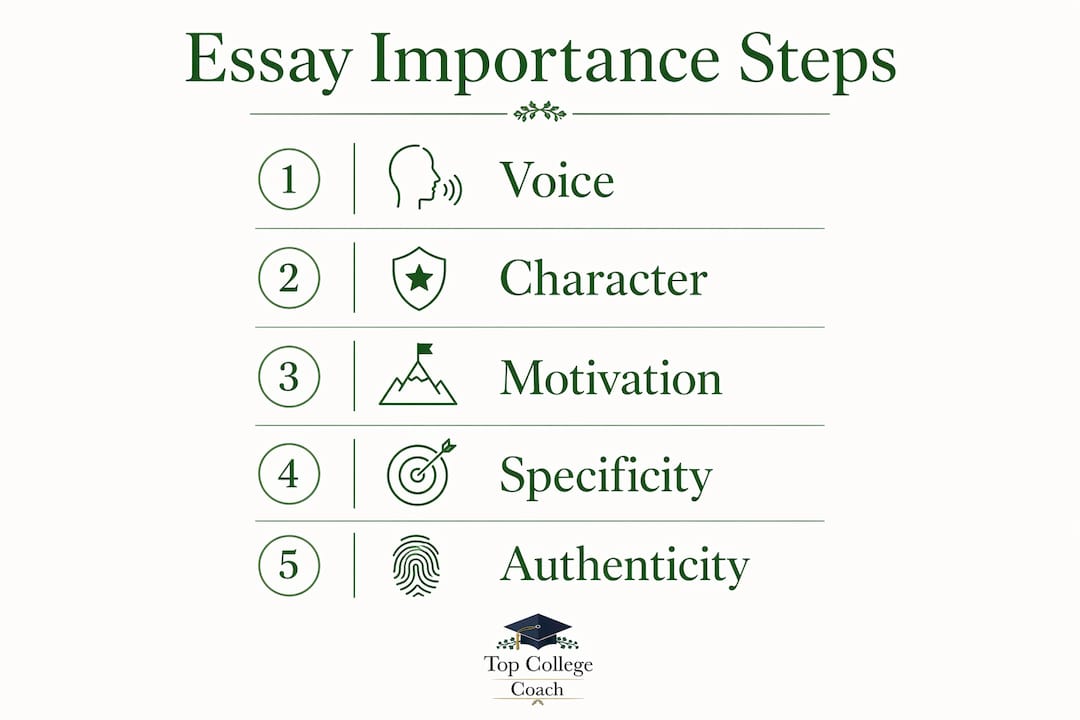
Voice and personality. Your writing style, humor, and perspective are uniquely yours. A transcript cannot convey warmth, wit, or depth of character.
Resilience and growth. Stories about overcoming obstacles, changing your mind, or learning from failure show maturity that test scores cannot quantify.
Values and motivation. Why do you want to study what you want to study? What drives you? Essays answer these questions directly.
Creativity and original thinking. The topics you choose and the angles you take signal how you approach problems and ideas.
Fit with the school. A thoughtful essay shows that you have done your research and genuinely want to be part of that specific community.
Admissions officers use essays to understand students holistically, preferring personal stories over argumentative writing. They want to see moments of growth or change, not a list of achievements. The student who writes about rebuilding a relationship with a sibling often leaves a stronger impression than the one who lists every award they have won.
Pro Tip: Write about something specific and personal, not something impressive and generic. A narrow, honest story almost always outperforms a broad, polished one.
How do college supplemental essays work?
Supplemental essays are short, college-specific prompts that go beyond the personal statement. They typically run 100–400 words and ask targeted questions like “Why do you want to attend our school?” or “Describe a challenge you have faced.” Understanding how college supplemental essays work is critical because they function differently from the main personal statement.
At schools with acceptance rates below 20%, supplemental essays are often the primary tool to distinguish between applicants with nearly identical academic profiles. When two students have the same GPA, the same AP course load, and similar test scores, the supplemental essay decides who gets in.
The challenge is compression. Fitting meaningful, specific content into 150 words is harder than writing 650 words. Students underestimate the time supplementals require, which leads to generic responses that fail to demonstrate real interest in the school.
Weak or generic supplemental essays can hurt an otherwise strong application. A great supplemental can tip the scales toward admit at highly selective schools. This is not a minor detail. It is a deciding factor.
Colleges also use supplemental essays to confirm demonstrated interest. An effective “Why this college?” essay shows real knowledge of campus community, specific professors, clubs, research opportunities, and traditions. Vague praise like “I love your diverse community” signals that you did not do your homework.
Pro Tip: Develop 4–5 core “anchor” essays that you can adapt for different supplemental prompts. This expert-recommended strategy reduces generic answers and helps you apply to more schools without sacrificing quality.
What makes a college essay stand out?
Admissions officers read hundreds of essays about mission trips, sports injuries, and immigrant grandparents. Not because those topics are bad, but because they are often handled without specificity or genuine reflection. The essays that stand out share a few consistent qualities.
Authenticity comes first. The Princeton Review notes that admissions officers look for authentic voice and unique perspective above almost everything else. A committee-written essay that sounds polished but impersonal is easy to spot and hard to remember.
Structure and focus matter. A strong essay has a clear beginning, middle, and end. It does not try to cover your entire life. It zooms in on one moment, one relationship, or one idea and develops it fully.
Connection to future goals seals the deal. Great essays connect past experiences to future aspirations and explain how the college’s specific offerings support those goals. This shows curiosity, direction, and potential for campus contribution.
Common pitfalls to avoid:
Writing what you think admissions officers want to hear instead of what is true for you
Choosing a topic that sounds impressive but does not reveal anything personal
Submitting an essay with typos or grammatical errors, which signal carelessness to admissions officers
Using a generic opening line that could apply to any student at any school
Letting a parent or counselor rewrite the essay so heavily that your voice disappears
Tools like Grammarly and the Hemingway Editor help catch surface errors before submission. They are not substitutes for strong content, but they eliminate the red flags that distract from your story.
How to use essays strategically to boost your chances
A strong essay strategy starts months before deadlines. Here is a step-by-step approach that works for students applying to Ivy League and top-20 schools:
Start early. Begin drafting your personal statement in the summer before senior year. This gives you time for multiple revisions without deadline pressure. Our summer admissions guide outlines exactly what to do each month.
Research each school thoroughly. Before writing any supplemental, spend time on the school’s website, talk to current students if possible, and identify specific programs, professors, or opportunities that genuinely excite you. Generic essays get generic results.
Build your anchor essay bank. Develop 4–5 core essays covering your key themes: a challenge you overcame, a passion you have pursued, a value you hold, a community you belong to, and a goal you are working toward. Adapt these for different prompts rather than starting from scratch each time.
Show your personality, not just your resume. Admissions officers already have your activity list. The essay should add dimension, not repeat information they already have.
Proofread with fresh eyes. After revising, set the essay aside for two days, then read it aloud. Errors you missed on screen become obvious when you hear them. Use Grammarly as a final pass.
Get feedback from a trusted advisor. A counselor, teacher, or mentor who knows you well can tell you whether the essay sounds like you. If they say it sounds formal or stiff, it probably does.
Use supplementals to demonstrate fit. Every supplemental is an opportunity to show that you belong at that specific school. Treat each one as a targeted argument for your admission, not a checkbox to complete.
For students applying to the University of California system, the UC essay prompts follow a different format and deserve their own preparation strategy.
Key takeaways
College essays are decisive in selective admissions because they reveal what grades and scores cannot: your voice, values, and fit with the school.
Point | Details |
Essays reveal character | Admissions officers use essays to understand personality, resilience, and motivation beyond academic metrics. |
Supplementals decide close cases | At schools with acceptance rates below 20%, supplemental essays often determine who gets admitted. |
Authenticity outperforms polish | Personal, specific stories with genuine voice consistently outperform generic, impressive-sounding essays. |
Errors signal carelessness | Typos and inconsistencies are major red flags that can seriously damage an otherwise strong application. |
Strategy multiplies impact | Building 4–5 adaptable anchor essays improves quality across multiple applications and saves time. |
The essay is where applications are won or lost
I have worked with hundreds of students over the years, and the pattern is consistent. The students who treat essays as an afterthought are the ones who end up on waitlists at schools where they were genuinely competitive. The students who invest real time and honesty into their writing are the ones who get the acceptance they worked for.
Here is what most articles will not tell you: supplemental essays are harder than the personal statement for most students. Not because they are longer, but because the compression is brutal. Saying something meaningful and specific in 150 words requires more drafts, not fewer. Students who start supplementals in October are already behind.
The other thing I see constantly is students writing what they think admissions officers want to hear. It never works. Admissions officers read thousands of essays. They recognize a performed answer immediately. The essays that move applications from the “maybe” pile to “yes” are the ones that feel like a real person wrote them, with real stakes and real self-awareness.
My honest advice: treat your essays like the most important writing assignment of your academic life, because at selective schools, they are. Get feedback early, revise often, and never submit anything that does not sound exactly like you. A well-crafted essay can move an application from waitlist to acceptance. We have seen it happen.
— Randy Pryor, Founder of Top College Coach
Work with an expert who knows what admissions officers want
At Top College Coach, we specialize in helping students craft essays that get results at Ivy League and top-20 universities. Our counselors have guided students through every stage of the essay process, from brainstorming authentic topics to refining final drafts that reflect each student’s genuine voice and goals.
If you are ready to stop guessing and start writing with a clear strategy, we are here to help. Our team provides personalized feedback, supplemental essay coaching, and full admissions counseling for students who are serious about their top-choice schools. You can also book a free strategy session to talk through your specific situation with an expert who has helped students just like you earn admission to the country’s most selective universities.
FAQ
How much do college essays affect admissions decisions?
College essays carry significant weight, especially at selective schools where most applicants have strong academic profiles. At schools with acceptance rates below 20%, supplemental essays are often the deciding factor between similarly qualified candidates.
What is the difference between a personal statement and supplemental essays?
The personal statement is a 650-word essay submitted through the Common App that tells your broader story. Supplemental essays are shorter, school-specific prompts (typically 100–400 words) that ask targeted questions about fit, interests, and goals.
Why do college essay topics matter so much?
The topic you choose signals what you value and how you think. Admissions officers prefer personal, specific stories that reveal growth or change over generic topics that could apply to any student.
Can a bad essay hurt a strong application?
Yes. Typos, grammatical errors, and generic content are major red flags that signal carelessness or lack of genuine interest. A weak supplemental essay can damage an otherwise competitive application at selective schools.
When should students start writing college essays?
Students should begin drafting their personal statement in the summer before senior year. Supplemental essays should be researched and outlined by early fall to allow enough time for multiple revisions before deadlines.
Recommended
Comments