What Is a College Admissions Spike? 2026 Guide
- Jun 26
- 8 min read

A college admissions spike is a focused area of exceptional achievement that sharply distinguishes a student’s application from the thousands of similar profiles top universities receive each year. This concept, widely used by admissions counselors, contrasts with the traditional “well-rounded” applicant model. As applications through Common App reached 9.4 million in 2026, a 5% year-over-year increase, understanding what is a college admissions spike has never been more relevant. Students and parents who grasp this concept gain a real strategic edge in one of the most competitive admissions cycles on record.
What is a college admissions spike and why does it matter?
A college admissions spike is defined as a deep, sustained commitment to one specific area, producing achievements that stand out even among high-achieving applicants. Think of it as a mountain peak on an otherwise flat profile. Admissions officers at schools like Harvard, MIT, and Stanford are not simply looking for students who do many things adequately. They want students who have done one thing exceptionally well and can demonstrate real impact.
The spike concept matters because admissions offices receive thousands of applications from students with near-perfect GPAs and strong test scores. Academic credentials alone no longer separate candidates at selective schools. A spike gives an admissions officer a clear, memorable reason to advocate for a student in the committee room. Without one, even a strong academic profile can blur into the background.

Top universities prioritize genuine passion and leadership potential over superficial achievements. This means a student who has published original biology research, built a nonprofit serving 500 families, or reached a national ranking in chess carries far more weight than a student who lists 12 clubs with no depth in any of them.
How does a college admissions spike differ from being well-rounded?
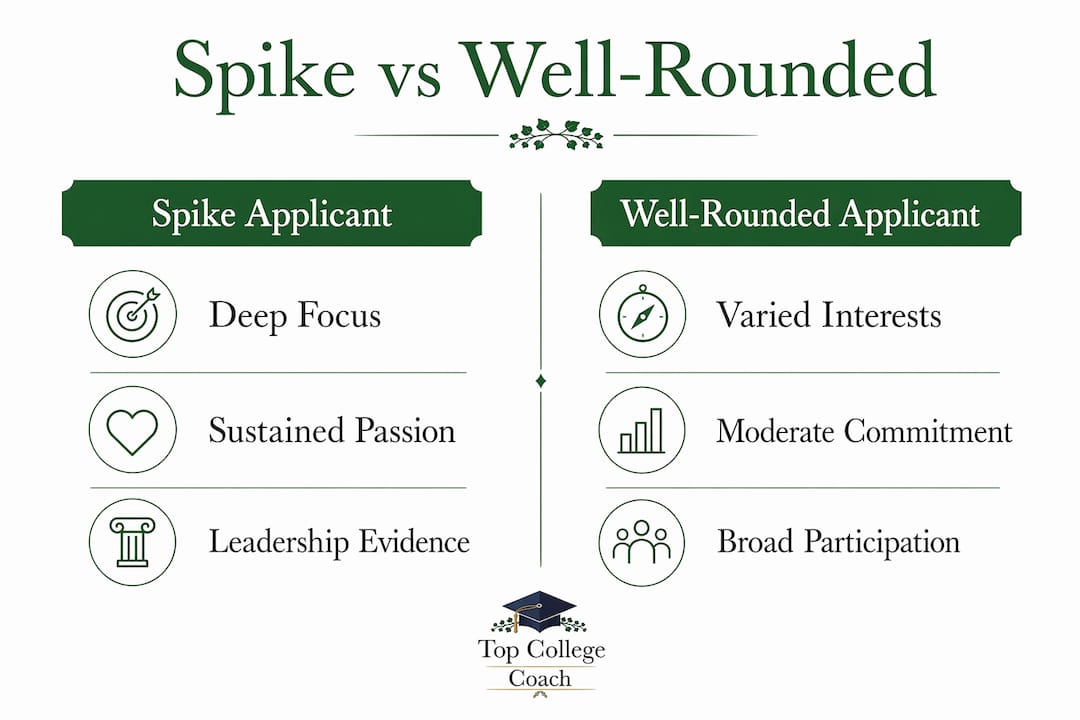
The well-rounded applicant and the spike applicant represent two fundamentally different philosophies. A well-rounded student participates in many activities across diverse areas, from student government to varsity sports to community service. A spike applicant concentrates time, energy, and achievement in one primary domain, building a profile that reads like a specialist rather than a generalist.
Both approaches have merit, but the admissions landscape has shifted. Selective colleges already build well-rounded classes. They do not need every individual student to be well-rounded. They need each student to fill a specific role, and a spike tells them exactly what role you play.
Characteristic | Spike applicant | Well-rounded applicant |
Activity focus | Deep in one area | Spread across many areas |
Admissions impression | Memorable and specific | Solid but often forgettable |
Risk | Narrow profile if spike is weak | Lacks a standout quality |
Best fit for | Highly selective schools | Moderately selective schools |
Key strength | Unique narrative and impact | Demonstrated versatility |
Spike applicants present a focused, deep passion like a mountain peak, while well-rounded applicants have varied but shallower profiles. The distinction is not about which student is smarter. It is about which student is more memorable and more clearly positioned to contribute something specific to campus.
What college admissions trends make spikes more relevant in 2026?
The admissions environment in 2026 makes a spike more necessary than ever before. Applications per student averaged 6.59 in the most recent cycle. That number reflects a pool where every selective school receives applications from students who look nearly identical on paper.
Several trends are intensifying this competition:
Rising application volume. Common App processed 9.4 million applications across 911 institutions in 2026, a 5% increase over 2025.
More diverse applicant pools. Black applicants grew 8% year over year, and first-generation applicants increased 6%, expanding the competitive field.
Test score resurgence. Nearly 784,000 students submitted test scores in 2026, a 22.9% increase over two years. Strong test scores are now table stakes, not differentiators.
Declining international applications. International applications dropped 9%, shifting competitive pressure entirely onto domestic applicants.
Enrollment cliff approaching. Demographic projections show a decline in traditional college-age students in the coming years, pushing schools to compete harder for top domestic talent.
What this means practically is that admissions officers are reading more applications with similar credentials than ever before. A spike cuts through that noise. The rising competitiveness and increasing applicant volume place a direct premium on students who present a compelling, focused narrative. A spike is no longer a bonus. It is a baseline expectation at schools like Princeton, Yale, and Duke.
What are common examples of spikes and how do students find theirs?
A spike can take many forms, but the strongest ones share two qualities: sustained commitment and external validation. External validation means the achievement is recognized beyond the student’s own school or community. It could be a national award, a published paper, a regional championship, or a business with real revenue.
Common spike categories include:
STEM research. A student who conducts original research, presents at a science fair like Regeneron or Siemens, or co-authors a paper with a university professor.
Arts excellence. A student who performs at Carnegie Hall, wins a national YoungArts award, or has work exhibited in a recognized gallery.
Competitive athletics. A student ranked nationally or regionally in their sport, with recruitment interest from Division I programs.
Community leadership. A student who founded an organization that demonstrably served their community, with measurable outcomes.
Entrepreneurship. A student who built a product, launched a business, or created a platform with real users or revenue.
Spikes are often recognized by tier-two achievements with external validation and evidence of leadership. The key word is “evidence.” Admissions officers cannot take a student’s word for impact. They look for proof.
Finding your spike starts with honest self-assessment. Ask yourself which activity you would pursue even if it were not on your application. Genuine passion is the foundation. From there, the goal is to build depth, seek mentorship, and pursue recognition that validates your commitment.
Pro Tip: Use the summer before junior year to pursue a spike-building experience. Research programs at universities, intensive arts conservatories, or entrepreneurship incubators give students both depth and a credential that carries real weight in applications. Top College Coach has a full guide on maximizing your summer for admissions purposes.
How can parents and students apply the spike concept in applications?
Translating a spike into a winning application requires intentional storytelling. The spike should not appear as one item on an activities list. It should be the central thread connecting your essays, recommendations, and extracurricular narrative.
Here is how to apply the spike concept effectively:
Lead with your spike in the personal statement. Your Common App essay is the best place to show the depth of your passion. Do not summarize your resume. Tell the story of how your spike shaped your thinking and your goals.
Align your activities list. List your primary spike activity first. Use the description space to quantify impact, not just describe tasks. “Founded a tutoring program serving 120 students” beats “tutored peers in math.”
Request a recommendation from your spike mentor. A letter from a university professor, a coach, or a professional in your field carries more weight than a second teacher recommendation.
Connect your spike to your intended major. Admissions officers at schools like Columbia and UChicago want to see a logical line between what you have done and what you plan to study.
Avoid padding. Adding unrelated activities to appear well-rounded dilutes your spike. Every item on your application should either reinforce your spike or demonstrate genuine character.
Pro Tip: Read your application as if you are an admissions officer seeing it for the first time. Ask: “What is this student known for?” If the answer is not immediately clear, your spike narrative needs sharpening. Top College Coach recommends reviewing what top colleges look for before finalizing your activities list.
Admissions counselors note that students with a well-defined spike tend to emerge as campus leaders and innovators, fulfilling universities’ future vision. That is the outcome admissions offices are trying to predict. Your job is to make that prediction easy for them.
Avoid the common mistake of treating your spike as a performance. Authentic passion and internal motivation are what top universities value most. A student who genuinely loves what they do writes about it differently, and admissions officers notice that difference immediately.
Key Takeaways
A college admissions spike is the single most effective way to stand out in a record-breaking applicant pool, and building one early gives students a measurable advantage at selective schools.
Point | Details |
Define your spike early | Identify one area of deep passion and build achievements with external validation before senior year. |
Spike beats well-rounded at top schools | Selective colleges build well-rounded classes, not well-rounded individuals. |
2026 trends demand differentiation | With 9.4 million applications submitted, a focused narrative is no longer optional at elite schools. |
Weave the spike through every application component | Essays, activities lists, and recommendations should all reinforce the same central story. |
Authenticity is non-negotiable | Admissions officers recognize genuine passion. Resume padding weakens, not strengthens, an application. |
Why I believe the spike is the most underused advantage in admissions
After working with hundreds of students applying to Ivy League and Top 20 schools, I have seen one pattern repeat itself more than any other. The students who get in are not always the most accomplished. They are the most clearly defined. They walk into the process knowing exactly what they stand for, and every part of their application reflects that clarity.
Parents often push students to do more, join more, achieve more across more categories. I understand the instinct. It feels safer to cover every base. But in my experience, that approach produces applications that read like a catalog of activities rather than a portrait of a person. Admissions officers at schools like Yale and Northwestern are reading thousands of those catalogs. What stops them is a story.
The students I have seen gain admission to their dream schools are the ones who went deep. The student who spent three summers doing marine biology research and published a paper as a junior. The student who built a mobile app that reached 10,000 downloads before she submitted her application. The student who trained six days a week and earned a national fencing ranking. Each of them had a spike, and each of them knew how to tell that story.
My honest advice to every parent and student reading this: stop trying to be everything. Pick the one thing that genuinely excites you, and pursue it with everything you have. The depth you build will speak louder than any list of activities ever could. Start that process early, ideally in 9th or 10th grade, because the most compelling spikes take years to develop. The college essay is where that story finally gets told, and it is worth getting right.
— Randy Pryor, Founder of Top College Coach
How Top College Coach helps you build a winning spike
Identifying and developing a spike is one of the most personal parts of the college admissions process. It requires honest self-reflection, strategic planning, and expert guidance to execute well.
At Top College Coach, we work directly with students and parents to identify genuine strengths, build a spike narrative, and craft applications that get noticed at Ivy League and Top 20 schools. Our counselors have helped students from Orlando and across the country gain admission to schools like Harvard, Princeton, and Vanderbilt. A free admissions strategy session is the fastest way to get a clear picture of where your student stands and what it will take to stand out. You can also learn more about our full admissions counseling services and what we offer families at every stage of the process.
FAQ
What is a college admissions spike in simple terms?
A college admissions spike is a deep, focused area of exceptional achievement that makes a student memorable to admissions officers. It contrasts with being well-rounded by emphasizing depth over breadth.
When should a student start developing their spike?
Students should begin building their spike in 9th or 10th grade. The most compelling spikes take two to three years of sustained commitment to develop meaningful achievements and external validation.
Can a student have more than one spike?
A student can have two related areas of strength, but the most effective applications center on one primary spike. Multiple unrelated spikes often dilute the narrative rather than strengthen it.
Does a spike matter more than GPA or test scores?
A spike does not replace strong academics. It works alongside a solid GPA and test scores to create a complete, memorable profile. At highly selective schools, strong test scores are now a baseline expectation, not a differentiator.
What if a student has not found their spike yet?
Students who have not identified a spike should focus on honest self-assessment and try new activities with genuine curiosity. Working with an admissions counselor at Top College Coach can help accelerate that discovery process significantly.
Recommended
Comments