What Does a College Counselor Do for Your Family?

A college counselor is a specialized advisor who guides high school students and their families through the college admissions process, from building a college list to preparing for interviews and submitting applications. The industry term for this work is admissions consulting, and it covers far more ground than most families realize until they are deep in the process. With acceptance rates at top universities tightening every cycle, the difference between a scattered application and a focused one often comes down to who is guiding the strategy. This article breaks down exactly what a college counselor does, how they differ from school counselors, and how to choose the right one for your family.
What does a college counselor actually do?
A college counselor, also called an admissions consultant, assesses a student’s academic record, extracurricular profile, and goals to build a targeted application strategy. That is the core of the work. But the day-to-day scope goes well beyond that single task.
Counselors manage timelines, track deadlines across multiple schools, and make sure nothing falls through the cracks. They guide students through the personal statement, help identify the right angle for supplemental essays, and provide feedback that sharpens clarity without erasing the student’s voice. They also coach students on how to demonstrate interest in specific schools, which admissions offices track more closely than most families know.

The role also includes interview preparation. A strong counselor does not just hand a student a list of practice questions. They help the student identify personal stories that reveal character, curiosity, and growth, then coach them on how to tell those stories naturally in a high-stakes conversation.
School counselor vs. college counselor: what is the difference?
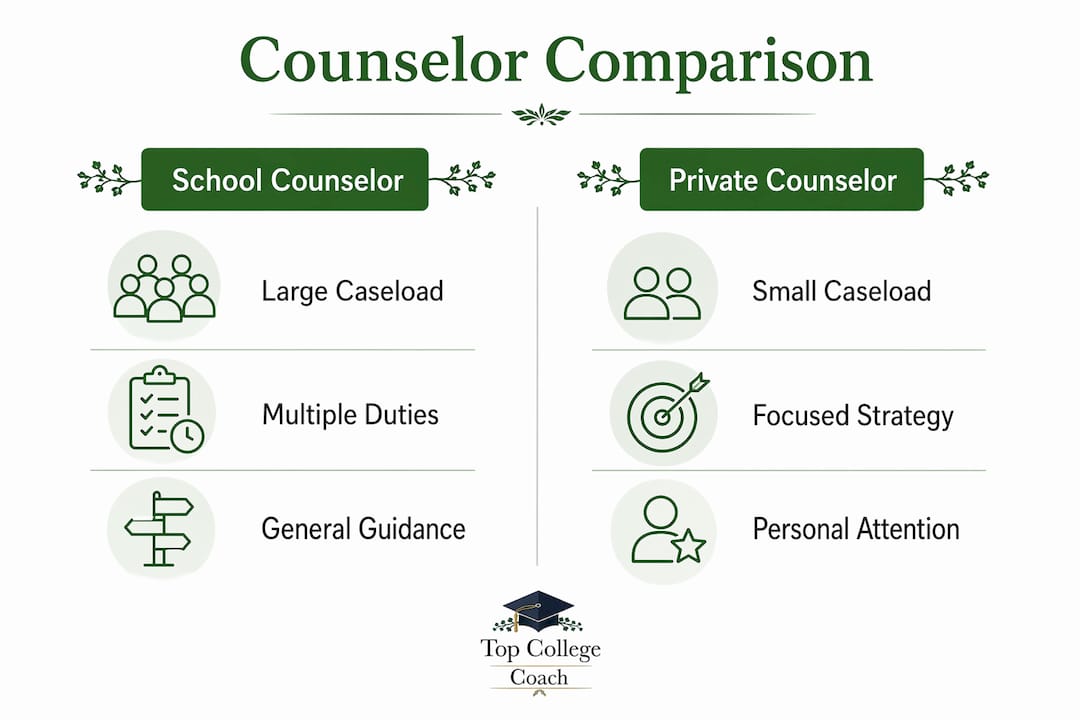
The distinction matters, and it is bigger than most families expect. School counselors carry large caseloads, often serving hundreds of students at once. Their responsibilities include mental health support, course scheduling, and general academic advising. College admissions is only one part of their job.
A private college counselor, by contrast, provides personalized, in-depth guidance focused entirely on admissions strategy. That focus changes everything. When a counselor is working with a manageable number of students, they can track each student’s application across every school, give detailed essay feedback, and adjust strategy in real time as decisions come in.
Feature | School counselor | Private college counselor |
Caseload | Often 300+ students | Small, focused client roster |
Admissions focus | General guidance | Full admissions strategy |
Essay support | Limited or none | Detailed, iterative feedback |
Interview coaching | Rarely offered | Standard part of the service |
Timeline management | Minimal | Proactive, deadline-driven |
Families who are targeting selective schools, navigating complex financial aid situations, or working with a student who has an unusual academic profile benefit most from private college counseling. School counselors are valuable, but they cannot replicate the depth of one-on-one admissions work.
What services do college counselors provide?
The best admissions consultants offer a full suite of services that cover every stage of the application process. Here is what that looks like in practice:
College list building. Counselors evaluate GPA, test scores, course rigor, and extracurricular depth to create a balanced list of reach, target, and likely schools. A well-built list protects students from applying only to long shots or settling for schools that do not fit.
Essay and personal statement guidance. Counselors help students present authentic stories and refine their ideas without losing their voice. The goal is clarity, structure, and personality, not a polished but generic essay.
Interview preparation. Counselors coach students on storytelling, pacing, and how to handle unexpected questions. This is one of the most underused services families pay for.
Timeline and deadline management. Structured guidance from counselors keeps students on track across multiple applications with different requirements and deadlines.
Demonstrated interest strategy. Counselors advise students on campus visits, email outreach, and other signals that show genuine enthusiasm for a school.
Pro Tip: Start working with a counselor in 10th or 11th grade, not senior year. The students who see the biggest results are the ones who build their extracurricular narrative and college list well before applications open.
The summer before senior year is one of the most productive windows for counselor-guided work. Students can draft essays, finalize their college list, and prepare for early decision deadlines without the pressure of a full course load.
How to prepare for a college admissions interview with counselor help
Interview preparation is where many students leave points on the table. The biggest mistake in interview prep is over-preparing scripted answers. Admissions officers prefer specific, genuine responses over rehearsed monologues. A counselor’s job is to help students find the line between prepared and authentic.
Here is what effective interview preparation looks like with counselor guidance:
Build a story bank. Experts recommend preparing 3–5 specific life stories that demonstrate core values, curiosity, and personal growth. These stories become the raw material for almost any open-ended question.
Practice out loud, not just in your head. Recording your answers and reviewing them helps catch filler words, awkward pauses, and pacing issues that you cannot notice in the moment.
Think out loud. When a question catches you off guard, narrate your thinking process. Admissions interviewers respond well to students who engage genuinely rather than stall for a perfect answer.
Prepare questions for the interviewer. Thoughtful questions signal real interest and give you control over the conversation’s tone.
Know the format. Alumni interviews tend to be conversational, while admissions officer interviews are more structured and carry more evaluative weight. Your counselor should prep you differently for each.
Pro Tip: Do at least two full mock interviews with your counselor before the real thing. The first one reveals your habits. The second one shows your improvement.
Authenticity in essays and interviews is the single most significant factor counselors emphasize for standing out in a competitive applicant pool. That is not a soft idea. It is a practical strategy that requires real preparation.
College counseling services comparison: how to choose the right fit
Not all college counseling services are built the same. Families have three main options: school-based counselors, online programs, and private admissions consultants. Each has a different price point and a different level of personalization.
Service type | Cost range | Personalization | Best for |
School counselor | Free | Low | General guidance, basic support |
Online programs | Low to moderate | Moderate | Self-directed students, budget-conscious families |
Private consultant | Moderate to high | High | Competitive applicants, selective school targets |
When evaluating a private counselor, ask these questions before signing any agreement:
How many students do you work with at one time?
What is your track record with schools in my target range?
How do you handle essay feedback, and how many rounds of revision are included?
Do you offer interview coaching, and how is it structured?
What does your timeline look like for a student starting now?
Red flags include counselors who guarantee admission to specific schools, who offer to write essays for students, or who cannot clearly explain their process. Early, personalized counseling builds a competitive application. A counselor who shortcuts that process is not actually helping.
The benefits of working with a private admissions consultant go beyond the application itself. Students who work with experienced counselors develop a clearer sense of their own story, their academic trajectory, and what they want from college. That clarity shows up in every part of the application.
Key takeaways
A college counselor provides personalized admissions strategy, essay guidance, interview coaching, and timeline management that school counselors cannot replicate at scale.
Point | Details |
Start early | Begin working with a counselor in 10th or 11th grade to build a strong narrative before applications open. |
Know the difference | Private counselors offer depth and focus that school counselors, with large caseloads, cannot provide. |
Interview prep matters | Build a story bank of 3–5 personal experiences and practice out loud with recorded mock interviews. |
Evaluate carefully | Ask about caseload, track record, and essay process before hiring any admissions consultant. |
Authenticity wins | Admissions officers respond to specific, genuine stories over polished but generic responses. |
Why I believe early counseling changes everything
I have worked with hundreds of families through the admissions process, and the pattern is consistent. The families who wait until senior year to seek help are always playing catch-up. The students who start in 10th or 11th grade have time to build something real: a coherent story, a thoughtful college list, and the confidence that comes from genuine preparation.
One misconception I hear constantly is that college counseling is only for students applying to Ivy League schools. That is wrong. Every student applying to a selective school, whether that means the University of Florida or Princeton, benefits from someone who knows the process deeply and can see the application from an admissions officer’s perspective.
Another misconception is that counselors write the essays. The best counselors do not. They ask the questions that help students find their own story, then coach them on how to tell it clearly. The student’s voice has to be present in every word. Admissions officers read thousands of applications. They recognize a ghost-written essay immediately.
My advice to parents: get involved early, stay engaged, and trust the process. Your student’s authentic story is their greatest asset. A good counselor’s job is to help them find it and present it with confidence.
— Randy Pryor, Founder of Top College Coach - College Admissions Counselor
Top College Coach: expert admissions support for your family
Top College Coach works with students and families who are serious about gaining admission to Ivy League and Top 20 universities. Based in Orlando, Florida, Top College Coach brings a proven track record and 5-star reviews to every engagement.
The work covers every stage of the admissions process: college list building, personal statement development, supplemental essay coaching, interview preparation, and deadline management. If your student is targeting competitive schools in the 2026 admissions cycle, the time to build a strategy is now. Schedule a free admissions strategy session with Top College Coach and get a clear picture of where your student stands and what it takes to get where they want to go. You can also explore Ivy League admissions guidance to understand what top schools are looking for in 2026.
FAQ
What is a college counselor?
A college counselor is a professional advisor who guides students through the college admissions process, including college list building, essay development, interview preparation, and deadline management. Private college counselors, also called admissions consultants, offer more personalized support than school counselors.
When should my student start working with a college counselor?
Starting in 10th or 11th grade gives students the most time to build a strong extracurricular narrative and college list before applications open. Students who begin in senior year often miss key planning opportunities.
How is a private college counselor different from a school counselor?
School counselors manage large caseloads and cover a wide range of student needs beyond admissions. Private college counselors focus exclusively on admissions strategy and provide detailed, one-on-one guidance that school counselors cannot offer at scale.
How do I prepare for a college admissions interview?
Prepare 3–5 personal stories that demonstrate your values and growth, practice your answers out loud, and record yourself to catch filler words and pacing issues. Avoid scripted responses. Admissions officers respond to genuine, specific answers over rehearsed ones.
Are college counseling services worth the cost?
For families targeting selective schools, private college counseling provides a level of personalization and strategic depth that significantly improves application quality. The key is finding a counselor with a clear process, a strong track record, and a commitment to keeping the student’s authentic voice at the center of every application.
Recommended
Comments