How to Write a Standout College Application Essay

A standout college application essay is an authentic personal story that reveals who you are beyond your GPA and test scores. Admissions officers at Harvard, Yale, Princeton, and other top universities read thousands of applications each year. Your essay is often the single element that makes you memorable. The Common App essay limits you to 650 words, which means every sentence must earn its place. This guide walks you through every step to write standout college application essays that get noticed at competitive universities.
How to write a standout college application essay that gets noticed
The college admissions essay, also called the personal statement, is your chance to speak directly to an admissions committee. Grades show what you achieved. The essay shows who you are. Admissions officers prioritize authentic stories that reveal personality over dramatic events or impressive accomplishments. A student who writes honestly about learning to cook with her grandmother can outshine a student who writes a generic story about winning a championship.
Your essay also fills gaps that the rest of your application cannot. It shows self-awareness, intellectual curiosity, and the ability to reflect. These are exactly the qualities top universities say they want in future students. Think of the essay as the one puzzle piece that completes the picture of who you are.

How to brainstorm and choose the best topic for your college essay
Topic selection is less important than authenticity. Students often waste time over-analyzing essay prompts instead of focusing on honest storytelling. The right approach is to write your most genuine story first, then match it to the best prompt.
Start by asking yourself these reflective questions:
What experience changed the way I see the world?
What do I do when no one is watching or grading me?
What would my closest friend say is my most defining quality?
What challenge taught me something I could not have learned in a classroom?
What part of my background or identity has shaped my goals?
Brainstorming with reflective questions and free writing helps uncover topics you would otherwise overlook. Set a timer for 15 minutes and write without stopping. Do not edit. Do not judge. Just write whatever comes to mind about a moment, a person, or a habit that matters to you.
Small, specific, personal moments make more compelling essays than dramatic backstories. A summer job at a local bakery, a family tradition around a specific holiday, or the process of learning a new skill can reveal far more character than a mission trip or a sports injury. Specificity is what makes a story stick.
The 2026–2027 Common App essay prompts cover broad themes including personal growth, challenges, intellectual curiosity, and a free-choice option. If none of the first six prompts fit your story naturally, use Prompt 7. Admissions officers do not track which prompt students choose. They focus entirely on the content.
Pro Tip: Write your story completely before you look at the prompts. Once it is written, you will find the right prompt in under five minutes.
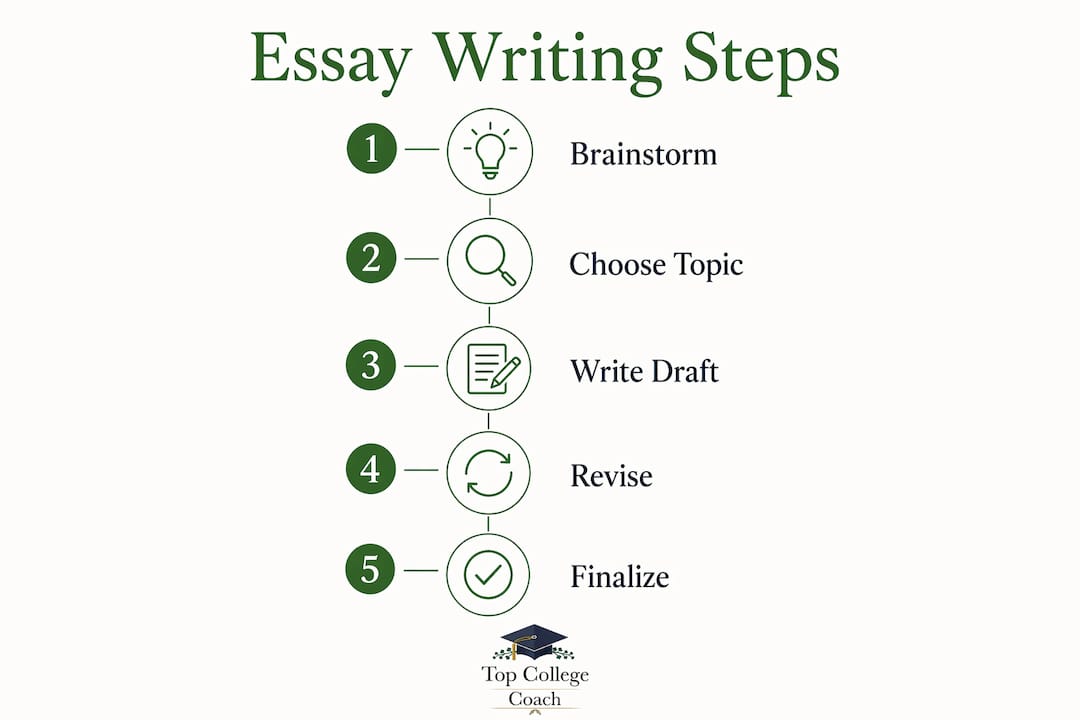
What steps to follow when writing your college application essay
Writing a compelling essay requires a clear process. Skipping steps leads to flat, forgettable drafts.
Write a full first draft without stopping. Do not edit as you go. Get the story on the page. Perfectionism at this stage kills momentum and voice.
Focus on a single moment or theme. A concise essay that reflects deeply on one experience is more effective than a broad survey of your life. Depth beats breadth every time.
Show self-awareness and growth. Admissions committees want to see that you understand how an experience changed you. State what you learned, not just what happened.
Write in your own voice. Read your draft aloud. If it sounds like a textbook or a speech, rewrite it in the way you actually talk. Honest voice is more persuasive than formal language.
Stay within the word limit. The Common App essay limit is 650 words. Cutting down to that limit forces you to keep only the strongest sentences. Learn more about managing your count with this word limit guide.
Pro Tip: If a sentence does not reveal something about your character or advance your story, cut it. No exceptions.
Common mistakes and how to avoid them in your college essay
Most weak essays share the same problems. Recognizing them early saves you weeks of revision.
Common essay pitfalls include clichés, forced narratives, and ignoring essay guidelines. Here are the most frequent errors and how to fix them:
Writing what you think admissions wants to hear. Admissions officers read thousands of essays about leadership, community service, and overcoming adversity. Write what is true for you, not what sounds impressive.
Using clichés and overused themes. “I scored the winning goal,” “My mission trip changed my life,” and “I want to be a doctor to help people” are among the most common openings. They signal a lack of originality.
Choosing a controversial or inappropriate topic. Avoid topics that could alienate readers, including strong political opinions, graphic personal details, or humor that does not land in writing.
Overthinking the prompt. Spending weeks choosing between prompts instead of writing leads to rushed, underdeveloped essays. Pick a story, write it, then match the prompt.
Ignoring the word limit or formatting guidelines. Submitting an essay that exceeds 650 words or uses unusual formatting signals carelessness to admissions committees.
Skipping proofreading. A single typo in the opening paragraph can undermine an otherwise strong essay. Read your essay at least three times before submitting.
How to polish and finalize your essay before submission
The final stage of writing a compelling college admissions essay is revision. Most students underestimate how many rounds it takes to get an essay right.
Revise for content first. Read your draft and ask: Does this essay show who I am? Does it answer the prompt? Does it add something new to my application?
Revise for flow and structure second. Check that your opening grabs attention, your middle develops the story, and your closing reflects on what you learned.
Read the essay aloud. Your ear catches problems your eye misses. Awkward sentences, repeated words, and unnatural phrasing all become obvious when spoken.
Get feedback from a trusted reader. A parent, teacher, or counselor can tell you whether your voice comes through clearly. Ask them what they learned about you after reading it.
Run a final grammar check.
Final checklist item | Why it matters |
Essay is 650 words or fewer | Exceeding the limit can disqualify your submission |
Opening sentence grabs attention | Admissions officers decide quickly whether to keep reading |
Essay reveals character and growth | Content, not credentials, is what resonates |
No typos or grammar errors | Errors signal carelessness and undermine credibility |
Voice sounds like you | Authenticity is the single strongest quality in any essay |
Pro Tip: Print your essay and read it on paper. You will catch errors you missed on screen every single time.
Key takeaways
A standout college application essay requires authentic storytelling, a specific personal topic, and multiple focused revision rounds before submission.
Point | Details |
Authenticity beats drama | Write a genuine personal story, not the most impressive one you can invent. |
Story first, prompt second | Write your story before selecting a Common App prompt for a more natural fit. |
Specificity creates impact | Small, concrete moments reveal character better than broad life summaries. |
Revision is the real work | Plan at least three revision rounds covering content, flow, and grammar. |
Stay within 650 words | The Common App word limit is firm; cutting strengthens every essay. |
What I have learned from years of reading college essays
After working with hundreds of students at Top College Coach, I can tell you the most common mistake I see: students write the essay they think admissions wants, not the one only they could write. A student once spent three weeks crafting a polished essay about founding a nonprofit. It read like a press release. We scrapped it. She rewrote it in two days about the specific moment she realized her younger brother learned differently than she did. That second essay got her into three top-20 universities.
The essays that move admissions officers are almost never about extraordinary events. They are about ordinary moments described with extraordinary honesty. I have read essays about fixing a broken lawnmower, arguing with a parent about music, and failing a driving test twice. Each one was memorable because the student was willing to be specific and vulnerable.
My honest advice: stop waiting for the perfect topic. You already have it. It is the story you keep almost telling people but hold back because it feels too small or too personal. That is exactly the one you should write. The personal statement is not a resume summary. It is a window into your mind. Open it.
— Randy Pryor, College Admissions Coach & Founder of Top College Coach
How Top College Coach supports your essay writing process
Writing a college admissions essay is one of the most personal things a student will do in the application process. At Top College Coach, we work one-on-one with students to identify their strongest story, develop their voice, and refine their essay through expert feedback.
Our counselors have helped students gain admission to Ivy League schools and top-20 universities from our base in Orlando, Florida. We bring that same expertise to every student we work with, regardless of where they are starting. If you are ready to write an essay that truly represents you, explore our college admissions coaching and take the next step with a team that knows what works.
FAQ
What makes a college application essay stand out?
A standout essay tells a specific, authentic personal story that reveals character and self-awareness. Admissions officers remember essays that feel honest and original, not polished or generic.
How long should a college application essay be?
The Common App essay must be no more than 650 words. A focused, well-developed essay near that limit is stronger than a shorter essay that leaves ideas underdeveloped.
Which Common App prompt should I choose?
Admissions officers do not track which prompt students select. Write your story first, then choose the prompt that fits it best. Prompt 7 works as a flexible option for almost any topic.
Can I write about an ordinary topic?
Ordinary topics written with specific detail and honest reflection produce some of the best college essays. A family dinner, a part-time job, or a personal hobby can reveal more character than a dramatic event.
How many times should I revise my essay?
Plan for at least three full revision rounds. The first covers content and story, the second covers flow and structure, and the third covers grammar and final polish.
Recommended
Comments