Personal Statement Essays: A Complete 2026 Guide
- 2 days ago
- 8 min read

A personal statement essay is the one place in your college application where your voice, not your GPA, does the talking. Every other section of the Common Application tells admissions officers what you have done. The personal statement tells them who you are. At Top College Coach, we have helped hundreds of students gain admission to Ivy League and Top 20 universities, and the essay is consistently the piece that separates good applications from great ones. The Common App personal statement gives you 650 words and seven prompts to make that case. Use them well.
What makes personal statement essays stand out?
Admissions officers read thousands of college application essays each cycle. They are not looking for perfect grammar or impressive vocabulary. They are looking for a clear, authentic voice and a window into how a student thinks.
The single most effective technique is showing rather than telling. Specific, sensory details reveal character far better than unsubstantiated adjectives. “I am a curious person” tells an officer nothing. “I spent three summers cataloging moth species in my backyard with a UV light and a field notebook” shows curiosity in action. That distinction matters more than any other writing rule.

Strong essay themes tend to center on growth, challenge, identity, or genuine curiosity. The topic does not need to be dramatic. A student who writes with depth about learning to bake bread with her grandmother can outshine a student who writes a flat account of winning a state championship. The depth of reflection is what creates impact.
Here is what admissions readers consistently respond to:
A specific opening scene that drops the reader into a moment, not a biography
A clear sense of the student’s inner life, not just their outer accomplishments
Reflection that explains why an experience mattered, not just that it happened
A consistent voice that sounds like a real teenager, not a college brochure
A conclusion that looks forward, not just backward
Pro Tip: Read your draft out loud. If you stumble over a sentence or it sounds stiff, rewrite it. Your spoken voice is almost always closer to your authentic written voice than your first draft.
How do you choose your personal statement topic and prompt?
The seven Common App prompts for the 2026–2027 cycle are unchanged from the previous year. That stability is a gift. It means strong guidance exists, and you can focus your energy on the story rather than decoding new requirements.
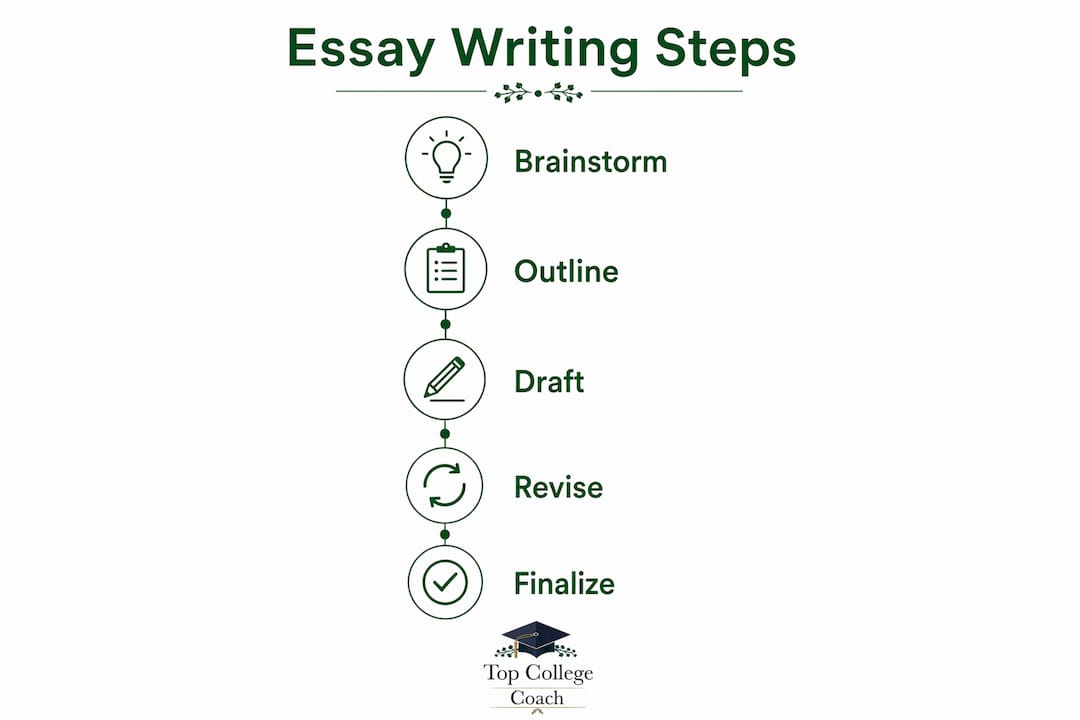
Choosing the right prompt starts with choosing the right story, not the other way around. Identify two or three experiences that genuinely shaped you. Then find the prompt that fits the story, not the story that fits the prompt. Most strong essays could technically answer several prompts at once.
Two essay structures work best for the Common App format:
Narrative arc. Opens with a specific scene, builds through a sequence of events, and lands on a moment of reflection or change. This works best when one experience had a clear before and after.
Montage. Connects multiple short vignettes around a single unifying theme. This works best when your identity or interest cannot be captured in one moment.
Structure | Best for | Opening style | Risk |
Narrative arc | One defining experience | Vivid scene or dialogue | Can become a plot summary |
Montage | Multiple related interests | Thematic statement or image | Can feel scattered |
The most memorable essays skip the throat-clearing introduction entirely. Do not open with your birth, your family background, or a dictionary definition. Open with a moment. Put the reader somewhere specific in the first two sentences.
How to draft and revise your personal statement essay
Writing a strong college application essay is a process, not a single sitting. Follow these steps to move from a blank page to a polished final draft.
Write a messy first draft fast. Aim for 800 words without stopping to edit. A fast, unedited draft preserves your natural voice better than slow, sentence-by-sentence writing. You can cut later. You cannot add personality back in once it is gone.
Flip the balance toward reflection. Most students write 80% event and 20% reflection. Effective personal statements do the opposite. The back half of the essay should explain what the experience meant, how it changed your thinking, and what it says about who you are becoming.
Get feedback from multiple readers. Ask a teacher, a counselor, and a trusted peer to read your draft. Each reader catches different things. A teacher spots logic gaps. A peer spots places where your voice disappears.
Polish with tools, not replacements. Grammarly and similar writing tools catch grammar and style errors, but you should never use their suggestions, as they often trigger AI detectors.
Trim to 650 words with intention. Cut adverbs, redundant phrases, and any sentence that does not add new information. Every cut should make the remaining words stronger.
Pro Tip: After your final revision, paste the essay into a plain text document and remove all formatting. Read it as a stranger would. If any sentence feels vague or generic, replace it with something specific.
The Common App word limit guide from Top College Coach breaks down exactly how to use every one of those 650 words.
Common mistakes that weaken your personal statement
The most frequent errors in writing personal statements are predictable, which means they are also avoidable.
Generic openings. Starting with a cliché like “I have always been passionate about…” signals to admissions readers that the essay will not surprise them. It rarely does.
Writing a resume in essay form. Listing accomplishments in paragraph format wastes the one space in your application reserved for narrative. Admissions officers already have your activity list.
Covering too much ground. Students who try to summarize their entire high school career produce shallow essays. One focused story told with depth beats five stories told in passing.
Over-polishing until the voice disappears. Best essays sound like the applicant, not like a parent or counselor. If every sentence sounds formal and perfect, something has been lost.
“The goal is not to impress. The goal is to be known. An admissions officer who finishes your essay and feels like they just met you has done exactly what a great personal statement should do.”
Parents play a real role in this process. Read drafts. Ask questions. Point out places that feel unclear. But resist the urge to rewrite sentences. The moment a parent’s vocabulary replaces a student’s vocabulary, the essay loses its most important quality.
How to tailor your essay for different college types
Admissions committees do not evaluate essays based on conformity to templates. They evaluate logical coherence and personal trajectory. That said, the tone and emphasis of your essay should shift depending on where you are applying.
College type | What they prioritize | Essay emphasis | Tone |
Ivy League and Top 20 | Intellectual curiosity, original thinking | Ideas and how you engage with them | Reflective, specific |
Large state universities | Fit, resilience, community contribution | Growth and values | Warm, direct |
Specialized programs (engineering, arts) | Demonstrated passion and preparation | Skills, process, and purpose | Focused, purposeful |
For Ivy League personal statements, the bar for intellectual depth is higher. These readers want to see how you think, not just what you have done. A student applying to MIT who writes about debugging code should spend more time on the problem-solving process than on the achievement itself.
A strong, clear essay can offset lower test scores. A weak or generic essay can undercut strong academic credentials. That asymmetry is worth taking seriously. The essay is not a formality. It is a deciding factor.
Key takeaways
A compelling personal statement essay requires authentic voice, focused storytelling, and reflection that outweighs event narration.
Point | Details |
Reflection over narration | Spend the back half of your essay explaining meaning, not describing events. |
Show, don’t tell | Replace adjectives with specific, sensory details that reveal character. |
Structure matters | Choose narrative arc or montage based on your story, not the prompt. |
Draft fast, revise slow | Write 800 words freely first, then cut to 650 with intention. |
Voice is non-negotiable | Parents and tools should refine, never replace, the student’s own voice. |
What I have learned coaching hundreds of personal statements
Writing personal statement essays is the part of college admissions that students fear most and understand least. After years of working with students at Top College Coach, I have come to believe that fear is actually useful. It means the student cares. The problem is when that fear produces caution instead of honesty.
The essays that get students into Harvard, Princeton, and Duke are not the ones with the most impressive topics. They are the ones where a student was willing to be specific and a little vulnerable. I have seen a student write about failing a driving test three times and get into a Top 10 school. I have seen a student write about winning a national science competition and get rejected everywhere. The difference was always reflection. The first student understood what the failure revealed about her. The second student just described what happened.
Parents, I know you want to help. The best thing you can do is ask your student questions after they share a draft. “What did that moment actually feel like?” and “Why does that matter to you?” are more useful than any edit you could make. Your student’s answer to those questions is the essay.
One more thing: do not wait for the perfect topic. The perfect topic is the one your student can write about with genuine feeling. Start there, and the structure will follow.
— Randy Pryor
Work with Top College Coach on your personal statement
Your personal statement is too important to leave to chance. At Top College Coach, we work one-on-one with students to develop essays that reflect their authentic story and align with what admissions committees at Ivy League and Top 20 schools actually want to read.
Our counselors have guided students through every stage of the essay process, from brainstorming and prompt selection to final revision. We know what works because we have seen what gets students in. If you are ready to write an essay that truly represents you, book a free strategy session with our team today. You can also explore our full range of admissions counseling services to find the right level of support for your application timeline.
FAQ
What is the word limit for the Common App personal statement?
The Common App personal statement has a strict 650-word limit. Students should aim to use close to the full limit, as cutting the essay significantly short can signal a lack of depth.
How is a personal statement different from a statement of purpose?
A high school personal statement focuses on character, growth, and motivation within 650 words. A graduate school statement of purpose is longer (typically 800–1,500 words) and emphasizes research experience and professional goals.
Can a strong personal statement offset a lower test score?
Yes. A clear, specific, and reflective essay can offset weaker test scores in the admissions review. Conversely, a generic essay can undercut an otherwise strong academic record.
How many drafts should a student write?
Most strong essays go through at least three to five drafts. The first draft should be written quickly to preserve voice. Subsequent drafts focus on reflection, structure, and trimming to the word limit.
Should parents edit their child’s personal statement?
Parents should read drafts and ask clarifying questions, but avoid rewriting sentences. The best essays sound like the student, not the parent, and admissions officers can tell the difference.
Recommended

Comments