Understand College Acceptance Rates: A Student's Guide

College acceptance rates are defined as the percentage of applicants a college admits during a single admissions cycle. This number tells you how selective a school is, not how good it is. Most students and parents treat acceptance rates as the ultimate measure of a college’s worth. That misreading leads to poor application strategy and unnecessary stress. This guide breaks down what acceptance rates actually mean, how they are calculated, and how to use them wisely when building your college list.
How to understand college acceptance rates and what they actually measure
A college acceptance rate is calculated by dividing the number of admitted students by the total number of applicants, then multiplying by 100. A school that receives 10,000 applications and admits 3,000 students has a 30% acceptance rate. That formula sounds simple, but the number it produces carries a lot of context that most families miss.
The average acceptance rate across four-year colleges in the U.S. sits above 60%, with most schools admitting 80% or more of applicants. That fact reframes the entire conversation. The schools dominating news headlines, the ones with single-digit acceptance rates, represent fewer than 50 colleges out of nearly 4,000 in the country.

Acceptance rates also shift depending on when and how you apply. Early Decision acceptance rates are often two to three times higher than Regular Decision rates at highly selective universities. A school with an overall 10% acceptance rate may admit 25–30% of Early Decision applicants. That gap is significant and changes how you should think about your application timeline.
One more thing to keep in mind: an acceptance rate is a school-wide average. It does not reflect your individual chances. Your GPA, test scores, extracurriculars, and the strength of your application all shape your personal odds in ways a single percentage cannot capture.
Pro Tip: Never use an acceptance rate as your only measure of whether to apply. It tells you about the pool of applicants, not about you specifically.
What do different acceptance rate ranges tell you about a college?
Acceptance rates fall into three broad ranges, and each one signals something different about the admissions experience you can expect.
High acceptance rates (above 80%)
Schools in this range admit the large majority of applicants. They typically have open or broad access missions, meaning they are designed to serve a wide population of students. These schools are not less rigorous by definition. Many strong regional universities, state schools, and specialized colleges fall here. The admissions process at these schools focuses more on meeting baseline requirements than on competitive comparison between applicants.
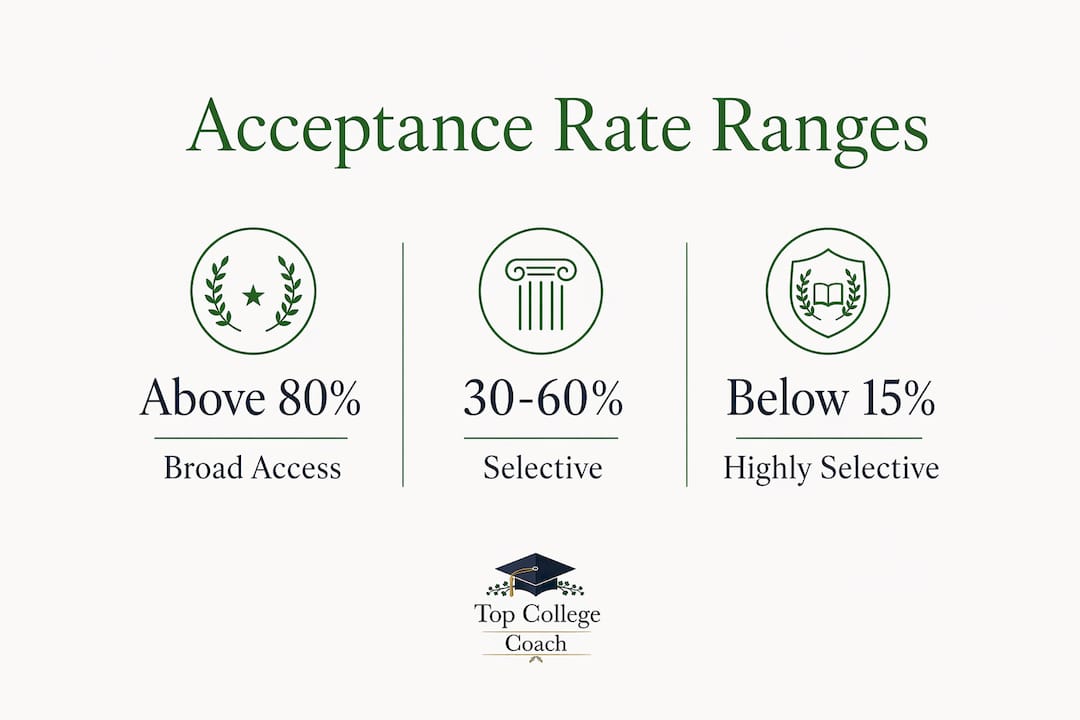
Moderate acceptance rates (30–60%)
This middle range represents schools with genuine selectivity. Admissions offices at these colleges do compare applicants and make competitive decisions. Your academic record, course rigor, and personal essays carry real weight. Many well-regarded universities with strong programs and excellent career outcomes sit in this range. Students who focus only on the extremes often overlook these schools entirely, which is a mistake.
Low acceptance rates (below 15%)
Fewer than 50 U.S. colleges have acceptance rates below 15% as of 2026. These are the schools that generate the most media coverage and the most anxiety. Admission at this level involves a highly competitive pool where even exceptional students face long odds. The process at these schools accounts for factors well beyond grades and scores.
The table below summarizes what each range typically signals:
Acceptance rate range | What it signals | Example school type |
Above 80% | Broad access, baseline requirements | Regional state universities |
30–60% | Moderate selectivity, competitive review | Mid-tier national universities |
15–30% | High selectivity, strong applicant pool | Top public flagships |
Below 15% | Highly selective, holistic and competitive | Ivy League and peer institutions |
A low acceptance rate is not a guarantee of a better education. Acceptance rates reflect selectivity, not degree value or student experience. A school with a 50% acceptance rate may offer a stronger program in your specific field than a school admitting 8% of applicants.
How to use acceptance rates to build a smart college list
Acceptance rates are one input in a larger decision, not the decision itself. The most effective way to use them is alongside your own academic profile and a tool called the Common Data Set, or CDS.
Here is a practical four-step process:
Pull the Common Data Set for every school you are considering. Every accredited college publishes CDS data annually. Look at Section C, which shows the GPA and test score ranges of admitted students. The CDS 25th to 75th percentile ranges give you a realistic picture of where you stand relative to admitted classes, not just the overall applicant pool.
Sort your list into reach, match, and safety schools. A reach school is one where your scores fall below the 25th percentile of admitted students. A match school is one where your profile sits in the middle of the range. A safety school is one where you are clearly above the 75th percentile. Acceptance rate alone does not tell you which category a school falls into for you personally.
Factor in Early Decision if you have a clear first choice. Early Decision application timing meaningfully affects admission chances at selective schools. If you are committed to a school and your profile is competitive, applying Early Decision can significantly improve your odds. Understand the binding commitment before you apply.
Research program fit, not just school prestige. Look at graduation rates, career placement data, faculty research, and campus culture. A school that fits your academic goals and personal style will serve you better than a prestigious name that does not. Top College Coach recommends reviewing what colleges look for in students beyond test scores and GPA.
Pro Tip: Build your list with at least two schools in each category: two reaches, three matches, and two safeties. That structure protects you without limiting your ambition.
Common misconceptions about college acceptance rates
The biggest myth in college admissions is that a lower acceptance rate means a better education. Acceptance rates do not measure educational quality or career outcomes. The correlation between a school’s admit rate and its graduation rate or post-graduation earnings is weak. What acceptance rates actually reflect is a combination of applicant volume, available seats, and institutional yield expectations.
A second widespread mistake is treating the overall acceptance rate as your personal acceptance rate. Highly selective colleges have varied acceptance rates across different applicant subgroups, including legacy applicants, recruited athletes, international students, and underrepresented groups. No single published rate captures the experience of every applicant.
“The obsession with record-low acceptance rates distorts understanding of American higher education. Balanced application strategies require viewing the full landscape, not just the schools that generate the most headlines.”
Headlines about record-low acceptance rates at elite schools create a distorted picture of how college admissions actually works. Elite schools have very low rates, but most students attend schools that admit the majority of their applicants. Fixating on that narrow slice of the market causes students to overlook hundreds of excellent institutions where they would thrive.
The right frame is fit, not selectivity. A school where you are academically challenged, personally engaged, and well-supported will produce better outcomes than a school where you are admitted but mismatched. Admissions experts affirm that students should focus on program strengths and campus culture when evaluating colleges, not just the admit rate.
Key Takeaways
College acceptance rates measure selectivity, not quality, and the most effective application strategy combines CDS academic percentiles, Early Decision timing, and genuine program fit rather than chasing the lowest admit rate.
Point | Details |
Acceptance rate definition | It is the percentage of applicants admitted, reflecting selectivity, not educational quality. |
Most schools are accessible | The average U.S. acceptance rate exceeds 60%; fewer than 50 schools admit below 15% of applicants. |
Early Decision advantage | ED acceptance rates are often two to three times higher than Regular Decision at selective schools. |
Use the Common Data Set | CDS percentile ranges show your real competitiveness far better than the overall acceptance rate. |
Fit beats prestige | A school aligned with your goals and profile will serve you better than a low-rate school that does not fit. |
Why I tell every family to stop leading with acceptance rates
After years of working with students applying to Ivy League and Top 20 universities, the pattern I see most often is this: a student builds an entire college list around acceptance rates and ends up with a list that is either too risky or too safe. Neither serves them well.
The families who get the best results are the ones who treat acceptance rates as a filter, not a goal. They use the number to understand the competitive environment at a school, then they go deeper. They look at the Top 20 university acceptance rates in context, compare their academic profile to CDS data, and ask whether the school is genuinely a good fit for what the student wants to study and who they want to become.
The students who get hurt are the ones who equate a 5% acceptance rate with the best possible outcome for their future. That thinking leads to under-researched applications, mismatched schools, and a lot of unnecessary anxiety. A student who attends a school with a 40% acceptance rate and graduates with a strong GPA, meaningful research experience, and a clear career direction will outperform a student who attends a prestigious school without direction or engagement.
My honest advice: read the Ivy League acceptance rates if those schools are on your list, understand what they mean, and then build your strategy around your strengths and your goals. The acceptance rate is the starting point of the conversation, not the end of it.
— Randy Pryor
How Top College Coach supports your admissions strategy
Knowing how to read acceptance rates is one piece of a much larger puzzle. Translating that knowledge into a college list that fits your profile, your goals, and your timeline takes experience and a clear process.

Top College Coach works with students and families across the country to build application strategies grounded in real data and genuine fit. From interpreting CDS percentiles to deciding whether Early Decision is right for you, our counselors bring the same expertise that has helped students gain admission to Ivy League and Top 20 universities. If you are ready to move from confusion to clarity, schedule a free admissions strategy session and get a personalized plan built around your strengths. You can also learn more about our full range of services at Top College Coach.
FAQ
What does college acceptance rate mean?
A college acceptance rate is the percentage of applicants a school admits in a given admissions cycle. It reflects how selective a school is, not how good its programs are.
What is the average acceptance rate at U.S. colleges?
The average acceptance rate across four-year colleges in the U.S. is above 60%, with most schools admitting 80% or more of applicants. Fewer than 50 schools have rates below 15%.
Does a low acceptance rate mean a better college?
No. Acceptance rates measure selectivity, not educational quality or career outcomes. A school with a higher acceptance rate may offer stronger programs in your field than a more selective one.
How does Early Decision affect acceptance rates?
Early Decision acceptance rates are often two to three times higher than Regular Decision rates at selective schools. A school with a 10% overall rate may admit 25–30% of Early Decision applicants.
How should I use acceptance rates when choosing colleges?
Use acceptance rates alongside Common Data Set percentile data to categorize schools as reach, match, or safety. Your personal academic profile determines your actual odds far more than the overall acceptance rate does.
Recommended
Comments