Transfer Admissions: A Counselor's Checklist to Protect Credits
- 10 hours ago
- 11 min read

A transfer student is anyone applying to a new college after completing coursework at another accredited institution, and every review board looks for the same four things first: enough transferable credits to justify the switch, a GPA that clears the program’s threshold, official transcripts sent directly from your current school, and completed prerequisites for your intended major. The specifics shift by campus and major, which is exactly what we unpack below.
TL;DR:
Transfer credit thresholds vary by total credits, with under 12 resembling first-year review, 12–30 a hybrid, and over 60 indicating junior standing, affecting application focus.
GPA expectations range from as low as 2.4 for some public schools to above 3.5 at selective campuses, with competitive majors often requiring higher averages and completed prerequisites.
Official transcripts must come directly from all attended institutions, and international or non-regionally accredited coursework may face additional evaluation hurdles.
Articulation agreements and course equivalency tools help confirm which credits transfer, but students should verify course content and keep documentation before applying.
Demonstrating specific interest through tailored essays, supplemental materials, and demonstrating awareness of faculty or research opportunities greatly enhances transfer prospects.
Table of Contents
What Counts as a Transfer Student, and Why Credit Thresholds Matter
Most universities define a transfer applicant as someone who has finished between 12 and 30 semester credits after high school. Cross the 60 credit mark, and you typically hit “junior level” standing, which changes how a school reads your file. Below that threshold, your high school GPA and test scores often still carry weight. Above it, Cal State’s transfer guidance makes clear that your college transcript becomes the whole story, and your high school record fades from consideration.
That distinction matters for what you submit, not just how you’re judged:
Under 12 credits: treated closer to a first-year applicant, with high school transcripts and test scores often required.
12 to 30 credits: a hybrid review weighing college performance alongside your academic background.
60 credits or more: junior-level standing, where college coursework and major prep dominate the decision.
Before you apply anywhere, add up your transferable credits yourself. Registrars sometimes count differently than you’d expect, and a few missing credits can bump you into a different review category entirely.
GPA Expectations and Major Prerequisites
GPA minimums vary more than most applicants assume. Some public university systems set eligibility as low as a 2.4 GPA, while selective campuses often admit transfer cohorts averaging above 3.5. A 3.0 might clear the bar for eligibility but still fall short of being competitive.
Major matters as much as the number itself:
Less selective public universities: often 2.0 to 2.5 minimum GPA for general admission.
Competitive liberal arts programs: typically 3.2 to 3.5 for a realistic shot.
Engineering, computer science, and nursing: frequently require both a higher GPA and specific completed prerequisite courses, regardless of your overall average.
Engineering and computing programs are notorious for this. A strong 3.4 GPA won’t offset a missing calculus sequence or an unfinished physics prerequisite. Report in-progress grades honestly on your application, and lay out exactly which remaining prerequisites you’ll complete before enrollment.
Pro Tip: Call the transfer admissions office directly and ask what GPA their most recently admitted class averaged in your intended major. That number is often far more useful than the published minimum.
What Documents Do Transfer Applicants Need to Submit?
Every prior institution you’ve attended needs to send an official transcript directly to your target school. Yale’s transfer requirements reflect a standard most selective schools share: a transcript you upload yourself, or one printed from a student portal, typically gets rejected. Admissions offices want the sealed, institution-to-institution version.
Request official transcripts from every college you’ve attended, even one you took a single summer course at.
Submit proof of high school completion (diploma or GED) if you have fewer than roughly 24 to 30 transferable credits.
Check whether TOEFL or IELTS scores are required. Many schools waive this if you’ve completed a set number of credits at an English-language institution, but plenty do not.
If your transcript includes withdrawals, incompletes, or an academic gap, most applications include a section for context. Use it. An unexplained gap reads worse than an explained one, almost every time.
Application Components, Platforms, and Deadlines
Transfer applications share a common skeleton but vary in the details. Expect to submit a personal statement or transfer-specific essay, a Transfer Report or college report (often completed by a dean or adviser at your current school), a list of activities, and a full course list covering completed, in-progress, and planned coursework.
Platform choice depends entirely on where you’re applying:
The Common Application handles transfer applications for many private and public schools.
The Coalition Application, required by schools like Columbia, includes its own profile sections and a transfer supplement essay that differs from first-year application flows.
Cal State Apply serves as a single portal for all 22 CSU campuses, using self-reported coursework to calculate your GPA.
Deadlines cluster around two patterns: many selective private schools accept transfers for fall only, with applications due in February or March, while public university systems often run multiple entry terms. After admission, expect deadlines for final transcripts, a deposit, and sometimes a midterm grade update. Track these the same way you tracked your original application deadlines, using a tool like Top College Coach’s application timeline checklist if you need a structured calendar.
How Do Articulation Agreements Protect Your Credits?
Articulation agreements are formal deals between institutions (or systems) spelling out exactly which courses transfer and how they count toward your new degree. Tools like ASSIST for California schools, NJTransfer for New Jersey, and individual campus articulation pages let you check equivalency before you ever submit an application.
A few habits protect your credits:
Confirm course equivalency for every class before enrolling in your next term, not after you’ve already applied.
Keep syllabi and course descriptions for anything unusual, since collecting this material before applying speeds credit evaluation and gives you something concrete if a credit gets denied.
Track major-prep deadlines separately from general admission deadlines. Missing a prerequisite window can cost you a full semester.
Accreditation and course numbering also matter more than most students realize. Credit earned at a regionally accredited community college transfers far more reliably than credit from a nationally accredited or unaccredited program, and Columbia’s policy of limiting standardized exam credit and excluding pre-high-school coursework illustrates how specific these caps can get. Check your target school’s policy on both fronts before you assume anything transfers cleanly.
How Do Admissions Offices Actually Evaluate Transfer Files?
Meeting the minimum GPA and credit thresholds gets your file read. It doesn’t get you admitted. The University of Washington’s own description of holistic transfer review makes the point directly: reviewers weigh the rigor of your coursework, whether your grades trend upward, how well your background fits your intended major, and any context you provide about your circumstances.
The most common denial reasons are avoidable. Missing prerequisites, thin major preparation, and incomplete transcripts sink more applications than a mediocre GPA does. If something in your record looks unusual, a course repeated three times, a semester with no grades, use the application’s additional information section to explain it plainly.
Pro Tip: If your file has a genuine anomaly, don’t just explain it in your essay. Email the transfer adviser directly and ask if they’ll review a brief note or supporting syllabus before you submit. Most will.
A Step-by-Step Checklist for a Competitive Transfer Application
Work through this in order, starting at least two semesters before your target enrollment date.
Confirm your total transferable credits and check them against each target school’s equivalency tool.
Request official transcripts from every institution you’ve attended, sent directly to each school.
Complete as many major prerequisites as possible before applying, not after.
Draft your essays and Transfer Report request early. Give recommenders and advisers real lead time.
Submit before the deadline, including any required fee or fee waiver.
After admission, send final transcripts, complete your credit evaluation, and pay your deposit on time.
Timing matters more than most applicants expect. Missing a midterm grade update or final transcript deadline is one of the more common reasons admitted transfer students have their offers rescinded, and it’s entirely preventable with a simple calendar reminder.
Do Repeated Courses and Grade Forgiveness Transfer?
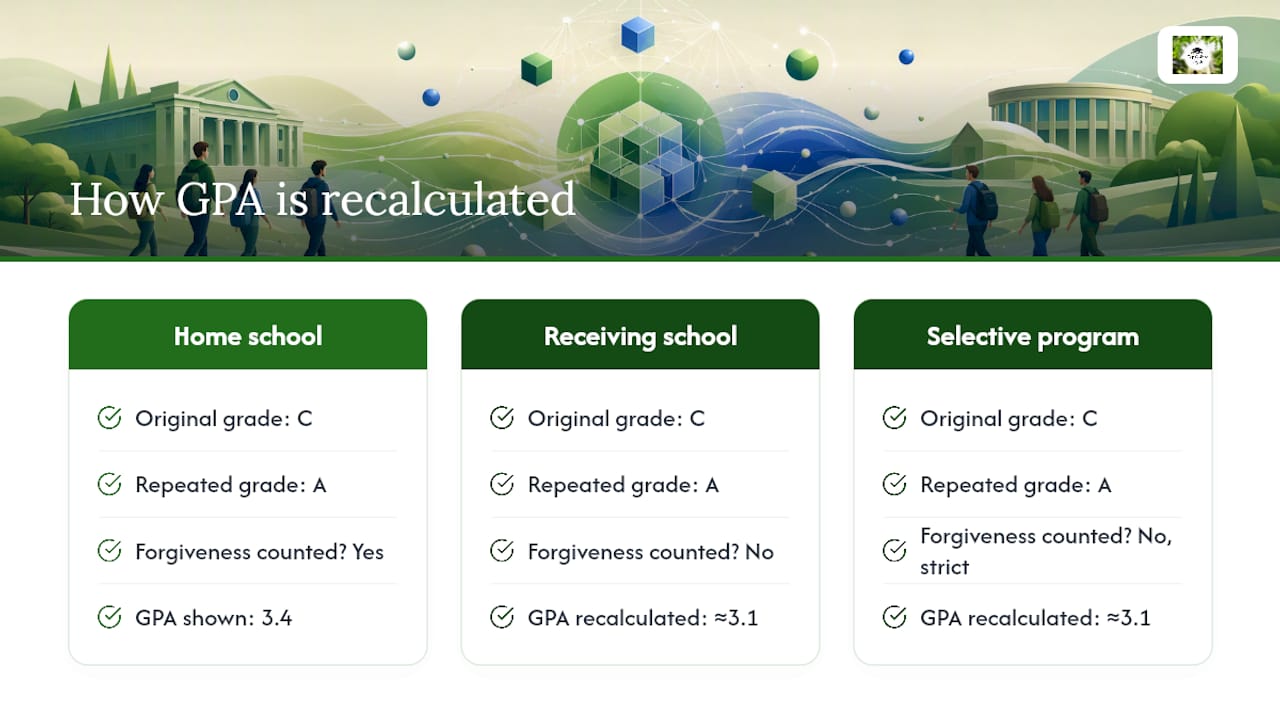
Grade forgiveness policies rarely travel with you. If your current school lets you retake a class and erase the original grade from your GPA calculation, that forgiveness usually does not follow you to your new institution. Most admissions offices recalculate your GPA using every grade you ever earned in a course, original attempt included, regardless of what your old school’s transcript shows as your “official” GPA.
This catches students off guard constantly. You might have a 3.4 GPA on your current transcript thanks to grade replacement, only to have a receiving school calculate closer to a 3.1 once it factors in the original attempt at a class you retook. Selective programs are especially strict here, since they’re trying to see your actual academic trajectory, not a cleaned-up version of it.
Repeated courses themselves are usually fine to include, and can even work in your favor if they show improvement over time. A C followed by an A in the same subject tells a reviewer you struggled, adjusted, and mastered the material. What doesn’t help is assuming a repeat wipes the slate clean in someone else’s GPA calculation.
The practical move is to ask your target schools directly how they recalculate GPA for repeated courses, since policies genuinely differ by institution and sometimes by program within the same school. Don’t rely on your current registrar’s math. Bring your full grade history and let the receiving institution tell you how it counts.
Does Where You Started College Affect Your Transfer Eligibility?
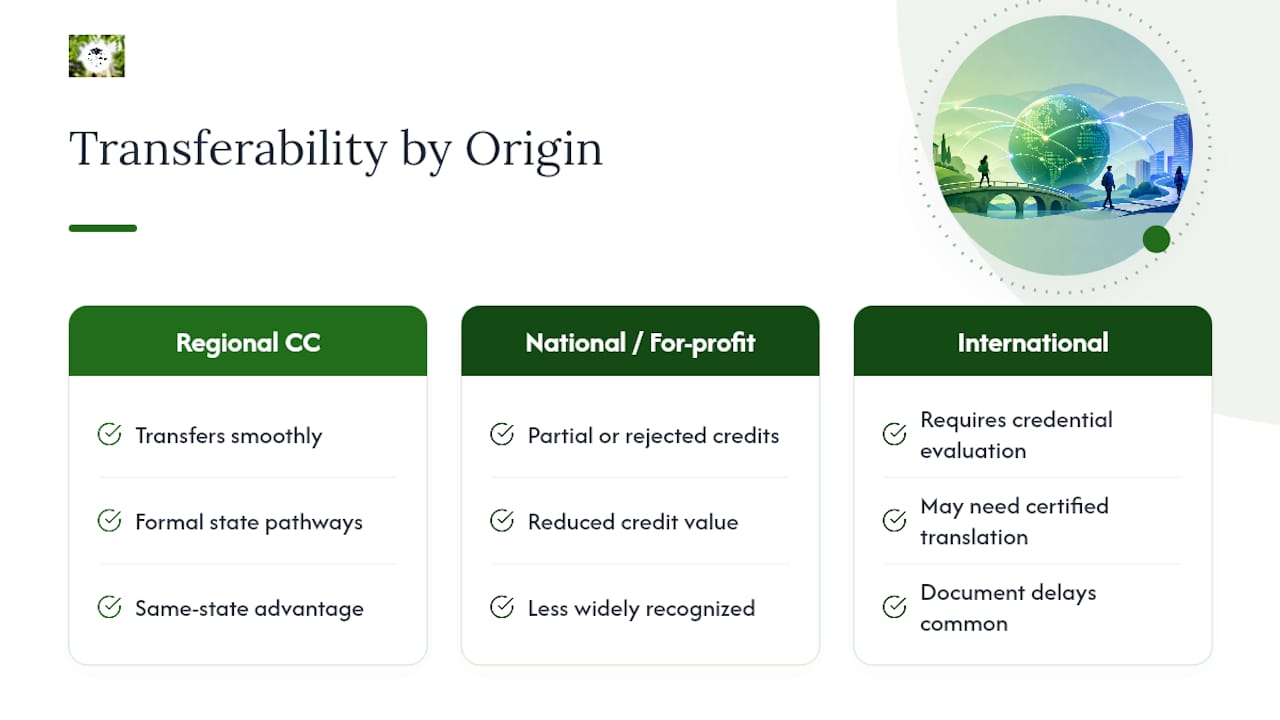
Accreditation status is one of the most overlooked factors in transfer eligibility, and it can quietly disqualify credits you assumed were safe. Regional accreditation is the gold standard most four-year universities recognize without hesitation. Credits from a nationally accredited institution, a for-profit school, or an unaccredited program often transfer partially, at reduced value, or not at all.
Community colleges with strong regional accreditation and established relationships with nearby four-year schools tend to transfer the most smoothly, particularly within the same state system. That’s not an accident. Many state systems build formal pathways specifically because so many students move between two-year and four-year institutions within their borders.
Region adds another layer. A course numbering system that makes sense at one community college may not map cleanly onto a university’s requirements in another state, even when both schools are regionally accredited. This is where course-by-course equivalency review becomes essential rather than optional. A “College Algebra” course at one school might satisfy a general education requirement at your target university, while an identically named course somewhere else does not, depending entirely on content and rigor as documented in the syllabus.
If you attended school outside the United States, this gets more complex still. International transcripts often require a credential evaluation service before a university will even consider the coursework, and foreign-language records may need certified translation. A resource like CertiTranslate’s guide to academic document translation is worth reviewing early, since document delays are one of the more common reasons international transfer files stall.
How Can You Strengthen a Transfer Application Beyond the Minimums?
Clearing GPA and credit requirements gets you into the applicant pool. Standing out inside that pool takes more deliberate work, and this is where a lot of otherwise qualified students leave opportunity on the table.
Supplemental materials matter more for transfers than many students expect. A brief portfolio, writing sample, or research summary tied to your intended major can demonstrate readiness in a way a transcript alone cannot. If your target school offers an optional interview for transfer applicants, take it. Interviews let you explain your academic trajectory, address any rough patches directly, and show genuine interest in a way an essay sometimes can’t capture.
Your essay is your best tool for explaining why you’re transferring, and vague answers hurt you here. “Better opportunities” tells a reviewer nothing. A specific account of the program, faculty, or research you’re pursuing, and how your current coursework built toward it, tells them everything. Reference specific courses or experiences from your activity list, since a well-built activity list can carry real weight in a transfer file, just as it does for first-year applicants.
Recommendation letters from college faculty, not high school teachers, carry more credibility once you have a semester or two of college performance behind you. If you’re weighing which two or three specific improvements to prioritize before submitting, our guide on improving your college application walks through the highest-leverage moves.
What We See Most Often, and What Actually Works
Every transfer season, we watch capable students weaken their own applications through timing, not talent. The most common mistake isn’t a low GPA. It’s requesting transcripts three weeks before a deadline, discovering a prerequisite gap too late to fix it, or writing an essay that never explains why this specific school and program make sense for where the student is headed.
Start earlier than feels necessary. If you know you’ll apply to transfer in a year, map your remaining prerequisites against your target school’s requirements now, not the semester you plan to submit. Prioritize major prep over chasing a marginally higher overall GPA. A 3.3 GPA with completed prerequisites beats a 3.6 with gaps in required coursework almost every time we’ve seen it play out.
The weakest essays we read share one trait: a reason for transferring that could apply to any school. The strongest ones name specific faculty, specific coursework, or a specific gap between the student’s current program and their goals. That specificity is what separates an eligible applicant from a compelling one, and it’s a pattern echoed in how holistic transfer review actually works at selective campuses. Reviewers aren’t just checking boxes. They’re looking for evidence that you understand exactly what you’re moving toward.
— Randy Pryor
Getting Expert Guidance on Your Transfer Application
Top College Coach gives transfer applicants something a checklist can’t: a strategist who has read thousands of files and knows exactly which gaps get flagged and which essays actually land. For a student juggling current coursework, prerequisite planning, and an application deadline, that difference in preparation time alone is worth the investment.
Our transfer-focused counseling covers application strategy built around your specific major and target schools, essay and narrative coaching that turns a generic “better opportunity” into a specific, compelling case, and transcript review that maps your completed coursework against each school’s major prep requirements before you submit anything. Based in Orlando with 5-star client reviews, our team works with transfer applicants nationwide through a structured consultation process that starts with a review of your current transcript and target list. If you’re aiming for a competitive transfer decision this cycle, visit Top College Coach to schedule a consultation and find out exactly where your application stands today.
Sources
FAQ
What Are the Requirements for a Transfer Student?
Baseline requirements typically include a set number of transferable credits (commonly 12 to 30, with 60 credits marking junior-level standing), a minimum GPA that varies by school and major, official transcripts sent directly from every prior institution, and completed prerequisites for your intended major.
What Is the 4-2-4 Transfer Rule?
The “4-2-4” pattern refers to students moving through a four-year high school, a two-year community college, and then a four-year university, a common transfer pathway supported by many state articulation agreements and pathway tools like ASSIST.
Can You Get Denied as a Transfer Student?
Yes. Common reasons include missing major prerequisites, insufficient GPA for a competitive program, incomplete or unofficial documentation, and unexplained gaps or withdrawals on a transcript, since holistic review weighs far more than baseline eligibility.
What GPA Do I Need to Transfer to a Selective University?
Eligibility minimums can be as low as 2.4, but admitted cohorts at selective campuses often average above 3.5, so meeting the minimum rarely makes you competitive on its own.
How Do I Know if My Credits Will Transfer?
Check your target school’s articulation agreement or transfer equivalency tool, such as ASSIST or NJTransfer, and confirm course-by-course equivalency directly with a transfer adviser before you apply. Working with a counselor through services like Top College Coach’s transfer admissions guidance can help you map this out earlier in the process.
Recommended
Comments