Ivy League Admissions Tips That Actually Move the Needle
- 15 hours ago
- 15 min read

Getting into an Ivy League school comes down to five things, in order: academic rigor, a defined academic “spike” (or exceptional well-roundedness), authentic essays, smart standardized testing, and a deliberate application strategy. Everything else, including alumni networks and interview polish, matters at the margins. If you’re starting this process now, do three things this week: pick one area of genuine interest to go deep on instead of wide, audit your junior-year schedule against your school’s toughest available courses, and schedule a practice SAT or ACT so you have real data instead of guesses.
Choose one academic or extracurricular interest to develop into a real spike
Compare your current course load to the most rigorous options your school offers
Take a full-length practice test this month to establish a baseline score
Pro Tip: Print your transcript and activities list side by side. If a stranger couldn’t guess your intended major or passion from those two documents alone, you don’t have a spike yet. You have a resume.
Key Takeaways
Ivy League admission depends on course rigor, a defined academic spike, authentic essays, competitive testing, and a deliberate application strategy working together, not any single factor alone.
Point | Details |
Prioritize rigor over GPA padding | Choose the hardest available courses in your strongest subject area rather than easy A’s. |
Build one real spike | Go deep on a single research project, competition, or initiative instead of collecting shallow activities. |
Target the middle 50%, don’t panic below it | Aim for the 1500s SAT or 34+ ACT where possible, but a strong spike can offset a 1400. |
Use Early Decision strategically | ED can raise acceptance odds significantly, but only apply where the fit is genuine and the commitment is binding. |
Get professional help when the stakes are high | Top College Coach offers essay coaching, interview prep, and full application strategy built around these exact priorities. |
Table of Contents
Recommendation Letters and Interviews: Choosing Advocates and Preparing to Talk
Building Your College List: Early Decision and Timeline Milestones
How Top College Coach and Randy Pryor Turn Advice Into Action
What Financial Aid and Scholarships Look Like at Ivy League Schools
How to Build a Personal Brand That Colleges Actually Remember
What Holistic Admissions Actually Means at Selective Schools
Showing Resilience Without Turning Your Essay Into a Trauma Narrative
How Top College Coach Helps You Apply These Ivy League Admissions Tips
Ivy League Admissions Tips Start With Course Selection
Admissions officers at selective schools read transcripts in context, not isolation. A 3.8 GPA earned in the least demanding track available carries less weight than a 3.6 earned in a schedule loaded with AP, IB, or dual-enrollment courses. Yale’s own admissions guidance names academic preparation and intellectual curiosity as core attributes officers look for, and rigor is the clearest evidence of both.
The mistake many families make is chasing a slightly higher GPA instead of a harder schedule. CollegeVine’s admissions research backs this up directly: course rigor tends to outweigh a marginally higher GPA in easier classes, because it signals how a student performs under real academic pressure, not just how well they optimize for a transcript.
Here’s how to think about junior-year course selection if you’re aiming at the most selective tier:
Max out rigor in your strongest subjects first. Take AP or IB courses in the areas tied to your intended spike before spreading rigor thin across unrelated subjects.
Add dual enrollment if your school’s AP/IB catalog is limited. Community college courses in a relevant subject can substitute credibly when your high school doesn’t offer advanced options.
If a grade dipped sophomore year, build a recovery narrative. A strong junior year, a note from your counselor, or a rigorous summer course can reframe one weak semester as a blip, not a pattern.
Check your schedule against your school’s most competitive graduates. Ask your counselor what course loads recent admits to top schools carried, then benchmark yourself.
Pro Tip: If your school caps AP enrollment or doesn’t offer IB, say so in the “Additional Information” section of your application. Admissions officers evaluate rigor relative to what was actually available to you, not against a national maximum.
What SAT and ACT Scores Do Ivy League Schools Expect?
Testing is back at the center of the conversation. After several years of test-optional experimentation, many Ivies have reinstated testing requirements, and recent coverage of the 2025–2026 admissions cycle confirms rigor and testing performance are weighted more heavily again than they were during the pandemic years.
Competitive SAT ranges at the most selective Ivies are generally very high, with ACT composite scores also commonly near the top, but these numbers describe context, not a hard cutoff. A student in the 1450s with an exceptional academic spike and a compelling essay can still be competitive, especially at schools that read applications holistically.
Superscore across multiple sittings. Most Ivies will take your highest section scores across different test dates, so retesting strategically often beats one all-or-nothing attempt.
Cap yourself at three sittings if possible. Diminishing returns and application fatigue set in after that, and a long testing history can raise questions of its own.
Build a 3 to 6 month prep runway. Baseline test, eight to twelve weeks of targeted practice, a mid-point retake, then a final attempt in the fall of senior year if needed.
Students with very high SAT scores are generally well-positioned within typical ranges at Ivy League schools, while those with scores somewhat below may need to lean harder on other parts of the application.
If your score plateaus below the range for your target schools, consider whether a test-optional or test-flexible policy applies to that specific school and whether your transcript and spike are strong enough to carry more weight in a holistic read.
How to Build an Academic Spike That Actually Stands Out
A spike is depth in one area instead of breadth across many. Admissions officers read hundreds of applications listing student council, a sport, and a part-time job. They remember the student who spent two years building a water-quality monitoring project for local streams, or the one who placed in the Regeneron Science Talent Search.

Stanford’s admissions overview emphasizes holistic review built around intellectual curiosity and demonstrated initiative, and a spike is the clearest way to show both. CollegeVine’s research on selective admissions echoes this: extracurricular depth carries more weight than a long list of shallow activities at schools receiving tens of thousands of applications.
Credible spike outcomes tend to share a few traits: they’re measurable, sustained over time, and owned by the student rather than assigned by a parent or program. Consider these benchmarks:
Research with a tangible product. A published paper, a science fair placement, or recognition through something like the Regeneron Science Talent Search demonstrates independent academic work beyond the classroom.
Competition results that show trajectory. Moving from a local qualifier to a state or national round over two or three years reads as growth, not a one-time fluke.
A self-started initiative with real impact. A tutoring program that served 40 students, a nonprofit that raised a specific dollar amount, or an app with measurable downloads all give admissions officers something concrete to evaluate.
Academic honors like National Merit recognition. National Merit standing remains a credible, externally validated marker that selective schools recognize.
Document impact the way a resume would: role, timeline, and outcome. “Founded a coding club” says less than “Founded a coding club in sophomore year, grew it to 25 members, and partnered with a local elementary school to teach basic programming to 60 third graders.” If you’re starting from scratch, give yourself a real runway: pick the interest by fall of junior year, commit to a specific project or competition by winter, and have a measurable result by the following fall so it’s ready for your applications.
How to Write Ivy League Essays That Sound Like You
Every college essay tip you’ve heard boils down to one test: does this sound like a real 17-year-old, or does it sound like what a 17-year-old thinks admissions wants to hear? Yale’s own guidance on what the school looks for names contribution to community and intellectual curiosity as core attributes, and essays are where you prove those traits with a specific story rather than a claim.
Start with an exercise, not a draft. List five moments where you failed, changed your mind, or felt genuinely uncertain. The best essay themes usually hide in that list, not in your proudest achievement, because admissions officers have read a thousand proud-achievement essays already.
Draft your Common App essay around a small, specific moment, then zoom out to what it reveals about your values. The Common App prompts are built around reflection, not resume recap.
Make sure your supplemental essays connect to something concrete at that specific school, not a generic “great academics and vibrant community” line that could apply anywhere.
Run every essay through a three-stage edit: you cut anything that doesn’t sound like your voice, a teacher checks clarity and grammar, and a final reviewer checks whether the whole application tells one consistent story.
Read the essay aloud. If it sounds like a speech instead of a conversation, it’s probably overwritten.
Recent coverage of the 2025–2026 cycle notes that admissions offices increasingly use AI-assisted tools early in review to flag inconsistencies and overly polished writing. An essay that sounds suspiciously perfect, with no rough edges or personal quirks, can raise more questions than it answers.
Pro Tip: After your final draft, ask someone who knows you well to read it without telling them it’s yours. If they can’t guess it was you within a paragraph, the voice isn’t there yet.
Recommendation Letters and Interviews: Choosing Advocates and Preparing to Talk
Choose recommenders who can speak to specific moments, not just general impressions. A teacher who watched you struggle through a difficult concept and push past it usually writes a more compelling letter than one who only knows you as a quiet A student.
Ask teachers who taught you in core academic subjects tied to your intended path, ideally junior year, when performance is most recent and relevant.
Give recommenders a packet: a brief brag sheet covering your goals and a memorable class moment, the actual deadline, and any context about your spike they might not know firsthand.
Build a story bank before interviews. Prepare five specific anecdotes covering a challenge, a failure, a leadership moment, an intellectual interest, and a community contribution, then adapt them to whatever question comes up.
Practice out loud, not just in your head. A mock interview with a teacher or counselor exposes filler words and rambling answers that silent rehearsal never catches.
For virtual interviews, test your setup the day before. Lighting, camera angle, and a quiet room matter more than most students expect.
Building Your College List: Early Decision and Timeline Milestones
Early Decision carries a real statistical pull. Recent analysis of the current cycle suggests ED applicants see acceptance rates roughly two to three times higher than the regular pool at many schools, though that advantage assumes you’re already a competitive candidate. ED works best when one school is a genuine first choice, not a strategic guess, since the commitment is binding.
Build your list using a reach, match, and safety framework based on actual fit, not just prestige rankings. A “match” school should align with your academic profile and offer the specific programs tied to your spike, not just sit at a comfortable ranking tier.
Junior spring: finalize your list and identify one ED-worthy school if applicable
Summer before senior year: draft essays and request recommendation letters
Early fall senior year: submit ED or early action applications by their deadlines
Winter: finalize regular decision applications and keep a genuine safety school in the mix
Pro Tip: A safety school only works as a safety if you’d actually be happy attending it. Don’t let prestige bias turn your “safety” into a second reach.
Ivy League Application Do’s and Don’ts
Don’t join five clubs to pad a resume. Do commit to two or three activities where you can show real growth and measurable outcomes.
Don’t let your essay repeat your activities list. Do use it to reveal values, growth, or thinking the resume can’t show.
Don’t rely on one strong number, whether it’s a test score or a GPA, to carry the whole application. Do build a narrative where academics, activities, and essays reinforce the same story.
Do start planning by sophomore or junior year. Applications built in three months rarely show the depth that a two-year runway allows.
How Top College Coach and Randy Pryor Turn Advice Into Action
A curriculum audit that flags weak rigor before junior year starts. An essay-theme workshop that pulls a real story out of a student who insists they “haven’t done anything interesting.” A mock interview that catches the rambling answer before a real admissions officer does. That’s what turns a checklist into a plan, and it’s the kind of work a private college counselor does best when a family wants more than a blog post.
What Financial Aid and Scholarships Look Like at Ivy League Schools
Every Ivy League school meets full demonstrated financial need without loans for admitted students, funded through institutional aid rather than merit scholarships. That distinction surprises a lot of families: Ivies generally don’t offer athletic or academic merit scholarships the way many state schools do, because their aid model is need-based and often extremely generous at lower income levels.
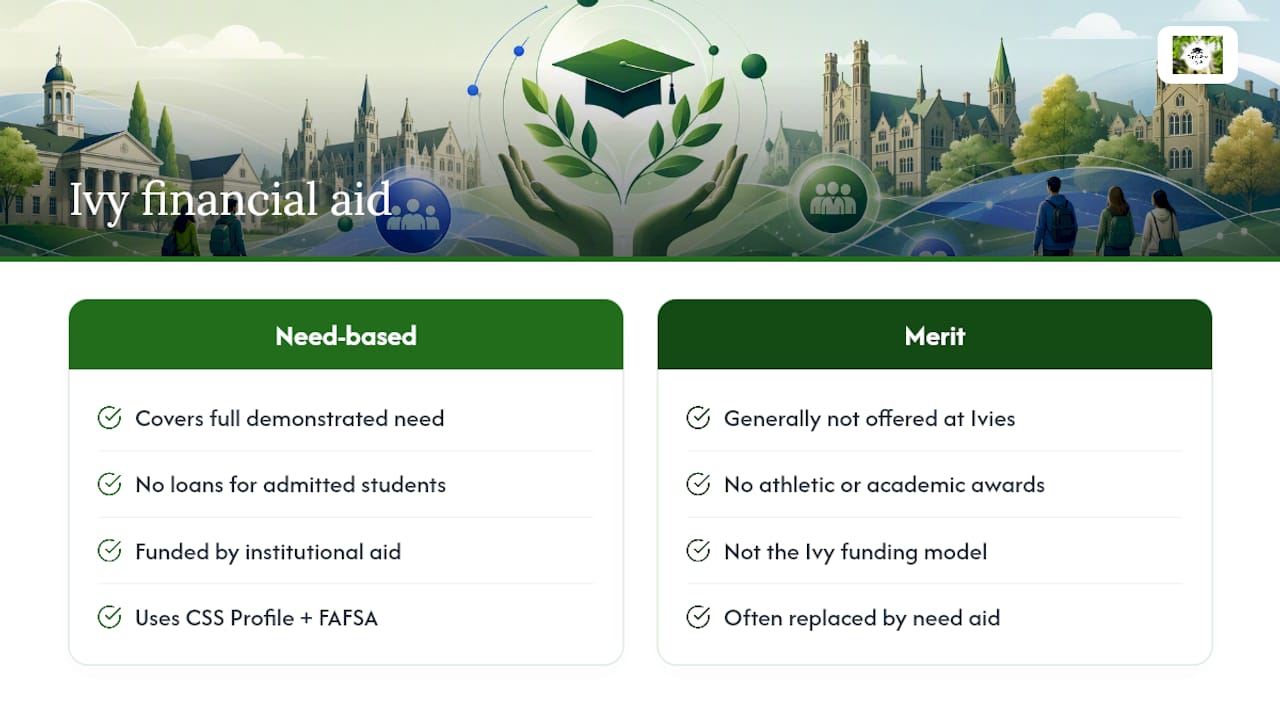
Most Ivies use both the CSS Profile and the FAFSA to calculate aid, and several have expanded free-tuition thresholds for middle-income families in recent years. The specifics vary by school, so check each institution’s own net price calculator rather than assuming one school’s policy applies across the board.
The financial aid application timeline runs parallel to the admissions timeline, not after it. CSS Profile submissions are typically due around the same time as Early Decision or Regular Decision applications, which means families need to gather tax documents and financial records months before the admissions deadline, not after an acceptance arrives.
A common mistake: assuming a school is financially out of reach before applying. Because aid is need-based rather than merit-based, a family earning a moderate income can sometimes pay less at an Ivy League school with a $75,000 grant than at a state school offering a partial merit scholarship. Run the numbers before you cross a school off the list for cost reasons alone.
How to Build a Personal Brand That Colleges Actually Remember
A personal brand in college admissions isn’t a slogan. It’s the through-line that connects your course choices, your spike, your essays, and your recommendation letters into one coherent impression. Admissions officers read your application in about fifteen to twenty minutes. If every section points in a different direction, nothing sticks.
Start by naming the two or three words you’d want an admissions officer to use when describing you to a colleague. Maybe it’s “environmental researcher with a community focus,” or “self-taught programmer who teaches younger kids.” Then check every part of your application against that description. If your essay is about music but your activities list is entirely STEM competitions with no connecting thread, something needs to shift, either the essay topic or the story you’re telling about your activities.
The strongest personal brands emerge from genuine interest sustained over time, not a narrative reverse-engineered senior year. That’s why starting the spike-building process early matters so much: a two-year track record of consistent interest reads as authentic, while a project started in September of senior year can read as strategic, even when the interest is real.
Avoid the trap of trying to sound unique through unusual word choices or gimmicky essay structures. A distinctive personal brand comes from specific, real details, not stylistic flourishes. The student who writes plainly about restoring a 1988 Honda with their grandfather often stands out more than the one who writes an elaborately structured essay about “finding themselves” with no concrete story underneath it.
Using Alumni Connections the Right Way
Legacy status and alumni connections can factor into admissions decisions at some Ivy League schools, though several have scaled back how much weight they give it in recent years amid broader scrutiny of admissions practices. If you have a legacy connection, disclose it accurately on your application. Don’t inflate it or assume it guarantees anything, because it doesn’t.
The more useful way to leverage alumni networks is informational, not transactional. Reaching out to an alum for a genuine conversation about their experience, especially one connected to your intended field of study, can sharpen your understanding of a program and give you specific, accurate details for a supplemental essay. That’s a legitimate use of a connection. Asking an alum to “put in a word” with admissions is not, and most schools explicitly discourage it.
If your school has an alumni interview program, treat it as a real conversation, not a formality. Alumni interviewers often submit a brief report that becomes part of your file, and a genuine, curious conversation tends to produce a stronger report than a rehearsed pitch. Ask questions back. Alumni interviewers notice when a student is actually curious about their experience versus simply performing enthusiasm.
Never use a connection to bypass or shortcut the standard application process. Admissions offices are attuned to this, and a family that leans too hard on a connection can create the opposite impression from the one intended.
What Holistic Admissions Actually Means at Selective Schools
Holistic review means every part of your application gets read together, not scored separately and added up. A strong essay can soften the impact of a slightly lower test score. A demanding course load can offset one weak semester. Stanford’s own description of its process frames this directly around intellectual curiosity and demonstrated initiative evaluated across the whole file, not a single metric.
Non-academic factors carry real weight in this process: leadership, community contribution, resilience, and how a student’s background shapes their perspective. Admissions committees are often looking for what a student will add to a campus community, not just what they’ve already accomplished. That’s why two students with identical GPAs and test scores can receive very different decisions. Context, voice, and the coherence of the whole file matter as much as any single number.
This is also why families sometimes misread rejection as arbitrary. It rarely is. A committee reading 40,000 applications for a few thousand spots is optimizing for a class, not ranking individuals purely on merit. A student can be fully qualified and still not be the specific fit a committee is building for that year, which has nothing to do with worth and everything to do with an admissions class functioning like a puzzle rather than a leaderboard.
Showing Resilience Without Turning Your Essay Into a Trauma Narrative
Resilience matters in admissions, but it doesn’t require a crisis. Colleges look for evidence that a student can face a setback, adapt, and keep moving, and that setback can be as ordinary as a failed leadership election or a project that didn’t work the first three times.
The mistake many students make is either avoiding the topic entirely, presenting themselves as flawless, or going too far the other direction and turning an essay into a hardship competition. Neither approach lands well. The strongest resilience essays are specific and proportionate: they name a real obstacle, show what the student actually did about it, and connect it to a change in how they think or act now.
If you’re writing about a genuine challenge, whether it’s a learning difference, a family circumstance, or an academic setback, focus more of the essay on your response than on the difficulty itself. Admissions officers already know life is hard. What they want to see is what you did with a hard moment, not just that you survived it.
A grade dip explained honestly in the “Additional Information” section, paired with a clear recovery in the following semester, often reads as more compelling than no explanation at all. Silence around an obvious dip can look like avoidance. A brief, factual note framed around what changed reads as self-aware.

Even Strong Applicants Make the Same Mistakes
The applications that stall out most often aren’t missing talent. They’re missing focus. A student with five scattered activities and no clear thread almost always loses to a student with two activities and a real story, and I think that gap gets underestimated by families every single cycle.
— Randy Pryor, Founder of Top College Coach
How Top College Coach Helps You Apply These Ivy League Admissions Tips
Everything in this guide, from building a spike to timing Early Decision correctly, gets harder to execute alone, especially when you’re also managing AP courses, testing, and everyday high school life. That’s the gap Top College Coach closes: personalized counseling from advisors who include former admissions officers and current Ivy League students, built specifically around the strategy families need for the most selective schools rather than generic college-search advice.
A typical engagement starts with an initial consult where a counselor reviews your transcript, activities, and testing plan, then maps out where you already have a spike and where one needs to be built. From there, packages can include essay coaching that pushes past the first draft everyone else submits, mock interviews that mirror what real admissions interviewers ask, and a full application strategy covering Early Decision timing and list construction. If you’re weighing whether to build this plan on your own or bring in professional support, the practical next step is to book a consult through Top College Coach and get a specific read on where your application stands today.
Official Admissions Pages and Trusted Resources
Stanford admissions overview: official explanation of holistic review criteria.
What Yale looks for: Yale’s own statement of core applicant attributes.
Common App: the primary platform for essays and supplements.
NACAC: professional standards body for admissions counseling ethics.
Regeneron Science Talent Search: a benchmark research competition for academic spikes.
Sources
FAQ
How can I increase my chances of getting into an Ivy League school?
Focus on course rigor relative to what your school offers, build one measurable academic spike instead of a long activities list, write essays that reveal genuine reflection, and consider Early Decision if you have a true first-choice school. Working with an experienced counselor, such as those at Top College Coach, can help you sequence these steps correctly across your junior and senior years.
How do I stand out in Ivy League admissions?
Depth beats breadth. A sustained project, research effort, or leadership role with measurable results reads as far more distinctive than five unrelated clubs, and it gives your essays and recommendation letters something specific to reinforce.
What is considered the easiest Ivy League school to get into?
Acceptance rates shift year to year, and several Ivies now sit within a few percentage points of each other, so “easiest” is a moving target rather than a fixed fact. Fit and program strength matter more than chasing whichever school currently has the highest admit rate.
Is a 1400 SAT good enough for the Ivy League?
A 1400 typically falls below the middle 50% range at most Ivies, which generally runs from the mid-1400s to the 1580s depending on the school. It isn’t disqualifying on its own, especially with a strong academic spike and rigorous coursework, but it does mean the rest of your application needs to carry more weight.
Recommended
Comments