Davidson Admission Rates: 12.6–14.2% and Counselor Advice for Applicants
- 5 hours ago
- 9 min read

Davidson College admitted roughly 12.6% to 14.2% of applicants for its most recent incoming class, drawing from a pool of about 8,222 applications. That places Davidson firmly among the nation’s most selective liberal arts colleges, closer in difficulty to a mid-tier Ivy than to a typical private college. If your student is considering applying, the takeaway is simple: strong grades alone won’t cut it, but a well-built, authentic application still has a real shot.
TL;DR:
Applicants should aim for high academic rigor and meaningful engagement, as top-tier GPA and strong test scores are heavily weighted in the review.
Submitting a solid application that emphasizes authentic essays and demonstrates genuine interest can improve chances, especially since Davidson is test-optional with around 50% submitting scores.
Early decision applications, due by November 15, offer higher acceptance odds, and the application fee is permanently waived, removing cost barriers.
The admitted class is diverse, with students from most U.S. regions and international backgrounds, emphasizing the importance of highlighting unique perspectives in the application.
As application volume increases, prospective students should build a well-rounded profile that showcases fit, consistency, and depth to stand out against a highly selective pool.
Table of Contents
Davidson College Admission Rates: The Current Numbers
Davidson’s Class of 2030 profile puts the acceptance rate between 12.6% and 14.2%, depending on how you slice early and regular decision pools together. Independent data from BigFuture lands right in that range too, at roughly 13.37%, which tells you Davidson’s self-reported figures hold up against outside verification.
Here’s the snapshot families ask us for first:
Metric | Figure |
Applications received | ~8,222 |
Overall acceptance rate | 12.6%–14.2% |
Independent estimate (BigFuture) | ~13.37% |
Testing policy | Test-optional since 2020 |
Students submitting test scores | ~50% |
A few things stand out beyond the headline rate:
Davidson enrolls a small, tight-knit class each year, which is part of why the school competes for the same students as much larger research universities.
The applicant pool has grown steadily as more students discover Davidson through expanded outreach and its test-optional policy.
Yield (the percentage of admitted students who enroll) tends to run high at Davidson relative to peer liberal arts colleges, a signal that admitted students who visit or engage with the school often commit.
None of this means Davidson is unreachable. It means the margin for a forgettable application has shrunk, and the students who get in tend to have something specific that stands out on the page.
What GPA and Test Scores Do Admitted Students Have?
Admitted students at Davidson typically arrive with a heavy academic transcript and, for those who submit them, strong standardized test scores. Davidson doesn’t publish a single average GPA, but the applicant pool skews toward students ranked at or near the top of their graduating class with substantial Advanced Placement or honors coursework.
On testing, the official policy reports these middle 50% ranges among students who do submit scores:
SAT Evidence-Based Reading and Writing: 700–750
SAT Math: 690–760
ACT Composite: 31–34
Roughly half of admitted students submit scores at all, since Davidson has been test-optional since 2020. That means the other half get evaluated entirely on transcript, essays, and recommendations, so a missing test score doesn’t automatically put an applicant at a disadvantage. It does mean that if you submit a score below those middle 50% bands, it’s competing against a pool where the other half chose not to show a number at all.
Davidson also recommends a minimum of 16 college-preparatory units in high school, but most competitive admits complete closer to 20, often including coursework through calculus and multiple years of the same foreign language. A standardized testing guide can help families decide whether submitting a borderline score adds or subtracts from an application.
When Should You Apply and Is the Fee Really Free?
Davidson runs three admission rounds, and the deadlines matter more than most families realize because they shape which applicant pool you’re compared against.
Early Decision I: November 15
Early Decision II: January 4
Regular Decision: January 11
Every one of those applications is free. Davidson has permanently waived its $50 application fee, which quietly removes one of the biggest hidden barriers to applying to a reach school. If your family has been holding back on adding Davidson to the list because of cost, that reason no longer applies. Our guide on finding college application fee waivers covers similar policies at other schools, in case Davidson isn’t the only reach on the list.
Davidson’s own admissions FAQ states that admit rates run higher under Early Decision than under Regular Decision. That’s consistent with what we see across selective liberal arts colleges: ED signals genuine commitment, and admissions offices reward it when the applicant is a realistic fit. Our comparison of Early Action versus Early Decision walks through when binding early applications make sense.
How Does Davidson Decide Who Gets In?
Davidson uses holistic review, meaning no single number determines an outcome. Admissions officers weigh several factors together, and the first-year applicant guidance makes clear that course rigor sits near the top of that list.
Here’s roughly how the file gets built:
Course rigor first. Officers look at whether you challenged yourself within what your school offered, not just your final grades.
Essays and voice. Davidson wants to hear an authentic story, not a polished résumé dressed up as prose.
Recommendations. Letters that speak to character and classroom presence carry more weight than generic praise.
Extracurricular depth over breadth. A student who led one initiative for three years usually reads stronger than a student with ten shallow activities.
Demonstrated interest. Attending an info session, visiting campus, or joining a “Chat with a Wildcat” call signals genuine intent to enroll.
Pro Tip: Demonstrated interest doesn’t mean flooding the admissions office with emails. One thoughtful campus visit or virtual session, plus a specific reference to it in your essay, does more than five generic follow-up messages.
How Do You Compare Your Profile to Davidson’s Admitted Students?
Start with a direct, honest comparison against the ranges Davidson publishes, then decide where you stand before you build a strategy.
Compare your unweighted and weighted GPA against the top of your school’s grading distribution, not just a national average.
Check whether your course load reaches Davidson’s recommended 16 units, and ideally closer to the 20 units many admits complete.
If you have test scores, see where they land against the SAT 700–750 (Reading/Writing) and 690–760 (Math) bands, or the ACT 31–34 range.
Look honestly at your extracurricular record: is there one area of sustained depth, or is everything surface level?
Decide whether Davidson is a genuine top choice, which matters for whether Early Decision makes sense.
With roughly 8,222 applications competing for a small admitted class, the students who stand out are rarely the ones with the single best transcript. They’re the ones whose entire file, scores, essays, activities, and demonstrated interest, tells one consistent story.
From there, the next moves are practical: meet with admissions if you can, use a college-fit calculator to sanity-check your list, and read through our application review process guide before you draft a single essay.
Who Gets Admitted: Diversity Among Davidson’s Class
Davidson has been actively building a class that draws students from across the country and, increasingly, from outside the United States. The admitted class typically includes representation from most U.S. states, with a mix of public and private school backgrounds that skews more balanced than many peer liberal arts colleges.
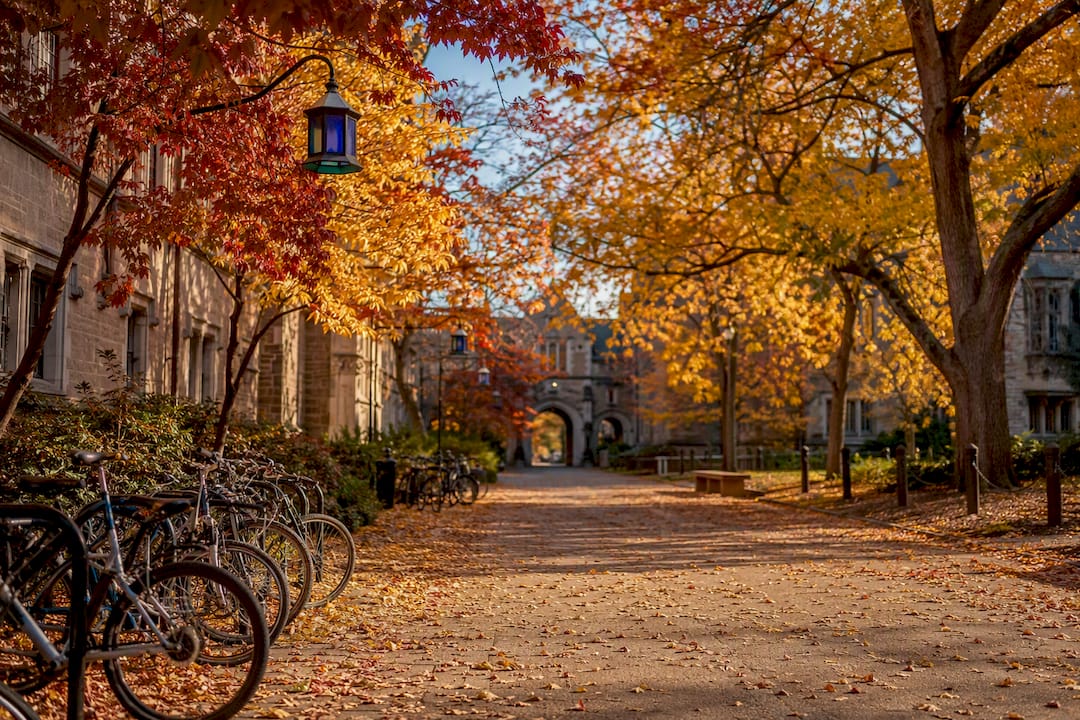
Geographic diversity matters at Davidson partly because the college is smaller than most students expect. A class this size means every accepted student adds a distinct voice, and admissions officers actively look for applicants who bring a perspective the class doesn’t already have in abundance. That includes first-generation college students, students from rural and under-resourced high schools, and international applicants who add a genuinely different lens to campus conversations.
If your student comes from a region or background that’s underrepresented in Davidson’s typical applicant pool, that’s worth naming directly in an essay or additional information section. Admissions officers read context, and a student’s background often explains opportunities taken or missed in ways a transcript alone can’t.
Does Your Intended Major Affect Your Odds at Davidson?
Davidson doesn’t publish separate acceptance rates by intended major, and as a liberal arts college, it doesn’t require students to declare a major before enrolling. That structure works in an applicant’s favor: you’re evaluated as a whole candidate, not slotted into a departmental quota the way you might be at a large research university with capacity-limited programs like engineering or nursing.
That said, some intended interests can help an application stand out if the rest of the file supports it. A student who has taken every science and math course their school offers and writes convincingly about pursuing a specific area of study gives admissions a clearer, more coherent picture than a student who lists an intended major with no supporting evidence in their transcript or activities. Coherence between your stated interest and your actual academic record matters more than which major you pick.
Has Davidson’s Acceptance Rate Changed in Recent Years?
Davidson’s admit rate has tightened over the past several admissions cycles, following a pattern common across selective liberal arts colleges. Application volume has climbed as more students discover Davidson through test-optional policies, expanded outreach, and rising name recognition tied to its academic reputation and Division I athletics profile.
The practical effect for applicants: the rate you see quoted for the current cycle reflects a smaller share of admits than Davidson accepted a decade ago. That trend doesn’t mean the school has become unreachable. It means the applicant pool has gotten more self-selecting, with students applying who’ve researched the school and built a genuine case for fit, rather than adding Davidson to a list of interchangeable reach schools. Families should expect this tightening trend to continue rather than reverse in the next few cycles.
What Happens if You’re Waitlisted at Davidson?
Being waitlisted at Davidson means the admissions committee sees a viable candidate but doesn’t have room to offer a seat outright. Movement off the waitlist depends heavily on how many admitted students accept their offers each spring. In a year with strong yield, few or no waitlisted students get pulled in. In a year where accepted students choose other schools at higher rates, more waitlist offers go out, sometimes as late as summer.
If you land on Davidson’s waitlist, the most useful move is a concise letter of continued interest that adds real new information: an updated grade report, a new achievement, or a clearer statement of why Davidson remains your top choice. Vague reaffirmations of interest rarely move the needle. Specific, updated evidence does. Treat the waitlist as a real possibility, not a soft rejection, and keep your enrollment deposit at another school active while you wait.
Can You Transfer Into Davidson, and How Hard Is It?
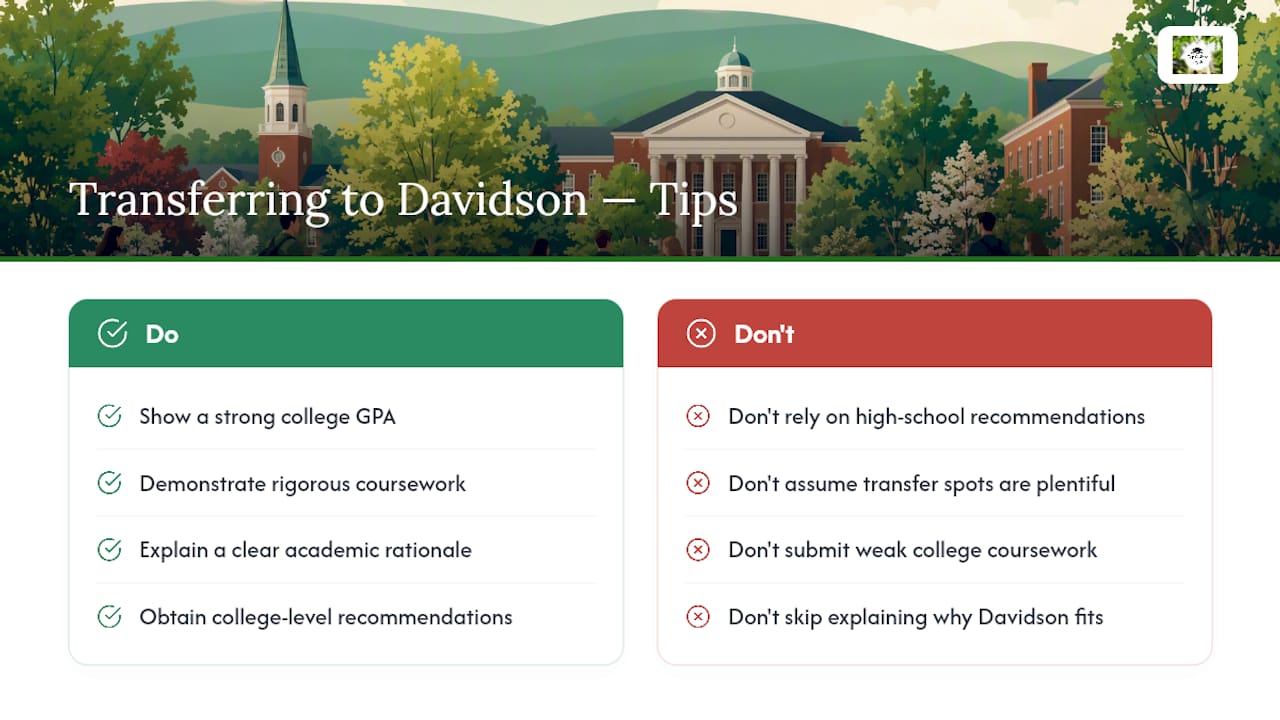
Davidson accepts a limited number of transfer students each year, and the process is considerably more selective than the already competitive first-year pool. Transfer admission depends heavily on college-level grades, the rigor of coursework completed, and how well a student’s academic direction fits Davidson’s curriculum.
Because Davidson enrolls such a small class overall, transfer spots open up mainly when enrolled students leave, study abroad long-term, or take a leave of absence, which keeps the available seats limited from year to year. Strong transfer applicants typically show a college GPA well above average, a clear academic rationale for switching schools, and recommendations from college-level instructors who can speak to classroom performance in a way high school teachers can’t. If transferring is part of your plan, treat the application with the same rigor as a first-year application, essays, recommendations, and a specific reason Davidson fits better than your current school.
How Counselors Read Davidson’s Admissions Data
Raw acceptance rates tell you how hard it is to get in. They don’t tell you how to get in, and that’s the gap counseling closes.
We also help families decide whether to submit test scores at all. A 33 ACT strengthens a borderline transcript; a 26 usually doesn’t help and can hurt. The improvements that move the needle most often aren’t new activities. They’re sharper essays, a recommendation request framed around specific classroom moments, and a senior schedule that shows one more year of rigor instead of an easy finish.
— Randy Pryor
Sources
FAQ
Is Duke or Davidson Harder to Get Into?
Duke’s acceptance rate typically runs lower than Davidson’s, making Duke somewhat harder to get into on raw numbers, though both schools evaluate applicants holistically rather than by test scores or GPA alone.
Is Davidson College a “Mini Ivy”?
Davidson is often grouped with the “mini Ivy” label because of its academic rigor, small class size, and selectivity in the low teens, similar to some Ivy League admit rates, though it’s not an official Ivy League affiliate.
How Difficult Is It to Get Into Davidson College?
Davidson admitted roughly 12.6% to 14.2% of applicants for its most recent class, making it one of the more selective liberal arts colleges in the country.
Is Davidson the Smallest D1 School?
Davidson is one of the smallest Division I schools in the country by undergraduate enrollment, competing athletically against much larger universities while maintaining a small, liberal arts class size.
Recommended
Comments