What Does Enrollment Management Mean for Colleges?
- 19 hours ago
- 8 min read

Enrollment management means the coordinated, campus-wide strategy institutions use to attract, admit, and retain the students who fit their mission, while keeping tuition revenue stable enough to plan for the future. Most practitioners call this discipline strategic enrollment management, or SEM, and it stretches far beyond the admissions office into financial aid, retention, marketing, and data analytics. The Association for Collegiate Registrars and Admissions Officers (AACRAO) and the Society for College and University Planning (SCUP) both treat SEM as an institution-wide function, not a departmental task, and that distinction shapes everything else in this guide.
Here’s what we’ll cover:
The core components that make up a working enrollment management system
Who owns SEM on campus and how governance should work
How to plan on an annual and multi-year cycle
The data and technology that make the strategy measurable
A six-step starter checklist you can act on this term
Key Takeaways
Enrollment management works when institutions align recruitment, financial aid, retention, and analytics under one strategic plan instead of running them as separate departmental efforts.
Point | Details |
Define SEM correctly | Treat enrollment management as strategic and campus-wide, not a synonym for admissions or recruitment marketing. |
Plan on two clocks | Run an annual situational analysis and refresh the full SEM plan every three to five years. |
Fix governance first | Name an executive sponsor and cross-functional team before investing in new technology. |
Prioritize retention | Fund retention interventions with the same seriousness as recruitment, since retaining students costs less than replacing them. |
Start with one pilot | Test a single retention intervention against a matched cohort to build the case for broader investment. |
Table of Contents
What Does Enrollment Management Mean in Practice? The Core Components
Enrollment management functions as a set of interlocking systems, not a single office. Blackbaud describes it as coordinated activity across admissions, financial aid, retention, marketing, and analytics, all aimed at shaping enrollment to meet institutional goals like net revenue, diversity, and graduation rates.
Each component owns a distinct stage of what practitioners call the enrollment funnel:
Marketing and communications generate inquiries, the top of the funnel, through outreach, digital campaigns, and campus visits.
Admissions converts inquiries into applications and applications into admitted students, evaluating fit and readiness.
Financial aid turns admits into enrolled students by pricing the offer correctly. This is where net tuition revenue gets decided, not just where discounts get handed out.
Retention and student success teams keep enrolled students enrolled through graduation, protecting the revenue the other three stages worked to generate.
Analytics sits underneath all four, tracking conversion at each handoff so leaders know where students are being lost.
Financial aid deserves special attention because it functions as a lever, not a formality. A poorly calibrated aid strategy can fill seats while gutting net tuition revenue, while a well-modeled one can hit both enrollment and revenue targets at once.
Statistic to watch: the funnel metrics that matter most are inquiry-to-application conversion, admit-to-enroll yield, and discount rate relative to net tuition revenue. Institutions that track only application volume, without watching yield and discount rate together, routinely misjudge how healthy their pipeline actually is.
Who Owns Enrollment Management? Roles and Organizational Models
Admissions and enrollment management are not the same thing, and confusing the two is one of the most common mistakes campuses make. Admissions is tactical: it recruits and processes applications within a single cycle. Enrollment management, or SEM, is strategic: it sets multi-year goals, aligns departments, and treats admissions as one input among several.
Three organizational models show up most often on campus:
Centralized, where one enrollment division houses admissions, financial aid, and often the registrar under a single VP.
Distributed, where each function reports separately and coordination happens through committees.
Hybrid, where a senior enrollment officer holds strategic authority while operational teams stay in their home departments.
Core roles typically include a VP or director of enrollment management, admissions leadership, the financial aid director, the registrar, academic deans, student affairs staff, and a marketing or analytics lead. AACRAO’s guidance on SEM stresses that success depends on breaking down the silos between these roles, since a campus-wide, data-driven approach only works when every department shares the same data and goals.
Pro Tip: Set a standing enrollment governance meeting, weekly during active recruitment cycles and monthly otherwise, with a named executive sponsor who has authority to reallocate budget. Without that sponsor, strategic priorities quietly lose to whatever tactical fire admissions is fighting that week.
How Should Institutions Plan for Enrollment Management?
SEM planning runs on two clocks at once. SCUP recommends an annual situational analysis paired with a full plan refresh every three to five years, keeping the strategy aligned with shifting demographics, competitor moves, and institutional priorities.
A situational analysis combines two data streams:
Internal data: historical yield by segment, discount rate trends, retention rates by cohort, and program-level capacity.
External data: demographic projections, competitor pricing, regional high school graduation trends, and shifts in student demand by major.
Goal setting has to start from that data, not from aspiration. Practitioners increasingly model three scenarios, conservative, baseline, and aspirational, each tied to a specific financial projection, so leadership can see what each outcome costs and what it funds.
Core KPIs to track against budget and capacity:
Inquiry-to-application and application-to-admit conversion rates
Admit-to-enroll yield, broken out by segment and by aid tier
Net tuition revenue per enrolled student
First-to-second-year retention rate
Tie every one of these to your program capacity, because a strategy that hits enrollment targets while overloading a program’s faculty or facilities isn’t a win. It’s a deferred problem.
What Data and Technology Support Enrollment Management?
Modern SEM depends on systems that talk to each other. A CRM platform is usually the backbone, tracking every inquiry from first contact through enrollment and giving admissions, financial aid, and marketing a shared view of where each prospect stands. AACRAO’s resources on enrollment management point to CRM adoption as central to improving conversion, largely because it replaces scattered spreadsheets with one pipeline everyone can see.
The analytics that matter most run in four categories.
Funnel conversion at each stage, updated often enough to catch a slump before the cycle ends.
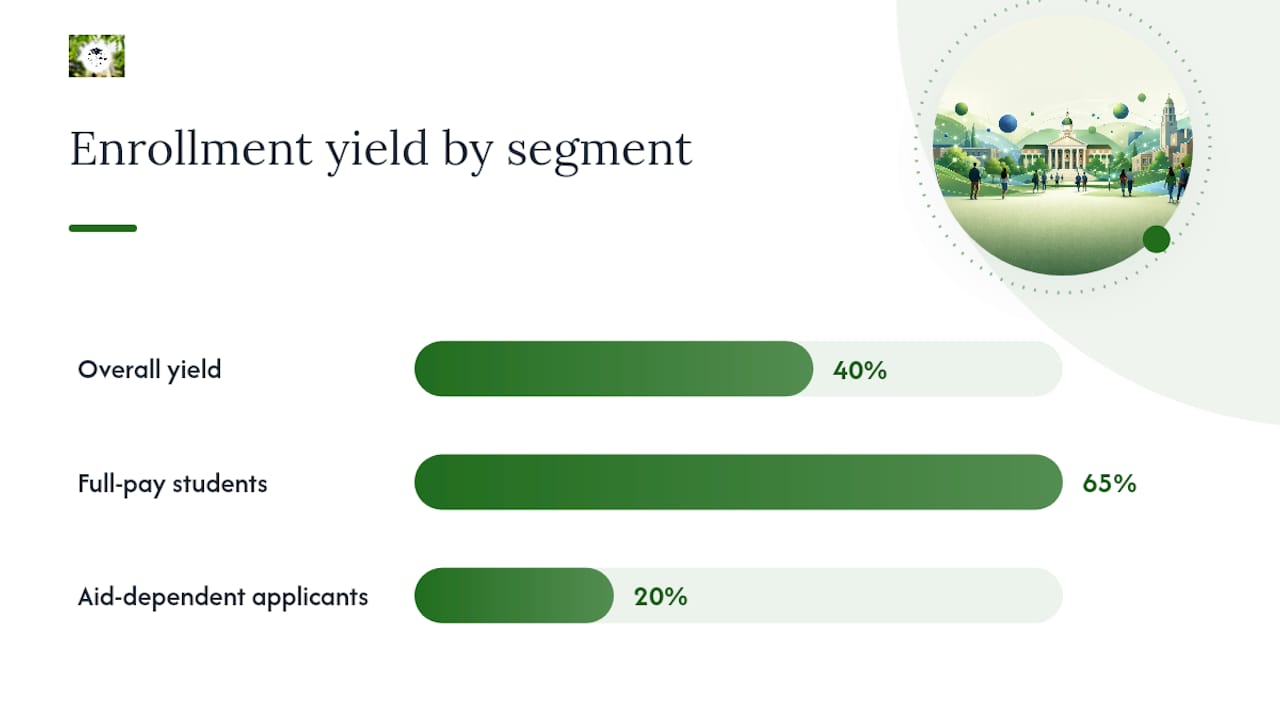
Yield by segment, since a 40% overall yield can hide a 65% yield among full-pay students and a 20% yield among the aid-dependent applicants you actually need.
Financial aid ROI, measuring incremental enrollment generated per aid dollar spent.
Retention early-warning indicators, like course withdrawal patterns or advising no-shows, flagged before a student disengages entirely.
None of this works if admissions, financial aid, advising, and the registrar keep separate, unsynced records. Data governance, clear ownership of which system is the source of truth, and a routine for cleaning duplicate or stale records, is the unglamorous work that makes every dashboard trustworthy. Institutions that skip it end up with three departments reporting three different enrollment numbers in the same meeting.
Why Retention Deserves Equal Billing With Recruitment
Treating enrollment management as a synonym for recruitment is the single biggest strategic error a campus can make. Retaining a current student is consistently less expensive than recruiting a new one, since a returning student requires no marketing spend, no application processing, and no admit-to-enroll conversion effort at all.
Interventions that move the needle include using tools like Semester Flow to support early academic advising and structured onboarding,
Early academic advising check-ins during the first six weeks of a term
Structured first-year onboarding beyond orientation week
Proactive academic support tied to early-warning data, not just end-of-term grades
When retention becomes a strategic priority, it changes how financial aid and marketing get allocated too. Renewal aid packages need the same scrutiny as first-year offers, and marketing budgets should fund current-student engagement, not just prospect acquisition.
Pro Tip: A single retention pilot, one intervention tested against a matched comparison group, can show measurable ROI within one academic year and build the internal case for larger investment.
Where Enrollment Management Strategies Usually Break Down
Most SEM failures trace back to a handful of repeat offenders.
Departmental silos. Admissions, financial aid, and advising operate on separate data and separate goals, so nobody notices a leak until enrollment numbers are already down.
Goals detached from data. Growth targets set by budget pressure rather than by historical yield and market trends set institutions up to miss year after year.
Underfunded analytics. A CRM nobody has time to clean, or a data team of one, means decisions get made on gut feeling dressed up as strategy.
Tactics without a roadmap. Chasing this year’s recruitment fad, without a multi-year plan tying it to capacity and budget, produces enrollment numbers that bounce instead of grow.
Resource planning matters more than most campuses admit going in. Institutions frequently underestimate the staff and operational investment SEM actually requires, then blame the strategy when the real gap was capacity.
A Six-Step Starter Checklist for Enrollment Management
Run a situational analysis. Pull historical yield, discount rate, and retention data, plus regional demographic trends, and involve admissions, financial aid, and the registrar from day one.
Convene governance. Name an executive sponsor and a cross-functional core team with authority to make budget decisions.
Set data-informed targets. Build conservative, baseline, and aspirational scenarios, each tied to a financial projection your CFO has already reviewed.
Map the funnel and assign ownership. Every stage, inquiry through enrollment, needs a named owner accountable for that conversion rate.
Pick one dashboard and clean your data. Resist the urge to overhaul every system at once; get one source of truth working first.
Pilot one retention intervention. Measure it against a comparable cohort so you have real evidence before scaling.
Pro Tip: Start the pilot in step six during a term when advising staff have bandwidth, not during peak recruitment season, so early results don’t get lost in the noise.
A Practitioner’s View: What SEM Looks Like Up Close
Top College Coach works from the student-level end of enrollment management, guiding families through the exact funnel stages institutions are trying to optimize on the other side. Watching thousands of applicants move through that funnel from Orlando, Florida, gives a ground-level view of where institutional strategy actually meets a 17-year-old’s decision.
The strongest signal we see from families is that students choose institutions where the fit feels authentic, not just the ones with the biggest recruitment budget. Financial aid packaging and early, genuine advising contact often decide where a student enrolls just as much as brand name does.
Colleges that treat their applicants the way a good counselor treats a client, with specific, individualized attention rather than mass messaging, tend to see stronger yield among exactly the students they most want to keep.
Why Enrollment Management Gets Misunderstood
Most conversations about enrollment management still collapse it into recruitment marketing, and that’s a mistake with real financial consequences. A campus can pour money into lead generation and applications while its retention rate quietly erodes the class it already spent a fortune recruiting. The data consistently favors retention as the higher-return investment, yet retention rarely gets the same budget line or executive attention that recruitment campaigns do.
The other blind spot is governance. Institutions love to buy a CRM and call it a strategy, but a tool doesn’t fix a silo problem. The campuses that get SEM right are the ones willing to give one person real authority over a cross-functional budget, then hold that person accountable to KPIs the whole cabinet can see. Everything else, the dashboards, the funnel maps, the situational analyses, is infrastructure in service of that one governance decision.
— Randy Pryor
Sources
FAQ
What does enrollment management include?
Enrollment management includes admissions, financial aid strategy, retention and student success programs, marketing and communications, and the data analytics that connect all four to institutional goals.
Is enrollment management the same as admissions?
No. Admissions handles the tactical work of recruiting and processing applicants within a single cycle, while enrollment management is the multi-year, campus-wide strategy that admissions operates within.
What is an enrollment management system?
An enrollment management system typically refers to the combination of a CRM platform, enrollment dashboards, and integrated data pipelines that track prospects from inquiry through graduation across admissions, financial aid, and the registrar.
What is an enrollment process?
The enrollment process is the sequence a student moves through from inquiry to application, admission, financial aid offer, and finally enrollment, with each stage owned by a different institutional function.
Recommended
Comments