Role of Admissions Counselor Explained for Families

An admissions counselor is a college representative who recruits prospective students, evaluates applications, advises families, and supports enrollment efforts from first contact through move-in day. The role of admissions counselor explained simply is this: they are the human face of a university’s admissions process. Understanding what they do, and what they cannot do, gives your family a real advantage. At Top College Coach, we see families misread this relationship constantly, and that misreading costs students opportunities they deserved to win.
What are the primary responsibilities of an admissions counselor?
Admissions counselors carry a wide range of duties that span the entire college application process. Their work falls into four core areas: recruiting, evaluating, advising, and supporting enrollment.
Recruiting prospective students is where the job begins. Counselors travel to high schools, attend college fairs, and host virtual information sessions to build interest in their institution. They are measured, in part, on how many qualified students they bring into the funnel.

Evaluating applications is the next major function. Counselors review application credentials and make initial candidacy assessments before files move to committee review. They are not the final decision-makers, but their early read shapes how an application is framed for senior reviewers.
Advising students and families covers everything from explaining application requirements to walking parents through financial aid timelines. This is where your direct relationship with a counselor pays off. A counselor who knows your student’s name and story will advocate more specifically when the file comes up in committee discussion.
Supporting admitted students through enrollment is the final phase. Counselors provide admitted students with information on completing enrollment steps and refer them to campus services like housing, financial aid offices, and orientation programs.
Recruit students through outreach, campus visits, and regional events
Review applications and make initial candidacy recommendations
Advise families on deadlines, requirements, and financial aid options
Guide admitted students through enrollment paperwork and next steps
Manage communication during decision release periods to convert admits
Pro Tip: When you email an admissions counselor, reference something specific from a campus visit or information session. Counselors remember students who demonstrate genuine, informed interest in their institution.
How do admissions counselors manage territories and relationships?
Every admissions counselor owns a geographic territory. That territory is their recruitment responsibility, and they are accountable for the yield numbers that come out of it.
Travel is a core part of the job
Counselors travel 7–9 weeks in fall and 5–6 weeks in spring, visiting high schools and college fairs across their assigned region. That travel schedule means a counselor covering the Southeast, for example, is physically present at dozens of high schools each year. Students in those schools have a real opportunity to build a face-to-face relationship.
Building high school counselor relationships
University admissions counselors invest heavily in relationships with high school college counselors. Those relationships matter because high school counselors send referrals, share student profiles, and provide context that does not appear on a transcript. A university counselor who trusts a high school counselor’s recommendation will pay closer attention to students from that school.
Using data to refine outreach
Territory management today is data-driven. Counselors use CRM pipelines to track engagement metrics and refine outreach based on yield signals from prior years. If a particular zip code consistently produces enrolled students, that area gets more programming investment. If a high school has never sent a student despite strong demographics, the counselor targets it for a visit.
Here is how a counselor typically manages a recruitment territory across the year:
Summer: Plan fall travel schedule, update CRM with new prospect lists, prepare outreach campaigns
Fall: Travel to high schools and college fairs, host information sessions, collect contact information
Winter: Review applications from territory, make initial candidacy notes, communicate with applicants about deadlines
Spring: Support admitted students through enrollment decisions, attend yield events, analyze territory data for next cycle
For student athletes, the recruiting dynamic adds another layer. Athletic recruiting roles in college admissions involve coordination between admissions counselors and athletic departments, which families should understand when navigating that process.
What is the role of the admissions committee vs. the counselor?
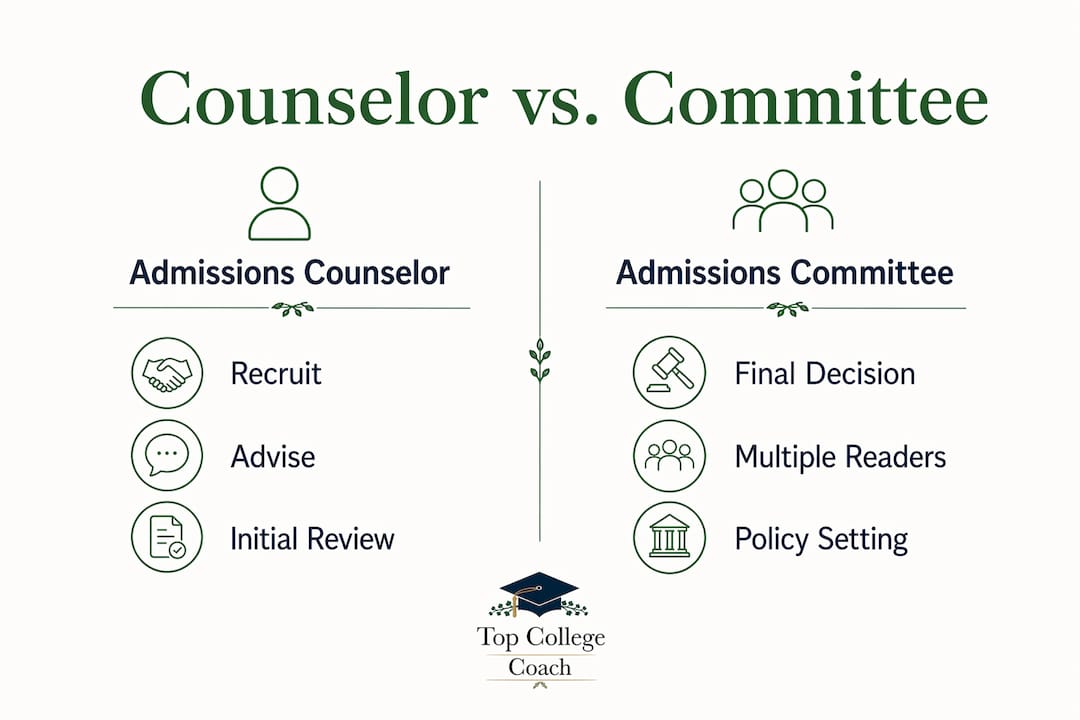
This is the distinction families most often get wrong. The role of admissions committee explained is straightforward: committees make the final accept, reject, or waitlist decisions. Counselors do not make those calls alone.
Applications are reviewed by multiple readers and discussed in committee meetings where senior officers weigh in on borderline cases. The counselor assigned to your territory may be the first reader on your file and may advocate for you in that room, but the final outcome is a collective decision.
Function | Admissions Counselor | Admissions Committee |
First application review | Yes, makes initial candidacy notes | No |
Final admit/deny/waitlist decision | No | Yes |
Student and family advising | Yes, primary contact | No |
Territory recruitment | Yes, owns geographic region | No |
Multi-reader file discussion | Participates as first reader | Leads final deliberation |
Enrollment support post-admission | Yes | No |
Counselors often make initial recommendations for admission candidacy, but the final accept or reject decision is made by committees after multiple reviews. This means your counselor is an advocate, not a gatekeeper. Treating them as a resource rather than an obstacle changes how productively you engage with them.
Families who understand this division stop asking counselors “Will I get in?” and start asking better questions: “What makes a strong application for your program?” and “What should I highlight about my background?” Those questions get real, useful answers.
How does a college admissions counselor differ from a high school counselor?
These two roles share a name but serve completely different purposes. Confusing them leads families to ask the wrong person the wrong questions.
College admissions counselors represent a specific institution and are paid to recruit students to that school. Their loyalty is to their university’s enrollment goals. That does not make them adversarial, but it does mean their advice is filtered through the lens of their institution’s interests.
High school college counselors, by contrast, advise students broadly. Their job is to help you identify the right schools, build a balanced list, write strong essays, and submit competitive applications across multiple institutions. They work for the student, not for any single university.
Here is what each counselor type is best positioned to help with:
College admissions counselor: Application requirements for their specific school, campus culture, financial aid at their institution, enrollment deadlines, and what their admissions committee values
High school counselor: Building a balanced college list, essay strategy, timeline management, recommendation letters, and comparing offers from multiple schools
Independent college counselor (like Top College Coach): Strategic positioning across all target schools, application narrative, Ivy League and top-20 specific guidance, and personalized coaching that no single school’s counselor can provide
The practical takeaway is this: use your college admissions counselor to learn everything about that specific school. Use your high school or independent counselor to build the strategy that gets you there. These roles complement each other when families understand the boundaries.
How can families best engage with admissions counselors?
Effective engagement with an admissions counselor is a skill. Most families either over-rely on counselors for decisions those counselors cannot make, or they ignore counselors entirely and miss a genuine relationship-building opportunity.
Counselor outreach around deadlines and decision releases is carefully timed to maximize enrollment yield. Calls, emails, texts, and admitted student events are all part of that strategy. When a counselor reaches out, responding promptly signals interest and keeps your student visible.
Ask specific questions that counselors can actually answer. “What GPA do I need?” is less useful than “What does a strong application from a student interested in your engineering program typically look like?” The second question invites a real conversation. Counselors appreciate students who have done their homework and come prepared.
Attend every campus visit, virtual information session, and admitted student event you can. These touchpoints build the kind of rapport that matters when a counselor is sitting in a committee meeting and your file comes up. Families should ask counselors about enrollment next steps and support services, not just admission chances. That shift in focus shows maturity and genuine interest.
Pro Tip: After every interaction with an admissions counselor, send a brief, specific follow-up email. Reference what you discussed and one thing you learned. This takes two minutes and keeps your name in their memory without being pushy.
Key takeaways
Admissions counselors recruit, advise, and support enrollment, but final admission decisions rest with the committee, not the counselor alone.
Point | Details |
Counselors recruit and advise | Their primary job is building enrollment pipelines and guiding families through requirements. |
Committees make final decisions | Multiple readers and senior officers decide admits; counselors provide initial recommendations only. |
Territory management is data-driven | Counselors use CRM tools and yield data to prioritize outreach across their geographic region. |
College and high school counselors differ | College counselors represent one school; high school counselors advise students across all options. |
Engagement quality matters | Specific questions, prompt responses, and campus visits build the rapport that supports your application. |
What i have learned after years in college admissions
The most common mistake I see families make is treating the admissions counselor as either an all-powerful gatekeeper or a glorified brochure distributor. Neither view is accurate, and both cost students real opportunities.
In my experience, the families who get the most out of their counselor relationships are the ones who treat counselors as informed allies with real constraints. They ask smart questions. They show up to events. They respond to emails. They do not ask counselors to predict outcomes, because counselors genuinely cannot tell you whether you will be admitted. What they can tell you is what the committee values, what gaps they see in your profile, and what would make your application more competitive. That information is worth more than any prediction.
The other thing I want families to understand is that counselors are managing hundreds of students across a large territory. Your student is one file among thousands. That is not discouraging. It is a reason to be proactive. The students who stand out are the ones who make the counselor’s job easier by being organized, responsive, and genuinely curious about the school. That behavior signals the kind of student a university wants on campus.
Working with an independent admissions counselor through a firm like Top College Coach gives your student a strategic advantage that a university counselor simply cannot provide. We work for your student, not for any institution’s enrollment numbers. That difference in loyalty changes everything about the advice you receive.
— Randy Pryor, College Admissions Counselor at Top College Coach
Get expert admissions guidance from top college coach
Knowing how admissions counselors work is the first step. Knowing how to position your student in front of them is where the real work begins.
Top College Coach specializes in helping students gain admission to Ivy League and top-20 universities, with a proven track record and 5-star reviews from families across the country. Our team provides the kind of personalized admissions strategy that university counselors are not positioned to offer. From application narrative to financial aid timing, we cover every angle. Schedule your free admissions strategy session today and give your student the focused, expert support this process demands.
FAQ
What does an admissions counselor do exactly?
An admissions counselor recruits prospective students, reviews applications, advises families on requirements and financial aid, and supports admitted students through enrollment. They serve as the primary contact between a family and the university throughout the admissions process.
Do admissions counselors decide who gets accepted?
No. Final admission decisions are made by admissions committees after multiple readers review each application. Counselors provide initial candidacy recommendations but do not determine outcomes alone.
How is a college admissions counselor different from a high school counselor?
A college admissions counselor represents one specific university and works to recruit students to that school. A high school counselor advises students across all college options and works in the student’s interest, not any single institution’s.
How should students communicate with admissions counselors?
Students should ask specific, informed questions about the institution, attend campus events and information sessions, and respond promptly to any outreach. Building a genuine, organized relationship with a counselor strengthens your application’s visibility during review.
What is the role of the admissions committee in the process?
The admissions committee reviews files that have been read by multiple evaluators and makes the final accept, reject, or waitlist decisions collectively. This group includes senior admissions officers who weigh institutional priorities alongside individual application strength.
Recommended
Comments