Penn Admission Requirements: 2026 Guide for Students

Penn admission requirements are the specific academic standards, standardized testing mandates, application components, and deadlines that all applicants must meet to be considered for undergraduate enrollment at the University of Pennsylvania. Penn is an Ivy League school, and is one of the most selective universities in the country, with a 5.8% acceptance rate for the Class of 2030. As the parent of a Penn student, it is difficult to explain the opportunities that exist at one of America's oldest universities. Understanding exactly what Penn expects, from GPA and test scores to essays and recommendations, gives you a real advantage before you submit a single word of your application.
What academic standards and standardized tests are required for Penn admission?
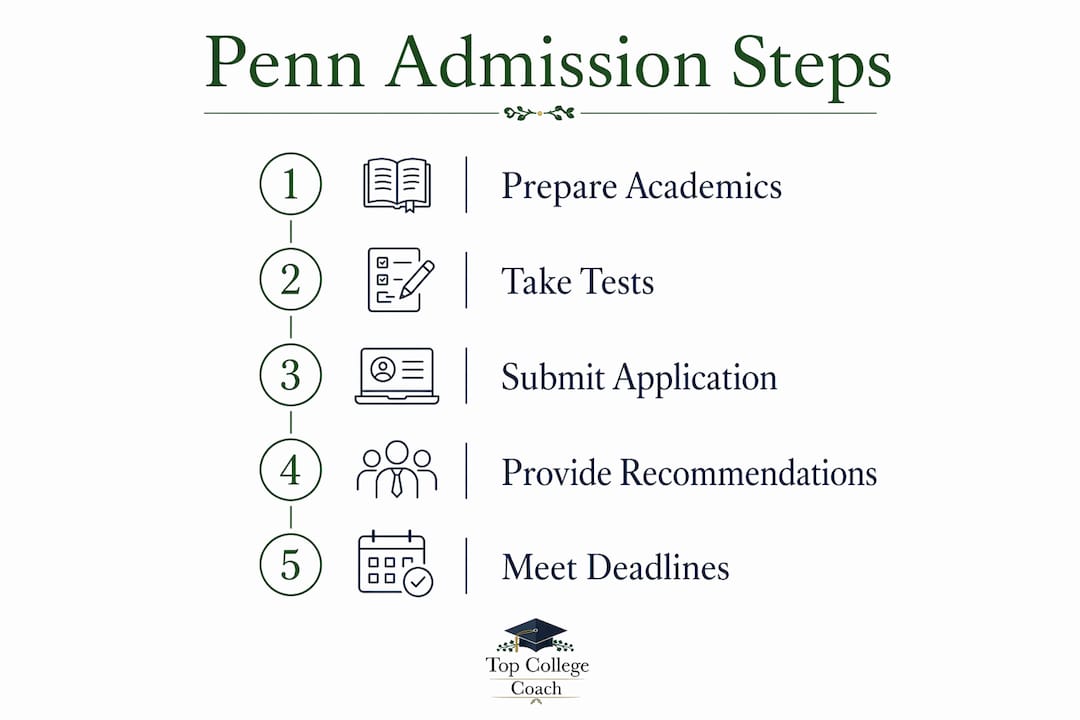
Penn expects applicants to present the strongest academic record possible. Competitive admitted students typically carry a GPA in the 3.8–4.0 range on an unweighted scale, with a course load that reflects consistent rigor. Advanced Placement, International Baccalaureate, and dual enrollment courses all signal that you can handle college-level work.
Starting with the Fall 2026 cycle, Penn reinstated mandatory SAT or ACT testing for all first-year applicants. The test-optional era is over at Penn. Every student must submit scores, and the bar is high.

The middle 50% SAT range for admitted students sits between 1440 and 1550. That means a quarter of admitted students scored above 1550, and a quarter scored below 1440. The ACT equivalent range runs approximately 34–36. Scoring within or above these bands puts you in a competitive position. Scoring below them does not disqualify you, but it raises the bar on every other part of your application.
Specific schools within Penn place extra weight on quantitative ability. Wharton and the School of Engineering and Applied Science look closely at math performance on standardized tests and in coursework. If you are applying to either school, a strong math SAT section or ACT math score is not optional in practice.
Aim for a GPA of 3.8 or higher on an unweighted scale
Take the most rigorous courses your school offers
Target an SAT score of 1500 or above, or an ACT score of 34 or above
Wharton and Engineering applicants should prioritize math performance specifically
Retake tests if your first score falls below the middle 50% range
Pro Tip: Start SAT or ACT preparation no later than the spring of your junior year. That gives you time for at least two full test cycles before Penn’s november deadline.
What are the key application components and deadlines for Penn admission?
Penn accepts both the Common Application and the Coalition Application. Most students use the Common App, but either platform works. The application fee is $75, and fee waivers are available for students who demonstrate financial hardship. You can learn more about qualifying for a waiver in this guide on finding fee waivers.
Every Penn application requires the following documents:
Official high school transcript
Three supplemental essays written specifically for Penn
One counselor recommendation letter
Two teacher recommendation letters
SAT or ACT scores (mandatory for Fall 2026)
Application fee or approved fee waiver
Penn’s supplemental essays are not generic. They ask you to reflect on why you chose your specific school within Penn and what you plan to contribute. Admissions officers read these closely. A vague or recycled essay signals low interest. Strong essays signal fit, and fit matters at Penn. Read this guide on why essays matter to understand how much weight they carry.
Penn offers two application rounds with distinct deadlines:
Early Decision (ED): Applications due November 1. Notifications arrive mid-December. ED is binding, meaning you commit to attend if admitted.
Regular Decision (RD): Applications due January 5. Notifications arrive late march.
Enrollment reply deadline: May 1 for all admitted students.
Pro Tip: Alert your counselor and teachers about your Penn application by September of your senior year. Recommendation writers need time to craft strong, specific letters. Giving them six to eight weeks minimum is the standard.
The Early Decision acceptance rate runs approximately 12–16%, compared to roughly 4–5% for Regular Decision. That gap is significant. If Penn is your clear first choice, applying ED is the single most impactful strategic decision you can make. Review the full UPenn deadlines guide for a complete timeline.
How do specialized programs affect Penn admission requirements?
Penn houses four undergraduate schools: the College of Arts and Sciences, the Wharton School, the School of Engineering and Applied Science, and the School of Nursing. Each school has its own application focus, and you apply directly to one of them. Choosing the right school for your goals is part of the application itself.
Penn also offers coordinated dual-degree programs that combine two schools into one undergraduate experience. The most well-known is the Jerome Fisher Program in Management and Technology, called M&T, which combines Wharton and Engineering. The Huntsman Program in International Studies and Business combines Wharton and the College. These programs are among the most selective undergraduate tracks in the country.
Coordinated dual-degree programs admit at rates between 7% and 12%, which sounds higher than Penn’s overall rate but reflects a smaller, more targeted applicant pool. Applicants to these programs go through a separate admissions evaluation and must submit additional supplemental essays specific to the program. The bar for demonstrated preparation is higher. Reviewers want to see that you have already developed relevant skills and interests, not just an interest in prestige.
Key points for dual-degree applicants:
Submit all program-specific supplemental essays with care and specificity
Demonstrate concrete preparation in both fields the program covers
Understand that being denied from a dual-degree program does not automatically deny you from Penn’s general pool
Research the program’s curriculum and reference specific courses or faculty in your essays
If you are unsure whether a dual-degree program fits your goals, applying to a single school within Penn and pursuing cross-registration later is a legitimate path. Applying to M&T or Huntsman because they sound impressive, without genuine preparation, is a common mistake that hurts otherwise strong applications.
What recent admissions trends are shaping Penn’s applicant pool?
Penn received 61,264 applications for the Class of 2030. That number represents a 15.5% drop from the prior year’s pool of approximately 72,544 applicants. A smaller pool, combined with a stable class size, pushed the acceptance rate from 4.9% to 5.8%. Penn is still extraordinarily selective, but the slight uptick in acceptance rate reflects real math, not a loosening of standards.
The 2023 Supreme Court ruling ended race-conscious admissions at Penn and all other universities. The Class of 2030 includes approximately 23–24% students from underrepresented minority backgrounds, a figure that has declined slightly since the ruling. Penn has stated a continued commitment to access and diversity, but the legal framework for how it pursues those goals has changed.
“Penn’s reinstatement of mandatory testing signals a broader shift among elite universities toward quantifiable academic benchmarks, even as holistic review remains central to the process.”
Legacy students make up 13.1% of Penn’s enrollment. That figure reflects the ongoing role of institutional relationships in admissions, though Penn, like other Ivies, faces growing scrutiny over legacy preferences. For most applicants, the path forward runs through academic excellence and a compelling personal narrative, not family connections.
What strategic tips can improve your chances of meeting Penn’s standards?
The strongest Penn applicants treat the application as a year-long project, not a fall-semester sprint. Preparation that starts in 10th or 11th grade produces better outcomes than cramming in senior year.
Build your GPA consistently across all four years. A strong senior year after a weak sophomore year raises questions.
Take the SAT or ACT at least twice. Most students improve on their second attempt.
Write your Penn supplemental essays from scratch. Do not adapt essays written for other schools.
Ask recommenders who know your academic work specifically, not just your character generally.
Apply Early Decision if Penn is your top choice. The ED advantage is real and well-documented.
Use the Common Application essay to tell a story that no other part of your application tells. Read this Common App essay guide for practical direction.
Pro Tip: The most common mistake we see is a Penn supplemental essay that could have been written for any Ivy League school. Name specific Penn programs, professors, or initiatives. Generic enthusiasm does not move admissions officers.
Strong recommendations require preparation too. Your counselor needs to know your story well enough to advocate for you specifically. Share your activities list, your goals, and your Penn interest with your counselor early. This guide on the counselor recommendation letter explains exactly what a strong letter includes.
Key Takeaways
Penn admission requirements demand academic excellence, strong test scores, and a carefully constructed application across every component.
Point | Details |
Mandatory testing reinstated | All Fall 2026 applicants must submit SAT or ACT scores; the middle 50% SAT range is 1440–1550. |
Early Decision advantage | ED acceptance rates run 12–16%, compared to 4–5% for Regular Decision. |
Three essays required | Penn’s supplemental essays must be school-specific and written from scratch. |
Dual-degree programs are more selective | M&T and Huntsman admit at 7–12% and require separate essays and demonstrated preparation. |
Application pool shrank in 2026 | Penn received 61,264 applications, down 15.5% from the prior year, pushing the acceptance rate to 5.8%. |
What I’ve learned after years of watching students apply to Penn
Penn is not looking for the student who did everything. Penn is looking for the student who did something with real depth and can explain why. That distinction sounds simple, but it changes how you should build your entire application.
The reinstatement of mandatory testing is a signal worth taking seriously. Penn is telling you that numbers matter again. A 1380 SAT with a compelling story used to have a path. That path is narrower now. Students who have been coasting on the hope that test scores would not count need to recalibrate immediately.
What I find most encouraging about Penn’s process is that the holistic review is genuine. A student from a small rural high school with a 3.9 GPA, a 1490 SAT, and a deeply specific passion for urban planning has a real shot. Penn’s admissions team reads files carefully. The students who get in are not always the ones with the most credentials. They are the ones whose applications feel coherent and authentic.
The biggest mistake I see families make is treating Penn as a reach school to throw an application at. Penn deserves a targeted, deliberate application. If you are not willing to write school-specific essays and research specific programs, your application will read like it belongs somewhere else. Admissions officers notice that immediately.
Apply with intention. Know why Penn specifically, not just why an Ivy League school. That clarity comes through in every sentence you write.
— Randy Pryor, Founder of Top College Coach
How Top College Coach can help you meet Penn’s standards
Applying to Penn without a clear plan is the fastest way to leave your chances to luck. Top College Coach works with students and families to build applications that reflect genuine preparation, authentic stories, and strategic timing.

From test preparation strategy and essay development to recommendation coaching and deadline management, our team has guided students into Penn and other Ivy League schools with a track record that speaks for itself. We know what Penn’s admissions team looks for, and we help you present your strongest self across every component. If you are ready to approach Penn’s application with the seriousness it deserves, book a free strategy session with Top College Coach today. You can also explore our full range of Ivy League admissions support to see how we work with students at every stage.
FAQ
What GPA do you need for Penn admission?
Competitive Penn applicants typically present a GPA of 3.8 or higher on an unweighted scale. Penn evaluates GPA alongside course rigor, so a 3.9 in standard courses is less competitive than a 3.8 in the most demanding curriculum your school offers.
Is the SAT or ACT required for Penn in 2026?
Yes. Penn reinstated mandatory standardized testing for all first-year applicants starting Fall 2026. The middle 50% SAT range for admitted students is 1440–1550, with an ACT equivalent of approximately 34–36.
When is the Penn Early Decision deadline?
The Early Decision deadline is november 1, with notifications arriving mid-december. Early Decision is binding and carries a significantly higher acceptance rate of approximately 12–16% compared to Regular Decision.
What essays does Penn require?
Penn requires three supplemental essays in addition to the Common Application or Coalition Application personal statement. Each essay should be written specifically for Penn and reference your chosen school or program within the university.
How selective are Penn’s dual-degree programs?
Penn’s coordinated dual-degree programs, including M&T and Huntsman, admit students at rates between 7% and 12%. They require separate supplemental essays and evaluate applicants on demonstrated preparation in both fields the program covers.
Recommended
Comments