U.S. Applicant Families: Why $95,000 Plus Private Colleges Mislead on Cost

Pepperdine University, Pepperdine University, Harvey Mudd College, the University of Chicago, Stanford, and Columbia currently post some of the highest total costs of attendance among U.S. private colleges, with several topping $95,000 a year. That number rarely reflects what a family actually pays. Need-based aid, merit scholarships, and institutional endowments routinely cut the real cost by tens of thousands of dollars, which is why every serious applicant family should run a net price calculator before crossing a school off the list for cost alone. We break down the numbers, the methodology behind them, and what they actually mean for your application strategy below.
TL;DR:
Families should run each school’s net price calculator to determine actual affordability, as high sticker prices often underestimate the aid that can reduce costs.
The most expensive private colleges are located mainly in expensive metro areas, with costs driven by regional housing, facilities, and support services, not prestige alone.
Schools like Harvard, Stanford, MIT, and Columbia can significantly lower net costs through generous aid policies, even with high sticker prices.
Cost differences among top private schools are largely regional, meaning families in lower-cost areas may find comparable programs more affordable elsewhere.
Table of Contents
Which Are the Most Expensive Private Schools in the World?
Ranking the priciest private colleges by total cost of attendance produces a list dominated by small liberal arts colleges with high room-and-board assumptions and elite research universities in expensive coastal cities. The list below reflects reported total cost of attendance, which bundles tuition, fees, housing, meals, and estimated personal expenses for a typical on-campus undergraduate.
Several of these figures come from the schools’ own published cost pages, others from aggregated cost-of-attendance data compiled by CollegeData. All reflect the 2024 through 2026 reporting window.
Harvey Mudd College: Total cost of attendance near $102,312, driven by Southern California housing costs and a science-heavy curriculum with expensive lab and equipment fees. Harvey Mudd meets full demonstrated need for admitted students, so the net price for middle-income families often lands far below sticker.
Pepperdine University: Frequently cited among the highest-COA private universities nationally, with cost estimates exceeding $98,000 once Malibu housing and campus fees are factored in, according to aggregated cost comparisons. Pepperdine’s aid budget is smaller than an Ivy League endowment school’s, so sticker price tends to track closer to actual cost for non-aid families.
University of Chicago: Total cost sits in the high $90,000s, reflecting Hyde Park housing costs and the university’s core curriculum, which often requires five years of coursework for double majors. Chicago has expanded need-based aid significantly in recent years, narrowing the gap between sticker and net price for many admitted students.
Stanford University: Total cost of attendance runs close to $95,000, with Silicon Valley cost-of-living assumptions baked into housing and personal expense estimates. Stanford’s endowment allows it to offer free tuition to families earning below a set income threshold, making net price dramatically lower than sticker for a large share of admits.
Columbia University: New York City living costs push Columbia’s total cost near $95,000 annually. Columbia meets full demonstrated financial need for all undergraduates, and its aid packages are typically loan-free for the highest-need families.
California Institute of Technology (Caltech): A smaller student body and intensive STEM facilities keep Caltech’s cost of attendance in a similar range to its Ivy peers. Caltech’s endowment per student is among the largest in the country, which typically produces generous aid offers for qualified applicants.
Harvard University: Sticker price sits in the low-to-mid $90,000s, but Harvard’s aid policy covers full cost for families earning below a set income band and caps contributions well below sticker for a wide income range above that.
Massachusetts Institute of Technology (MIT): MIT’s total cost tracks closely with Harvard’s, and its aid policy similarly eliminates tuition costs for a large share of domestic applicants based on family income.
Cornell University: As an Ivy League school with several state-supported colleges alongside its endowed colleges, Cornell’s sticker price varies by program, but its endowed colleges post costs in the low $90,000s, per CollegeData.
Duke University: Duke’s total cost of attendance lands in a comparable range to Cornell’s, with need-blind admission for domestic applicants and aid packages designed to meet full demonstrated need.
For selective-applicant families, the pattern matters more than any single number: the schools with the deepest endowments (Harvard, Stanford, MIT, Columbia) tend to have the widest gap between sticker price and what a typical admitted family actually pays.
How Do Colleges Calculate Cost of Attendance?
Cost of attendance, or COA, is a federally defined figure that every college must publish, and it includes more than tuition. The core components are tuition and required fees, on-campus room and board, and an estimate of indirect costs like books, transportation, and personal expenses. Some schools also fold in mandatory health insurance if students aren’t covered under a family plan.

CollegeData explains that COA figures are meant to represent a full academic year for a typical student living on campus, which is why the numbers above assume dormitory housing and a standard meal plan rather than off-campus living, which can run cheaper or more expensive depending on the local market.
The figures in this article reflect institution-reported data and aggregated cost comparisons from the 2024 through 2026 academic years. Where a school’s own cost of attendance page and a third-party aggregator showed slightly different numbers, we prioritized the institution’s own published figure. Costs for commuter students, students studying abroad, or those in specialized programs (medicine, certain engineering tracks) can differ from the standard on-campus estimate used here.
Why Does Sticker Price Differ From Net Price?
Sticker price is the advertised cost. Net price is what a family actually pays after subtracting grants, scholarships, and other aid that doesn’t need to be repaid. The gap between the two can be enormous at wealthy private colleges, and it’s the single most misunderstood number in college admissions.
The U.S. Government Accountability Office found that roughly 91% of colleges provide financial aid offers that are unclear or incomplete, often omitting the total cost of attendance, failing to distinguish grants from loans, or leaving out key fees entirely. That opacity is precisely why families can’t just compare award letters side by side and assume they’re comparing apples to apples.
NCES data show average net price at private nonprofit four-year institutions runs substantially below the sticker prices posted by the schools on this list, reflecting how much aid actually flows at the sector level. A school with a $95,000 sticker price and a strong endowment can end up cheaper for a middle-income family than a $45,000-sticker school with a thin aid budget. Wealthy schools that meet full demonstrated need, as Brookings has noted in its analysis of college endowment policy, often turn out more affordable than their sticker price suggests, which is exactly why high cost alone should never eliminate a school from consideration.
What Steps Should Parents Take to Estimate Net Price?
Every college is required to post a net price calculator, and using it before applying is the single most useful thing a family can do to turn a scary sticker price into a real number. BigFuture’s guidance walks through the process: enter household income, assets, and family size, and the calculator returns an estimated grant aid figure specific to that school.
From there, the math is straightforward. Add direct costs (tuition, fees, housing, meals) to indirect costs (books, travel, personal expenses) to get total cost of attendance. Subtract any grants or scholarships that don’t need to be repaid. What’s left is the net price. The GAO’s research on opaque financial aid offers recommends treating loans and work-study separately from grant aid in this calculation, since colleges sometimes present “self-help” aid in a way that makes a package look more generous than it is.
Families should also compare net price across a range of schools rather than treating any single offer in isolation, and understanding how tuition discount rates work helps explain why two schools with similar sticker prices can produce very different aid outcomes. Running these numbers before applying, not after admission, keeps a family from falling in love with a school it can’t actually afford, or ruling one out that would have been within reach.
How Do These Costs Compare to Average College Costs?
The ten schools above sit far above the national average. NCES data on the average cost of attending an undergraduate institution shows the typical private nonprofit four-year college charges tens of thousands less than $95,000 a year in total cost. Public four-year in-state costs sit even lower.
That gap exists for a reason. The schools on this list cluster in expensive metro areas (New York, Boston, the Bay Area, Los Angeles) where housing and food costs alone push up the room-and-board line item well beyond what a college in a smaller city would report. Add small student-to-faculty ratios, specialized science facilities, and deep support services, and the sticker price climbs further.
The comparison that matters most for applicant families isn’t sticker price against the national average. It’s net price against the national average. A family qualifying for a full-need aid package at Harvard or Stanford can end up paying less than the average net price at a mid-tier private college with a smaller endowment. Sticker price tells you what a school costs on paper. It says almost nothing about what a specific family will actually owe, which is why the national average figure works better as a benchmark for typical aid outcomes than as a warning label on any one school.
What Actually Drives These Schools’ High Costs?
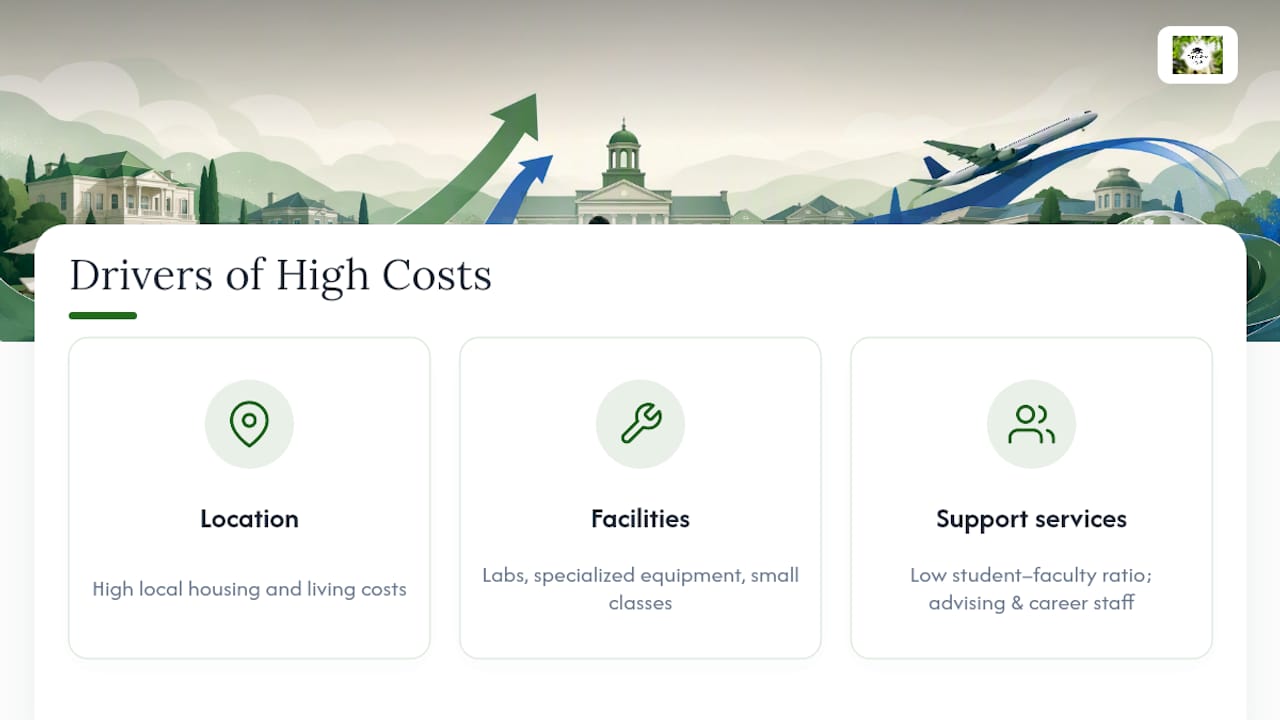
Three factors explain most of the cost gap between these schools and the typical American college: location, facilities, and the depth of support services layered into the student experience.
Location does the heaviest lifting. Stanford, Caltech, and Pepperdine sit in some of the most expensive real estate markets in the country, and Columbia’s Manhattan campus faces housing costs that dwarf almost anywhere else in American higher education. Room and board estimates in these COA figures aren’t padding. They reflect what it genuinely costs to house and feed a student in these zip codes.
Facilities and program intensity add another layer. Harvey Mudd’s science-focused curriculum requires lab space, specialized equipment, and small class sizes that cost far more per student than a typical lecture-based program. MIT and Caltech carry similar cost structures, built around research facilities that few institutions can match.
Reputation plays a role too, though less directly than most people assume. These schools don’t charge more because they’re prestigious. They charge more because prestige tends to correlate with the very things that raise costs: low student-to-faculty ratios, extensive advising and mental health resources, and career services staffed well beyond what a tuition-dependent college could afford. The prestige is a byproduct of the investment, not the reason for the price tag.
Where Are These High-Cost Schools Located?
Every school on this list operates in the United States, and the geographic clustering is not a coincidence. Six of the ten (Columbia, Cornell, Stanford, Caltech, Harvard, MIT) sit in one of three metro corridors: the Northeast urban belt, the San Francisco Bay Area, or greater Boston. Pepperdine and Harvey Mudd add Southern California to that list, while Duke and Chicago represent the two major cost outliers outside the coasts, each still carrying urban cost pressures from Durham and Hyde Park real estate markets.
This concentration matters for a practical reason: it tells you the cost driver is largely regional cost of living, not some universal feature of elite private education. A student weighing a high-COA coastal school against a strong private college in a lower-cost region (the Midwest, the South outside major cities) should expect a meaningfully lower room-and-board line item at the latter, even when tuition itself is comparable.
It also explains why international comparisons rarely appear on lists like this one. American higher education’s combination of high published tuition and geographically concentrated elite institutions produces cost structures that most other countries’ university systems don’t replicate at the undergraduate level, since public funding models elsewhere keep sticker prices lower across the board.
How Selective Are These Schools Relative to Their Cost?
Every school on this list admits a small fraction of applicants, and there’s no meaningful relationship between how much a school costs and how easy it is to get in. If anything, the correlation runs the other way: the highest-COA schools here, Harvard, MIT, Stanford, Columbia, Caltech, are also among the hardest schools in the country to gain admission to, with acceptance rates in the single digits most cycles.
That combination, sky-high cost and sky-high selectivity, creates a specific kind of pressure for applicant families. Parents sometimes assume a school’s price tag signals how competitive it is, expecting cheaper options to be easier admits. That assumption breaks down fast once you look at the data. Duke and Cornell, for example, carry costs in line with their Ivy peers but historically post somewhat higher acceptance rates than Harvard or Columbia, while Harvey Mudd’s small size makes its admission rate deceptively tight despite a less household-famous name.
The practical takeaway for families building a college list: cost and selectivity are two separate filters, not one. A school being expensive tells you nothing about your child’s odds of admission. Build your list around fit, academic trajectory, and authentic story first, then run the net price numbers separately for whichever schools make the cut on merit.
Is the Investment Worth It Long-Term?
Return on investment from an elite private education shows up less in starting salary and more in access, networks, and optionality over a career’s span. Graduates of the schools on this list disproportionately populate leadership roles across law, medicine, technology, and finance, though isolating the school’s specific contribution from the caliber of student it admits in the first place is genuinely difficult.
What’s clearer is the aid math working in favor of long-term value at the wealthiest institutions. A family paying near-zero net price at Harvard or Stanford because of a full-need aid package is getting elite outcomes without elite debt, which is about as strong a return profile as higher education offers. The risk shows up at schools with high sticker prices and thinner aid budgets, where a family that doesn’t qualify for substantial aid can end up financing $300,000 or more in undergraduate education. In those cases, the long-term value calculation depends heavily on major, career path, and how much of that cost gets covered by loans versus family savings.
The honest answer is that value isn’t fixed. It’s a function of what a specific family actually pays, not what the school charges everyone else.
What This Ranking Gets Wrong (and Right) About College Cost
Rankings like this one are useful and dangerous in equal measure. Useful, because families need a realistic sense of what these institutions cost before they build a list or start budgeting. Dangerous, because a sticker-price ranking, taken at face value, systematically overstates cost at exactly the schools where families are least likely to pay full price.
The conventional advice, “check the sticker price, then check your budget,” has the order backward. The number that actually predicts affordability is net price at your specific income level, not the published cost of attendance. I’d go further: sticker price is close to useless as a planning tool for any family that hasn’t yet run the net price calculator at each school on their list, because the schools with the highest stickers here (Harvard, Stanford, Columbia, MIT) are frequently the ones where a qualifying family pays the least.
What the data supports is a two-track approach. Build the college list on fit and admissibility first. Only then layer in net price, school by school, using each institution’s own calculator rather than assumptions based on the sticker. Families who skip that second step end up either scared away from schools that would have been affordable, or blindsided by ones that weren’t.
— Randy Pryor
How Top College Coach Helps Families Navigate High-Cost Schools
Once you’ve run the net price numbers, the harder question is strategy: which of these schools actually fits your child’s academic profile, and how do you build an application strong enough to compete for the aid packages that make a $95,000 sticker price irrelevant?
Top College Coach is built around exactly that problem. Every student works directly with the lead admissions counselor, not a rotating junior staffer, and gets mentoring from current Ivy League students who’ve been through the same aid and admissions calculus firsthand. Personalized college admissions counseling covers everything from building a realistic college list that balances high-cost dream schools against strong-fit alternatives, to essay coaching and interview prep that helps your child stand out at schools where a single-digit acceptance rate leaves no room for a generic application. Early High School Planning and Junior Year Preparation get students positioned years before decisions are due, while The College List and The Application & Beyond carry families through submission and final decisions with application review from former admissions officers. Visit Top College Coach to see current packages and start a conversation about your child’s list.
Sources
FAQ
What Is the Most Expensive Private College in the World?
Among widely reported figures, Pepperdine University posts one of the highest total costs of attendance at roughly $102,312 a year. Harvey Mudd College, the University of Chicago, Stanford, and Columbia follow closely behind in the high $90,000s.
Does a High Sticker Price Mean I Can’t Afford the School?
Not necessarily. Schools with the largest endowments, including Harvard, Stanford, MIT, and Columbia, often meet full demonstrated financial need, so many families pay far less than the published cost after using each school’s net price calculator.
How Do I Calculate What I’ll Actually Pay?
Add a school’s direct costs (tuition, fees, housing, meals) to indirect costs (books, travel, personal expenses) to get total cost of attendance, then subtract grants and scholarships that don’t require repayment. The College Board’s BigFuture tool walks through this calculation school by school.
Why Do Financial Aid Offers Feel Confusing?
The U.S. GAO found that about 91% of colleges send financial aid offers that omit key details, like total cost or a clear breakdown of grants versus loans. That’s why comparing net price calculator estimates directly, rather than relying solely on award letters, gives families a clearer picture.
Can Top College Coach Help Me Choose Between High-Cost Schools?
Yes. Top College Coach’s College List service helps families weigh high-COA schools against strong-fit alternatives based on admissibility and likely aid outcomes, not sticker price alone. Current package pricing is available directly on the site.
Recommended
Comments