300 Word Rule for Common App Additional Information (First Year)

The Additional Information section is optional, and most applicants should treat it that way: use it only when a short factual explanation or a genuine activity overflow will change how an admissions reader interprets the rest of your application. The three legitimate uses are brief context on a specific circumstance, overflow from an activity or honor you couldn’t fully describe elsewhere, and quick academic clarification. First-year applicants now have just 300 words to work with, and a blank box has never hurt an applicant.
TL;DR:
Most students should leave the Additional Information section blank unless they need to clarify a specific circumstance or provide activity overflow context.
This section is limited to 300 words for first-year applicants and 1,500 characters for transfers, encouraging concise and targeted explanations.
It should be used only for factual, non-repetitive details that impact how an admissions officer interprets your application, not for general reflections or excuses.
Typical entries include explaining unusual grading scales, brief academic disruptions, or clarifying activities that exceeded the character limit on the Activities List.
Avoid filling this section with redundant information, emotional explanations, or links, as most admitted students leave it empty without penalty.
Table of Contents
What Is the Common App Additional Information Section?
The Additional Information box sits inside the Essay & More section of the Common App, right after your personal statement. It is the last stop before you submit, which is exactly why so many students misuse it. After spending months on your main essay, it’s tempting to treat this box as one more chance to make your case. Resist that instinct.
For first-year applicants, Common App shortened the box from 650 words to 300 words starting with the 2025–26 admissions cycle. Transfer applicants work within a separate limit of 1,500 characters, which is a meaningfully different constraint and worth noting if you’re advising a student who might transfer later or who is applying as a transfer now.
Common App made this change for a clear reason: the longer box invited padding, and admissions officers were seeing a second personal statement instead of a targeted clarification. A shorter box forces better decisions about what actually needs to be said.
Here’s what governs the section:
Location: Essay & More tab, directly after the personal essay, visible to every college on your list.
First-year limit: 300 words, effective for the 2025–26 cycle.
Transfer limit: 1,500 characters, a distinct and separate cap.
Status: Completely optional. Leaving it blank does not count against you.
Visibility: Every school receiving your application sees whatever you enter here, so keep it school-neutral.
That last point matters more than students realize. Unlike supplemental essays, you can’t customize this box per college. Write it once, and write it so it reads clearly no matter which admissions office opens the file.
Additional Information vs. Challenges and Circumstances vs. Activities List
Common App gives you three separate places to add context, and mixing them up is one of the most common mistakes we see. Each has a distinct job.
Challenges and Circumstances is for documented, often ongoing hardships (homelessness, family caregiving responsibilities, a natural disaster) that Common App flags through its own dedicated question. If you’re answering yes to that prompt already, don’t repeat the same story in Additional Information.
Additional Information is for short, factual context that doesn’t fit anywhere else: a semester interrupted by illness, an unusual grading scale, a research project that outgrew its Activities List entry.
Activities List is for structured achievement data: what you did, your role, and the time commitment. If something can be described in that format, it belongs there first.
A useful rule of thumb: ask whether the fact you want to share changes how an admissions reader interprets your transcript or activity record. A single B in tenth grade doesn’t. A semester where your GPA dropped because your family relocated twice does.
Run through this quick decision flow while you edit:
Does Common App have a dedicated field for this already (Challenges and Circumstances, Activities List, Honors)? If yes, use that field first.
Can the fact fit inside an Activities List description with a short addition? If yes, keep it there and skip Additional Information entirely.
Does the fact need more room than 150 characters allow, and would an admissions reader misread your record without it? If yes, that’s a legitimate Additional Information entry.
Is this simply restating strengths already visible in your essay or resume? If yes, cut it. Repetition wastes the reader’s time and your limited word count.
Coalition for College’s guidance puts it plainly: use this section when part of your story isn’t reflected elsewhere or needs more depth than another field allows. Anything that already has a home doesn’t need a second one.
What Belongs in the Box (and How to Present It)
Four categories cover almost every legitimate use of this section.
Activity overflow. If you held a role that evolved over multiple years, or a research project that shifted focus midway through, the Activities List character limit often can’t capture it. A short Additional Information entry that names the project and clarifies your actual contribution helps a reader who’s trying to figure out what you really did versus what a generic club title suggests.
Academic context. If your school uses an unusual grading scale, offers a limited number of AP or IB courses, or placed you in a nontraditional track (dual enrollment, early graduation, homeschool curriculum), a few sentences here prevent a reader from misjudging your transcript. This is especially useful if your school profile, which counselors submit separately, doesn’t fully explain the situation.
Short personal context. A brief, factual note about something that affected your semester (a move, an illness, a family change) can help. The key word is brief. If the situation is severe or ongoing, it likely belongs in Challenges and Circumstances instead, where Common App expects more detail. Keep personal disclosures factual and avoid unnecessary medical specifics unless the diagnosis itself is directly relevant to understanding a grade or gap.
Portfolio and link guidance. Some students want to point to outside work: a coding project, a published article, a design portfolio. A link can help, but only when the college’s own supplements don’t already provide a place for it, and only when the material adds something your Activities List can’t. If you include a link, use one line: what it is, what it shows, and nothing more. Don’t caption it like a museum exhibit.
Here’s what does not belong in this box:
A second personal statement retelling your values or dreams in different words.
An excuse for one low grade in an otherwise strong transcript.
Achievements or awards already listed in the Activities or Honors sections.
Links to social media profiles, general portfolios with no direct relevance, or anything requiring a password or login.
Anything defensive in tone, explaining why a weakness “isn’t really a weakness.”
Common App’s own framing around the 2025–26 change makes the intent clear: this box exists for clarification, not elaboration.
How to Write It: Structure, Tone, and Editing
A tight, three-part structure works for almost every entry: context, fact, outcome. State what happened, give the concrete detail an admissions reader needs, and close with where things stand now. Skip the narrative arc you’d use in a personal essay. This isn’t the place for a hook or a reflective ending.
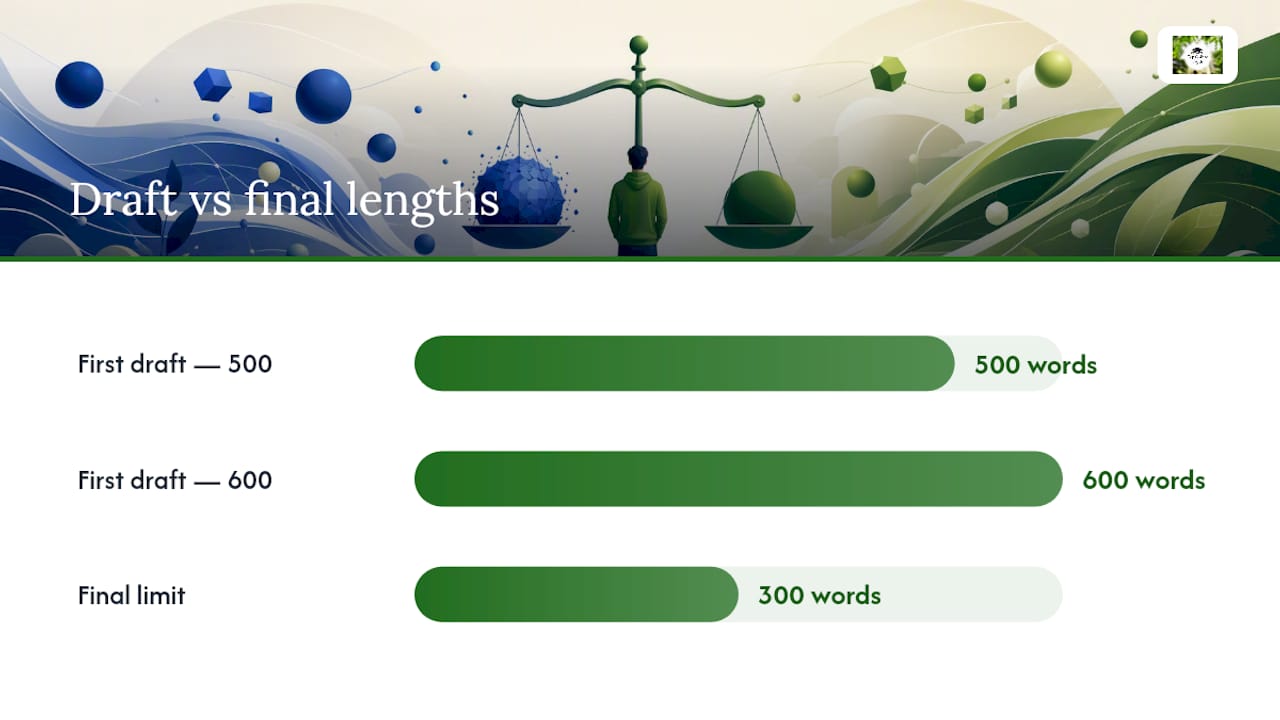
Draft first without a word limit. Write out everything you think matters, even at 500 or 600 words. You’ll cut it down, but starting cramped often means missing the actual point.
Cut anything the reader can infer. If your Activities List already shows you were team captain, don’t re-explain the role here. Only add what’s genuinely new.
Convert clauses into phrases. “Because my family moved twice during my sophomore year, which disrupted my class schedule” becomes “A family move during sophomore year disrupted my class schedule.” Same fact, half the words.
Remove subjective qualifiers. Words like “very,” “extremely,” and “incredibly difficult” add length without adding information. An admissions reader wants the fact, not your emotional framing of it.
Cross-reference other sections by name. If you’re expanding on something in your Activities List, say so directly: “As noted in my Activities List entry for the robotics team…” This tells the reader exactly where to look, rather than making them guess.
Read it out loud. If it sounds like you’re pleading a case, rewrite it. If it sounds like a fact sheet, you’re close.
Check the word count against the 300-word first-year limit, or the 1,500-character transfer limit, before you submit. Common App will stop you at the hard limit, but you want room to spare, not a sentence cut off mid-thought.
Pro Tip: Write your first draft as if you’re explaining the situation to a stranger on the phone who has thirty seconds to understand it. That forces the same brevity an admissions reader needs.
Tone matters as much as content. Keep every sentence factual and non-defensive. Avoid phrases like “I know this looks bad, but…” The moment you start explaining away a weakness, you’ve shifted from clarification to justification, and admissions readers notice the difference immediately.
Six Micro-Examples That Show the Box Done Right
Short, specific entries outperform long, vague ones every time. Here are six examples across the categories that matter most, each under 60 words.
Activity overflow: “My role on the debate team expanded beyond the 150 characters listed in Activities: I co-designed our novice training curriculum, now used by 40 incoming members each fall, in addition to competing at the varsity level.”
Grade dip: “My chemistry grade dropped in the fall of junior year due to a five-week absence following surgery. I returned with a tutor, raised my grade by one full letter by the semester’s end, and finished the year with an A in the spring term.”
Gap semester: “I took a modified course load in the spring of sophomore year while relocating states with my family. I completed all core requirements and resumed a full course load, including two AP classes, by junior fall.”
Course access context: “My school offers only three AP courses. I completed all three, plus two dual-enrollment classes at a local community college, to pursue the most rigorous schedule available to me.”
Extra honors overflow: “I was named a National Merit Semifinalist and a state finalist in policy debate the same week, both of which fell after the Common App Honors section deadline for updates and are not reflected elsewhere in this application.”
Portfolio link: “I’ve attached a link to three data visualization projects I built independently using Python, referenced in my Activities List entry for ‘Independent Data Science Study.’”
Each entry follows the same discipline: one fact, one outcome, no editorializing. Notice what’s missing from all six. None of them apologize, none of them explain feelings, and none of them repeat something already visible elsewhere in the application. That restraint is exactly what makes them work, and it’s also what a shorter word limit forces you to practice.
Counselor Checklist and the Mistakes Students Keep Making
Before you submit anything in this box, run it through four questions:
Does this change how the reader interprets my application? If removing it wouldn’t alter anyone’s understanding of your record, cut it.
Is it entirely factual? No speculation, no framing designed to generate sympathy.
Is it concise? If you can say it in fewer words without losing meaning, do that.
Is it verifiable? Admissions offices occasionally follow up with counselors on details mentioned here. Never include something that can’t be confirmed if asked.
The mistakes we see most often at Top College Coach fall into a short, predictable list: students use the box to rehash their essay’s themes, they explain away a single low grade that no reader would have flagged anyway, they include an unrelated link “just in case it helps,” and they write in a tone that reads more like an appeal than a clarification. Each of those choices dilutes the box’s actual purpose.
Admissions readers open this section looking for one thing: information they can’t get anywhere else in the application. A short, well-placed fact does more work than three paragraphs of context nobody asked for.
Randy Pryor has spent years reviewing applications for patterns exactly like these, watching where strong students undercut otherwise polished files with a box that tries to do too much.
When Leaving the Box Blank Is the Smarter Move
Most admitted students leave this box empty, and that choice never counts against them. The temptation to fill it comes from anxiety, not strategy. A student who has already told their story clearly in the essay and activities list gains nothing by repeating it here in a shorter, choppier form.
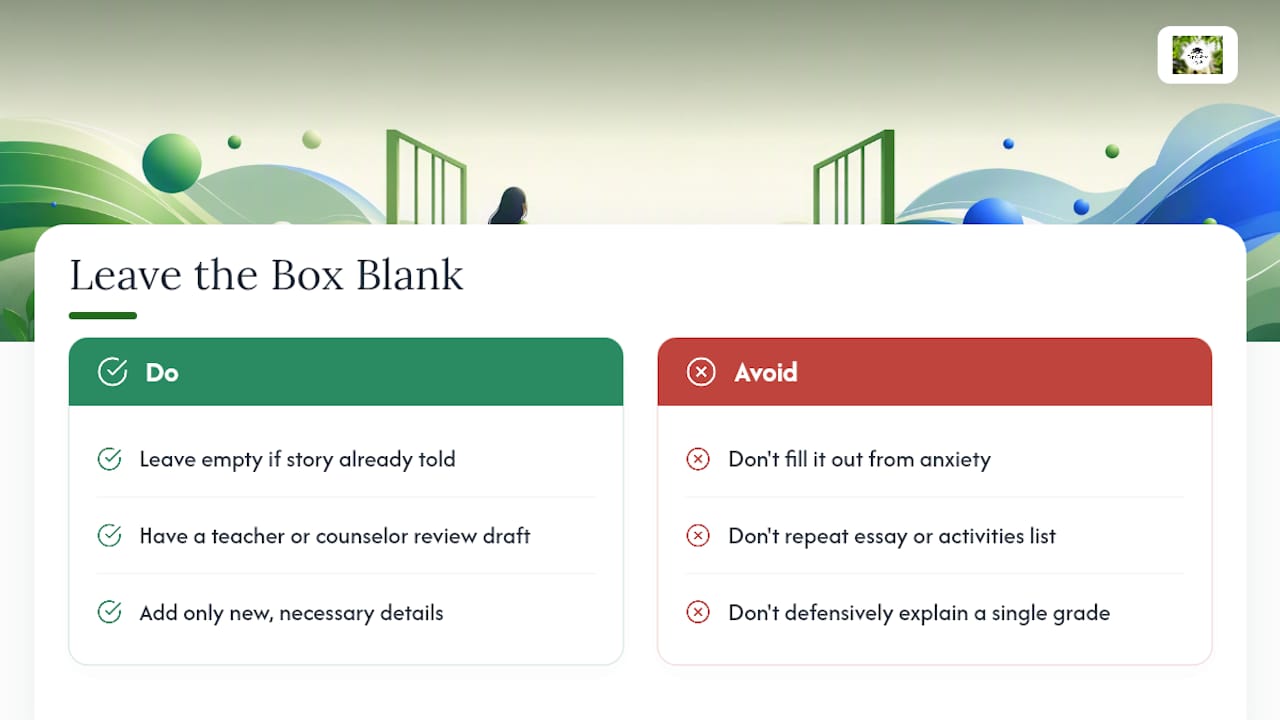
Overuse actually creates risk. A defensive entry explaining a single average grade can draw attention to something a reader would have otherwise skimmed past. Repetition dilutes your strongest material by surrounding it with filler.
If you’re unsure whether something belongs in this box, show the draft to a teacher or your school counselor before you submit. A second set of eyes catches defensive framing faster than you can when you’re this close to your own application.
— Randy Pryor
Get a Second Opinion Before You Submit
Additional Information box reviews are conducted looking for what strengthens the reader’s understanding and cutting whatever doesn’t. Some firms hand files to junior staffers, but personalized feedback shaped by mentors and application reviews by experienced former admissions officers can help identify what makes a reader pause.

If you’re weighing whether a specific circumstance belongs in this box, a quick review conversation often settles it faster than another round of solo editing. Our essay editing and application review services cover exactly this kind of decision, alongside the personal statement itself, so the two pieces read as one coherent file instead of two competing narratives. Details on how a consult works, along with answers to common questions about our process, are on our FAQ page. If you’re earlier in the process and want to build a stronger file before senior year even starts, our Early High School Planning and Junior Year Preparation services are built for exactly that runway. Reach out and get a specific answer for your situation instead of guessing at 11 PM the night before a deadline.
Sources
FAQ
Should I Fill Out the Additional Information Section on the Common App?
Only if you have a specific fact, an activity overflow, or academic context that would change how an admissions reader interprets your application. Most admitted students leave it blank, and that carries no penalty.
What Should I Put in the Additional Information Section?
Include brief, factual context such as a grading-scale explanation, an activity that outgrew its Activities List description, or a short note on a circumstance that affected a grade or course load. Keep it under the 300-word limit for first-year applicants and avoid repeating your essay or resume.
Can You Give Examples of Good Additional Information Entries?
Strong examples include clarifying limited AP access at your school, explaining a grade dip tied to a documented illness with a clear recovery, or expanding on a research role that didn’t fit the Activities List character count. Each should state one fact and one outcome, nothing more.
How Do I Answer “Is There Any Additional Information You Would Like the College to Know About You?”
Answer only if something material is missing from the rest of your application; otherwise, leave it blank without worry. When you do answer, state the fact plainly, keep the tone non-defensive, and stay within 300 words for first-year applications or 1,500 characters for transfer applications.
What’s the Difference Between Additional Information and Challenges and Circumstances?
Challenges and Circumstances is Common App’s dedicated field for documented, often ongoing hardships like housing instability or major family disruption. Additional Information is for shorter, more limited context, like a course-schedule quirk or a brief academic gap, that doesn’t require that dedicated question.
Recommended
Comments