Check the Net Price Calculator Before Choosing ED or RD, U.S. Families

Early Decision (ED) is a binding commitment: apply, get in, enroll, no exceptions. Early Action (EA) and Regular Decision (RD) are non-binding, so you keep the freedom to compare offers. Most families do best choosing ED only when one school is a genuine first choice and the cost is clearly manageable; otherwise, EA or RD keeps your options, and your leverage, intact.
TL;DR:
Applying ED is only advisable if your finances are confirmed and the school is your clear first choice, as it locks you in before aid offers are known.
Most colleges’ ED pools include more committed applicants, which can inflate acceptance rates compared to regular decisions, but applying ED does not guarantee admission.
To avoid application issues, ensure all materials are thoroughly prepared and polished well before early deadlines, since most application mistakes are logistics problems.
Use the college’s Net Price Calculator and aid policies to confirm affordability before applying ED, and communicate with financial aid offices if needed.
Balancing one ED application with multiple EA applications and backup RD plans is often the most strategic approach for most families.
Table of Contents
Early Decision vs Regular Decision: A Side-by-Side Look
The core difference is commitment. ED locks you in before you know your financial aid package. EA and RD let you wait, compare, and decide with full information.
Factor | Early Decision (ED) | Early Action (EA) | Regular Decision (RD) |
Binding? | Yes | No | No |
Typical deadline | November (ED I) or January (ED II) | November | January |
Typical notification | December or February | December to January | March to April |
Compare aid before committing? | No | Yes | Yes |
Admissions advantage | Often higher, but see below | Slight to none | Baseline pool |
Best for | A clear first choice, finances confirmed | Strong applicants wanting an early read | Students still building or comparing options |
A few wrinkles matter. Schools that offer ED I and ED II let you apply binding twice, once in the fall and again in January if you’re deferred or decide later. Restrictive Early Action (also called Single-Choice Early Action, or REA/SCEA at schools like Yale and Stanford) is non-binding but limits you from applying early anywhere else, private or sometimes public. Recruited athletes often work through ED on a different timeline entirely, coordinated directly with coaches.
The ED advantage is real, but it’s not as clean as it looks. College Board notes that roughly 450 colleges offer early plans, and ED pools tend to include more prepared, more committed applicants, including recruited athletes, which inflates the early admit rate relative to RD. The boost is partly about who applies, not just when.
What Are the Real Benefits and Drawbacks of Each Round?
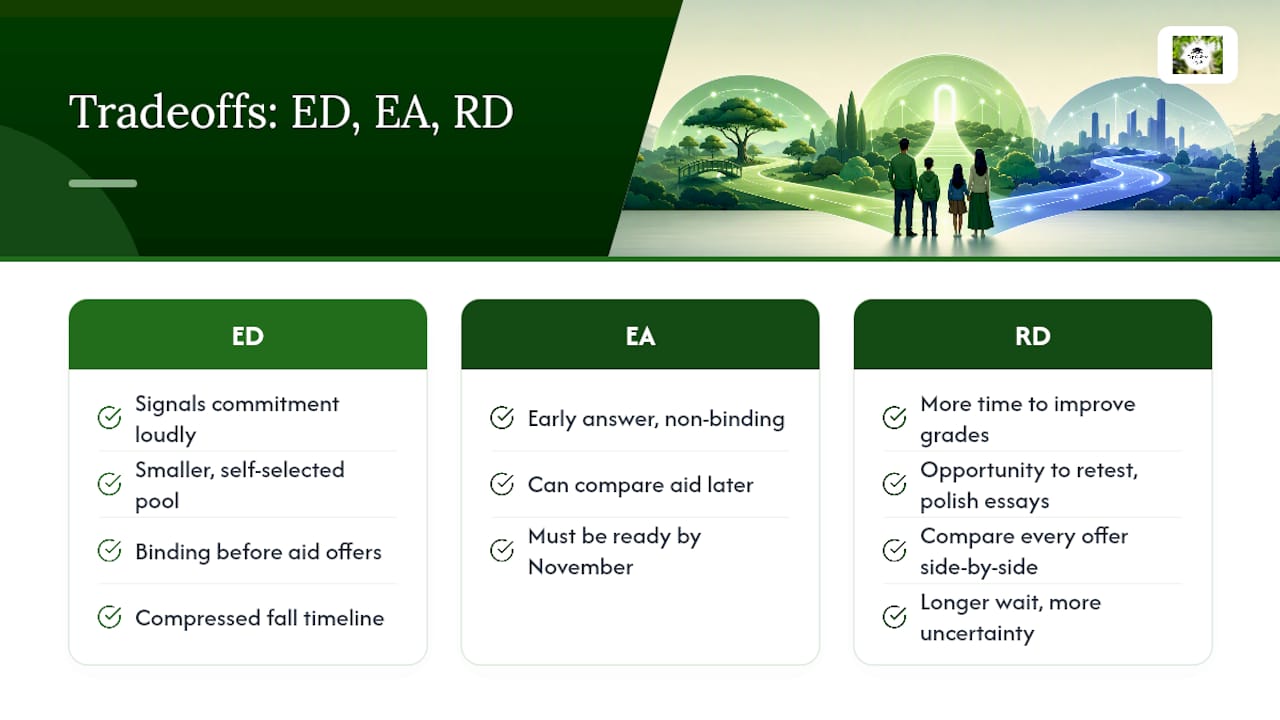
Every round trades something for something else. Here’s what you’re actually weighing.
Early Decision signals commitment loudly, and admissions offices notice. The applicant pool is smaller and more self-selected, which can work in your favor. The tradeoff: you’re bound before seeing your aid offer, and you’re compressing your essay and testing timeline into the fall of senior year.
Early Action gives you an early answer without the handcuffs. You can still compare financial aid packages once other offers arrive. The catch is that the application still needs to be genuinely ready by November, not just started.
Regular Decision buys you time to strengthen grades, retest, and polish essays, and it lets you compare every offer side by side. The cost is a longer wait and more uncertainty heading into spring.
One myth needs correcting directly: ED does not guarantee admission. It improves your odds at many schools, but a weak application submitted early is still a weak application.
Pro Tip: If you’re not 100% sure a school is your first choice, don’t apply ED just to “try for the bump.” A rushed ED essay to the wrong school often loses to a polished RD essay at the right one.
What Happens After You Apply, Round by Round?
Timing drives everything in the fall and winter of senior year. Here’s the typical sequence:
ED I and EA deadlines land around November 1, with decisions arriving mid to late December.
ED II deadlines typically fall in early January, with decisions in February.
RD deadlines usually land in early January, with decisions arriving between March and April.
If you’re deferred, your application typically moves into the RD pool for reconsideration, which means you’ll want updated grades or testing ready to submit.
While you wait, finalize backup essays, confirm counselor recommendations are submitted, and keep RD applications moving so you’re never stuck scrambling in January.
How Do You Know If Early Decision Is Financially Safe?
ED is a financial commitment before it’s anything else. Unlike EA or RD, you’re agreeing to enroll before a single aid offer lands on the table, which means you need real numbers, not guesses, before you sign an ED agreement.
Start with the college’s Net Price Calculator. Every school is required to post one, and running the numbers before applying tells you roughly what you’d actually pay, not the sticker price. Then check the school’s aid policy: does it meet full demonstrated need, or does it gap students with loans and work-study? That distinction matters more for ED than almost anything else on the checklist.
Run the Net Price Calculator before you finalize your school list, not after you’re admitted.
Confirm whether the school “meets full need” or only “meets part of need.”
If admitted with insufficient aid, document any real financial hardship and contact the aid office directly to ensure all your school documents are correctly prepared, including apostille or transcript notarization when necessary, as explained in school docs apostille and transcript notarization.
Genuine ED releases exist, but they’re rare and require documented circumstances, not buyer’s remorse over a bigger-than-expected bill.
A Step-by-Step Framework for Choosing Your Round
Picking the right round isn’t a gut call. Run through this before you commit to anything binding:
Is this school truly your first choice, above every other option on your list? If you hesitate, that’s your answer: not ED.
Is your application actually ready by November? Essays, testing, and recommendations all need to be genuinely finished, not merely started.
Have you run the Net Price Calculator, and can your family afford the estimate without surprises? If the answer is no or unclear, ED is too risky.
Do you need to compare multiple aid offers before deciding? If yes, ED is off the table entirely.
Any “no” on questions 1, 2, or 3 is a red flag serious enough to disqualify ED for that school this cycle.
The strategy that works best for most families combines all three rounds: one ED application to a true first choice, only if finances are confirmed; a handful of EA applications to strong-fit target schools for an early, non-binding read; and RD for reach schools and safeties that benefit from extra polish.
Pro Tip: Build your RD list in October, even if you’re applying ED. If your ED decision doesn’t go your way, you’ll already have strong alternatives ready to submit instead of assembling them in a panic over winter break.
Once you’ve chosen your rounds, map out your admissions timeline in detail so nothing slips between now and decision day.
What Do Admissions Counselors See Go Wrong Under Early Deadlines?
The pattern repeats every fall: strong students undercut their own ED or EA applications because the essay was rushed, a recommendation letter arrived late, or an institutional form got missed entirely. None of these are admissions problems. They’re logistics problems, and they’re fixable weeks in advance.
The students who benefit most from applying early aren’t necessarily the strongest on paper. They’re the ones whose applications were genuinely finished, reviewed, and polished well before the deadline, not scrambled together the week of.
Fixing these gaps ahead of November materially changes outcomes, which is exactly why timeline discipline matters as much as strategy.
— Randy Pryor
Is Applying Early Fair to Every Family?
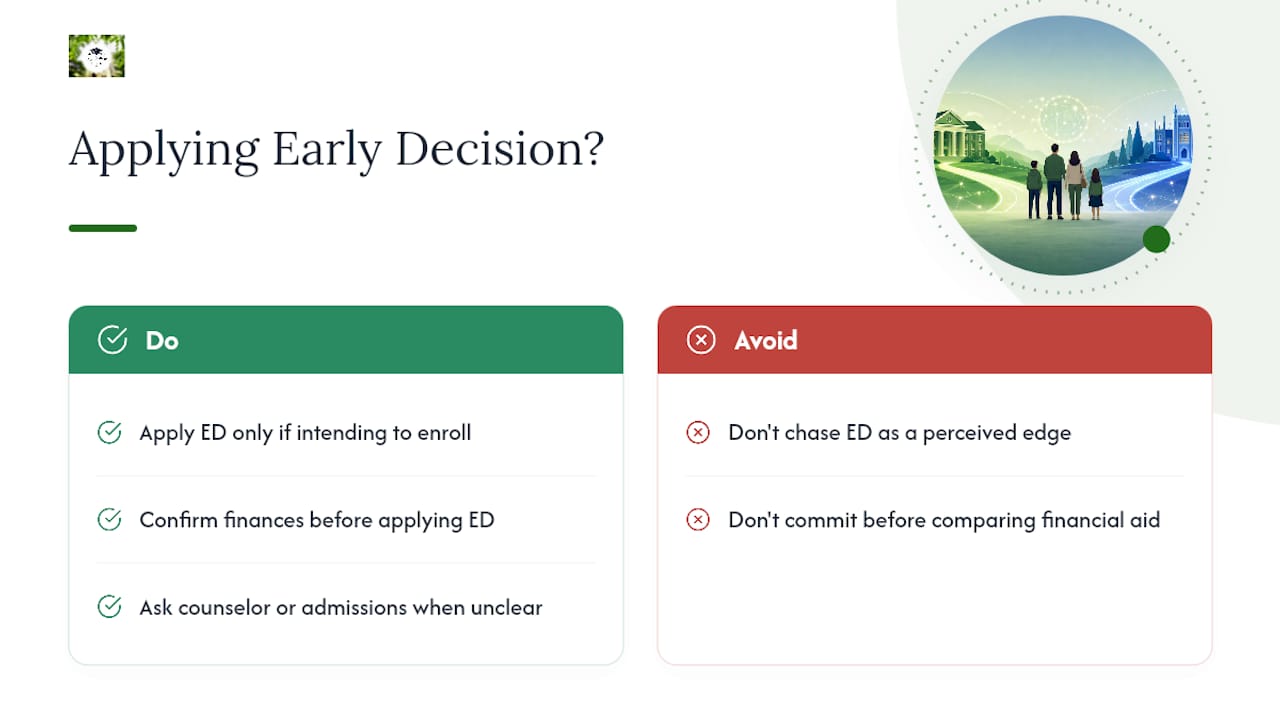
Early Decision favors families who can commit to a price before comparing aid, which isn’t every family’s reality. Apply ED only when you genuinely intend to enroll and your finances are confirmed, not to chase a perceived edge. When your school’s policy is unclear, your high school counselor and the admissions office both have direct answers worth getting before you sign anything binding.
How Top College Coach Helps You Choose the Right Round
Picking between ED, EA, and RD is as much a financial decision as an admissions one, and getting it wrong locks you into a binding commitment or a missed opportunity. Some college admissions counselors work with families to pressure-test whether a first-choice school is genuinely ED-safe, reviewing Net Price Calculator estimates, aid policies, and application readiness before signing anything binding.

Counselors experienced in college admissions help build a realistic round strategy: one ED shot where it makes sense, EA applications to strengthen your position, and RD backups that are ready to go, not thrown together in December. Essays and application materials are often reviewed carefully so nothing weak slips through under a tight early deadline. If you’re unsure whether ED is the right move for your family this cycle, schedule a consultation with Top College Coach and get a straight answer before you commit to anything binding.
Where to Verify the Details Before You Decide
Confirm every deadline directly with the source: College Board’s early-application guidance, Common App’s decision-plan overview, each college’s published early-round policy, and that school’s own Net Price Calculator.
Sources
FAQ
Is it better to apply Early Decision or Regular Decision?
Neither is universally better. ED can improve your odds at a genuine first-choice school with confirmed finances, while RD makes more sense if you need to compare aid offers or your application needs more time to develop.
Is early decision more likely to get you accepted?
At many selective schools, yes, ED admit rates run higher than RD, but that gap partly reflects a smaller, more committed applicant pool rather than a lowered bar, according to College Board.
Is a 60% acceptance rate high?
It depends entirely on the school and round. A 60% rate would be considered high at a highly selective university but average or low at a less selective one, so compare it against that specific school’s own historical numbers, not a general benchmark.
Is Harvard Early Action or Early Decision?
Harvard offers Restrictive Early Action, not Early Decision, which means it’s non-binding but limits you from applying early to most other private schools at the same time.
What happens if I’m deferred from Early Decision?
A deferral typically means your application moves into the Regular Decision pool for reconsideration, so you should submit updated grades, testing, or achievements as soon as they’re available.
Recommended
Comments