U.S. Students: Take Two Official Practice Tests to Decide SAT vs ACT

If you need more time to think through each question and prefer a digital format, start your prep with the SAT. If you work faster under pressure and want a standalone science section to show off your data skills, try the ACT. Either way, take one full-length timed practice test of each before you commit. The results, not your gut feeling, should make the call.
TL;DR:
The SAT favors students who prefer more time per question and utilizing tools like a graphing calculator, while the ACT suits students who move quickly and excel in scientific reasoning.
Practicing on official digital platforms like Bluebook for the SAT and authentic ACT materials will help reduce interface friction and improve question pacing.
Performance on one full-length practice test, converted using official concordance tables, provides the most accurate basis for choosing between the tests, rather than relying on reputation or guesswork.
Most colleges accept both tests equally, but some selective schools have reintroduced requirements, so verifying each school’s policies is crucial.
Focusing on mastering a single test yields better results than splitting prep efforts, with personalized counseling and official practice tests guiding strategic decision-making.
Table of Contents
SAT vs ACT: The Key Differences at a Glance
The honest answer to “sat vs act” is that neither test is universally easier or more respected. They measure similar academic skills through different formats, and your comfort with pacing and question style usually decides which one produces a better score.
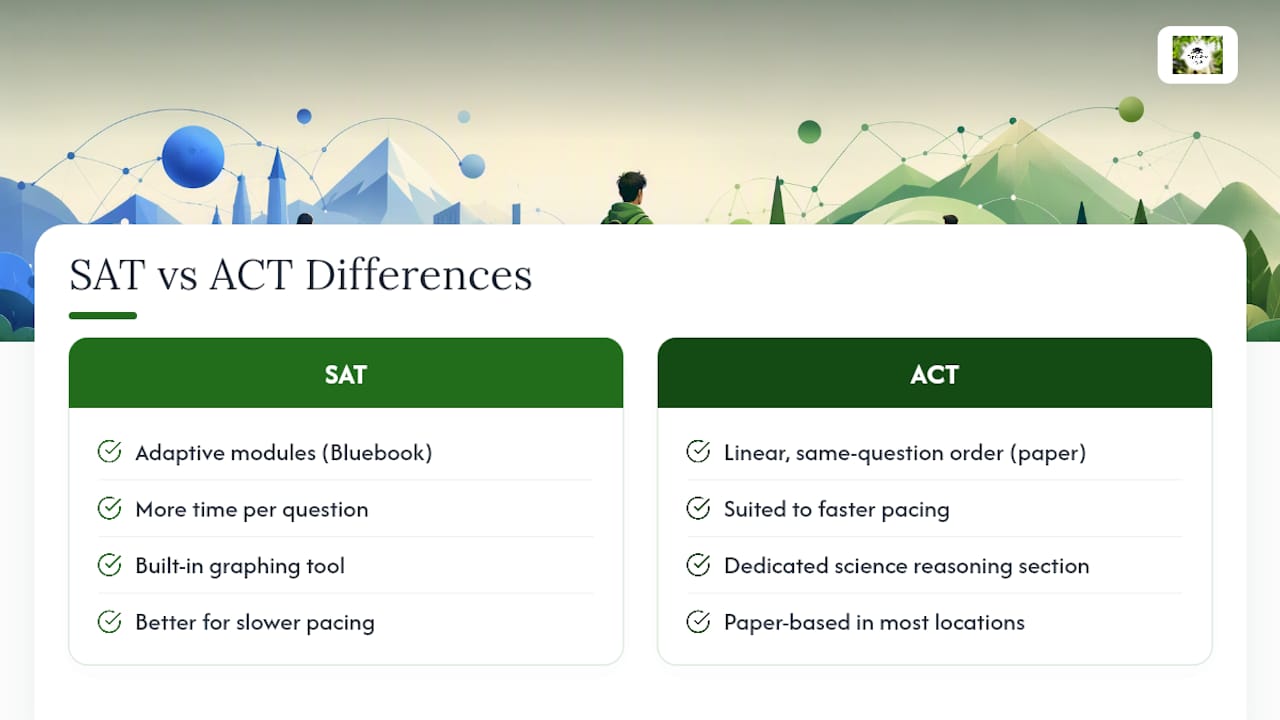
The SAT runs on College Board’s Bluebook platform everywhere now, and it adapts across modules as you progress. The ACT remains a linear, paper-based exam in most testing locations, meaning every student sees the same questions in the same order regardless of how earlier answers went.
The SAT tends to suit students who want more time per question and who like having a graphing tool built right into the test. The ACT tends to suit students who move quickly through material and want a dedicated section to demonstrate scientific reasoning.
Most U.S. colleges accept both tests with no preference, but that landscape has been shifting. Several highly selective schools have reinstated testing requirements in recent admissions cycles, so check your target colleges’ current testing policies before you assume either score matters equally everywhere.
How Test Structure and Timing Affect Your Performance
The clock is the real difference between these two exams, not the subject matter.
SAT: Two digital modules (Reading & Writing, then Math), about 98 questions total, roughly 134 minutes, averaging about 1 minute 22 seconds per question.
ACT: Four linear sections (English, Math, Reading, and an optional Science section), about 131 questions, 125 to 175 minutes depending on whether you add Science or the optional Writing test, averaging about 57 seconds per question.
SAT extras: A built-in Desmos graphing calculator and a formula reference sheet reduce the mental load on math sections.
ACT extras: Adding the optional Science section or Writing test extends your total seat time significantly, so factor that into your test-day stamina.
Digital familiarity matters more than students expect. Because the SAT is delivered entirely through Bluebook, practicing on that actual app before test day cuts down on the kind of interface friction that costs you points you already knew how to earn. The ACT’s paper format varies less by device, but its question order and pacing rhythm can shift slightly between practice books, so lean on official ACT materials rather than generic guides.
What Does an SAT Score Mean Compared to an ACT Score?
An SAT score of 1570–1600 roughly matches a top ACT composite of 36, based on official concordance tables from the Princeton Review that map ACT composites to SAT totals for admissions comparison.
Statistic Callout: Concordance tables exist precisely because colleges receive both SAT and ACT scores and need a consistent way to line them up. A 1450 SAT and a 33 ACT sit close to each other on most concordance charts, which is why neither score has a clear edge over the other in a typical admissions review.
Most colleges also superscore, combining your best section results across multiple test dates rather than judging you on one sitting. Before you lock in a testing plan, check how your target schools use standardized scores in their review process, since superscoring rules and required score types vary by institution.
Which Test Matches Your Strengths?
The SAT leans on shorter passages, one question per passage, and a heavier dose of algebra and data analysis, with that graphing calculator available throughout the math sections. The ACT gives you longer reading passages with several questions clustered around each one, a broader spread of math topics including geometry and trigonometry, and a separate Science reasoning section built around data tables, charts, and conflicting viewpoints.
If you read quickly and retain detail across a longer passage, the ACT’s reading style tends to reward that.
If you prefer answering one question at a time before moving to new material, the SAT’s structure fits better.
If geometry and trig are strong subjects for you, the ACT’s math section covers more of that ground.
If you like having Desmos available to check your work, the SAT hands you that advantage automatically.
If interpreting graphs and research summaries under a ticking clock is a skill you want colleges to see, the ACT’s dedicated Science section puts that skill on full display.
Pro Tip: Grab an ACT Science section and an SAT Reading & Writing module and time yourself on both. The one that feels tight but manageable, rather than rushed or sluggish, is usually telling you something real about fit.
How Should You Decide Between the SAT and the ACT?
Skip the debates about which test is “harder.” Testing experts consistently recommend comparing real performance under real conditions instead of guessing based on reputation.
Take one full-length, timed official practice test of each exam under strict test-day conditions, no pausing the clock and no skipping sections.
Convert both results using an official concordance table, then compare not just the score but how much time you had left and how confident you felt in each section.
Confirm your target colleges’ testing requirements, superscoring policies, and any scholarship criteria tied to specific score types.
Build a prep schedule around whichever test performed better, and plan to retake that same test rather than splitting effort across both.
Decision Factor | What to Check | Why It Matters |
Timing comfort | Minutes remaining per section on your practice test | Reveals whether faster or slower pacing suits you |
Score comfort | Concordance-converted results side by side | Shows which test rewards your current skills more |
College policy | Required tests, superscoring rules, scholarship criteria | Some schools still require specific score types |
Prep timeline | Weeks until your target test date | Determines whether you have time to master one test well |
What Do SAT and ACT Prep and Registration Cost?
Official SAT practice is free through Bluebook and Khan Academy’s partnership with College Board, which includes seven full-length practice tests. The ACT offers one free downloadable practice test plus limited web practice, and leans more heavily on paid partner programs for additional material.
SAT registration runs around $68, and ACT’s core exam costs a similar amount plus optional add-ons for Science or Writing.
Fees change from year to year, so confirm current pricing directly on the College Board or ACT sites before registering.
A junior-year prep plan typically layers free official practice first, then adds paid tutoring only if a student plateaus below their target score.
Spaced review methods, like the ones covered in research comparing flashcards to notes, tend to outperform cramming for both exams’ content-heavy sections.
What Randy Pryor Recommends Before You Commit to a Test
Randy Pryor, college admissions counselor at Top College Coach, recommends two full-length timed official practice tests before choosing a direction. Then build your entire prep plan around whichever result was stronger and more comfortable, rather than splitting energy across both exams.
Expert college admissions counselors help families interpret practice scores, build targeted study plans, and connect testing strategies to the broader application, from course selection to essays.
Does the SAT or ACT Require an Essay?
Neither test requires an essay anymore, and that shift changes how you should think about the writing portion of your application.
The ACT still offers an optional Writing test, a 40-minute essay scored separately from your composite score. Very few colleges request it today, so most students skip it unless a specific school explicitly asks for it. The SAT eliminated its essay option entirely when it moved to the fully digital format, so there is no writing add-on to consider at all.
What used to be a scored essay section on both exams is now essentially irrelevant for the overwhelming majority of applicants. Colleges get their sense of your writing ability from the actual essays in your application, not from a timed response to a prompt you saw for the first time that morning.
If you are applying to a small number of schools that still list the ACT Writing test as required or recommended, register for it specifically for those test dates. Otherwise, put that 40 minutes of stamina toward the sections that actually move your composite score.
When Are the SAT and ACT Offered?
The SAT is offered roughly seven times a year, typically in March, May, June, August, October, November, and December, with digital administration now standard everywhere.
The ACT runs on a similar schedule, with national test dates typically in February, April, June, July, September, October, and December. Both tests require registration several weeks in advance, and late registration windows carry additional fees.
Juniors generally get the most value out of testing in the spring, then again in the fall if a retake is needed. Seniors applying under early action or early decision deadlines usually need their final scores in hand by October or November, which means their last practical test date often falls in September or early October. Check each specific college’s score deadline before you assume a later test date will arrive in time.
When Should You Start Prepping for the SAT or ACT?
A ten to twelve week runway before your first official test date gives most students enough time to move their score meaningfully without burning out.
Start with a diagnostic full-length practice test to establish your baseline, then spend the middle weeks on targeted review of your weakest section types. The final two weeks should shift toward full-length timed simulations rather than isolated drills, since stamina and pacing matter as much as content knowledge by that point.
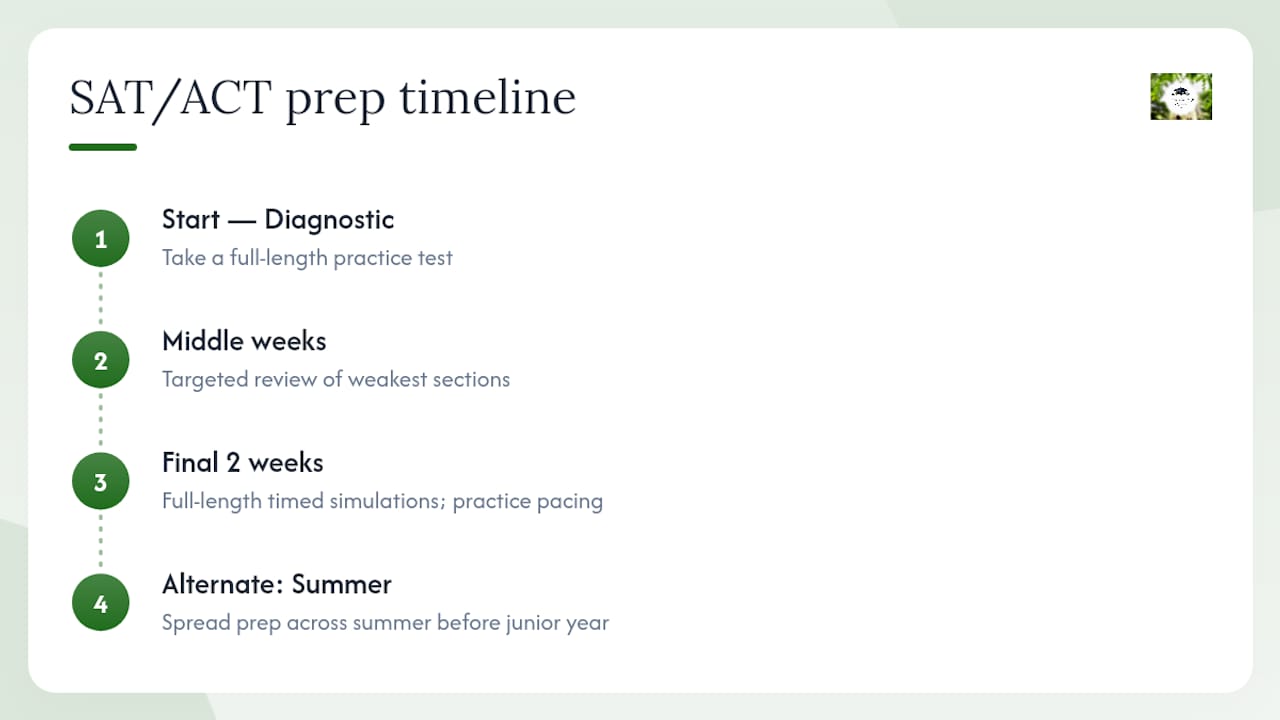
Students juggling AP courses or fall sports often do better spreading prep across the summer before junior year rather than cramming it into a single spring semester. If you are managing time pressure or attention challenges during study sessions, resources on recognizing and managing time blindness can help you build a study schedule that actually holds up.
How Do SAT and ACT Question Styles Actually Differ?
The SAT builds most of its Reading & Writing questions around short passages, often just a paragraph, paired with a single targeted question about evidence, structure, or vocabulary in context. The ACT clusters several questions around each longer passage, which rewards students who can hold a fuller narrative or argument in their head while answering.
Math styles diverge too. The SAT frequently frames questions in real-world scenarios that reward careful reading and setup as much as calculation. The ACT tends to ask more direct, computation-forward questions, with a wider range of topics including geometry and trigonometry showing up more often than on the SAT.
Neither style is objectively harder. A student who thrives on direct, front-loaded questions may find the ACT feels faster and more natural, while a student who prefers digging into evidence before answering may find the SAT’s format less rushed.
Should You Split Prep Between Both Tests?
Splitting prep across both tests usually dilutes your results. Mastering one test almost always beats mediocre performance on two.
Taking both makes sense only in specific cases: you discover a mismatch late in junior year, a scholarship explicitly requires one test type, or a target college has an unusual score policy. Otherwise, protect your time for course rigor, strong recommendation letters, and essays that actually differentiate your application.
— Randy Pryor
Let Top College Coach Help You Choose and Prepare With Confidence
Personalized college admissions counseling provides more than a practice test score alone can offer: interpretation of results and guidance on what they mean for your application as a whole. Instead of guessing whether a 1450 SAT or a 33 ACT is the stronger foundation, clients can get direct interpretation from an experienced counselor who works closely with families.

Every plan, from Early High School Planning through Junior Year Preparation, folds your testing strategy into the bigger picture: course selection, extracurricular timing, and eventually The College List itself. Pricing details for personalized counseling packages are available directly through Top College Coach’s FAQ page, where you can also see how test interpretation fits into the full application strategy. If you’re ready to stop guessing between two tests and start building a plan around the one that actually fits, reach out through the FAQ page to schedule a conversation about your next steps.
Sources
Registration and practice: SAT Suite, ACT.org, Khan Academy’s SAT practice partnership, and concordance tables via Princeton Review.
How is the SAT different from the ACT? – SAT Suite | College Board
SAT vs. ACT: Which Test is Right for You? | The Princeton Review
FAQ
Do Colleges Prefer the SAT or the ACT?
No, most U.S. colleges accept both tests with no preference between them, though some selective schools have reinstated testing requirements in recent cycles, so always confirm each target school’s current policy.
Is a 1600 SAT or a 36 ACT Harder to Achieve?
Both represent the top of their respective scales and are treated as roughly equivalent on official concordance tables, so neither is considered harder to earn than the other.
What Is Harder, the SAT or the ACT?
Neither test is inherently harder. The SAT gives you more time per question in a digital, adaptive format, while the ACT moves faster and adds a separate Science section, so difficulty comes down to which pacing and style fits you.
Is a 1450 SAT or a 33 ACT the Better Score?
A 1450 SAT and a 33 ACT sit close together on concordance charts, meaning colleges generally view them as comparable scores rather than one being clearly stronger.
How Do I Know Which Test Fits Me Best?
Take one full-length, timed official practice test of each exam under real conditions, then compare your comfort and results using a concordance table. College admissions counselors can help you interpret those results and build a prep plan around your stronger performance.
Recommended
Comments