MIT Early Admission: Your 2026 Complete Guide

MIT Early Admission is defined as a non-binding Early Action program that allows students to apply by November 1 and receive decisions by mid-December, without any obligation to enroll. This is not Early Decision. You keep full freedom to apply Regular Action to other schools while still getting MIT’s answer months ahead of the standard timeline. MIT’s overall acceptance rate sits at approximately 5%, making it one of the most selective universities in the world. Applying early gives you clarity sooner, and for students who are genuinely ready, that clarity is worth pursuing. At Top College Coach, we work with students every year who benefit enormously from understanding exactly how this process works before they submit a single word.
What are the MIT Early Admission application requirements?
MIT’s application requirements are specific, and meeting them is the floor, not the ceiling. Every competitive applicant checks the boxes below. The students who get in go further.
Academic profile
MIT expects the highest academic rigor available to you. Admissions readers look at the trajectory of your coursework, not just your GPA. If AP Chemistry, Multivariable Calculus, or Computer Science is offered at your school and you did not take it, that absence gets noticed. There is no published minimum GPA, but admitted students consistently show near-perfect records in the most demanding courses available.
Standardized testing
MIT has reinstated its standardized testing requirement. Median scores for admitted students are 34 or above on the ACT and 1510 or above on the SAT, though a small percentage of admitted students score below those thresholds. A high score alone does not guarantee admission. It removes a barrier. The November testing date is the last accepted for Early Action applicants, so plan your test schedule accordingly.

Letters of recommendation
MIT requires three letters: two from teachers, preferably in STEM subjects, and one from your school counselor. These letters carry real weight. A physics teacher who watched you wrestle with a problem set for three weeks writes a more useful letter than a teacher who simply liked you. Choose recommenders who can speak to your intellectual curiosity and work ethic with specific examples.
Essays and short answers
MIT does not use the Common Application. It runs its own portal with a $75 application fee. The short-answer prompts ask about your activities, your community, and what excites you about MIT specifically. Admissions readers want authenticity. They are not looking for polished corporate language. They want to hear your actual voice and understand what drives you.
Activities list: Prioritize depth over breadth. Two or three serious commitments beat ten surface-level clubs.
Maker Portfolio: Optional but powerful for students with engineering, design, or creative projects. If you have built something, show it.
Interviews: MIT alumni conduct interviews in most regions. Treat this as a conversation about your intellectual passions, not a formal job interview.
For international students, a TOEFL score above 100 or an IELTS score above 7.5 is strongly recommended to demonstrate English proficiency.
Pro Tip: Request your letters of recommendation by September 1 at the latest. Give your recommenders a one-page summary of your goals, your strongest academic moments, and why MIT fits your trajectory. The more context they have, the stronger the letter.
What is the timeline for MIT Early Admission?
The MIT Early Action calendar is tight. Missing a single date can cost you an entire application cycle.
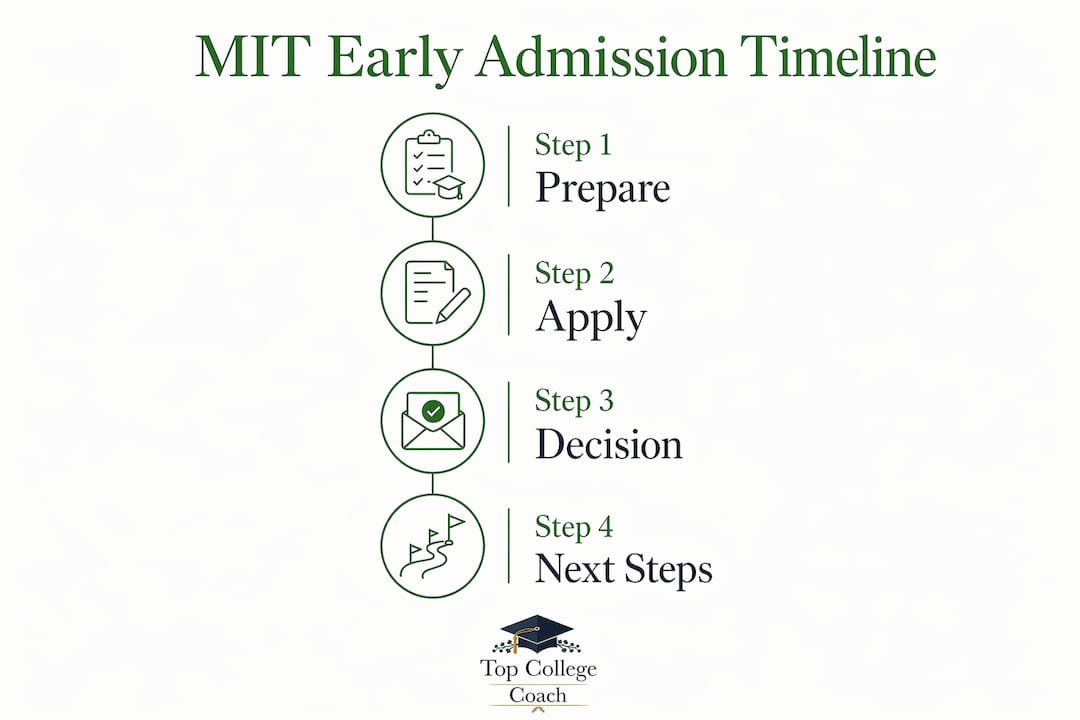
Event | Date |
Early Action application deadline | November 1 |
Last accepted SAT/ACT testing date | November (same month) |
Early Action decisions released | Mid-December |
February Updates and Notes Form | February (deferred applicants only) |
Regular Decision deadline | Early January |
Regular Decision notifications | Mid-March |
Here is what each stage means in practice:
November 1: Your complete application, including all test scores and recommendation letters, must be submitted. Do not wait for November scores to arrive before submitting. Scores can be sent directly from College Board or ACT after the fact.
Mid-December: You receive one of three outcomes: admitted, deferred, or denied. Admitted students see something close to digital confetti raining down on their screen. Deferred and denied students need a clear plan for what comes next.
February: Deferred applicants must submit the February Updates and Notes Form. This is your opportunity to share new achievements, grades, or awards since your original application. Use it.
Mid-March: Regular Decision notifications go out. Deferred Early Action students are reconsidered in this round alongside Regular Decision applicants.
The Early Action deadline of November 1 is firm. MIT does not grant extensions. Build your personal deadline at least two weeks earlier to allow for technical issues, recommender delays, and final essay revisions.
How competitive is MIT Early Admission?
The numbers are sobering, and you deserve to see them clearly. MIT admitted 665 Early Action applicants to the Class of 2030. In that same cycle, 7,738 applicants were deferred and 2,703 were rejected. Another 787 withdrew their applications before a decision was issued.
That means more than 70% of Early Action applicants were deferred, not rejected. Deferral is not a soft rejection. It is a genuine reconsideration in the Regular round. Students who use the February Updates form effectively and continue building their record do get admitted in March.
The Early Action acceptance rate has ranged from approximately 4.8% to 7.4% depending on the year. That range reflects real variation in applicant pool strength and class composition goals. No single year’s number tells the whole story.
What these figures mean for you:
A rejection in Early Action is not a reflection of your worth. It reflects the extraordinary competition in a pool of the most accomplished high school students in the world.
A deferral means MIT wants more information. Respond with new evidence of growth, not with anxiety.
Admission in Early Action is a genuine signal that MIT sees you as a strong fit right now.
The best preparation is not obsessing over acceptance rates. It is building the strongest, most authentic application you can and submitting it with confidence.
What strategies improve your chances with MIT Early Admission?
Preparation is the single biggest differentiator between applicants who feel ready and applicants who actually are. Here is a numbered framework we use at Top College Coach with students targeting MIT.
Start your testing plan by junior year. Sitting the SAT or ACT for the first time in October of senior year leaves no room for improvement. Aim to have a strong score locked in by June or august before your senior year begins.
Write essays that sound like you. MIT’s prompts are designed to surface personality, not vocabulary. Read your draft aloud. If it sounds like a press release, rewrite it. The application essay process rewards specificity and honesty over grandeur.
Choose recommenders who know your work deeply. A teacher who gave you a B but watched you grow teaches MIT more than a teacher who gave you an A and barely remembers your name. Depth of relationship matters more than grade received.
Show a clear intellectual spike. MIT is not looking for well-rounded students. It is looking for students with a genuine, deep passion in at least one area. Your extracurriculars, essays, and recommendations should all point toward the same core identity.
Use the Maker Portfolio if you have built anything. A robotics project, a self-taught programming language, a designed piece of furniture. If you create things, document them and submit the portfolio. This is one of the few places in the application where you can show rather than tell.
Prepare for your alumni interview with substance. Research MIT’s research labs, faculty, and programs that connect to your interests. Come with specific questions. Interviewers remember students who demonstrate genuine intellectual curiosity, not students who memorize talking points.
Submit your application by October 15. Give yourself two weeks of buffer before the November 1 deadline. Use that time to review every component one final time.
Pro Tip: If you are deferred, do not go silent. Submit the February Updates form with your strongest new information: a first-semester senior transcript showing all As, a new award, a published project, or a meaningful new leadership role. Silence after deferral is a missed opportunity.
For a broader view of how MIT fits into your overall college strategy, the Ivy League application guide from Top College Coach covers the full picture of applying to the most selective schools.
Key takeaways
MIT Early Admission is a non-binding Early Action program with a November 1 deadline, a mid-December decision, and an acceptance rate between 4.8% and 7.4%, requiring a complete academic, testing, and essay package to compete.
Point | Details |
Non-binding Early Action | Applying early does not commit you to MIT; you can still apply Regular Decision elsewhere. |
November 1 deadline is firm | Submit by October 15 to allow buffer for technical issues and recommender delays. |
Deferral is not rejection | Over 70% of Early Action applicants are deferred and reconsidered in the Regular round. |
Test scores matter but are not enough | Median admitted scores are 34+ ACT or 1510+ SAT; scores open the door, essays and fit close it. |
February Updates form is critical | Deferred students must submit new achievements in February to stay competitive in the Regular round. |
What I have learned coaching students through MIT Early Action
The students I have seen succeed at MIT share one quality that no test score captures: they are genuinely excited about solving hard problems, and that excitement comes through in every part of their application. It is not manufactured. Admissions readers at MIT have reviewed tens of thousands of applications. They recognize authentic curiosity immediately, and they recognize performance just as fast.
The biggest mistake I see is students who treat the application as a checklist. They hit every requirement but never give the reader a reason to remember them. MIT is not just evaluating your credentials. It is asking whether you will contribute something real to its community. That question requires a real answer.
Deferral stings. I have sat with students who were devastated by a December deferral after months of preparation. My honest advice: give yourself 48 hours to feel disappointed, then get back to work. The February Updates form is not a formality. It is a second chance, and students who use it well do get admitted in March. I have seen it happen.
The college admissions timeline is long and demanding. The students who finish strongest are the ones who planned early, stayed consistent, and kept their focus on what they could control.
— Randy Pryor, Founder of Top College Coach
How Top College Coach supports MIT applicants
Applying to MIT is one of the most demanding things a high school student can do. The application requires months of preparation, careful essay work, and a clear understanding of what MIT is actually looking for.
Top College Coach specializes in exactly this kind of high-stakes application work. Our counselors have helped students gain admission to MIT, Ivy League schools, and other Top 20 universities through personalized essay review, interview preparation, and a complete application strategy built around each student’s unique strengths. We work with students and parents from the earliest planning stages through final submission. If you are serious about applying early to MIT, start with a consultation and give your application the foundation it deserves.
FAQ
What is MIT Early Admission?
MIT Early Admission is a non-binding Early Action program with a November 1 deadline. Admitted students receive decisions by mid-December and are not required to enroll.
Is MIT Early Action binding?
MIT Early Action is non-binding, meaning you can apply to other schools Regular Decision and compare offers before committing.
What happens if MIT defers my Early Action application?
Deferred applicants are reconsidered during the Regular Decision round. They should submit the February Updates and Notes Form to share new achievements before the march decision.
What SAT or ACT score does MIT expect?
MIT’s median admitted scores are 34 or above on the ACT and 1510 or above on the SAT. Scores below those ranges are occasionally admitted, but strong scores remove a significant barrier.
Does MIT use the Common Application?
MIT does not use the Common Application. Students apply through MIT’s own portal and pay a $75 application fee directly through that system.
Recommended
Comments