How to Get Into an Ivy League School

Getting into an Ivy League school is one of the most competitive challenges a student can face, and the anxiety around how to get into an Ivy League is completely understandable. Acceptance rates at schools like Harvard and Columbia hover below 4%, and the applicants you are competing against are exceptional. But here is what most students and parents do not realize: the process is far more strategic than it appears. With the right preparation, authentic storytelling, and a focused academic profile, your odds improve dramatically. This guide breaks down every step.
Table of Contents
Key takeaways
Point | Details |
Academic rigor matters most | Aim for a weighted GPA above 4.2 with AP, IB, or dual-enrollment courses to meet baseline expectations. |
Specialize, do not generalize | Deep achievement in one or two areas outperforms a long list of surface-level activities. |
Authenticity wins essays | Admissions officers want your real story, not a polished performance crafted for the committee. |
Recommendations reveal character | Choose teachers who know you well and can share specific, vivid examples of your contributions. |
Start early and plan strategically | A structured plan from freshman year produces stronger applications and fewer last-minute mistakes. |
How to get into an Ivy League: the academic foundation
The academic bar at Ivy League schools is simply non-negotiable. Most admitted students carry weighted GPAs above 4.2, achieved through a course load that includes AP, IB, or dual-enrollment classes. Admissions officers read your transcript as a story of intellectual ambition. A 4.0 in standard courses tells a different story than a 3.8 earned in five AP classes.
Here is what you need to understand about weighted versus unweighted GPA: Ivy League admissions offices recalculate your GPA using their own formula, stripping away inflated grades from easy electives. What matters is how hard you pushed yourself relative to what your school offered. If your school offers 12 AP courses and you took two, that gap gets noticed.
On testing, competitive applicants typically score in the 1500 to 1580 range on the SAT or 34 to 36 on the ACT. Most Ivy League schools have returned to test-required policies for 2026, so do not dismiss scores as optional.
Academic planning tips that actually work
Take the hardest courses available in your strongest subjects, not in every subject
Prepare for the SAT or ACT at least 12 months before your target test date
If your GPA sits between 3.3 and 3.7, stronger application components like research, essays, and recommendations can offset the gap
Use summers for academic enrichment: university pre-college programs, research internships, or online coursework at accredited institutions
Avoid course overload in junior year if it causes burnout. Consistency across four years beats one spectacular semester
Academic component | Competitive range | Why it matters |
Weighted GPA | 4.2 or above | Signals rigor and sustained effort |
SAT score | 1500 to 1580 | Meets baseline for most Ivy League schools |
ACT score | 34 to 36 | Comparable benchmark for testing preference |
AP/IB courses | 6 or more (school-dependent) | Demonstrates willingness to challenge yourself |
Pro Tip: Request your school’s course offerings list and compare it against your transcript at the end of sophomore year. If you have avoided hard courses, junior and senior year are your last chance to correct that narrative.
Building a standout extracurricular profile
The single most common mistake we see at Top College Coach is students who treat their extracurricular list like a grocery receipt: long, varied, and ultimately forgettable. Admissions committees prefer applicants with extraordinary achievement in a few areas over candidates juggling ten shallow activities.

Think about what this means in practice. A student who raised $40,000 for local food insecurity, published original research on soil microbiomes, or reached a national ranking in competitive chess tells a clear story. That student is someone with a distinct intellectual identity. A student who was in debate club, played JV soccer, volunteered at a hospital once, and served as class treasurer tells no story at all.
Here is how to build the kind of profile that gets noticed:
Identify your core area. Choose the one pursuit that genuinely excites you and that you can develop over three to four years of high school. Passion cannot be faked, and admissions officers read thousands of applications per year.
Create something, do not just join something. Start a club, launch a project, conduct research, or produce original work. Initiative signals leadership.
Seek external validation. Competitions, publications, awards, and community recognition quantify your impact in terms admissions committees trust.
Document sustained commitment. Showing up every week for two years matters more than an intense six-month sprint before application season.
Use summers strategically. Summer program participation and off-season work in your core area demonstrate year-round dedication that reinforces your interests.
Pro Tip: Before finalizing your activity list, ask yourself: “Does every item on this list support the story about who I am?” If the answer is no, cut what does not belong.
Crafting essays that feel genuinely human
In the post-2023 Supreme Court ruling era, Ivy League essay strategy has changed. Authenticity and lived experience now carry more weight than ever before. Admissions officers are looking for evidence of how your specific background shaped your thinking, your goals, and your motivation to contribute to their campus.
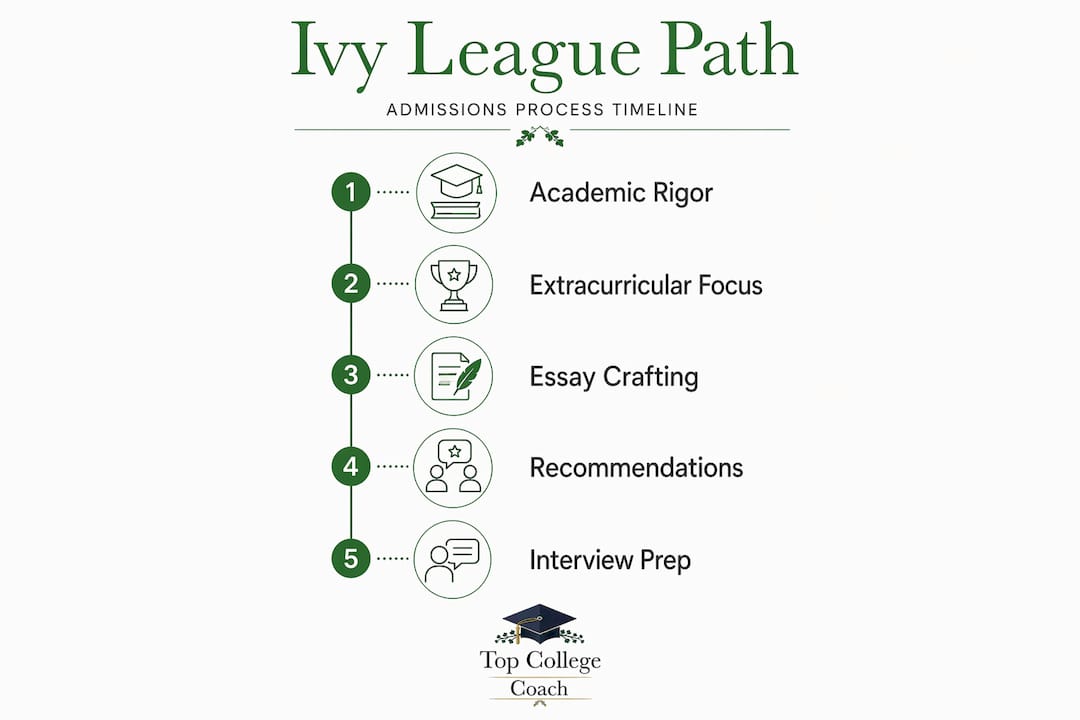
This is also the era of AI-generated essays, and universities know it. Detection tools are more advanced than ever, and more importantly, AI-produced writing has a recognizable texture: smooth, generic, and oddly uninspired. The antidote is specificity. An essay about your grandmother teaching you to make tamales while explaining algebra tells more about your character in 300 words than a thousand words of polished abstraction.
Here is what strong Ivy League essays consistently do:
Open with a scene, not a thesis. Pull the reader into a specific moment. The committee should feel like they are there with you.
Show growth and reflection. Describe not just what happened, but how it changed your thinking or behavior.
Connect to your future contributions. Admissions officers are building a class of future leaders. Help them see how you fit that vision.
Avoid the “overcome adversity” formula. Adversity essays are powerful only when they reveal something unique about your perspective. Generic hardship narratives without depth fall flat.
Revise at least five times. Each pass should remove one layer of cliché and add one layer of you.
“The best essays we read at Top College Coach are the ones students were afraid to write. The raw, honest, specific ones. Those are the essays that get remembered.”
The authenticity premium in modern admissions means that independent, sustained intellectual growth is what distinguishes accepted students. Your essay is the clearest window into that growth.
Securing strong recommendations and acing your interview
Letters of recommendation are often treated as a formality. They are not. Strong recommendation letters reveal your character, classroom presence, and potential in ways that grades and test scores simply cannot. A letter that says “she consistently brought original perspectives to class discussions and supported her peers with genuine generosity” tells an admissions officer something a 4.3 GPA does not.
When choosing recommenders, prioritize teachers who have seen you do something real. Not the teacher who gave you an A, but the teacher who watched you struggle with a concept and persist until you understood it. Effective letters come from recommenders who can offer detailed, anecdotal examples of your character and contributions, not boilerplate praise.
Here is how to set your recommenders up for success:
Ask at least six months before the deadline, ideally at the end of junior year
Provide a one-page “brag sheet” with your accomplishments, goals, and the specific moments you hope they will mention
Give recommenders a clear picture of the schools you are applying to and why
Follow up with a gracious thank-you note regardless of outcome
On interviews: most Ivy League schools use optional alumni interviews, and you should absolutely accept them. Harvard uses interviews as a way to identify community contributors beyond paper credentials. Common Ivy League interview questions include “Tell me about your most meaningful extracurricular,” “What book has influenced you most,” and “What would you contribute to our campus community?” Practice your answers aloud, but do not memorize scripts. Authenticity in conversation matters as much as it does in writing.
Pro Tip: Research your interviewer on LinkedIn before the meeting. Finding a genuine point of connection makes the conversation feel natural instead of interrogative.
Mastering the application timeline
The students who get into Ivy League schools rarely scramble. They plan. A structured application process starting from freshman year consistently produces stronger, more polished results than one assembled in a senior year panic.
Here is a practical roadmap:
Freshman and sophomore year. Establish your GPA trajectory, explore interests, and begin identifying your spike area. Take honors courses where available.
Junior year. Take the SAT or ACT in the fall and spring. Narrow your extracurricular focus. Begin researching schools and visit campuses where possible. Build relationships with two or three teachers who could write strong letters.
Summer before senior year. Draft your Common App personal statement. Finalize your school list. Complete early decision or early action research.
Senior year, fall. Submit early applications by November 1 or November 15. Request letters in September with ample lead time. Complete the FAFSA on October 1 when it opens.
Senior year, winter. Submit regular decision applications by January 1. Follow up on any missing documents.
Common mistake | Better approach |
Starting essays in October of senior year | Draft your personal statement the summer before senior year |
Choosing recommenders in September | Build relationships with teachers over junior year |
Submitting without proofreading | Have at least two trusted readers review every application |
Applying to all schools with the same essay | Customize supplemental essays for each school’s specific culture |
For families concerned about cost, understanding Ivy League scholarship advice early is smart. Every Ivy League school meets 100% of demonstrated financial need, and several have eliminated loans from financial aid packages entirely. The FAFSA and CSS Profile deadlines are non-negotiable, so treat them with the same urgency as application deadlines.
My perspective on what actually moves the needle
I have seen students who have everything on paper and still get rejected, and students with slightly rougher transcripts who get in because their story is undeniably real. What I have learned is that admissions committees are not just selecting credentials. They are selecting future contributors to a community.
The biggest shift I have witnessed is the desire to have applicants who can make an impact in multiple areas. Long-term academic identity now matters far more than checking every box on a generic achievement list. I have seen students with four AP classes and one genuine area of impact outperform students with ten APs and a resume that reads like a catalog.
What I tell every family I work with: do not build an application. Build a student. The application, and their story, will follow. When a young person spends three years genuinely pursuing something they care about, the essays are compelling, the recommendations glow, and the interviews feel easy. That is not an accident. It is the natural result of authentic growth.
The families who struggle most are the ones who start planning in August of senior year. The ones who succeed start in ninth grade with a clear-eyed view of where they are and a realistic plan for where they want to go.
— Randy Pryor, Founder - Top College Coach
Ready to build your Ivy League strategy?
Understanding the path is one thing. Executing it with precision is another. At Top College Coach, we work with students and families from freshman year through final submission, building the kind of personalized strategy that produces real results. Our team has a proven track record of helping students gain admission to Ivy League and Top 20 universities, and our approach is built on authenticity, specialization, and expert guidance at every step.
Whether you are just starting high school or you are staring down a senior year deadline, we can help you put your best application forward. The most important step is the first one. Book your free session with Top College Coach today and get a clear picture of exactly where you stand and what to do next.
FAQ
What GPA do you need for Ivy League admission?
Most admitted students carry a weighted GPA above 4.2, earned through rigorous coursework like AP or IB classes. Students with GPAs between 3.3 and 3.7 can still compete with exceptional essays, extracurriculars, and recommendations.
When should I start preparing for Ivy League applications?
Preparation ideally begins in ninth grade, with course selection, extracurricular focus, and early relationship-building with teachers. Starting in junior year is the practical minimum for a competitive application.
How important are extracurricular activities for Ivy League schools?
Depth matters far more than breadth. Admissions committees favor applicants with extraordinary achievement in one or two areas over students with many surface-level activities. Your extracurricular profile should tell a coherent story about your intellectual identity.
Are Ivy League interviews required, and how do I prepare?
Most Ivy League interviews are optional but strongly recommended. Prepare by practicing answers to common Ivy League interview questions like “What would you contribute to our campus?” aloud, and research your interviewer in advance to find genuine points of connection.
Can I get an Ivy League scholarship?
Every Ivy League school meets 100% of demonstrated financial need, and several have removed loans from their financial aid packages entirely. Submitting the FAFSA and CSS Profile on time is critical to maximizing your aid offer.
Recommended
Comments