How to Find College Application Fee Waivers in 2026

A college application fee waiver is a formal approval that removes the cost of applying to a college, typically ranging from $50 to $90 per school. For students applying to 10 or more colleges, those fees add up fast. Knowing how to find college application fee waivers before you start submitting applications can save hundreds of dollars and open doors to schools you might otherwise skip. The Common App, NACAC, College Board, and ACT all offer waiver programs, and many colleges have their own options too. This guide covers every path available to you in 2026.
What are the eligibility criteria for college application fee waivers?
Fee waiver eligibility is broader than most students and parents realize. A widespread misconception is that only free lunch students qualify. Many colleges consider a much wider range of financial hardship situations.
The Common App uses nine standard criteria to determine eligibility. You qualify if any one of these applies to you:
You receive or live in a household that receives public assistance
Your annual family income falls within the Income Eligibility Guidelines set by the USDA
You are enrolled in a federal, state, or local program that aids students from low-income families
Your family receives public assistance
You live in federally subsidized public housing or a foster home
You are homeless or a ward of the state
You are a dependent of an active-duty U.S. military member at the E1–E6 pay grade
You qualify for a fee waiver under your state’s testing program
Your school counselor confirms you have financial need
That last point matters more than most families know. Counselors have real authority here. If you experienced a temporary job loss, unexpected medical bills, or a family income disruption, your counselor can verify financial need and approve a waiver even if you do not meet the federal poverty guidelines exactly.
Pro Tip: Talk to your school counselor before you assume you do not qualify. Counselors can approve waivers based on their direct knowledge of your situation, and that conversation costs you nothing.

Where and how can you find and request college application fee waivers?
There are five distinct paths to securing college application fee assistance. Each one works differently, so knowing all of them gives you the most options.
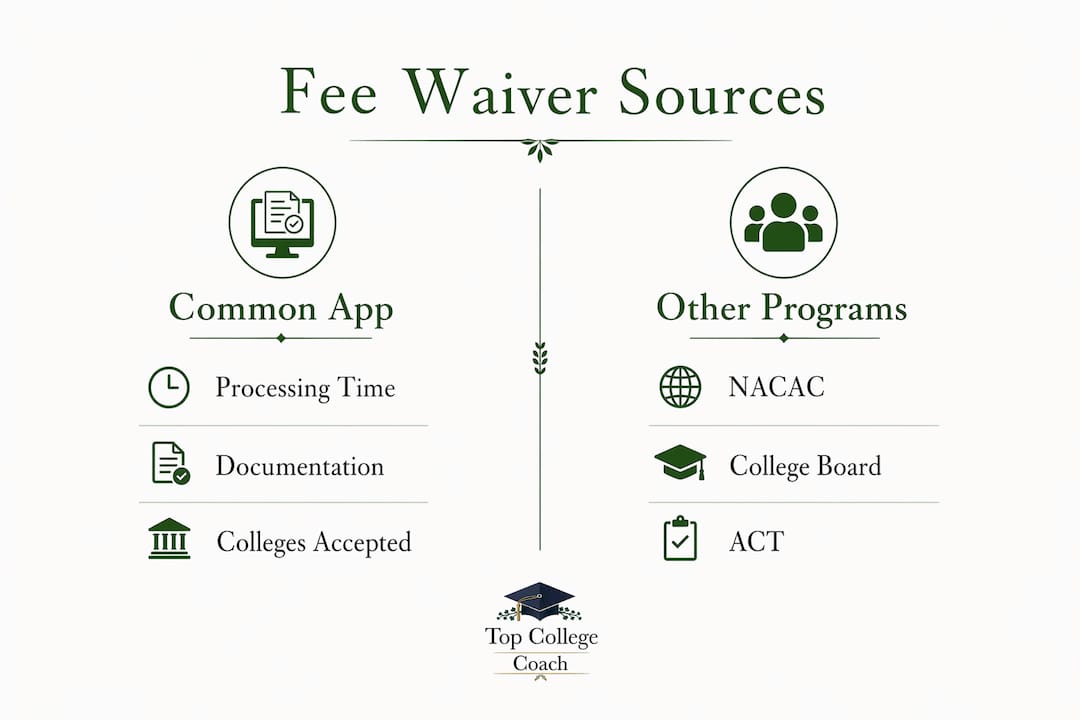
Common App fee waiver request. Log into your Common App account and go to the Profile section. Under the “Fee Waivers” tab, answer the eligibility questions honestly. If you qualify, the waiver applies automatically to all 1,000+ member colleges. Your counselor receives a notification and must confirm your eligibility before the waiver activates. This is the most efficient path because one request covers every Common App school.
College Board and ACT waivers. If you received a College Board fee waiver for the SAT, that same waiver typically extends to college application fees at participating schools. ACT offers a parallel program. Both agencies process waivers quickly. College Board and ACT waivers usually process in 2–3 business days, faster than most other routes.
NACAC fee waiver forms. The National Association for College Admission Counseling provides a standardized waiver form that school counselors can issue directly. Counselors issue NACAC waivers when they know the student’s financial situation, and participating colleges widely recognize them. Ask your counselor for this form if you do not qualify through Common App’s automated system.
Direct email to college admissions offices. This option surprises many families. You can request a fee waiver directly from a college’s admissions office by email, even if you do not meet federal guidelines, by documenting a recent financial hardship. Admissions offices typically respond within 48 hours. Keep your email brief, honest, and specific about your situation.
Fee-free application windows. Many colleges waive fees automatically during open houses, college fairs, or designated promotional periods. Fee-free application windows require no documentation at all. Check each college’s website or admissions calendar for these dates.
Here is a quick reference for processing times across the main waiver sources:
Waiver Source | Processing Time | Documentation Required |
Common App (universal) | 5–10 business days | Counselor verification |
College Board / ACT | 2–3 business days | Existing SAT/ACT waiver |
NACAC form | 3–5 business days | Counselor signature |
Direct college email | 24–48 hours | Hardship documentation |
Fee-free event windows | Instant | None |
Pro Tip: Save a screenshot or confirmation email every time a fee waiver is approved at checkout. Some colleges have conditions tied to residency or application timing, and having proof of waiver approval protects you if a question arises later.
Strategies to maximize fee waiver benefits and avoid common pitfalls
Fee waivers are a strategic tool for expanding your college list, not just a cost-saving measure. Students who use them well apply to more schools, protect more options, and avoid the painful choice of skipping a reach school because of a $75 fee.
Start early. Students should begin the waiver process at least two weeks before any application deadline. During peak season in October and November, processing times stretch. A waiver request submitted the night before a deadline may not clear in time, leaving you responsible for the fee or missing the deadline entirely.
Verify each college’s policy before you apply. Not all colleges accept application fee waivers, and checking each school’s policy is a necessary step. The College Board’s BigFuture search tool lets you filter colleges by waiver acceptance. Do this research before you build your final list, not after.
“Fee waivers protect options for students by enabling applications to more schools rather than limiting choices due to costs.” — College Help Guide
Watch for automatic fee-free windows tied to college admissions events. Some schools waive fees for every student who applies during a specific week or visits campus. These windows are not always advertised prominently, so checking the admissions calendar of each school on your list is worth the five minutes it takes.
Do not assume a waiver carries over automatically between application platforms. A Common App waiver does not transfer to the Coalition App or a school’s own portal. Each platform requires its own request.
Comparison of major fee waiver programs and college application fee assistance resources
Understanding the differences between programs helps you choose the right path for your situation. Here is a side-by-side look at the four main programs:
Program | Who It Covers | Colleges Accepting It | Special Notes |
Common App universal waiver | Students meeting any of 9 criteria | 1,000+ member colleges | One request covers all member schools |
College Board waiver | SAT fee waiver recipients | Hundreds of participating schools | Extends from existing SAT waiver |
ACT waiver | ACT fee waiver recipients | ACT-participating colleges | Parallel to College Board program |
NACAC form | Any student with counselor approval | Widely recognized nationally | Counselor discretion applies |
Coalition App waiver | Veterans, military, first-gen students | Coalition member schools | No documentation required |
The Coalition App deserves special attention. It extends fee waiver eligibility to veterans, active military members, and first-generation college students without requiring supporting documentation. That makes it one of the most accessible options for students who fall outside the Common App’s nine criteria.
Beyond these programs, almost half of Common App member colleges charge no application fee at all. You can filter for no-fee colleges directly on the Common App platform. Building your list around these schools reduces the total number of waivers you need to request and simplifies the process considerably.
State and nonprofit programs add another layer. Several states run free application weeks where all students, regardless of income, can apply to in-state public universities at no cost. Check your state’s higher education agency website for current dates. Organizations like QuestBridge also connect low-income students with fee-free applications to selective colleges.
Key takeaways
Fee waivers are available through Common App, NACAC, College Board, ACT, and direct college requests, and using them strategically expands your college list without adding financial pressure.
Point | Details |
Eligibility is broader than expected | Temporary hardship, counselor approval, and military status all qualify beyond free lunch criteria. |
One Common App request covers 1,000+ schools | Submit the waiver in your Profile section and have your counselor verify it early. |
Start at least two weeks before deadlines | Processing times stretch during peak season; late requests risk missing the window. |
Not every college accepts every waiver | Use College Board’s BigFuture search to confirm each school’s policy before applying. |
Fee-free event windows require no documentation | Check each college’s admissions calendar for open house or promotional application periods. |
My take on fee waivers after years in admissions counseling
I have worked with hundreds of students at Top College Coach, and fee waiver confusion is one of the most consistent and costly mistakes I see families make. Students assume they do not qualify, pay fees they did not need to pay, and then run out of budget before applying to their best-fit schools.
The families who get this right do two things. They talk to their school counselor early, before they even finalize their college list. And they treat fee waivers as a planning tool, not an afterthought. When you know your waiver is approved, you can build a longer, stronger list without the mental math of “can we afford this application?”
What surprises me most is how many students at moderate income levels qualify. A family that does not receive public assistance and does not qualify for free lunch can still get a waiver approved if a counselor documents a recent hardship. Medical bills, a parent’s job change, a divorce. These situations count, and most families never ask.
My advice: start the Common App fee waiver process in August or September, before applications open. Get your counselor involved early. Then check every school on your list for fee-free windows. You may find that half your applications cost nothing at all.
— Randy Pryor, Founder of Top College Coach
How Top College Coach can help you navigate fee waivers and admissions
Figuring out fee waivers is one piece of a much larger admissions puzzle. At Top College Coach, we help students and families in Orlando and across the country build college lists, secure fee waivers, and craft applications that stand out at Ivy League and Top 20 universities.
Our counselors know which colleges offer fee-free windows, which waiver programs apply to your situation, and how to position your application for the strongest possible outcome. We have helped students gain admission to schools they thought were out of reach, and we have helped families avoid spending money they did not need to spend. If you want personalized guidance on your admissions strategy, schedule a free strategy session with Top College Coach today. The conversation is free, and the clarity it brings is worth every minute.
FAQ
What is a college application fee waiver?
A college application fee waiver is an official approval that removes the cost of submitting a college application, typically $50–$90 per school. Students who qualify can apply to participating colleges at no cost.
How do I know if I qualify for a fee waiver?
The Common App uses nine eligibility criteria, including receiving public assistance, homelessness, and military dependent status. Students who do not meet these criteria can still qualify through counselor approval based on documented financial hardship.
Do all colleges accept Common App fee waivers?
Not all colleges accept fee waivers, so checking each school’s policy is a required step. Use the College Board’s BigFuture search tool to filter colleges by waiver acceptance before finalizing your list.
How long does it take for a fee waiver to be approved?
Most colleges approve fee waiver requests within 5–10 business days. College Board and ACT waivers process faster, usually in 2–3 days. Apply at least two weeks before any deadline to avoid timing issues.
Can I get a fee waiver if my family does not qualify for free lunch?
Yes. Many colleges approve fee waivers based on broader financial hardship, including temporary job loss or medical expenses. You can also email a college’s admissions office directly with documentation, and most offices respond within 48 hours.
Recommended
Comments