How College Transfer Admissions Works: 2026 Guide

College transfer admissions is defined as the formal process by which a student who has attended at least one post-secondary institution applies for admission to a different college or university. Understanding how college transfer admissions works means knowing that every school requires official transcripts from all colleges attended after high school, along with a separate set of application materials tailored specifically for transfer applicants. The process differs significantly from freshman admissions in its timeline, essay focus, and credit evaluation requirements. Top College Coach has guided hundreds of students through this process, and the single biggest mistake we see is students underestimating how early they need to start.
How does the college transfer admissions process work?
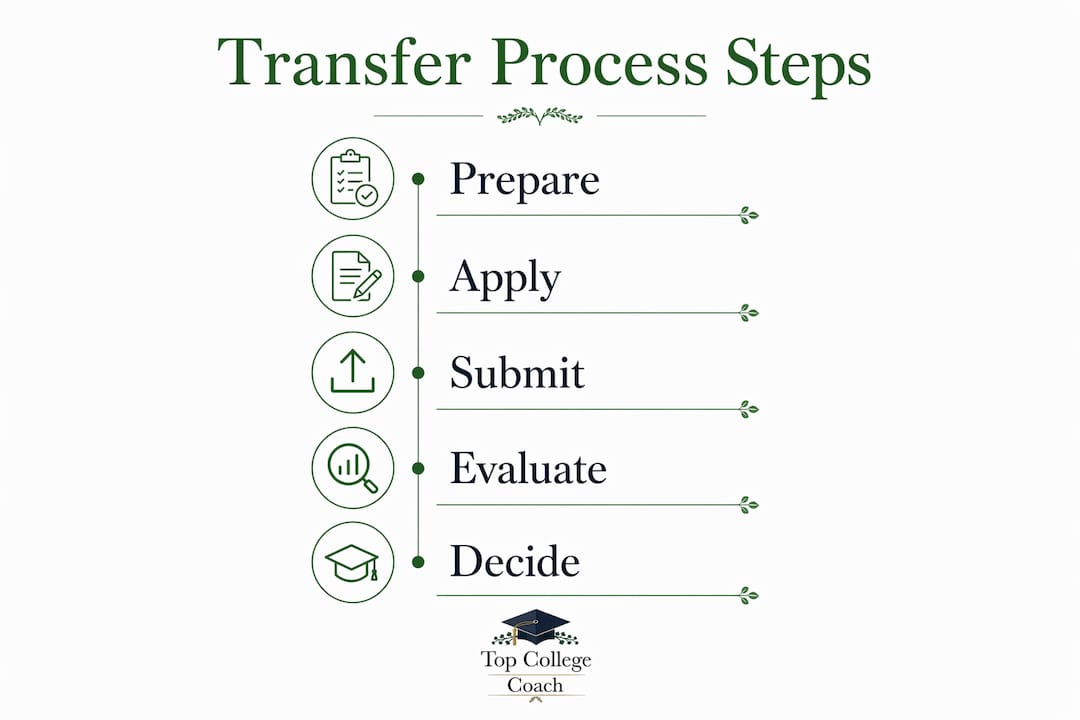
Transfer admissions follows a distinct sequence. You submit an application, provide official transcripts and supporting documents, wait for a credit evaluation, and then receive an admission decision. Each step has its own timeline, and a delay in one stage can push back everything that follows.
Admissions offices treat transfer applications differently from freshman applications. They are not looking for a perfect high school record. They want to see what you have done since high school and whether your academic trajectory points toward success at their institution. That shift in perspective is the foundation of the entire process.

Transfer applicants also face a more compressed review window than freshmen. Schools receive transfer applications later in the cycle and make decisions faster. That means your materials need to be complete and polished from the moment you submit.
What documents and application materials are required?
Most schools require a personal statement and official transcripts from every post-secondary institution you have attended. Some schools also require a college report completed by your current registrar or dean of students. Getting that report takes time, so request it early.
The full list of transfer application materials typically includes:
Official college transcripts from every institution attended after high school, sent directly from the registrar
A transfer essay that explains your reasons for transferring and your academic goals at the new school
Letters of recommendation from college professors, not high school teachers
Standardized test scores (required by some schools, optional at others)
A college report from your current institution’s registrar or dean of students (required at many selective schools)
A mid-term grade report showing current semester performance
The transfer essay deserves special attention. A compelling transfer essay should be 70% focused on what attracts you to the new school and 30% on the limitations of your current situation, while avoiding any negative tone. Admissions officers want to understand your motivation, not read a complaint about your current school.
Professor recommendations carry significantly more weight than letters from high school teachers. Admissions officers want detailed academic insights that reflect your intellectual growth and readiness for advanced coursework. Choose professors who know your work well and can speak to your specific contributions in class.
Pro Tip: Request your college report and transcripts at least six weeks before your application deadline. Registrar offices process high volumes of requests, and delays on their end become delays on yours.
How long does credit evaluation take, and what affects transferability?
Credit evaluation is the step most students underestimate. Transcript processing adds 5–10 business days before credit evaluation even begins. The evaluation itself then takes an additional 2–6 weeks, involving manual comparisons of your coursework against the receiving school’s requirements.
Several factors determine whether your credits transfer:
Factor | What it means for you |
Grade minimum | Most schools require a C or higher in each course for credit to transfer |
Course equivalency | Your course must match the content of a course offered at the new school |
Accreditation | Credits from non-accredited institutions typically do not transfer |
Credit type | Remedial or developmental courses rarely count toward degree requirements |
Program fit | Credits may transfer but not apply to your specific major |
Students often lose between 6 and 12 credits due to course equivalency gaps, grade minimums, and accreditation mismatches. That credit loss can add a semester or more to your degree timeline, which has real financial consequences.
Articulation agreements between community colleges and universities guarantee credit transfer for specific courses and significantly reduce credit loss. States like California, Florida, and Texas have formal articulation systems in place. California’s ASSIST database, for example, lets you preview exactly which credits will transfer and how they apply to degree requirements before you even apply.
Pro Tip: Look up your target school’s articulation agreement before registering for courses at your current institution. Choosing courses that are pre-approved for transfer can save you an entire semester of work.
What are the typical timelines and deadlines in the transfer process?
Timing is where most transfer applications succeed or fail. Most fall transfer deadlines fall between March 1 and April 1, but some systems set earlier cutoffs. The University of California system, for example, closes its transfer application in November for the following fall. Missing that window means waiting a full year.
Here is the sequence every transfer applicant should follow:
Research target schools and confirm their transfer deadlines and specific requirements (start at least 3 months before the earliest deadline)
Request official transcripts from every institution you have attended, allowing 2–3 weeks for processing
Request your college report from your registrar or dean of students
Contact professors for recommendation letters and give them at least 4 weeks’ notice
Draft and revise your transfer essay with enough time for multiple rounds of feedback
Submit your application before the deadline, not on it
Verify receipt of all materials with the admissions office within one week of submission
Await the credit evaluation and admission decision, which typically arrives 4–8 weeks after your application is complete
Waiting until transcript deadlines is one of the most common mistakes in the transfer process. Late or missing transcripts can delay your admission decision by 2–6 weeks, which can cause you to miss course registration windows and financial aid deadlines.
The timeline also differs depending on your transfer type. Community college to four-year transfers often benefit from formal articulation agreements and priority admission pathways. Four-year to four-year transfers face a more competitive review with fewer guaranteed credit transfers and less institutional support built into the system.
See the full college admissions timeline for a detailed breakdown of every stage, including financial aid deadlines that run parallel to the admissions process.
How can you improve your chances in transfer admissions?
GPA is the single most visible factor in a transfer application. Highly selective universities typically expect a GPA well above 3.5, and transfer admission at those schools is more competitive than freshman admission. A strong GPA signals that you can handle the academic rigor of the new institution.
Beyond GPA, these factors separate strong transfer applications from weak ones:
A focused transfer essay that centers on academic fit and future goals, not grievances about your current school
Professor recommendations that speak to specific academic contributions, not generic praise
A realistic school list that includes a range of selectivity levels, not just reach schools
Early and complete document submission that gives admissions offices time to process your file without rushing
Demonstrated interest in the specific programs, faculty, or opportunities at your target school
Admissions offices interpret transfer applications as evidence of academic and personal growth, not failure. Being honest and specific about why you are transferring, and what you plan to accomplish at the new school, reads as maturity rather than weakness.
One area students consistently overlook is financial aid. Financial aid does not automatically transfer when you do. You must submit a new FAFSA and apply for institutional aid at your new school. Merit scholarships from your current institution are typically not transferable, and new aid packages can average $3,000 less annually than what you currently receive. Factor that into your decision before you commit.
Pro Tip: Write your transfer essay as if the admissions officer knows nothing about your current school. Explain your academic goals clearly, name specific programs or professors at the new school that excite you, and connect those details to your long-term plans.
Key Takeaways
The college transfer process rewards students who start early, submit complete materials, and write essays that focus on future goals rather than past frustrations.
Point | Details |
Start at least 3 months early | Most fall deadlines fall between March 1 and April 1, and transcript processing takes weeks. |
Submit all transcripts immediately | Every post-secondary institution must send official transcripts directly to your target school. |
Expect 2–6 weeks for credit evaluation | Transcript processing adds 5–10 business days before the evaluation even begins. |
Use articulation agreements | States like Florida and California have formal systems that guarantee credit transfer for approved courses. |
Reapply for financial aid | A new FAFSA is required, and merit scholarships from your current school do not transfer. |
What I’ve learned from guiding transfer students
The transfer process has a reputation for being confusing, and that reputation is earned. But most of the confusion comes from one source: students treat it like a freshman application with extra steps. It is not. It is a fundamentally different process with different priorities, different timelines, and different evaluation criteria.
The students I have seen succeed are the ones who treat their transfer essay as a forward-looking document, not a backward-looking one. They do not spend 500 words explaining why their current school failed them. They spend those words painting a clear picture of what they want to accomplish and why the new school is the right place to do it. That specificity is what separates a compelling application from a forgettable one.
Credit evaluation is the other area where I see students get blindsided. They assume their credits will transfer cleanly, then discover mid-semester that they are missing prerequisites or have lost a full semester of progress. The fix is simple: use your target school’s articulation tools before you register for courses, not after. In Florida, the statewide articulation system makes this straightforward. In other states, you may need to contact the receiving school’s advising office directly.
The financial aid piece is the one students most often ignore until it is too late. A $3,000 annual reduction in aid is not a minor inconvenience. It is a real cost that should factor into which schools you apply to and which offer you accept. Request a financial aid estimate from your target school before you commit.
The students who navigate this process well are organized, proactive, and honest in their applications. They ask for transcripts early, they choose recommenders who know them well, and they write essays that are specific rather than generic. That combination works.
— Randy Pryor
How Top College Coach supports transfer applicants
Transfer admissions requires a different strategy than freshman admissions, and the margin for error is smaller.

Top College Coach works directly with transfer students to build applications that stand out at selective schools. Our counselors help you craft a transfer essay that articulates your academic goals with clarity, identify the right recommenders, and manage your document submission timeline so nothing falls through the cracks. We also guide students through credit evaluation questions and transfer admissions strategy so you enter the process with a clear plan. If you are ready to approach your transfer application with the same rigor that Ivy League and Top 20 admits bring to theirs, connect with Top College Coach to get started.
FAQ
What is a transfer applicant?
A transfer applicant is any student who has attended at least one college or university after high school and is applying to a different institution. Official transcripts from every post-secondary school attended are required.
How early should I start the transfer application process?
Start at least three months before your earliest deadline. Most fall transfer deadlines fall between March 1 and April 1, and transcript processing alone takes 5–10 business days.
Will all my credits transfer to the new school?
Not necessarily. Students commonly lose 6–12 credits due to course equivalency gaps, grade minimums, or accreditation differences. Articulation agreements can protect your credits if you plan your coursework in advance.
Do I need to reapply for financial aid after transferring?
Yes. Financial aid does not transfer automatically. You must submit a new FAFSA and apply for institutional aid at your new school. Merit scholarships from your current institution are typically not transferable.
What GPA do I need to transfer to a selective school?
Highly selective universities typically expect a GPA well above 3.5 for transfer applicants. Transfer admission at those schools is generally more competitive than freshman admission.
Recommended
Comments