College Admissions Rates Explained: 2026 Guide
- Jun 30
- 8 min read

Admissions rates are defined as the percentage of applicants a college accepts from its total applicant pool, making them the clearest single measure of a school’s selectivity. A school that receives 10,000 applications and admits 500 students has a 5% admissions rate. That number tells you how competitive the process is, but it does not tell you everything about your chances. The National Center for Education Statistics tracks these figures across thousands of institutions, and the range is wider than most families expect. From Harvard’s 3.2% acceptance rate to the University of Mississippi’s 98%, the spectrum of college acceptance rates reflects the full diversity of American higher education. Top College Coach works with students every day to help them read these numbers correctly and build a college list that is both ambitious and realistic.
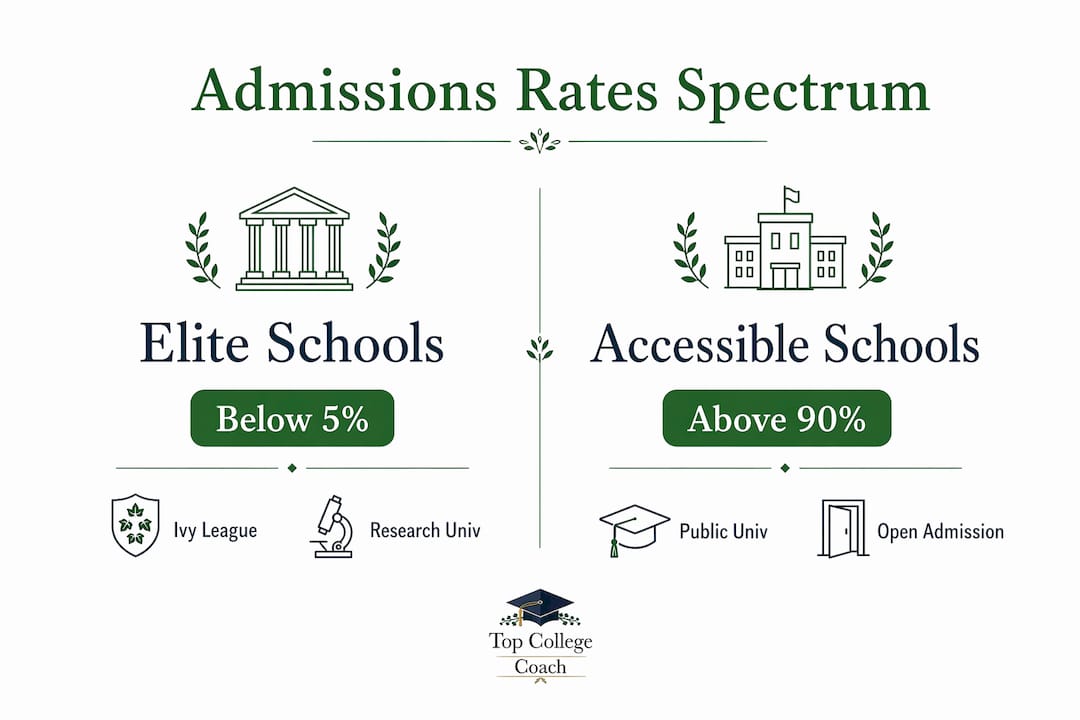
What are admissions rates across U.S. colleges?
Admissions rates vary more dramatically than most students realize. The top tier of selective universities sits well below 5%, while hundreds of four-year schools accept the vast majority of their applicants. Understanding this full range is the first step toward building a college list that fits your goals.
The selective end of the spectrum
Elite universities have acceptance rates below 5% as of 2026. Harvard sits at approximately 3.2%, Stanford at 3.1%, Columbia at 3.9%, Princeton at 3.9%, MIT at 3.5%, and Yale at 4.4%. These numbers reflect an extraordinary level of competition. Getting into any of these schools requires far more than strong grades. It requires a compelling, differentiated application.

The accessible end of the spectrum
On the other end, many public universities accept nearly every qualified applicant. The University of Mississippi accepts 98% of applicants. The University of Nevada, Las Vegas and the University of Maine both sit at approximately 96%. Utah State University accepts 94% of applicants, and the University of Memphis accepts 93%. These schools offer real academic value and strong career outcomes. High acceptance rates do not mean low quality.
Where most schools fall
The median acceptance rate across all four-year institutions is approximately 60% as of 2026. That means the typical American college admits three out of every five applicants. Most students applying to a balanced list of schools will find multiple options where they are genuinely competitive. The narrative that college admissions is universally brutal simply does not match the data.
College | 2026 Acceptance Rate | Type |
Harvard University | ~3.2% | Private, Ivy League |
Stanford University | ~3.1% | Private, Elite |
MIT | ~3.5% | Private, Elite |
Princeton University | ~3.9% | Private, Ivy League |
Yale University | ~4.4% | Private, Ivy League |
University of Mississippi | ~98% | Public |
University of Nevada, Las Vegas | ~96% | Public |
University of Maine | ~96% | Public |
Utah State University | ~94% | Public |
University of Memphis | ~93% | Public |
Why do admissions rates change over time?
Admissions rates are not fixed. They shift every year in response to forces that have nothing to do with the quality of any individual applicant. Knowing what drives those shifts helps students and parents set realistic expectations.
The single biggest driver is application volume. Common App submissions grew from approximately 2.8 million in 2010 to 7.5 million in 2026. That nearly tripled the number of applications flowing into colleges without a proportional increase in available seats. When more students apply to the same number of spots, acceptance rates fall.
Several factors have accelerated this trend:
Test-optional policies lowered the barrier to applying, encouraging students to submit applications to schools they might have skipped before.
Common App expansion made it easier to apply to more schools with less marginal effort per application.
Demographic growth in college-age populations increased the raw number of applicants.
Social media visibility of elite schools raised their profile and attracted more applications from students nationwide.
Harvard’s acceptance rate fell from 6.2% in 2010 to 3.2% in 2026. Stanford dropped from 7.2% to 3.1% over the same period. These are not small changes. They represent a fundamental shift in the competitive environment at the top of the market.
The median acceptance rate across four-year institutions also declined, from about 66% in 2010 to 60% in 2026. Even schools outside the elite tier felt the pressure of rising application numbers.
Pro Tip: When a school’s acceptance rate drops year over year, check whether its freshman class size stayed the same. If it did, the drop reflects more applicants, not a harder bar. That distinction matters when you assess your real odds.
How do elite and accessible institutions compare?
The gap between elite and accessible institutions is wider than at any point in recent history. Understanding that gap helps students and parents stop treating all rejections as personal failures and start making smarter decisions about where to apply.
Elite schools like the Ivy League and top research universities receive tens of thousands of applications for a few thousand seats. Their admissions process evaluates academic achievement, personal character, extracurricular depth, and institutional fit simultaneously. A 3.9% acceptance rate at Columbia means that even exceptional students face long odds. That is not a reflection of their worth. It is a reflection of math.
Public universities with acceptance rates above 90% operate under a different mission. They serve their state populations, prioritize access, and often have rolling admissions. A student with a solid academic record and a genuine interest in the school will almost certainly get in. These schools produce doctors, engineers, CEOs, and senators every year.
The most useful way to think about university admission statistics is in tiers. Reach schools sit below 20% acceptance. Match schools typically fall between 40% and 70%. Safety schools generally accept 80% or more of applicants. A well-built college list includes schools from all three tiers.
Pro Tip: Do not let a school’s acceptance rate be the only reason you apply or skip it. A school that accepts 15% of applicants may be a realistic match for a student with a 4.0 GPA, strong test scores, and a clear academic focus. A school that accepts 60% may be a reach for a student with a weaker transcript. Fit matters more than the raw number.
For a detailed breakdown of top 20 acceptance rates, the data shows meaningful variation even within the selective tier.
How can students use admissions rates in their application strategy?
Admissions rates are a tool, not a verdict. Students who use them correctly build stronger college lists and make smarter decisions about where to invest their time and energy.
The first mistake students make is treating acceptance rates as a measure of their own worth. A 3.5% acceptance rate at Harvard does not mean you are not good enough. It means the school has far more qualified applicants than available seats. Reframing that reality changes how you approach the process emotionally and practically.
Here is how to use acceptance rate data well:
Build a tiered list. Include two to three reach schools (below 20%), three to four match schools (40%–70%), and two safety schools (above 80%). This structure gives you real options at every level of selectivity.
Research beyond the headline number. Many schools publish acceptance rates broken down by major, in-state versus out-of-state status, and applicant pool characteristics. A school with a 25% overall rate may accept 40% of applicants to a specific program.
Strengthen the factors you control. Acceptance rates reflect competition, but your essays, recommendations, and extracurricular record are entirely within your control. Knowing what top colleges look for beyond raw numbers gives you a real edge.
Apply early where it helps. Many selective schools have meaningfully higher acceptance rates in their Early Decision or Early Action pools. If a school is your clear first choice, applying early is one of the most effective ways to improve your odds.
Do not over-apply to reach schools. Sending 15 applications to schools with sub-5% acceptance rates is not a strategy. It is a distraction from the applications where your effort will actually move the needle.
Use demonstrated interest. Visiting campus, attending information sessions, and engaging with admissions officers signals genuine interest. Some schools track this and factor it into decisions.
The admissions process rewards students who are self-aware, focused, and authentic. Acceptance rates give you context. Your application gives you agency.
Key takeaways
Admissions rates measure selectivity, but a well-built college list, strong application materials, and smart timing matter far more than any single acceptance percentage.
Point | Details |
Admissions rates vary widely | Rates range from 3.1% at Stanford to 98% at the University of Mississippi across four-year schools. |
Application volume drives rate changes | Common App submissions nearly tripled from 2010 to 2026, pushing acceptance rates down at most schools. |
The median rate is 60% | Most four-year colleges admit the majority of applicants, making a balanced list achievable for most students. |
Tiered lists reduce risk | Applying to reach, match, and safety schools gives students real options at every selectivity level. |
Rates are context, not destiny | Essays, test scores, extracurriculars, and early application timing all shape outcomes beyond the raw number. |
What I have learned after years of watching families read these numbers wrong
Families come to Top College Coach carrying a lot of anxiety about acceptance rates, and I understand why. When you see a 3.2% acceptance rate at Harvard, it feels like a wall. What I have observed over years of counseling is that the students who succeed at selective schools are not the ones who obsessed over the rate. They are the ones who focused on building a genuine, specific, and memorable application.
The number that surprises most families is the median. Sixty percent of applicants to the average four-year school get in. That means the admissions crisis people read about online is concentrated at a very small number of highly visible institutions. For the vast majority of students, a thoughtful college list will produce multiple acceptances.
The other thing families consistently underestimate is how much application inflation has distorted the picture. When Common App made it easy to apply to 15 schools instead of 5, acceptance rates at popular schools dropped even though the schools themselves did not get harder to get into. A student who would have been admitted in 2010 would still be admitted today. The pool just got bigger.
My honest advice is this: use acceptance rates to build your list, not to judge yourself. A student who applies to the right mix of schools, writes essays that reflect who they actually are, and demonstrates real interest in each institution will find a great college. The rate is just the starting point.
— Randy Pryor
How Top College Coach helps families make sense of admissions data
Making sense of university admission statistics takes more than reading a table. It takes knowing how to apply that data to a specific student’s profile, strengths, and goals.
Top College Coach has helped students gain admission to Ivy League and Top 20 universities by combining data-driven college list building with personalized application coaching. We explain what acceptance rates actually mean for your student, identify where they are genuinely competitive, and help them put their best application forward. Based in Orlando, Florida, with five-star reviews from families across the country, we bring clarity to a process that can feel opaque. If you are ready to build a college list grounded in real data and real strategy, visit Top College Coach to learn more about our admissions counseling services.
FAQ
What does admissions rate mean?
An admissions rate is the percentage of applicants a college accepts from its total applicant pool. A school with a 10% admissions rate admitted 1 out of every 10 students who applied.
What is a good college acceptance rate to aim for?
There is no single “good” rate. A balanced college list includes schools across the full range, from selective reaches below 20% to accessible safety schools above 80%.
Why are Ivy League acceptance rates so low?
Ivy League acceptance rates have fallen because application volume has grown dramatically. Common App submissions grew from 2.8 million in 2010 to 7.5 million in 2026, flooding elite schools with far more applicants than available seats.
Do acceptance rates affect my chances if I apply early?
Yes. Many selective schools accept a higher percentage of applicants in their Early Decision pool than in the regular decision round. Applying early to your top choice school is one of the most practical ways to improve your odds.
How do I improve my admission chances at selective schools?
Focus on the factors you control: write specific, authentic essays, build a meaningful extracurricular record, secure strong recommendations, and apply early where possible. Acceptance rates set the context. Your application determines the outcome.
Recommended
Comments