Why Private College Counselors Are Needed in 2026

Private college counselors are specialized advisors who guide students through the college admissions process with personalized strategies, detailed planning, and expert support that school counselors typically cannot provide. The question of why private college counselors are needed has a clear answer: the admissions process has grown more complex, more competitive, and more consequential than ever before. Families who understand the role of these professionals gain a real advantage. Research confirms that students who work with dedicated advisors are measurably more likely to enroll in college, complete financial aid applications on time, and submit stronger applications overall.
Why are private college counselors needed when schools already have counselors?
The core difference between school counselors and private college advisors comes down to time and focus. Public school counselors manage an average caseload that leaves little room for the deep, individualized attention college applications require. Private counselors, by contrast, serve 15–30 families per year, which means your student gets dedicated hours, not minutes.
School counselors do important work, but their responsibilities extend far beyond college prep. They handle mental health support, scheduling, disciplinary issues, and career guidance simultaneously. That breadth limits how much time any one student receives for college planning. A private college advisor focuses exclusively on admissions strategy, financial aid, and application execution.

The importance of college counselors in the private sector also reflects a structural gap in public education. Many high schools, particularly in under-resourced districts, have counselor-to-student ratios that make personalized college advising nearly impossible. Families who recognize this gap and act on it give their students a concrete edge.
What services do private college counselors provide?
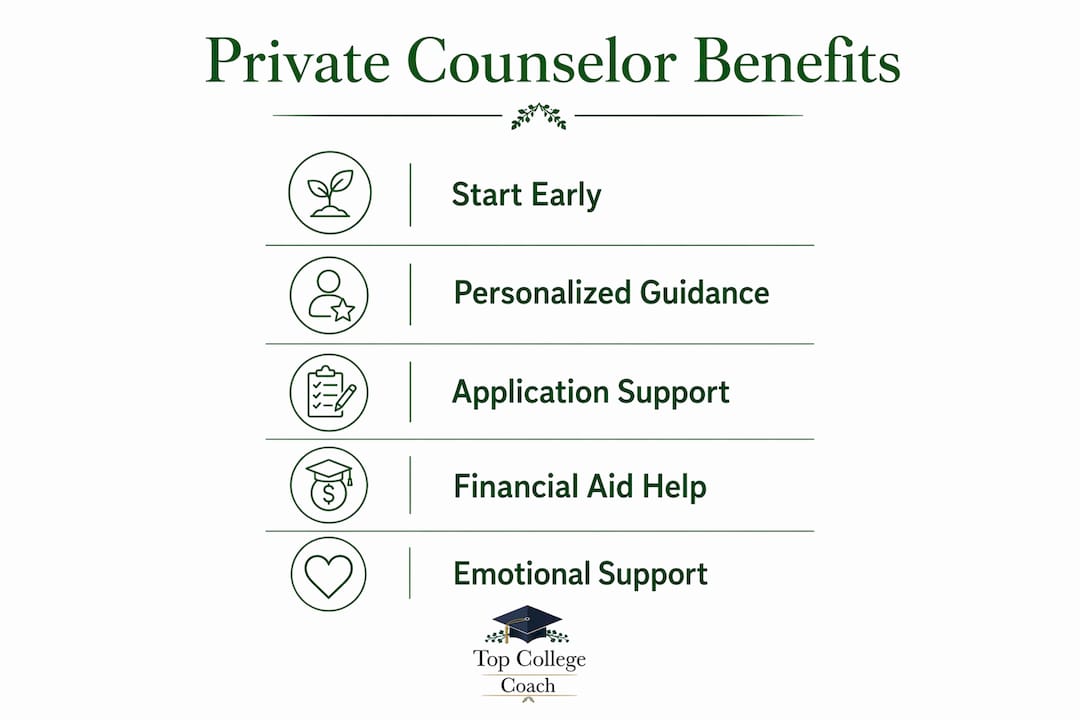
Private college counseling services cover every stage of the admissions process, from building a college list in 10th grade to submitting final applications in 12th grade. The scope of support goes well beyond what most families expect.
Core services include:
College list building: Counselors create balanced lists with dream, match, and safety schools based on academic fit and financial situation, not just prestige rankings.
Essay coaching: Advisors help students brainstorm authentic topics and select strong recommenders, which are two of the most fragile parts of any application.
FAFSA and financial aid guidance: Counselors walk families through complex aid processes, including timing strategies and understanding how assets affect eligibility.
Deadline and task management: Advisors build application calendars, track requirements, and hold students accountable to early completion milestones.
Interview preparation: Students practice articulating their story clearly and confidently before high-stakes conversations with admissions officers.
Pro Tip: File the FAFSA as early as possible in october of your senior year. Research shows that early financial aid completion is one of the strongest predictors of college enrollment, and a private counselor keeps this task from slipping.
The benefits of private counselors extend to the emotional side of the process as well. Students who feel supported and organized perform better in interviews and write stronger essays. Anxiety decreases when there is a clear plan in place.
How does working with a private counselor improve admissions outcomes?
The evidence here is direct and compelling. Students who engage in multiple in-person meetings with dedicated college advisors are 7 percentage points more likely to enroll in college. That gap represents thousands of students who reach their educational goals because they had expert guidance at the right moments.
“Early task completion, such as FAFSA filing, increases college-going rates by 7–8 points when professional advising is involved. The mechanism is not motivation alone. It is structured, technical help that removes barriers students cannot navigate on their own.” Brookings Institution, “Why Expert Advising Matters for College Access”
The University of Wisconsin research on Advise TN found that professional advisors with caseloads around 100:1 produced stronger enrollment outcomes than generalist counselors with far larger caseloads. That ratio matters because it determines how much time each student actually receives. Private counselors operate at an even lower ratio, often working with fewer than 30 families annually.
Technical, task-focused advising drives greater college enrollment than vague general guidance. This finding challenges the assumption that encouragement and motivation are enough. What students need most is someone who knows exactly which form to file, which deadline to hit, and which essay angle will resonate with a specific admissions committee.
The advantages of hiring college counselors also show up in financial outcomes. Families who receive expert aid guidance often identify scholarship opportunities and aid strategies they would have missed entirely, which can offset the cost of counseling many times over.
When should families consider hiring a private college counselor?
The ideal time to engage a private college advisor is the beginning of 10th grade, or even earlier for students targeting highly selective schools. Starting early allows the counselor to shape course selection, extracurricular strategy, and standardized test planning before those decisions become fixed.
That said, families who begin in 11th or 12th grade still benefit significantly. The key is matching the timing to your student’s specific needs.
10th grade start: Best for students aiming at Ivy League or Top 20 universities, where admissions strategy must begin years before application deadlines.
11th grade start: Appropriate for students who need help with standardized testing, course rigor, and building a preliminary college list.
12th grade start: Still valuable for essay coaching, deadline management, and financial aid navigation, though some strategic options are no longer available.
Specialized circumstances: Students with learning differences, athletes pursuing recruitment, or first-generation college students benefit from private counseling at any stage.
Cost is a real consideration for families. Private college counseling services range widely in price, and the return on investment depends on how well the counselor’s approach matches the student’s goals. Families should prioritize counselors who offer structured, data-driven plans over those who rely on vague promises about connections or insider access.
Pro Tip: Ask any prospective counselor to walk you through a sample application timeline. A counselor who cannot produce a clear, task-by-task plan is not offering the kind of technical support that research shows actually moves the needle.
A private counselor may not be necessary for every student. If your student attends a school with a dedicated college counselor and a low student-to-counselor ratio, and is applying to a straightforward list of schools, the additional investment may not be the right fit. Honest self-assessment matters here.
How to select the right private college counselor for your family
Choosing the right advisor requires more than reading testimonials. The college admissions counselor market includes professionals with vastly different backgrounds, methods, and track records.
Look for these qualities in a strong candidate:
Verifiable experience: Ask for specific examples of students they have helped and the outcomes those students achieved. General claims about “many Ivy League acceptances” are not enough.
Structured process: The counselor should describe a clear methodology covering college list building, essay development, financial aid planning, and deadline tracking.
Reasonable caseload: A counselor working with more than 50 families at once cannot provide the attention your student needs.
Transparent pricing: Fees should be clearly stated upfront, with no hidden charges for additional services.
No conflicts of interest: Avoid counselors who receive referral fees from colleges or who push students toward specific schools without clear justification.
Red flags include guarantees of admission to specific schools, pressure to apply to colleges the counselor has relationships with, and an inability to explain their process in concrete terms. The role of private college advisors is to serve your student’s interests, not to manage their own reputation.
The right counselor asks more questions than they answer in the first meeting. They want to understand your student’s academic trajectory, personal interests, financial situation, and long-term goals before offering any recommendations. That curiosity is a sign of genuine, personalized support.
Key Takeaways
Private college counselors provide structured, expert support that directly improves college enrollment rates, financial aid outcomes, and application quality for students at every level.
Point | Details |
Start early for best results | Beginning in 10th grade gives counselors time to shape course selection, testing, and extracurricular strategy. |
Task-focused advising works | Research shows technical help with FAFSA and deadlines raises enrollment rates by 7–8 percentage points. |
Low caseloads drive outcomes | Private counselors serving fewer than 30 families annually provide the dedicated time that produces results. |
Financial aid guidance pays off | Expert aid strategy often identifies scholarships and timing advantages that offset counseling costs. |
Structured plans over vague promises | Choose counselors who provide clear, step-by-step application timelines rather than general encouragement. |
The real value most families overlook
I have worked with hundreds of families over the years, and the most common regret I hear is not “we spent too much on a counselor.” It is “we waited too long to get help.”
Parents often assume that a strong GPA and high test scores are enough. They are not, and the data backs that up. Admissions at selective schools has become a craft, not a formula. The students who stand out write essays that reveal genuine character, build college lists that reflect real self-knowledge, and submit applications that are technically flawless. That combination rarely happens without expert guidance.
What surprises most families is how much of the private counseling value comes from the process itself, not just the outcome. Students who work through a structured admissions plan with a skilled advisor develop clearer thinking about who they are and what they want. That clarity shows up in every part of the application.
I also want to address a misconception directly: private college counseling is not only for wealthy families or students targeting elite schools. The college admissions process is complex at every level, and first-generation students, students from under-resourced schools, and students with non-traditional profiles often benefit the most from expert support. The counselor levels the playing field by giving every student access to the kind of knowledge that used to be available only through expensive networks.
My honest recommendation: prioritize counselors who show you their process before they show you their results. A counselor who leads with a clear methodology is one who has earned their outcomes through real work, not luck.
— Randy Pryor
How Top College Coach helps families navigate admissions
Top College Coach brings a proven record of helping students gain admission to Ivy League and Top 20 universities, with a personalized approach built around each student’s unique story, goals, and academic profile.
Based in Orlando, Florida, Top College Coach works with families across the country to build college lists, craft compelling essays, manage financial aid strategy, and meet every deadline with confidence. The team’s 5-star reviews reflect a commitment to real results, not generic advice. Whether your student is just beginning to think about college or is deep in the application process, Top College Coach offers the expert admissions support your family deserves. Reach out today to learn how a dedicated counselor can change your student’s trajectory.
FAQ
What does a private college counselor actually do?
A private college counselor builds personalized college lists, coaches students on application essays, manages deadlines, and guides families through financial aid processes. Their work is task-specific and tailored to each student’s academic profile and goals.
How early should you hire a private college counselor?
The best time to hire a private college counselor is the start of 10th grade, especially for students targeting selective universities. Students who begin in 11th or 12th grade still benefit, particularly for essay coaching and financial aid planning.
Do private college counselors actually improve admissions outcomes?
Research from the Brookings Institution shows that students working with dedicated advisors are 7 percentage points more likely to enroll in college. The impact is strongest when counselors provide structured, technical help rather than general encouragement.
What should you ask a private college counselor before hiring them?
Ask for a sample application timeline, a description of their process for building college lists, and specific examples of past student outcomes. A counselor who cannot answer these questions concretely is not the right fit.
Is private college counseling worth the cost?
For most families, the answer is yes. Expert financial aid guidance alone often identifies scholarship opportunities and aid strategies that offset the counseling fee. The return on investment grows when counseling begins early and follows a structured, data-driven plan.
Recommended
Comments