The Role of Senior Year Grades in College Admissions

Senior year grades are a direct signal to colleges that you can sustain academic momentum all the way to graduation. The role of senior year grades in admissions extends well beyond your GPA at application time. Colleges use mid-year reports, final transcripts, and course rigor to confirm you are ready for college-level work. 74.1% of four-year colleges rate overall high school grades as considerably important in admissions decisions. That number includes your senior year, not just your freshman through junior performance.
How do colleges evaluate senior year grades in the admissions process?
Colleges review your senior year grades at two key moments: the mid-year report and the final transcript. Neither is optional, and both carry real weight.

The mid-year report
The mid-year report arrives at colleges in February or march and contains your first-semester senior grades. Fall semester grades are the last new academic information colleges receive before making final decisions for Regular Decision applicants. That makes them the clearest confirmation of whether your academic trajectory is holding steady or slipping.
The final transcript
Your school counselor submits your final transcript after graduation. It includes every senior year grade and confirms you graduated. Colleges use this document to verify that nothing changed dramatically between acceptance and enrollment. A sudden drop in the second semester can trigger a review of your admission offer.
What colleges actually look for
Admissions officers assess two things: consistency and rigor. A student who earned a 3.8 GPA through junior year but drops to a 3.2 in senior year raises a flag. A student who maintained a full load of AP courses through senior year signals genuine readiness. Academic consistency and course rigor in senior year tell admissions officers you are committed and prepared, not just coasting to graduation.
Evaluation also varies by application round:
Early Decision and Early Action applicants receive decisions before mid-year reports arrive, but colleges still request and review those reports afterward.
Regular Decision applicants are evaluated with mid-year reports already in hand.
Waitlisted students benefit most from strong final grades, since updated transcripts can tip the decision in their favor.
Pro Tip: If you are on a waitlist, send an updated transcript proactively. Strong final grades are one of the most concrete ways to strengthen a waitlist appeal.
What are the consequences of a significant grade drop?
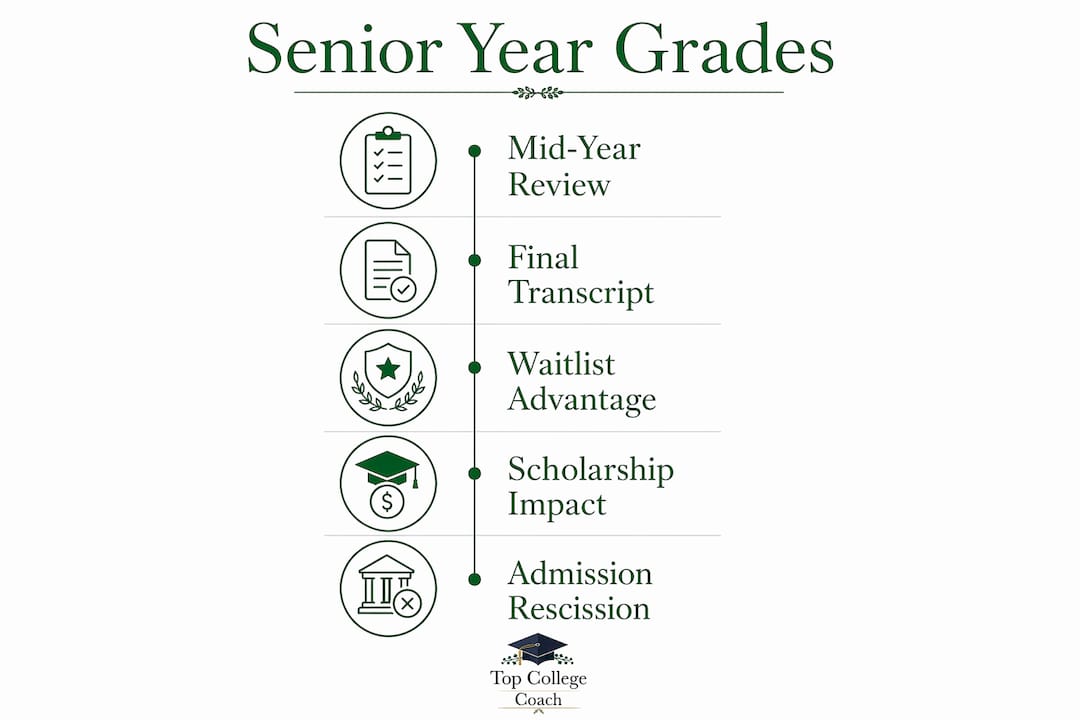
A serious grade decline in senior year carries real consequences. The risks range from scholarship reductions to a rescinded admission offer.
Rescinded admission offers
Rescission is rare, but it happens. Stanford, Cornell, Michigan, and UCLA all specify that serious grade drops or course failures during senior year can lead to a rescinded offer. Colleges typically send a warning letter first, asking for an explanation. Failing to respond or showing no improvement can result in the offer being pulled entirely.
Scholarship and merit aid loss
Merit-based scholarships often depend on your cumulative GPA at graduation. Senior grades directly affect scholarship eligibility when a grade drop pulls your final GPA below the required threshold. Losing a merit scholarship in the summer before college starts is one of the most avoidable financial setbacks a student can face.
Academic probation and housing changes
A college may place you on academic probation before your first class begins.
Honors housing or special program placement can be revoked if your final GPA falls below program requirements.
Some colleges require you to meet with an academic advisor before enrollment if your senior grades declined significantly.
Financial aid packages tied to academic performance may be restructured before you arrive on campus.
“Even after acceptance, colleges may place students on probation, reduce scholarships, or rescind offers based on senior year grade drops. Colleges have clear policies to respond to GPA declines, and they enforce them.”
The pattern is consistent across selective institutions. Colleges respond to GPA declines with probation, aid changes, or rescinded admission. Finishing strong is not optional. It is a condition of your acceptance.
How can strong senior grades improve your admissions outcome?
Strong final-year performance does more than protect your existing offer. It can actively open new doors, especially for students still waiting on decisions.
Waitlist advantages
Waitlisted students who submit updated transcripts showing improved grades give admissions committees a concrete reason to reconsider. Updated grades later in senior year can strengthen waitlist consideration and scholarship awards. A student who moves from a B+ average to a straight-A second semester sends a clear message: they finished strong when it counted most.
Additional merit aid
Some colleges award supplemental merit scholarships or honors program placement based on final cumulative GPA. A student who raises their GPA in the final semester may qualify for aid they were not initially offered. That is a direct financial return on academic effort.
Signals that matter to admissions officers
Completing a rigorous course load through senior year confirms you did not take the easy path after submitting your application.
Maintaining or improving grades in challenging subjects like calculus, AP English, or AP Chemistry shows you can handle college coursework.
Consistent performance across all four years tells a story of discipline, not just ability.
Colleges reviewing what top colleges look for consistently list academic consistency as a top factor.
Pro Tip: If your grades improved significantly in the second semester, ask your counselor to send an updated transcript to your top-choice school, even if they have not requested one. Proactive communication signals maturity and initiative.
Practical tips for sustaining strong academic performance in senior year
Senioritis is real, but it is also manageable. The students who avoid it share a few common habits.
Set specific academic goals for each semester. Vague intentions like “do better” do not work. Commit to a target grade in each class and track your progress monthly.
Seek help before you fall behind. Teachers and tutors are far more effective when you reach out at the first sign of trouble, not after a failed test. Most schools offer free tutoring resources that go underused in senior year.
Protect your schedule from overcommitment. College application season brings a flood of activities, visits, and social events. Build a weekly schedule that reserves dedicated study time, and treat it as non-negotiable.
Stay connected with your school counselor. Your counselor submits both your mid-year report and your final transcript. They need accurate information, and you need to know what is being sent. Check in with them at least once per semester to confirm everything is on track.
Manage stress with structure, not avoidance. Anxiety about college decisions can make it tempting to disengage from schoolwork. A consistent daily routine, including sleep, exercise, and study time, reduces stress more reliably than stepping back from academics.
Use your college admissions resources. Working with an experienced counselor through organizations like Top College Coach gives you a clear picture of how your senior year performance fits into your overall application story. Expert guidance helps you prioritize the right courses and maintain the right GPA targets for your specific schools.
For more guidance on sustaining academic consistency, the college admissions advice resources at Top College Coach cover senior year planning in depth.
Key Takeaways
Senior year grades are a binding part of your college application, not a formality after acceptance letters arrive.
Point | Details |
Grades reviewed twice | Colleges check mid-year reports and final transcripts as official checkpoints. |
Rescission is real | Stanford, Cornell, Michigan, and UCLA all enforce policies for serious grade drops. |
Scholarships depend on GPA | Merit aid eligibility often ties to your cumulative GPA at graduation, including senior grades. |
Strong grades help waitlisted students | Updated transcripts with improved grades can shift a waitlist decision in your favor. |
Rigor signals readiness | Maintaining challenging courses through senior year confirms college preparedness to admissions officers. |
Senior year is not the finish line. It is the proof.
After working with students and families for years, I have seen one pattern repeat itself more than any other. A student earns a strong junior year GPA, submits a polished application, and then mentally checks out. They assume the hard work is done. It is not.
The colleges that accepted you made a bet based on who you were through junior year. Senior year is where you prove that bet was right. I have watched students lose merit scholarships they desperately needed because their second-semester grades slipped by half a point. I have also watched waitlisted students earn admission to their first-choice school because they sent an updated transcript showing a strong final semester. The difference between those two outcomes is not talent. It is follow-through.
The most common mistake I see is treating senior year as two separate halves: the first semester matters, and the second does not. That is wrong. Colleges review your full senior year record. The second semester is often where the real story gets written, because it shows what you do when no one is watching and the pressure has lifted.
My advice to every student and parent: treat the second semester of senior year with the same seriousness as the first. Set a GPA target, stay in contact with your counselor, and do not drop the challenging courses just because you got in somewhere. The habits you build in senior year are the same ones that will carry you through your first semester of college.
— Randy Pryor, College Admissions Expert
How Top College Coach can help you finish strong
Senior year planning is one of the most high-stakes parts of the college admissions process, and it is also one of the most overlooked.

Top College Coach works with students and families to build a clear senior year plan that protects admission offers, supports scholarship eligibility, and positions students for the strongest possible outcome. Whether you are navigating a waitlist, managing a merit aid condition, or simply trying to stay on track through a demanding final semester, our team provides the expert guidance you need. Schedule your free admissions strategy session with Top College Coach today and get a personalized plan built around your specific schools, grades, and goals.
FAQ
Do senior year grades affect college admission decisions?
Yes. 74.1% of four-year colleges rate overall high school grades as considerably important, and senior year grades are included in that evaluation through mid-year reports and final transcripts.
Can a college rescind an offer because of senior year grades?
Yes. Schools including Stanford, Cornell, Michigan, and UCLA have explicit policies allowing them to rescind admission if senior year grades drop significantly or a student fails to graduate.
When do colleges see senior year grades?
Colleges receive first-semester grades through the mid-year report, typically in february or march. Final transcripts arrive after graduation and include all senior year grades.
Do senior grades affect merit scholarships?
Yes. Merit scholarships frequently depend on cumulative GPA at graduation, meaning a grade drop in senior year can reduce or eliminate an award before you set foot on campus.
Can strong senior grades help a waitlisted student?
Yes. Updated transcripts showing improved final grades give admissions committees a concrete reason to reconsider a waitlisted applicant, making senior year performance one of the most direct tools available to students still waiting on a decision.
Recommended
Comments