The Role of Standardized Testing in College Admissions

Standardized testing in college admissions is defined as the use of SAT and ACT scores to evaluate applicants’ academic readiness on a consistent, comparable scale across thousands of different high schools. The role of standardized testing in admissions has never been more contested or more consequential than it is right now. Yale, Dartmouth, and MIT have all reinstated score requirements for 2026 after years of test-optional experimentation, and the data behind those decisions tells a story every parent and educator needs to understand. Whether your student attends a rigorous private school or an under-resourced public one, knowing how scores are actually used can change the outcome of their application.
How do colleges use standardized test scores in admissions?
Test scores serve as a common academic benchmark across schools with wildly different grading standards, course rigor, and teacher expectations. A 4.0 GPA from one school may represent a very different level of preparation than a 4.0 from another. Admissions committees at selective universities use scores to contextualize GPA within that reality.
That said, scores do not operate in isolation. Admissions officers at most institutions practice holistic review, weighing test scores alongside high school GPA, course rigor, essays, extracurricular activities, and recommendation letters. The weight given to each factor shifts depending on the institution and the applicant pool. According to a 2023 survey, 74% of admissions officers rate high school GPA as very important, while only 5% give the same weight to standardized test scores. This means scores function more as a validation tool than a primary criterion at many schools.
Here is how scores typically fit into the process:
Threshold screening: Many selective schools use score ranges to identify applicants who meet a baseline academic standard before deeper review begins.
GPA contextualization: A strong score can offset a slightly lower GPA from a school known for grade deflation, and vice versa.
Merit aid qualification: Scores often determine eligibility for institutional scholarships, even at schools that are test-optional for admissions.
Predictive modeling: Admissions offices use historical score data to forecast academic performance and retention.
Pro Tip: Check each school’s Common Data Set to see exactly how much weight it assigns to test scores. This publicly available document reveals the real criteria behind each institution’s admissions decisions.
Understanding what colleges look for beyond scores is just as important as the scores themselves. The strongest applications present a coherent academic story where every element reinforces the others.
What evidence supports the importance of standardized tests?
The research on predictive validity is more definitive than most families realize. SAT and ACT scores explain approximately 22% of the variation in first-year college GPA at selective universities, compared to just 9% explained by high school GPA alone. That study analyzed 99,000 applicants across multiple admission cycles, making it one of the largest datasets ever applied to this question. The implication is clear: scores carry roughly twice the predictive power of GPA when it comes to forecasting how a student will perform academically in their first year.
The data on score submission strategy is equally striking. At Dartmouth, high-achieving students from less advantaged backgrounds who submitted scores saw their admission rates rise from 2.9% to 10.2%. That is a 3.6 times improvement in admission odds simply from including a score. For families who assume test-optional means scores do not matter, this finding is a wake-up call.
“Removing standardized testing has unintentionally harmed underrepresented students by removing a context-sensitive measure and increasing reliance on potentially biased metrics.” — Research insight from High Ed Insights
The table below summarizes the key data points on test score impact:
Metric | Finding |
SAT/ACT predictive power (first-year GPA) | Explains 22% of variation vs. 9% for high school GPA |
Dartmouth admission rate without scores | 2.9% for less advantaged high-achievers |
Dartmouth admission rate with scores | 10.2% for the same group (3.6x improvement) |
Admissions officers rating GPA as very important | 74% in 2023 survey |
Admissions officers rating test scores as very important | 5% in 2023 survey |
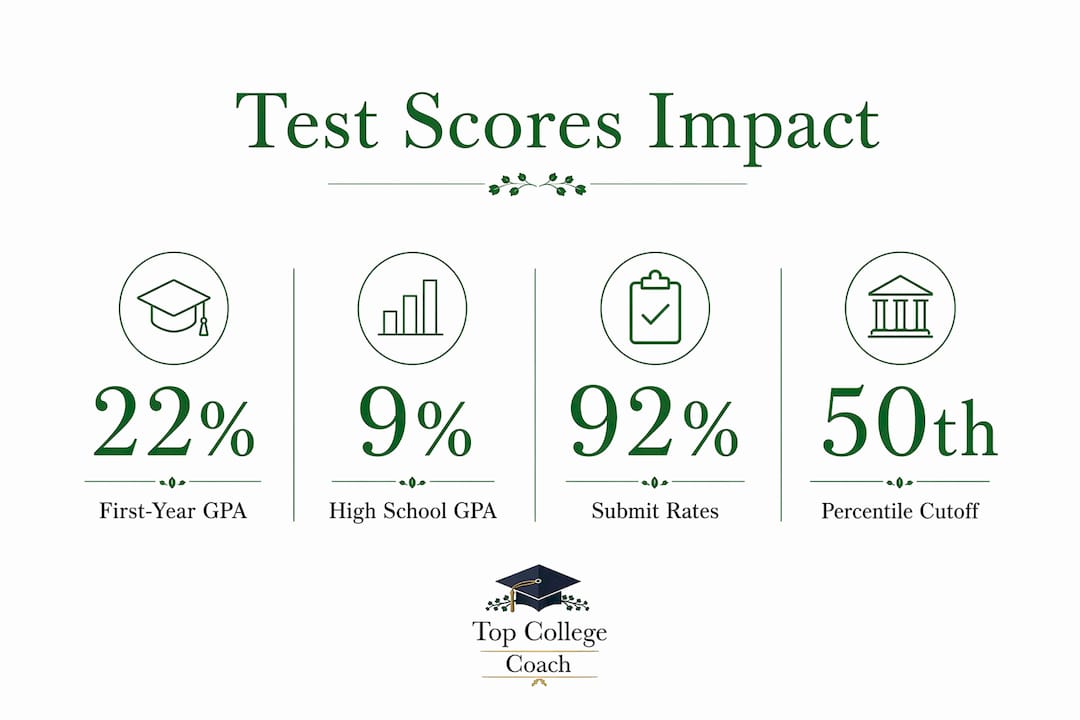
These numbers do not argue that scores override everything else. They argue that scores, used strategically, can be one of the most powerful tools in a student’s application.

What are the complexities and disparities in standardized testing?
The test-optional movement was built on a legitimate concern: standardized tests can reflect socioeconomic advantage as much as academic ability. Students from wealthier families have greater access to private tutoring, test prep programs like those offered by Kaplan or Princeton Review, and the ability to retake exams multiple times. That structural inequality is real and should not be dismissed.
But the policy response has created its own set of problems. Here are the key complexities families need to understand:
Strategic withholding is not universal. Advantaged students with scores below the 25th percentile often benefit from withholding scores strategically, but less advantaged students with even average scores frequently improve their odds by submitting. The same rule does not apply to everyone.
Misconceptions are widespread. Many families from underrepresented backgrounds assume test-optional means scores are unwelcome or irrelevant. Admissions officers can and do estimate a student’s likely score range from other application materials, so withholding a competitive score provides no real advantage.
Counselor pressure varies. Some school counselors, influenced by the test-prep industry or institutional culture, push students toward or away from submission without understanding the individual student’s profile. A counselor recommendation letter can be shaped by these same pressures, which is worth discussing openly with your student’s school.
Test-optional does not mean test-blind. Over 90% of four-year colleges are test-optional or test-free, yet more applicants are choosing to submit scores than ever before. The market is telling families something that policy language obscures.
Merit aid is often score-dependent. Even at schools that do not require scores for admissions, scholarship thresholds frequently depend on them. A student who withholds a solid score to appear test-optional may unknowingly disqualify themselves from significant financial aid.
Pro Tip: If your student’s score falls at or above the 50th percentile for a target school, submit it. The research consistently shows that submitting a competitive score helps, even at test-optional institutions.
How have college admissions testing policies evolved in 2026?
The most significant development in college admission testing processes over the past two years is the reversal of test-optional policies at elite institutions. Yale, Dartmouth, and MIT reinstated SAT and ACT requirements for the 2026 admissions cycle after conducting internal studies on student outcomes. These decisions were data-driven, reflecting in-house research on GPA correlations, retention rates, and graduation outcomes rather than ideological preferences.
The results at Yale were telling: 92% of Yale’s fall 2026 incoming class submitted scores even before the formal reinstatement, suggesting that high-achieving applicants already understood the strategic value of submitting. UT Austin reported a median SAT of 1420 for students who submitted scores versus 1160 for those who did not, with corresponding differences in first-year GPA. That 260-point gap is not noise. It reflects a real difference in academic preparation that institutions can no longer afford to ignore.
Policy type | Representative schools | Current direction |
Test-required (reinstated) | Yale, Dartmouth, MIT | Returning to mandatory scores for 2026 |
Test-optional (maintained) | University of Chicago, many state schools | Scores accepted but not required |
Test-free | Hampshire College, select liberal arts schools | Scores not accepted or reviewed |
COVID-19 accelerated the test-optional movement when testing centers closed in 2020 and 2021. Many schools adopted temporary policies that became permanent by default. The current wave of reinstatements reflects a more deliberate, evidence-based review of what those years of test-optional admissions actually produced in terms of student success.
What practical guidance should parents and educators know?
Navigating the current testing environment requires a clear-eyed look at each student’s individual profile and each school’s actual policies. Here is what the research and experience at Top College Coach consistently point to:
Know the school’s real policy. Test-optional language varies widely. Some schools use scores for merit aid but not admissions. Others use them for placement into honors programs. Read the fine print on every school’s admissions page.
Compare your score to the school’s middle 50%. If your student’s score falls within or above the 25th to 75th percentile range for a target school, submitting almost always helps. Below the 25th percentile is where strategic withholding makes sense.
Do not let prep industry pressure drive the decision. The test prep market generates significant revenue by convincing families that higher scores are always better. That is true up to a point, but obsessive retesting carries diminishing returns and real opportunity costs.
Factor in financial aid. At many schools, submitting a strong score unlocks merit scholarships that can be worth tens of thousands of dollars. This is one of the most overlooked dimensions of the score submission decision.
Stay current on admissions policy changes. The landscape shifted significantly in 2025 and 2026. Schools that were test-optional two years ago may now require scores, and families who are not tracking these changes can be caught off guard.
Pro Tip: Build your college list with testing policies in mind from the start. Applying to a mix of test-required and test-optional schools gives your student flexibility and maximizes their options regardless of their score trajectory.
Key takeaways
The role of standardized testing in admissions is neither obsolete nor all-powerful. It is a strategic tool that, when understood correctly, can significantly improve a student’s chances at selective universities.
Point | Details |
Scores predict college success | SAT/ACT scores explain 22% of first-year GPA variation, nearly double the predictive power of high school GPA. |
Submission strategy matters | Less advantaged high-achievers at Dartmouth saw admission rates jump from 2.9% to 10.2% by submitting scores. |
Elite schools are returning to testing | Yale, Dartmouth, and MIT reinstated score requirements for 2026 based on internal outcome data. |
Test-optional is not test-blind | Over 90% of colleges are test-optional, yet more students are submitting scores than before. |
Merit aid often depends on scores | Even at test-optional schools, scholarships frequently require scores for eligibility consideration. |
Why the test-optional debate misses the real question
I have spent years watching families agonize over whether to submit scores, and the honest truth is that most of them are asking the wrong question. The debate over whether standardized testing is fair or unfair is real and worth having. But for a family sitting down to build a college list right now, that debate is largely academic.
What I have seen consistently is this: families who understand the data make better decisions. A student from a rural public school with a 1280 SAT who withholds their score because they heard test-optional means it does not matter is leaving a significant advantage on the table. That same score, submitted to the right schools with the right context, can be the difference between admission and a waitlist.
The reinstatements at Yale and Dartmouth are not a step backward. They reflect what the data has been showing for years: scores, when evaluated in context, help admissions committees identify capable students who might otherwise be overlooked. The problem was never the test. The problem was using scores without context, which holistic review was always meant to address.
My advice to every parent and educator is to stop treating this as an ideological question and start treating it as a strategic one. Know your student’s score, know the school’s policy, and make the decision that serves your student’s actual goals. That is what we do at Top College Coach every day, and it is what separates informed applicants from anxious ones.
— Randy Pryor, Founder - Top College Coach
Work with Top College Coach on your admissions strategy
Understanding the role of assessments in admissions is one piece of a much larger puzzle, and getting it wrong can cost a student their top-choice school or a significant scholarship.

At Top College Coach, we work directly with families to analyze each student’s score profile, match it to the right schools, and build an application strategy grounded in real admissions data. Our counselors have helped students gain admission to Ivy League and Top 20 universities by making exactly the kinds of informed, strategic decisions this article describes. If you are ready to stop guessing and start planning, book a free strategy session with our team. We will show you exactly where your student stands and what to do next.
FAQ
What is the role of standardized testing in college admissions?
Standardized testing provides a consistent academic benchmark that admissions committees use to compare applicants across thousands of different high schools. SAT and ACT scores complement GPA, essays, and recommendations within a holistic review process.
Should my student submit test scores to test-optional schools?
If your student’s score falls at or above the 25th percentile for a target school, submitting it almost always improves their odds. Research from Dartmouth shows that high-achieving, less advantaged students who submitted scores saw admission rates increase by 3.6 times.
Why are elite universities reinstating SAT and ACT requirements?
Yale, Dartmouth, and MIT reinstated score requirements for 2026 based on internal data showing that students who submitted scores had higher first-year GPAs and better retention rates than those who did not.
Do test scores affect merit scholarships?
Yes. Many institutions use test scores to determine eligibility for merit aid, even when they are test-optional for admissions. Withholding a competitive score can disqualify a student from scholarships worth tens of thousands of dollars.
How much do test scores actually matter compared to GPA?
SAT and ACT scores explain approximately 22% of the variation in first-year college GPA at selective universities, compared to 9% for high school GPA. This makes scores nearly twice as predictive of academic performance in college.
Recommended
Comments