Testing Strategy for Selective Colleges: A 2026–27 Guide

The testing strategy that works for selective colleges is simple to say and takes planning to do: treat the SAT or ACT as a required part of the application, pick the one test that fits the student, take it in spring of junior year, and keep a retake in reserve for fall of senior year. A few years ago “test-optional” made that advice optional. Today several of the most selective schools have reversed course, and the families who plan early have the most choices.
This guide explains what the policy labels mean, what Yale, Princeton, Columbia, Stanford and Caltech have announced, how to choose between the SAT and ACT, and how to schedule testing around your child’s other application work. At Top College Coach, we build testing into each student’s full application plan so it never competes with grades, activities and essays.
TL;DR
Several top schools now require scores. Yale requires the SAT or ACT starting with the 2026–27 cycle, and Columbia and Princeton will require one beginning with the 2027–28 cycle.
Colleges accept the SAT and the ACT equally, so choose the one your student performs better on and commit to it.
Plan the first sitting for spring of junior year and keep a fall senior retake available.
At a test-optional school, a score near or above the school’s typical range generally belongs in the application.
Always confirm each school’s current policy on its admissions page before you finalize a testing plan.
Table of Contents
What the policy labels actually mean
Colleges use several terms that sound alike, and a misread label can cost a student an opportunity. ACT’s explanation of these policies draws the lines clearly:
Test-required: you must submit an SAT or ACT score.
Test-optional: scores are not required, but the college considers them if you send them.
Test-blind (also called test-free): the college does not consider scores in admission, though it may use them for scholarships or course placement.
Test-flexible: the college accepts a longer list of assessments, such as AP or IB exams, in addition to the SAT or ACT.
There are finer shades too. Times Higher Education’s overview lists “test-expected” and “test-preferred” schools, which technically allow you to skip scores but signal that they would rather see them. The practical lesson: read the exact wording on each admissions page, because “optional” does not always mean “neutral.”
Where selective colleges stand for 2026–27 and beyond
The direction is clear. Schools that went test-optional during the pandemic have been studying their own data, and many have concluded that scores help them. Here is what the schools’ own pages say.
College | Policy for the 2026–27 cycle | What is coming |
All first-year and transfer applicants must submit the SAT or ACT | Narrowed from a two-year test-flexible policy that also accepted AP or IB | |
Test-optional | Returns to requiring the SAT or ACT beginning with the 2027–28 cycle (fall 2028 entry) | |
Test-optional | Requires the SAT or ACT starting with the 2027–28 cycle | |
Requires the SAT or ACT for first-year applicants | Class of 2029 middle 50%: 34–36 ACT, 1520–1570 SAT | |
Requires the SAT or ACT for fall 2027 entry | Evaluates individual section scores, not just the composite |
Two details deserve a closer look.
Yale explained its reasoning with its own numbers. Its 2026 update reports that about three-quarters of applicants submitted scores in the first flexible year, almost 80% in the second, and more than 90% of enrolling students submitted one. Earlier, Yale’s dean of undergraduate admissions said the university’s research found test scores to be the single greatest predictor of Yale GPA, and that applicants without scores were less likely to be admitted, especially those from lower-income backgrounds or schools with fewer college-prep courses.
Caltech reads sections, not totals. Its page sorts SAT section scores of 780–800 (ACT subscores of 35–36) into the top bucket, 750–770 (33–34) into the next, and anything lower into a third. A student with a strong composite but one uneven section needs to know that before choosing a retake strategy.
At the Ivy League level, a family planning for a child who enters high school today should assume testing will be part of the file. Our own guides go school by school if you want more detail: see our 2026–27 test-optional strategy for parents and our Yale admissions guide.
Step 1: Choose the SAT or the ACT
There is no admissions advantage to either test. The College Board notes that most U.S. colleges, test-required and test-optional alike, accept either exam and have no preference between them. So the decision is about fit.
The formats differ in ways that matter to different students:
Length and pacing: the SAT runs 2 hours 14 minutes and gives more time per question. The ACT takes 125 minutes without the optional Science section and 165 minutes with it.
Passages: SAT reading passages are typically short, each with a single question. The ACT uses longer passages.
Calculator: the SAT has a built-in graphing calculator.
All of these details come from the BigFuture comparison. Check it each year, because the tests have both changed format recently.
A simple decision method
Have your student take one full-length, timed, official practice test of each exam under realistic conditions, ideally on consecutive weekends.
Compare the results using an official concordance table, which converts scores from one test to the other.
Ask which test felt more natural: the pace, the reading, the math style.
Commit to one and prepare deeply.
Splitting preparation across both tests usually produces two average scores instead of one strong one. Our guide to taking two official practice tests walks through the comparison in detail. Once you have picked, a spaced repetition study plan is a useful model for revisiting missed questions on a schedule instead of cramming. If the ACT wins, our roundup of prep courses for the enhanced ACT can help you choose a program.
Step 2: Build the testing calendar
The College Board recommends that students take the SAT for the first time in spring of junior year (March, May or June) and consider a retake in fall of senior year (August, October, November or December), before application deadlines. That rhythm works for the ACT as well.
A workable plan for a student aiming at selective schools looks like this:
When | What happens |
Fall of sophomore year | Take the first diagnostic practice test; learn the format |
Spring of sophomore year to winter of junior year | Choose SAT or ACT; prepare steadily alongside coursework |
Spring of junior year | First official sitting |
Summer before senior year | Targeted work on weak sections; optional second sitting |
Early fall of senior year | Final retake only if a higher score would change where you stand |
Two cautions about timing. First, each college sets its own last acceptable test date, and these differ between early and regular rounds. Stanford, for example, recommends testing well in advance of deadlines and says it cannot delay review for late-arriving scores. Second, do not let a fall retake collide with essay season. Senior fall is already crowded, which is one reason we encourage families to finish the bulk of testing by the end of junior year.
Test dates and registration windows change every year, so use the official College Board and ACT calendars for the current schedule rather than relying on any article’s dates.
Step 3: Decide what to send, and how
At a test-required school
There is nothing to decide: you send a score, and the work is making it the strongest score your student can earn. For Caltech-style section-based reading, look at each section, not only the total.
At a test-optional school
The decision is about context. Yale’s dean has argued that some applicants unwittingly hurt their chances by withholding scores that fall below the median range of enrolling students. Scores are also especially valuable, in his words, for students at high schools with fewer academic resources and fewer college-preparatory courses, where a strong score confirms what the transcript cannot.
A sensible working rule: look up the middle 50% range each school publishes. If your student’s score is within or above it, submit. If it is well below, talk it through with a counselor before deciding, because the answer depends on the rest of the file. Our four-step guide to applying test-optional and our look at whether to submit your scores give a fuller framework.
At a test-blind school
If a college does not consider scores in admission, as with the test-blind policies ACT describes, your student’s energy belongs elsewhere on that application. Our test-optional versus test-blind plan explains how to balance a list that mixes policies.
Superscoring and score choice
How a school treats multiple sittings changes how many times it makes sense to test. Columbia states that it superscores across sittings, including across paper and digital administrations. Princeton is more specific: it allows SAT score choice but no superscoring between paper and digital, and it accepts only the highest ACT composite. Read these rules for every school on the list, then build the retake plan around them. We explain the difference in superscore versus single sitting.
Stanford also notes it accepts self-reported scores for review, with official reports required only from students who are admitted and enroll, and it recommends sending scores from within the past five years.
Common mistakes we help families avoid
Assuming “optional” means “ignored.” At the most selective schools, a submitted score is part of the evidence.
Preparing for both tests at once. Focus beats breadth.
Testing too late. A fall senior sitting leaves no margin if the result disappoints.
Relying on last year’s policy. Yale, Columbia and Princeton all changed course within a short window. Policies are reviewed each cycle, so verify them on each school’s page.
Treating the score as the whole file. A strong score does not replace rigor, a clear story and strong essays. For a broader view, read our piece on the role of standardized testing in admissions.
How a counselor fits testing into the bigger plan
Testing is one part of a file that also includes course rigor, activities, essays and a balanced college list. The date a student should first sit for an exam depends on the list: a student aiming at Caltech needs section-level strength, while one applying to a mix of test-optional and test-required schools needs to know which scores will matter where.
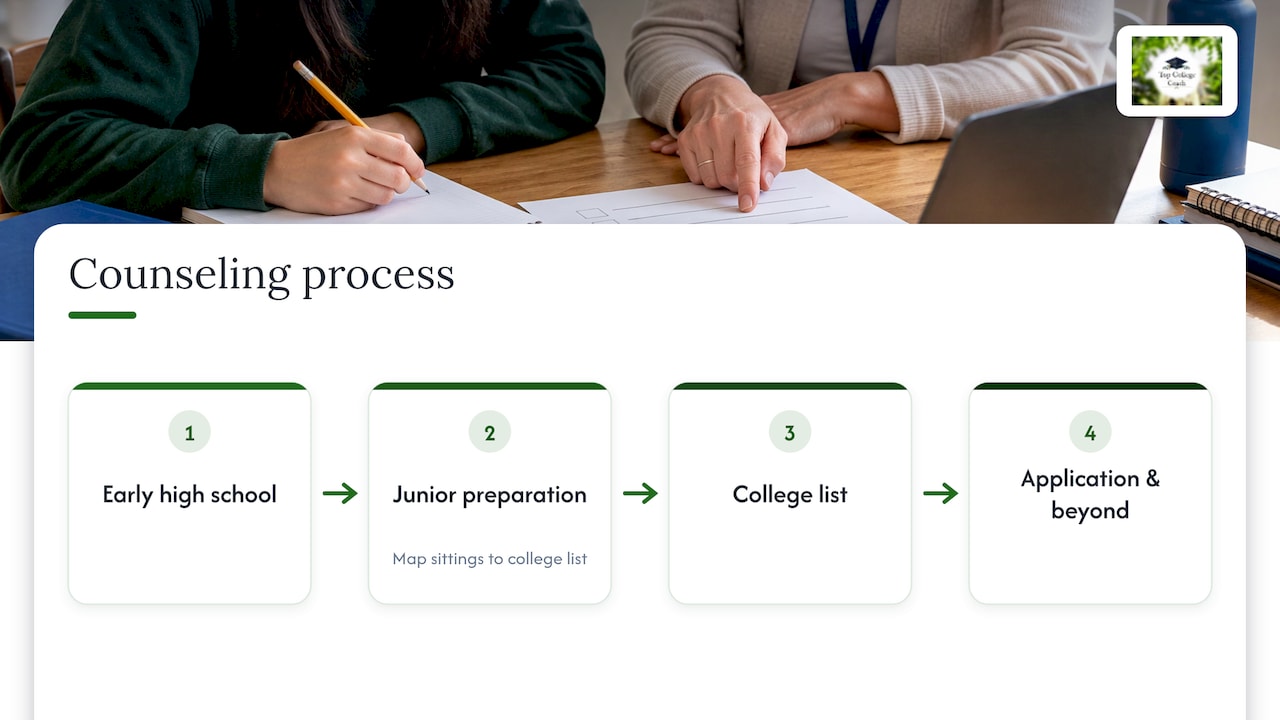
At Top College Coach, each student works directly with the lead admissions counselor, and our services follow the arc of the process: Early High School Planning, Junior Year Preparation, The College List, and The Application & Beyond. Testing decisions sit in the Junior Year Preparation stage, where the spring sitting, the summer plan and the fall retake are mapped against the college list.
If you want to talk through your child’s testing plan, you can learn more about our personalized college admissions counseling.

Students also receive application review from former admissions officers and mentoring from current Ivy League students, so the testing plan is built alongside the rest of the application and not in isolation. Our full list of programs is on our main site.
Our perspective
Families often come to us anxious about testing, and the anxiety is understandable. The rules changed quickly, and every school seems to say something different. Our advice is to keep the decision grounded in two questions: what does each school on the list require, and which test lets this student show their best work? We believe testing strategy should never be a separate project. It belongs inside a plan that starts early, with the right courses and a spike of genuine interest, and that carries through the college list and the application itself. When a student works directly with the lead counselor, the testing calendar, the essay timeline and the list stay in sync, and a parent is never left guessing what comes next. Test scores are one piece of the puzzle, and a well-prepared student can bring a confident, steady score to the table. That confidence frees up time and energy for the parts of the application that tell the student’s authentic story. Randy Pryor
FAQ
Do all Ivy League schools require the SAT or ACT now?
Not every one for every cycle. Yale requires an SAT or ACT score starting with 2026–27, while Columbia and Princeton are test-optional this cycle and will require scores beginning with 2027–28. Because policies keep changing, check each school’s admissions page when you build your list.
Is the SAT or ACT better for selective colleges?
Neither. Most colleges accept both and have no preference between them. Take one timed practice test of each, compare the results, and prepare for the test that suits your student’s pacing and strengths.
How many times should my child take the test?
Most students test once in spring of junior year and consider a retake in the summer or early fall of senior year. A retake is most useful when the score sits below the range of your target schools and a plan exists to improve it. Check whether each school superscores, since that changes how much a retake can help.
Should my child submit a score to a test-optional school?
A score within or above the school’s published middle 50% range generally strengthens the application. If the score is below that range, review the full file with a counselor before deciding. Yale’s dean has said that some applicants hurt their chances by withholding scores that fall below the median range.
When should we start preparing?
A diagnostic practice test in sophomore year gives families a baseline. Steady preparation through junior year, with the first official sitting in spring, leaves room for a retake before senior-year deadlines.
Sources
Recommended
Comments