Orlando Volunteer Opportunities for Teens: Where to Start
Orlando has far more teen volunteer roles than most families realize, from hospital desks and animal conservation to library leagues and science center floors. The best choice is rarely the one that is easiest to find. It is the role that fits your schedule, lets you keep showing up, and gives you a real story to tell later. This guide lists the programs, their age rules and what to expect, then shows how to turn the hours into something a college admissions reader will remember.
TL;DR
Most Orlando programs take teens at 13 to 16, and anyone under 18 needs a parent or guardian signature or supervision.
Orlando Cares, the Orange County Library System, hospitals, museums and animal and food programs all have teen roles. Each sets its own commitment, from one event to six months.
Hospital and long-term programs are competitive and slow. Apply two to three months before you need to start.
Keep your own log of dates, supervisors and hours, whatever the organization tracks.
Colleges care about depth and impact, not hour counts. One role you stay with beats five you sample.
Table of Contents
Start with the city: Orlando Cares
If you want one place to browse, begin with Orlando Cares, the City of Orlando’s volunteer portal. You can filter listings for youth volunteers ages 14 to 17. Youth roles include mentoring a student, coaching youth football, supporting community center events such as holiday gatherings, senior nights and tournaments, and teaching STEM through activities like Hour of Code or robotics.
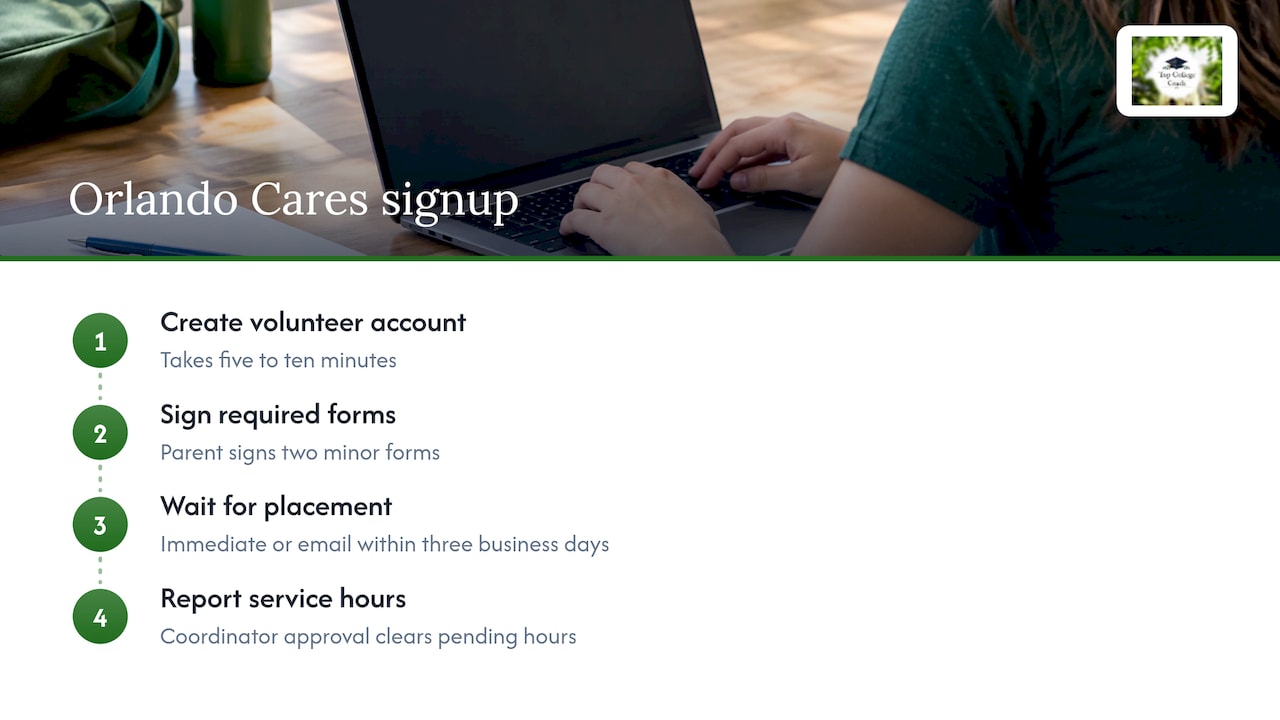
Signing up is simple. You open the portal, click Sign Up and create a volunteer account with an email address, which the city says takes five to ten minutes. Some opportunities place you right away. Others refer you, and a supervisor emails you within three business days with next steps and any background-check instructions.
Because you are under 18, a parent or guardian must sign the Volunteer Release and Waiver and a Parental Consent for Minor Background Check. Some roles also require an Affidavit of Good Moral Character. Get these signed early so paperwork does not hold up your first shift.
Orlando Cares also tracks your time. You report hours from your dashboard, and they stay pending until a Project Coordinator approves them. You can also add them to the logbook within 24 hours of service, and you can view everything under Logbook or Service History.
The program itself is worth knowing. Orlando Cares is the mayor’s initiative within the Cities of Service coalition, which Johns Hopkins describes as focused on youth literacy and community safety. Its programs include Mayor Buddy’s Book Club, Preschool Ambassadors, Third Grade Reads and Take Heart Orlando, a community CPR effort. Teens who like working with younger children will find a natural fit here.
Libraries, museums and science: roles for curious teens
Some of the most flexible roles are in places teens already visit.
Orange County Library System. The Teen Volunteer League is for high schoolers. Teen volunteer events earn up to two community service hours each. You can also help create the literary magazine, though you must submit work to earn hours. Monthly virtual advisory board meetings are worth one hour each. It is a low-pressure way to start, and the advisory board is a chance to speak up about what teens want from the library.
Orlando Museum of Art. Teens 16 and older can assist in education programs, including art classes, camps and family programs. The museum also offers internships in education, marketing and exhibitions, and special events support. You apply through the museum’s volunteer page and note your area of interest. If you are drawn to teaching or arts careers, this is a role that connects to a direction.

Orlando Science Center. The Catalyst Youth Volunteer Program is for ages 13 to 17 and runs year-round. It is competitive and requires a complete online application. Applications typically open twice a year, for the summer and school-year seasons, so check the page for the current window rather than waiting until you need hours.
Orange County Regional History Center. High schoolers ages 15 to 17 can help with the Adventures in History Summer Camp. The role offers 50 service hours for two full weeks of camp, with five-hour daily shifts. You apply online with a guardian, a teacher’s recommendation is part of the process, and screening registration and orientation are mandatory. The recommendation deadline falls in spring, so start in the winter.
Orlando Ballet. The ballet’s volunteer policies set a minimum age of 13 with an adult accompanying you, and 16 to volunteer independently. Roles include ticketing and ushering, merchandise, dancer escort and light walker. Background checks apply to assignments involving children under 18.
Hospitals and health: structured, competitive, worth the lead time
Hospital programs are the most demanding, and that is exactly why they are meaningful. They ask for a regular schedule over months, which shows reliability.
Orlando Health, Dr. P. Phillips Hospital. Teen volunteers must be at least 16, currently enrolled in high school with a minimum 3.0 GPA, and ready to commit to four hours on the same day each week for at least three months. Processing takes about two to three weeks. The hospital does not accept court-ordered community service.
Nemours Children’s Health, Orlando. High school volunteers must be 16 and have completed sophomore year. The commitment is at least 75 hours over six consecutive months. You complete nine online training modules of about two hours, which earn service hours, and you provide two non-relative references and clear a health screening. Shifts run weekdays during business hours and evenings until 7:00 pm, with no weekends.
Orlando VA Health Care System. The Junior Volunteer Summer Program has served students ages 14 to 17 and, in its 2026 edition, required at least 100 volunteer hours over the summer. Parents attend a virtual orientation and students attend one in person. Watch the VA’s news page each spring for the next edition.
Food, animals and youth: hands-on community roles
Heart of Florida United Way. It serves Orange, Osceola and Seminole counties, working on financial stability, education, health and basic needs. Its Volunteer Resource Center matches volunteers with opportunities throughout the year, and you can also join Impact Groups. It is a good directory if you want to see many causes at once. You can also learn more about the organization on its main site.
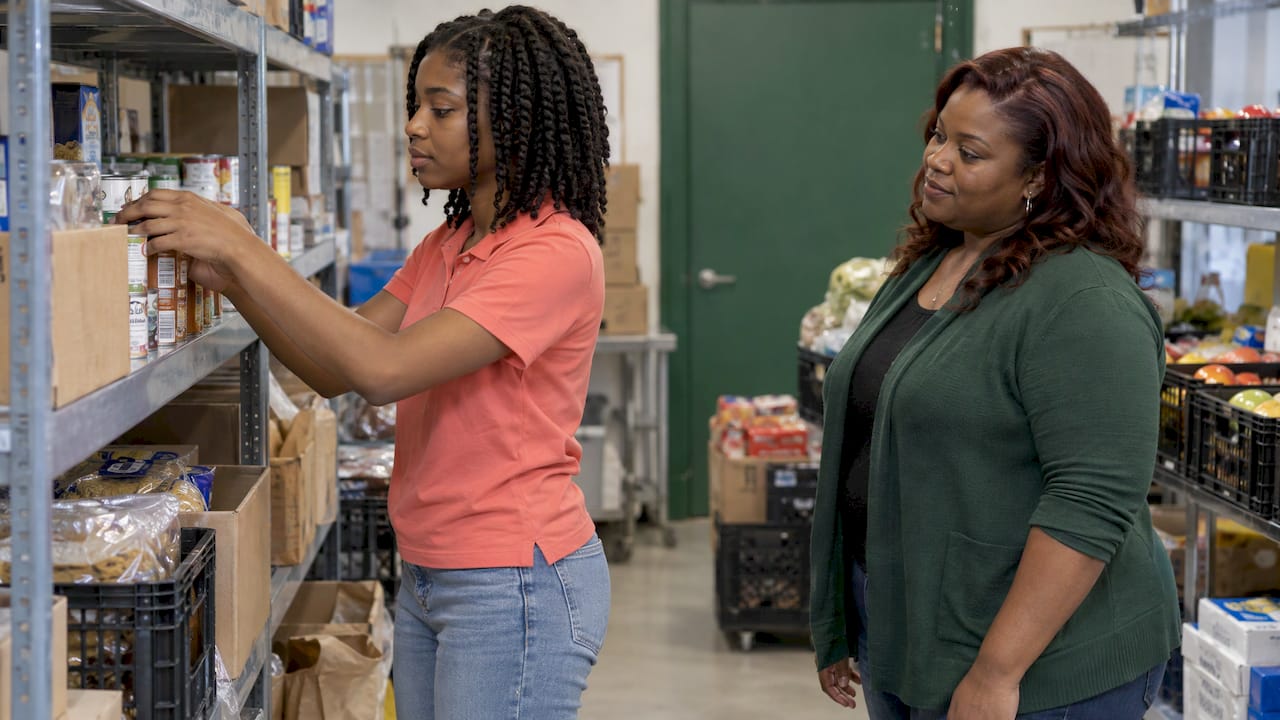
United Against Poverty Orlando. Volunteers must be at least 13 for regular on-campus roles, and everyone under 18 must be with a parent, guardian or approved chaperone at all times. Tasks include stocking the Member Share Grocery Program, organizing the food pantry and staffing the welcome desk. The organization accepts school and Bright Futures hours. This is a strong choice for a parent-and-teen pair or a younger teen.
Central Florida Animal Reserve. The Conservation Corps takes high school juniors and seniors and college students 16 and older. Under-18 volunteers need guardian-signed paperwork and attend an onsite orientation with a parent. You commit to at least one workday a month, on Mondays or Wednesdays from 3:30 to 6:00 pm, or weekend Visitor Center shifts from 11:00 am to 5:00 pm. Hours are validated only after you complete a full session, so plan to finish what you start. The environment is supervised and non-animal-contact, with training before each task.
Boys & Girls Clubs of Central Florida. The minimum community-service age is 12, with a minimum four-hour service. Ongoing volunteers must be 16 and high school juniors. A Level II background check is required and remains valid for five years. Middle schoolers must be accompanied by an adult who also completes a one-time application.
If you are interested in education-focused service, the question to ask is what the community actually asks for. This overview of youth service project types shows how the best projects start from local needs. In Orlando, the same idea applies to tutoring, STEM teaching and mentoring through Orlando Cares and the Boys & Girls Clubs.
Quick comparison
Program | Typical minimum age | Commitment | Good for |
Orlando Cares | 14 to 17 youth filter | Varies by role | Mentoring, STEM, community events |
OCLS Teen Volunteer League | High school | Event by event | First-time volunteers |
United Against Poverty | 13, with an adult under 18 | Flexible shifts | Families, food access |
Orlando Science Center Catalyst | 13 to 17 | Application each season | STEM and education |
Central Florida Animal Reserve | 16 | One workday a month | Conservation, teamwork |
Dr. P. Phillips Hospital | 16, 3.0 GPA | 4 hours weekly for 3 months | Health careers |
Nemours Children’s Health | 16, after sophomore year | 75 hours over 6 months | Pediatric health, long commitment |
Ages and rules change, so confirm each on the organization’s page before applying.
Requirements to expect before your first shift
Most programs share the same checklist. Prepare for it and you will move faster.
A parent or guardian signature. Waivers and consent forms are standard for anyone under 18.
A background check. Boys & Girls Clubs, the ballet and Orlando Cares all mention checks for roles involving minors or certain assignments.
An orientation. The VA, Nemours and the Animal Reserve all require one, sometimes with a parent.
References or recommendations. Nemours asks for two non-relative references, and the History Center asks for a teacher’s recommendation.
Patience. Hospital processing can take weeks, and competitive programs fill early.
Florida has also tightened screening for adults who work with young people. Starting July 1, 2026, Level 2 background screening applies to coaches, including volunteers, in private youth athletic organizations. If you coach or assist a youth team, expect fingerprinting and a registry search before you work with players.
How to choose a role that fits
Pick with three questions in mind.
What will you actually keep doing? A weekly four-hour shift for three months is a bigger commitment than a monthly workday. Choose a schedule you can honor through exam season. Dropping out mid-session can cost you validated hours at some programs.
What interests you beyond the hours? The art museum positions its teen roles as experience for arts education careers. A hospital role speaks to medicine. A library advisory board speaks to civic voice. When the role matches a real interest, you will have more to say about it, and you will want to do more of it.
Can the hours be verified? Ask how the organization confirms service. Orlando Cares uses a dashboard and coordinator approval. Your school may have its own process: for example, Winter Park High School’s Student Services page asks students to complete a Community Service Log and Reflection Form and attach a letter from the organization or a pay stub. Check your school’s counseling office for its form. If you are also working toward a Florida scholarship that counts service hours, confirm the current requirements with your school counselor and keep every letter.
A personal log helps whatever the system. Record the date, organization, supervisor name and phone number, and hours for every shift. Ask for a signed verification letter when you finish a program.
Perspective: what colleges actually see in service
We meet families every week who ask how many volunteer hours a student needs. The honest answer is that the count is the least interesting part of the story. Admissions readers look for trajectory: a student who started small, took on more responsibility and left something better than they found it. That is why we encourage students to choose fewer roles and go deeper. A teen who spends a year mentoring younger students, then starts a tutoring session at a community center, has a clear arc. A teen who collected scattered hours at six places has a list. When we work with students, we look for the thread that connects what they already care about to how they spend their time, and we help them build it from early high school onward. Our approach is personal. Each student works directly with the lead admissions counselor, and our students can also be mentored by current Ivy League students and have their applications reviewed by former admissions officers. We find that when a student sees service as part of their own authentic story rather than a requirement, the essays and activity descriptions become much easier to write. Parents can help most by letting teens choose. Support the logistics, the rides, the signatures and the deadlines, and let your teen own the commitment. Randy Pryor
Turning service into a story, honestly
When it is time to write about volunteering in an application, describe it plainly and precisely.
Say what you did and what changed. “Taught Hour of Code to third graders every Saturday for ten months” tells a reader more than “helped with STEM.” If something improved because of you, say so, and only if it is true.
Show your growth. Did you move from assisting to leading? Did you train newer volunteers? Responsibility over time is the signal.
Use real numbers carefully. Hours, weeks and people served are fine when they come from your log or a supervisor. Do not round up.
Tie it to your interests. A student drawn to medicine who spends months at a children’s hospital has a coherent story. So does a future teacher who runs a library reading group.
Leave out the inflation. Titles and impact that you cannot back up will not survive a reference or an interview.
Our guide on turning local volunteer work into a strong college asset goes deeper on Orlando examples. If your teen wants to lead something of their own, see leadership projects for high school students, and for ideas that go beyond one-off hours, read about community service ideas for high school clubs.
Where Top College Coach fits in
Volunteering works best when it is part of a plan rather than a scramble in junior year. We are based in Orlando, and our services include Early High School Planning, Junior Year Preparation, The College List, and The Application & Beyond. Early planning is where a student decides which activities deserve their time and how to build on them, and our counselors work with families on academic and extracurricular choices from the start of high school.
If you want a counselor to help your teen choose and shape their activities, you can learn about our personalized college admissions counseling or see the full list of programs on our home page.
FAQ
What is the youngest age for teen volunteering in Orlando?
It depends on the organization. Boys & Girls Clubs of Central Florida sets its community-service minimum at 12. United Against Poverty and the Orlando Ballet start at 13, with an adult required for younger volunteers at the ballet. Orlando Cares lists youth opportunities for ages 14 to 17.
How far in advance should my teen apply?
Hospital programs process applications in about two to three weeks at Orlando Health, and Nemours requires references, modules and a health screening. Science Center and summer programs open applications seasonally. Plan to start two to three months before you want to begin, and check each page for current windows.
Do my teen’s volunteer hours need to be approved by someone?
Usually yes. Orlando Cares holds hours as pending until a Project Coordinator approves them. Schools often require their own log and a letter from the organization. Ask the organization how it verifies hours at the start, and keep your own record as well.
Do colleges expect a certain number of volunteer hours?
We advise families to focus on consistency and impact rather than a target number. A sustained role with growing responsibility, described honestly, tells an admissions reader more than a high total spread across many places.
Sources
Recommended
Comments