Best College Ranking Websites for Parents and Students

The best college ranking websites are U.S. News, Niche, Forbes and Money for ranked lists, plus the government’s College Scorecard and College Navigator for raw data. Each one measures something different, so the same school can land in very different places. A ranking tells you how a school scores on one formula. It cannot tell you whether the school fits your student, which is the question that decides where they apply. That is the point where we step in: we use rankings as raw material, then build a list around your student’s strengths, goals and budget.
TL;DR
U.S. News is the best-known list and leans on reputation and graduation outcomes. Forbes and Money lean on cost and what graduates earn. Niche adds student reviews.
Most ranking sites are free. U.S. News sells an optional upgrade, College Compass, for $59.95 a year.
College Scorecard and College Navigator are free government tools with no account needed, and they are the place to check graduation, debt and earnings figures.
A school can rank high on one site and far lower on another because the formulas weigh different things.
Use rankings to build a first list, then narrow it by fit, cost and admission chances. Our counselors do that with each student.
Table of Contents
The ranking websites families use most, side by side
Here is the short version before we go into each site.
Site | What it ranks | What drives the score | Cost to families |
U.S. News Best Colleges | National universities, liberal arts colleges, regional schools and more | Peer assessment, graduation rates, financial resources | Free account; paid College Compass add-on |
Niche | More than 6,000 colleges, with letter grades | Academics, value, professors, student reviews | Free |
Forbes America’s Top Colleges | 500 U.S. colleges | Alumni salary, debt, graduation rate, return on investment | Free |
Money Best Colleges | Star ratings, not numbered ranks | Affordability, quality of education, outcomes | Free |
College Scorecard | No ranking, official data | Graduation, earnings, debt | Free |
College Navigator | No ranking, official data | Federal school profiles | Free |
Now, what each one is good for.
U.S. News & World Report: the familiar name
U.S. News is a media company whose “Best” series covers colleges as well as hospitals, and its college list is the one most parents have already heard of. Its formula puts real weight on how other institutions see a school: in the 2026 edition, peer assessment counted for 20%, graduation rates 16%, graduation-rate performance 10% and financial resources 8%, with student outcomes together making up 52%.
That peer assessment piece is why U.S. News tends to reward schools with long-established reputations. It is a useful lens if your student is looking at the Ivy League and other top universities, where name recognition and resources are part of what the school offers.
Cost: a free account gives you basic rankings and profiles. College Compass costs $59.95 for one year and adds regular and early admission odds, waitlist statistics, alumni salary and employer data, financial-aid breakdowns, and SAT and ACT percentile benchmarks, plus major-specific rankings.
Best for: a first look at the most selective schools and a quick sense of reputation.
For a closer read on how the top of the list looks, see our guide to national university rankings and our rundown of the top 20 colleges in America.
Niche: student reviews and letter grades
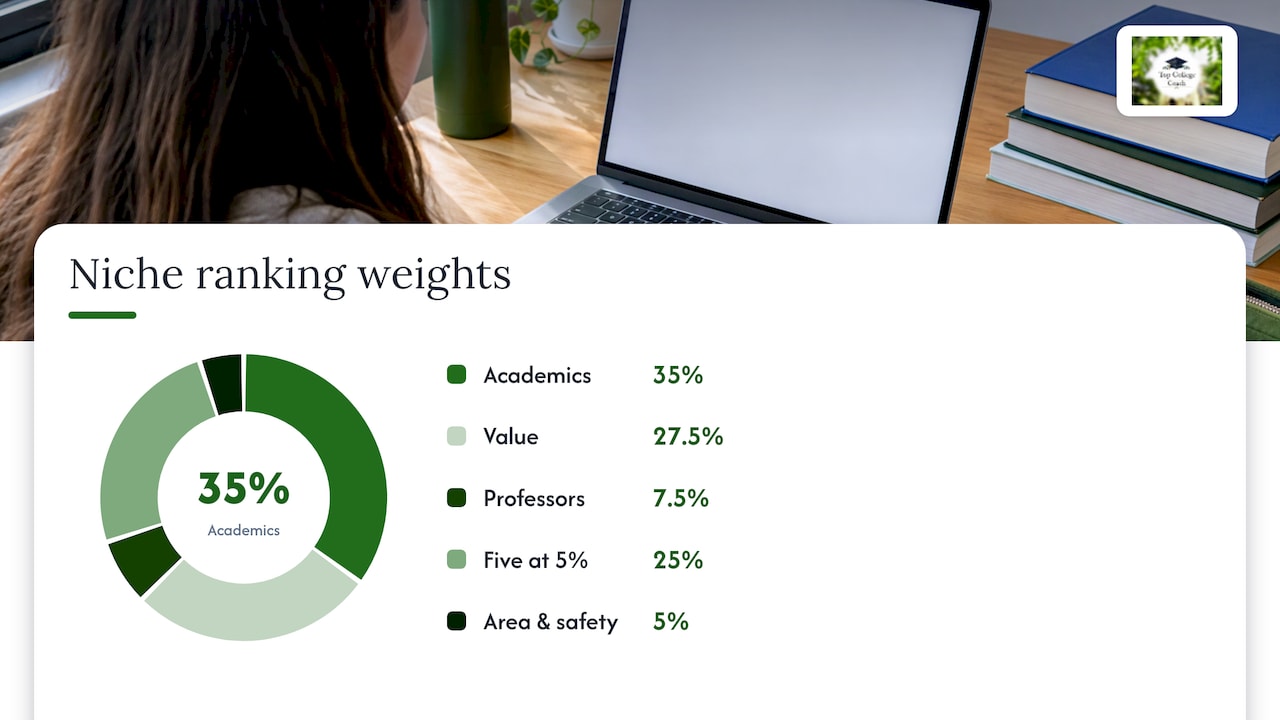
Niche takes a different route. Its 2027 Best Colleges rankings use 10 factors: Academics (35%), Value (27.5%), Professors (7.5%), five factors at 5% each including a new Institutional Success Score, and 2.5% each for Local Area and Safety. The data comes from U.S. Department of Education figures and millions of student and alumni reviews.
That mix gives you something the other lists do not: what current students say about campus life, dorms, professors and the surrounding area. According to its press page, Niche is free for students and families, and schools pay to enhance their presence on the site.
Best for: getting a feel for daily life at a school and comparing schools on factors beyond prestige. Student reviews are opinions, so read several rather than one.
Forbes: a return-on-investment lens
Forbes ranks 500 U.S. colleges using measured data only. According to Forbes’ methodology article, the weights are alumni salary (20%), debt (15%), graduation rate (15%), the Forbes American Leaders List (15%), return on investment (15%), retention rate (10%) and academic success (10%). The same article notes the list excludes schools with fewer than 300 undergraduates, the five federal military academies, and any school missing more than three metrics.
If your family is asking what a degree will return for the money, this is the list built around that question. It also tends to surface schools that do not dominate reputation-based lists.
Best for: families weighing earnings and debt against price.
Money: star ratings that put cost first
Money does not publish a numbered list. Its 2026 edition sorts 735 colleges into star ratings from 2 to 5 stars using 25 factors, grouped as Affordability (40%), Quality of education (30%) and Outcomes (30%). Affordability covers net price, price by income band, debt and ability to repay.
The star format is a small advantage in itself. A numbered list suggests that #12 is clearly better than #13, when the real gap may be tiny. Stars invite you to compare groups of schools, which is how most families should read rankings anyway.
Best for: budget-conscious families who want value emphasized over prestige.
Free government tools: where to check the numbers
Two official tools belong in every family’s bookmarks, and neither requires an account, according to Road2College’s review of search tools:
College Scorecard shows graduation, earnings and debt data.
College Navigator, from the National Center for Education Statistics, provides detailed federal data on each school.
The same review also describes other free options. Appily offers search, scholarships and virtual tours. BigFuture offers profiles with majors and careers. College Raptor gives net-price estimates and admission odds. CollegeData offers statistics and applicant tracking.
These are not rankings, which is their strength. When a ranking site quotes a graduation rate or a salary, this is the type of data behind it, and you can look at the figure directly.
While you are building a list, you will also meet financial-aid questions. Our guide to scholarship websites covers which ones are worth your time.
Why one college ranks so differently from site to site
Parents are often startled to find a school in the top 30 on one site and nowhere near it on another. That is by design, not a mistake.
A methodological review of five major ranking systems by NORC found that none of the major providers communicate the statistical uncertainty in each rank. It also describes an “equal interval problem”: a list implies the distance between #1 and #2 is the same as between #29 and #30, which it is not. The review argues there is no stable, universal idea of what a ranking measures; each provider defines its own target.
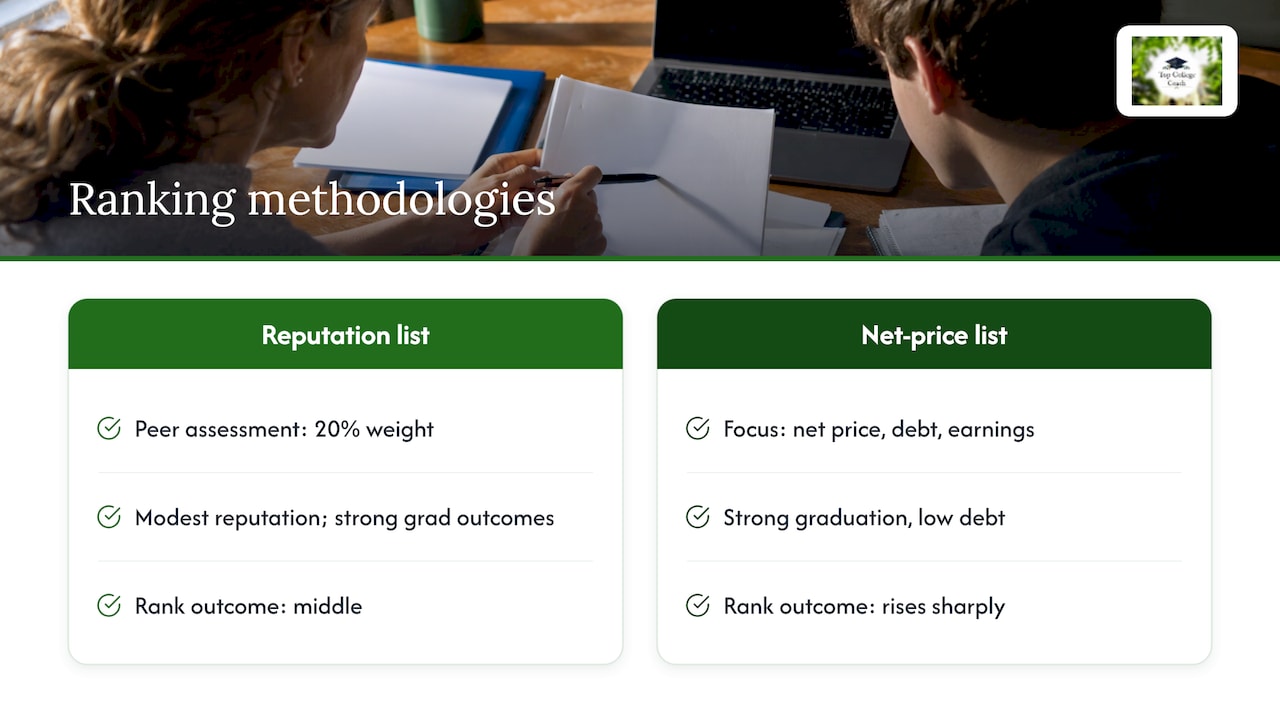
Here is a worked example of how that plays out. Imagine a school that is modest in reputation but strong at graduating students with low debt. On a list where peer assessment carries 20%, it may sit in the middle. On a list built around net price, debt and graduate earnings, it may rise sharply. Neither list is wrong. They answer different questions.
According to a comparison of ranking methodologies, the disagreements are largest in roughly the 20th to 150th positions, where a single heavily weighted factor can move a school dozens of places. At the very top, the same small group of wealthy, selective, research-heavy institutions appears on nearly every list.
The practical lesson: before you trust a number, find out what the list measures, and ask whether that matches what your student needs.
How recently each list is updated
Most of the big lists are refreshed once a year, with the new editions typically arriving in the late summer and fall, and each is named for the year ahead. Niche, for example, released its 2027 edition in September 2026. Money’s 2026 edition was published in June 2026. Forbes’ edition names the year it lists, so a 2026 list may reflect last year’s data. Forbes noted that its 2026 ranking used the previous year’s Scorecard salary and debt figures because the federal data had not been updated in time.
For the current edition of any list, check the publisher’s own page. The date on the list and the year of the data underneath it are not always the same.
How to use rankings without letting them run your process
Rankings are a starting point, and most students treat them that way. An Art & Science Group survey of more than 4,000 high school seniors found that only about 60% used rankings, and most of those used them to learn about schools they were already considering rather than to make the final call.
Here is a routine that works for families:
Pick two or three lists with different formulas. For example, one reputation-based (U.S. News), one value-based (Money or Forbes) and one student-voice-based (Niche). Schools that appear well on all three are worth a closer look.
Check the underlying data. Look up graduation rate, net price and earnings on College Scorecard or College Navigator.
Sort by admission chances. A school’s rank says nothing about your student’s odds. Our guide to college admissions rates explains how to read them, and our piece on the college match school explains how to balance reach, match and likely options.
Test the fit. Look at the major, class size, culture, location and cost for your student specifically. For example, our article on choosing an engineering university shows why program strength can matter more than overall rank.
Build the final list. Our guide to choosing the right colleges to apply to walks through that step.
If you want a sense of how the Wall Street Journal’s list reads at the top, we also break down the top 10 colleges by the Wall Street Journal.
Where Top College Coach fits
A ranking site answers “which schools score well?” Your family’s real question is “which schools are right for my student, and how do we get in?” That second question is where we work.
Top College Coach is a private college admissions counseling practice based in Orlando, Florida, helping students pursue admission to Ivy League and Top 20 universities. Our offering covers Early High School Planning, Junior Year Preparation, The College List and The Application & Beyond, along with essay coaching and interview preparation for students and parents. Each student works directly with the lead admissions counselor, receives mentoring from current Ivy League students, and benefits from application review by former admissions officers. We keep caseloads small so every family gets personal attention.
If you would like help turning rankings into a list built around your student, learn more about our personalized college admissions counseling or see how each stage works on our home page.
Our perspective
Every fall, we meet families who have printed three ranking lists and highlighted the schools that show up on all of them. That is a smart instinct. It is also only the first step. What rankings cannot see is your student’s story: the spike they have built, the classes they have chosen, the teachers who know them, the way they learn. A strong application shows an authentic story and a trajectory of rigor, and that is something we build with students over time, starting as early as freshman year. Our approach is to treat rankings as one input, alongside cost, fit and admission chances. Then we help each student shape a balanced list and an application that is theirs. Because each student works directly with the lead counselor, advice is never handed down through layers, and the former admissions officers who review applications know how readers actually evaluate them. Rankings tell you where the crowd is looking. Our job is to help you find where your student belongs, and to make sure the admissions committee sees why. Randy Pryor
FAQ
What is the most reliable college ranking website?
None is universally best, because each measures something different. U.S. News emphasizes reputation and graduation outcomes, Forbes and Money emphasize cost and earnings, and Niche adds student reviews. For raw facts, College Scorecard and College Navigator are the official sources.
Are college ranking websites free?
Mostly yes. Niche is free for students and families, and the government tools need no account. U.S. News offers a free account, with its optional College Compass add-on at $59.95 for one year.
Why does my student’s dream school rank differently on each site?
Each site picks its own factors and weights. A school strong on graduate earnings but modest on reputation will rise on a value-based list and fall on a peer-assessment one. NORC’s review notes that each provider defines its own target.
Should rankings decide where my student applies?
They are most useful for discovering schools and comparing them on cost and outcomes. The final list should rest on fit, budget and admission chances too. Our counselors help families combine all of these into one balanced list.
Sources
Recommended
Comments