How Private College Counselors Boost Ivy League Admission Chances

Private college counselors are specialized advisors who help students build competitive profiles for Ivy League schools by guiding academic planning, extracurricular development, and authentic storytelling. With acceptance rates between 3–8%, getting into Harvard, Yale, Princeton, Penn, or Columbia requires far more than strong grades. A private counselor, also called an independent educational consultant, works exclusively for your family. That focused attention is what separates a generic application from one that genuinely stands out. Understanding how private college counselors can help your chances of Ivy League admission is the first step toward building a real plan.
How private college counselors support academic planning for Ivy League competitiveness
Academic rigor is the foundation of every competitive Ivy League application. Admissions officers do not just look at GPA. They evaluate whether a student challenged themselves with the most demanding courses available at their school, including AP, IB, or honors programs.
Counselors guide students on course selection, transcript review, and standardized test preparation. That guidance matters because choosing the wrong mix of courses in 9th or 10th grade can limit options later. A private counselor maps out a four-year academic trajectory that aligns with what Ivy League schools expect to see.
The key areas where counselors add value in academic planning include:
Course selection: Identifying which AP or IB courses align with a student’s intended major and signal intellectual depth
GPA context: Explaining to students that a 4.0 in easier courses is less compelling than a 3.8 in the most rigorous curriculum available
Standardized testing: Advising on whether to submit SAT or ACT scores, when to test, and how many attempts make sense
Progress monitoring: Checking in each semester to catch grade dips or course mismatches before they become problems
Realistic workload balance: Preventing burnout by helping students take on challenge without sacrificing performance
Pro Tip: Start your course planning conversation with a private counselor as early as possible. The decisions you make entering high school shape your entire academic narrative.
Counselors also help families understand that Ivy League schools read transcripts in context. A student at a small rural school who takes every AP offered is viewed differently than one at a large prep school with 30 AP options. Private counselors know how to frame that context effectively.
What role do private counselors play in building extracurricular profiles?
Ivy League admissions officers are not impressed by long lists of clubs. They look for a clear pattern of sustained commitment and genuine passion. This is what admissions professionals call an “intellectual spike,” and it is one of the most powerful tools in a competitive application.
Developing a focused spike through clubs, projects, and leadership roles increases admission odds at selective schools. Private counselors help students identify that spike early and build around it intentionally. Here is how that process typically unfolds:
Identify the core interest. Counselors ask probing questions to uncover what genuinely excites a student, whether that is environmental science, entrepreneurship, classical music, or public health.
Audit current activities. They review existing commitments and identify which ones reinforce the student’s narrative and which ones dilute it.
Build toward leadership. Counselors advise students to move from participant to leader within their chosen area, whether by founding a club, leading a research project, or organizing a community initiative.
Document impact. They help students articulate the real-world results of their involvement, not just titles held.
Connect activities to academics. A student passionate about neuroscience who also takes AP Biology and volunteers at a hospital creates a coherent, compelling story.
Pro Tip: Quality beats quantity every time. Three deeply developed activities with measurable impact will outperform a list of ten surface-level memberships in the eyes of an Ivy League admissions reader.
Private counselors also help students find opportunities they would not discover on their own. Research programs at local universities, national competitions, and summer institutes tied to a student’s interest area all strengthen the extracurricular narrative.
How do private counselors elevate Ivy League essays and storytelling?
The college essay is where a student’s voice either comes through clearly or disappears into a sea of polished, forgettable prose. Private counselors help students find and protect that voice throughout the writing process.

Strong applications combine academic excellence, focused extracurriculars, and authentic narratives. The essay is where those three elements converge. A counselor’s job is to help a student identify the personal story that ties everything together, then shape it without overwriting it.
The essay process with a private counselor typically addresses these critical elements:
Authentic brainstorming: Counselors ask questions that surface genuine experiences rather than impressive-sounding ones. The best essays are often about small, specific moments.
Voice preservation: Editing improves clarity and structure without replacing the student’s natural tone with adult language.
AI screening awareness: Admissions offices use AI tools to flag essays that appear formulaic or inconsistent with other writing samples. A counselor helps students write essays that are genuinely theirs.
Narrative cohesion: The main essay, supplemental essays, and activity descriptions should all reinforce the same core story. Counselors review the full application for consistency.
Avoiding common traps: Overly polished essays, mission trip narratives without self-reflection, and sports injury comeback stories are all patterns that admissions readers recognize immediately.
For families who want deeper guidance on the essay process, Top College Coach offers detailed personal statement strategies built specifically for Ivy League applicants. The difference between a good essay and a great one is almost always specificity, honesty, and the ability to tell a compelling story.
How do private counselors differ from school counselors for Ivy League applicants?
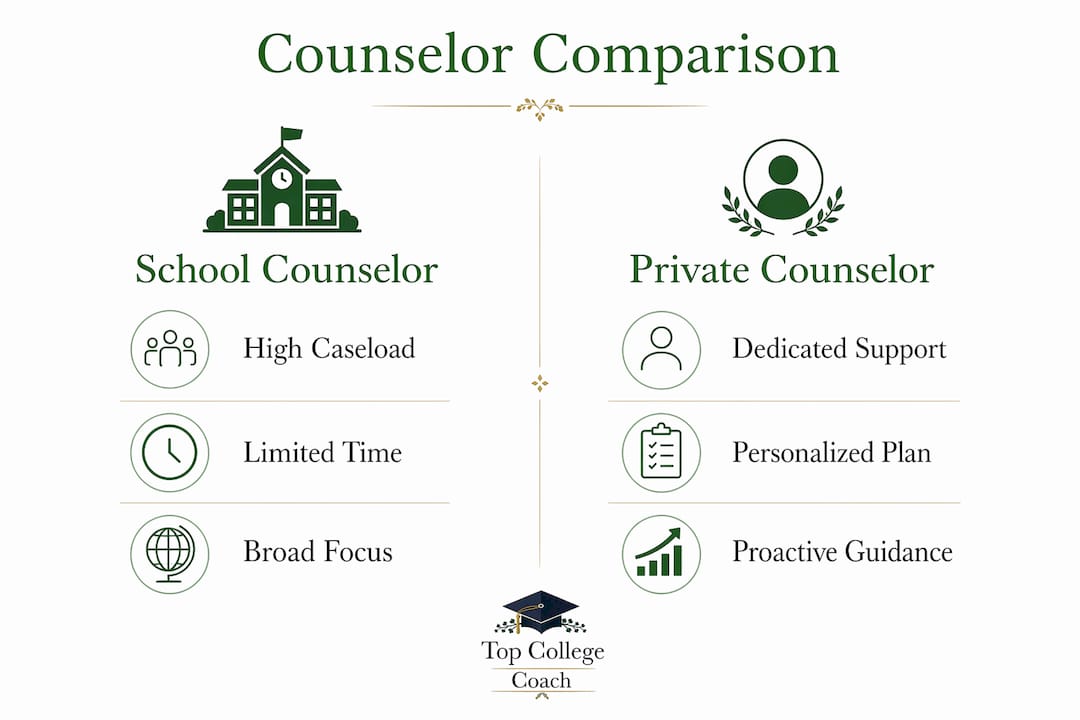
School counselors are dedicated professionals, but they operate under real structural constraints. The average school counselor manages hundreds of students alongside responsibilities like scheduling, mental health support, and institutional reporting. Private counselors work exclusively for your family.
Private counselors represent the family’s interests exclusively, offering advocacy and catching technical issues like financial aid submission errors early. That exclusive focus changes what is possible in terms of depth, availability, and personalization.
Area | School counselor | Private counselor |
Student caseload | Often 300 or more students | One family at a time |
Primary loyalty | School and institution | Student and family |
Availability | Limited by school hours and duties | Flexible, often evenings and weekends |
Application depth | General guidance and transcript support | Full strategy from 9th grade through enrollment |
Financial aid review | Basic information | Early identification of errors and opportunities |
Essay support | Light review | Deep brainstorming, drafting, and revision cycles |
Both roles can work together. A school counselor writes the counselor recommendation letter and knows the student’s academic context well. A private counselor builds the overall strategy and fills the gaps. Families who use both resources give their students the most complete support available.
Private counselors also tend to be more proactive, reaching out to flag deadlines, new scholarship opportunities, or shifts in admissions trends before families even know to ask. That proactive posture is especially valuable for Ivy League applicants, where missing a single early decision deadline can cost a year.
Practical ways families can maximize private college counseling
Getting the most from private college counseling requires active participation from both students and parents. The counselor provides the expertise. The family provides the honesty, the effort, and the follow-through.
Starting counseling as early as 9th grade enables the most complete preparation, including extracurricular exploration and academic course planning. Families who wait until junior year lose two full years of profile-building time.
Here is how to get the most from the relationship:
Start early. Engage a private counselor by the end of 9th grade or the beginning of 10th grade at the latest. The earlier the engagement, the more options remain open.
Be honest about the student. Share real interests, real struggles, and real goals. Counselors cannot build an authentic profile around a version of the student that does not exist.
Engage actively. Students who treat counseling as a passive service get passive results. Show up prepared, complete assignments on time, and ask questions.
Build a realistic college list. A strong list includes reach schools like Ivy League institutions, target schools, and safety schools. Counselors help families build lists that are both ambitious and grounded.
Prepare for early decision. Applying early decision to a top-choice school can meaningfully improve admission odds. Counselors help families understand the financial and strategic implications before committing.
For families weighing whether this investment makes sense, Top College Coach has a detailed breakdown of whether admissions consulting is worth it for families targeting selective universities.
Key takeaways
Private college counselors give Ivy League applicants a measurable edge by combining academic planning, extracurricular focus, authentic essays, and exclusive family advocacy into one coordinated strategy.
Point | Details |
Start early | Engage a private counselor by 9th or 10th grade to maximize profile-building time. |
Build an intellectual spike | Focus extracurriculars on one sustained area of excellence rather than a long list of activities. |
Protect essay authenticity | Counselors help students write genuine essays that pass AI screening and resonate with readers. |
Private counselors advocate for you | Unlike school counselors, private counselors represent only the student’s and family’s interests. |
Use both counselor types | School and private counselors serve different roles and work best when used together. |
What I have learned advising Ivy League applicants
The families who see the best results are not always the ones with the most impressive students. They are the ones who commit to the process earliest and most honestly.
I have seen students who had near-perfect GPAs and still struggled to get traction at Ivy League schools. The reason was almost always the same: their applications were technically strong but personally thin. They had grades and scores. They did not have a story. That is the gap private counseling closes.
What surprises most families is how much of the admissions process is about coherence. Admissions readers spend minutes, not hours, on each file. They are looking for a clear picture of who this student is and what they will contribute to campus. When the academic record, the activities, and the essays all point in the same direction, that picture comes through fast. When they do not align, the application feels scattered, no matter how strong the individual pieces are.
The other thing I tell every family: authenticity is not a soft concept. It is a technical requirement. AI-assisted screening now flags linguistic inconsistencies between essays and other writing samples. Admissions readers are trained to spot essays that sound like they were written by a parent or a consultant. The counselor’s job is to help the student find their own voice and then get out of the way. That is harder than it sounds, and it is the skill that separates good counselors from great ones.
Private counseling is not a shortcut. It is a structure. It gives students the framework to become the most competitive version of themselves. That is what Ivy League schools are actually selecting for.
— Randy Pryor, Founder of Top College Coach
How Top College Coach supports your Ivy League application
Top College Coach works with students and families across the country who are serious about Ivy League and Top 20 university admission. Based in Orlando, Florida, with a track record of 5-star results, the team provides the kind of personalized, expert guidance that turns strong students into compelling applicants.
From academic planning in 9th grade to final essay review before submission, every step is covered. Families get exclusive advocacy, honest feedback, and a clear strategy built around their student’s real strengths. If you are ready to build a plan that gives your student a genuine edge, schedule a free strategy session with Top College Coach today. You can also learn more about the full range of admissions counseling services available for Ivy League applicants.
FAQ
What do private college counselors actually do?
Private college counselors provide personalized guidance on course selection, extracurricular strategy, essay writing, college list building, and application submission. They represent the student’s and family’s interests exclusively throughout the entire admissions process.
When should a student start working with a private counselor?
Starting in 9th grade gives students the most time to build a competitive profile, including selecting rigorous courses and developing meaningful extracurricular involvement. Waiting until junior year limits the options available.
Can a private counselor guarantee Ivy League admission?
No ethical counselor guarantees admission results. Ivy League acceptance rates fall between 3–8%, and no counselor controls the final decision. What private counselors do is increase a student’s competitiveness by building the strongest possible application.
How is a private counselor different from a school counselor?
School counselors manage hundreds of students and balance institutional responsibilities, while private counselors focus exclusively on one family’s goals. Private counselors offer deeper strategy, more availability, and proactive advocacy throughout the process.
What makes an Ivy League essay stand out?
Specificity and authenticity are the two qualities that separate memorable essays from forgettable ones. Counselors help students identify personal stories that are genuine and consistent across all application materials, which also protects against AI screening tools that flag formulaic writing.
Recommended
Comments