Ivy League Requirements: What Families Need to Know

Every year, thousands of families approach Ivy League admissions with the same flawed assumption: that all eight schools share the same requirements and that those requirements stay the same from year to year. Neither is true. The ivy league requirements for the Class of 2030 look meaningfully different from those of even two years ago, with schools like Harvard reinstating mandatory testing while others like Columbia remain permanently test-optional. If you are a parent or student trying to build a competitive application strategy, this guide cuts through the confusion and gives you the school-by-school clarity you actually need.
Table of Contents
Key takeaways
Point | Details |
Testing policies vary by school | Six of eight Ivies require SAT or ACT for 2026 applicants; Yale and Columbia are notable exceptions. |
GPA and course rigor matter most | Near-perfect GPAs with rigorous coursework are the baseline expectation at every Ivy League school. |
Holistic review is real and complex | Essays, recommendations, and extracurricular depth carry significant weight alongside academic metrics. |
Financial aid is generous | All Ivies meet 100% of demonstrated financial need, and many families pay far less than the sticker price. |
Policies change by cohort | Confirm each school’s current requirements for your specific application year before finalizing your strategy. |
Ivy league requirements: the academic foundation
The academic bar at Ivy League schools is genuinely high, and understanding exactly what that means helps families set realistic preparation goals early.
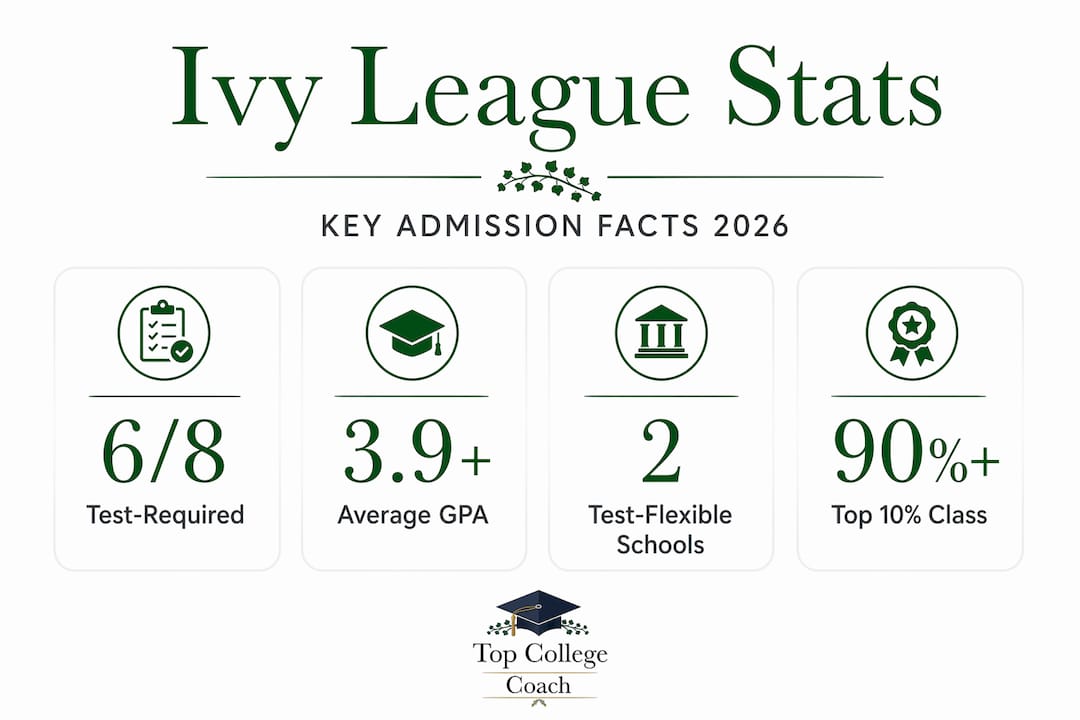
Most admitted students carry a GPA at or very near 4.0 on an unweighted scale. But raw GPA is only part of the picture. Admissions officers look closely at the rigor of the courses behind that GPA. A 3.9 earned through mostly standard-level classes will not carry the same weight as a 3.8 built on a schedule packed with AP, IB, and honors courses. Course rigor and class rank are evaluated as seriously as the grades themselves.
Class rank still matters, even at high schools that no longer officially report it. 98% of Dartmouth’s early admits were in the top 10% of their high school class. That figure tells you something important: being excellent in a general sense is not enough. You need to be excellent relative to your peers in a demanding academic environment.
Here is what the typical Ivy League application requirements list looks like on the academic side:
GPA: Unweighted 3.9 or higher is the norm; lower GPAs are considered in context but require exceptional strength elsewhere
Course load: Four years of English, math through calculus or statistics, lab science, foreign language, and history or social studies
Advanced coursework: A meaningful number of AP or IB courses, ideally in subjects aligned with your intended area of study
Class rank: Top 5 to 10% of your graduating class, where reported
Transcript trajectory: Upward trends matter; a strong junior year can partially offset a weaker freshman year
Pro Tip: If your high school does not offer many AP courses, admissions officers account for that. What they look for is whether you have taken the most rigorous courses available to you, not whether you have matched a student from a school with 30 AP offerings.
Standardized testing: a school-by-school breakdown
This is where families most often get tripped up, because the Ivy League SAT score requirements and testing policies are no longer uniform. They have fragmented significantly since the pandemic, and the landscape continues to shift.

Six of the eight Ivies require SAT or ACT for Fall 2026 applicants. The two exceptions operate under distinct models that require their own understanding.
School | Testing Policy (Fall 2026) | Notes |
Harvard | Test-required | SAT or ACT mandatory |
Princeton | Test-optional | Last test-optional cycle before mandatory return |
Yale | Test-flexible | SAT, ACT, AP, or IB accepted |
Columbia | Test-optional | Permanently test-optional |
Penn | Test-required | SAT or ACT mandatory |
Brown | Test-required | SAT or ACT mandatory |
Dartmouth | Test-required | SAT or ACT mandatory |
Cornell | Test-required | SAT or ACT mandatory |
Harvard reinstated mandatory SAT/ACT starting with the Class of 2029, ending its pandemic-era test-optional experiment. That decision shifted competitive dynamics in the applicant pool almost immediately.
Yale’s test-flexible model deserves special attention. Yale requires full AP or IB scores if you choose that path instead of the SAT or ACT. Predicted scores do not count. That means if you plan to use AP exams as your testing credential at Yale, you need to have already sat for those exams and received official scores before applying.
Princeton’s situation is equally important to track. Princeton remains test-optional for the 2026 and 2027 cycles but has publicly announced it will return to mandatory testing beginning with the Class of 2028. If you are a current junior applying next fall, you are in Princeton’s last test-optional window. Plan accordingly.
Pro Tip: Even at test-optional schools, submitting strong scores almost always helps. Research consistently shows that applicants who submit scores at test-optional schools tend to have higher acceptance rates than those who withhold them. If your score is at or above the school’s median, send it.
Students who require accommodations for standardized testing should review accommodation options early, since the process of securing and documenting accommodations takes time and varies by testing organization.
Holistic admissions criteria beyond the numbers
Here is something many families underestimate: grades and scores account for roughly 40 to 50% of how Ivy League admissions officers evaluate an application. The other half is everything else. Understanding that “everything else” is where most students either differentiate themselves or blend into the crowd.
The holistic Ivy League admissions criteria typically include the following components, each carrying real weight:
Personal essays. Your Common App essay and school-specific supplements are your opportunity to show who you are beyond the transcript. Admissions officers at schools like Princeton and Yale read thousands of essays that describe overcoming adversity in generic terms. What stands out is specificity, voice, and genuine reflection. Essays carry an 85% importance rating in some admissions data sets.
Letters of recommendation. Two teacher recommendations and one counselor letter are standard. The best recommendations come from teachers who know you deeply in a subject where you have genuinely excelled. A glowing letter from a teacher who barely knows you reads as hollow to experienced readers.
Extracurricular depth and leadership. Ivy League schools are not looking for students who joined every club. They want students who committed deeply to a few things and made a measurable impact. A student who founded a nonprofit, led a research project, or reached a national level in a competitive activity stands out far more than one with ten surface-level activities.
Personal background and context. Socioeconomic background, geographic diversity, first-generation status, and adversity overcome are all considered. Following the Supreme Court’s 2023 ruling on race-conscious admissions, schools have shifted toward evaluating how an applicant’s background shaped their character and perspective, communicated through their own words.
Interviews. Not all Ivies offer or require interviews, but when they do, treat the opportunity seriously. It is a chance to demonstrate intellectual curiosity, maturity, and genuine interest in that specific school.
Financial aid and what families often overlook
One of the most persistent myths about Ivy League schools is that they are only for wealthy families. The reality is the opposite. All Ivy League schools are need-blind for domestic applicants and commit to meeting 100% of demonstrated financial need. Roughly 50 to 60% of students at many Ivies receive institutional grant aid, and a significant portion of families pay well below the published sticker price.
Here is what that means in practical terms for your family:
Families earning under $75,000 per year typically pay little to nothing at schools like Harvard, Princeton, and Yale
Families earning between $75,000 and $150,000 often pay a percentage of income, not the full cost of attendance
Ivy League financial aid packages are grants, not loans, meaning students graduate with far less debt than peers at many lower-ranked schools
Applying for financial aid does not hurt your admissions chances at need-blind schools
Filing the FAFSA and CSS Profile early and accurately is non-negotiable; missing deadlines can cost your family tens of thousands of dollars in aid
The financial aid process is a separate application track that runs parallel to admissions. Start it at the same time. Many families who assume they earn too much to qualify are surprised by what the institutional aid formulas actually calculate.
Strategies for navigating the application process
The single most important thing you can do right now is confirm the specific requirements for your cohort at each school on your list. Post-pandemic test policy shifts have created real confusion, and students who discover a school’s testing requirement six weeks before a deadline face a significant disadvantage.
Beyond that, here is how to build a genuinely competitive approach:
Start your academic preparation in 9th or 10th grade. The students who gain admission to Ivies are not cramming in senior year. They have built four years of consistent academic excellence, meaningful extracurricular commitment, and a clear sense of who they are and what they care about.
Organize your application materials early. Reach out to recommenders in the spring of junior year, not the fall of senior year. Give your teachers and counselor enough time to write something thoughtful, not something rushed.
Use official school resources. Each Ivy League school publishes detailed application guidance, class profile data, and frequently asked questions. Reading those materials carefully reveals nuances that generic advice misses. You can also explore our 2026 application guide for a structured walkthrough of the process.
Avoid the common pitfall of writing essays that tell admissions officers what you think they want to hear. Authenticity is not a buzzword. It is the difference between an essay that a reader remembers and one they forget before moving to the next file.
Pro Tip: Build a school-specific spreadsheet that tracks each Ivy’s testing policy, essay prompts, interview availability, and financial aid deadlines. Treating each school as its own unique application, rather than a copy-paste project, is one of the clearest signals of a serious applicant.
My honest take on what actually matters
I have worked with hundreds of students and families through the Ivy League admissions process, and I want to share something that does not always make it into the standard advice columns.
The families who approach this process with the most anxiety are often the ones who have reduced Ivy League requirements to a checklist. They obsess over whether the GPA is high enough, whether the SAT score clears the median, whether there are enough extracurricular activities on the list. I understand that impulse completely. But in my experience, the students who actually get in are the ones who have developed a genuine sense of purpose and can communicate it clearly.
What I have seen admissions readers respond to is specificity. Not “I am passionate about science” but “I spent two summers researching water quality in my county and presented findings to the city council.” Not “I am a leader” but “I built our school’s first robotics team from four members to forty.” The numbers get you in the room. The story gets you the offer.
I also want to be honest about something many families overlook: the role of fit. Each Ivy has a distinct culture, and admissions officers are reading for whether you understand and genuinely want to be part of that community. A student who writes a compelling, specific essay about why Princeton’s residential college system excites them will outperform a student who submits a generic essay about wanting to “be challenged academically.” Do your homework on each school. It shows.
The admissions changes happening right now make early planning more important than ever. Do not wait until senior year to figure out your strategy.
— Randy Pryor
Ready to build your Ivy League strategy?
Understanding the requirements is only the first step. Turning that knowledge into a competitive application takes planning, self-awareness, and expert guidance tailored to your specific profile and goals.
At Top College Coach, we have helped students gain admission to Harvard, Princeton, Yale, and every other Ivy League school through personalized strategy sessions that go far beyond generic advice. We know how to position your academic record, craft essays that stand out, and navigate testing policies for your specific cohort. Our team is based in Orlando, Florida, and has earned five-star reviews from families across the country. If you are ready to get serious about your application, book a free strategy session and let us show you exactly what your path forward looks like.
FAQ
What GPA do you need for Ivy League schools?
Most admitted students carry an unweighted GPA of 3.9 or higher, though GPA is always evaluated alongside course rigor. A slightly lower GPA earned through a demanding AP or IB schedule can be more competitive than a higher GPA from easier coursework.
Are SAT scores required for Ivy League admissions?
It depends on the school and the year. For Fall 2026, six of eight Ivies require the SAT or ACT. Yale accepts AP or IB scores as alternatives, and Columbia is permanently test-optional. Always confirm the policy for your specific application cycle.
How important are extracurricular activities in Ivy League applications?
Extracurricular depth and leadership carry significant weight in holistic Ivy League admissions. Schools look for meaningful commitment and measurable impact in a few areas rather than surface-level participation in many.
Can students with disabilities get testing accommodations for Ivy League applications?
Yes. Students requiring accommodations for the SAT or ACT should apply for accommodations through the College Board or ACT early, as the documentation and approval process takes time.
Does applying for financial aid hurt your chances at Ivy League schools?
No. All eight Ivy League schools practice need-blind admissions for domestic applicants, meaning your financial aid application does not factor into the admissions decision. Applying for aid is always worth doing.
Recommended
Comments