How to Choose Right Colleges to Apply to in 2026

The college search process can feel like standing in front of a wall of 4,000 options with no map. You want to choose right colleges to apply to, but between rankings, campus visits, financial aid packages, and everyone’s opinions, it’s hard to know where to start. The good news: this isn’t a guessing game. With the right framework, you can build a college list that reflects who you are, where you’re headed, and what you can realistically afford. This guide gives you that framework, step by step.
Table of Contents
Key Takeaways
Point | Details |
Start with self-reflection | Identify your academic strengths, career goals, and personal values before researching any school. |
Evaluate four core criteria | Assess every college on affordability, academic fit, social fit, and graduation rates above 60%. |
Build a balanced list | Aim for 8 to 15 schools split roughly 30% reach, 40% target, and 30% safety schools. |
Research beyond overall rates | Major-specific acceptance rates can be far lower than a school’s published overall acceptance rate. |
Commit with confidence | Once you make your deposit, focus forward. Envisioning success at your chosen school matters more than second-guessing. |
How to choose right colleges to apply to: start with you
Before you open any college ranking site, you need to spend real time on self-assessment. Students who align choices with their personal interests and abilities tend to perform better and stay committed through graduation. That’s not a soft suggestion. It’s the foundation of a smart college selection guide.
Ask yourself these questions honestly:
What subjects genuinely excite you, not just the ones you’re good at for grades?
Do you have a career direction in mind, even a loose one? Engineering, health sciences, business, the arts?
Are you someone who thrives in large lecture halls, or do you need smaller classes and closer faculty relationships?
What does your academic record actually reflect about your strengths and your trajectory?
Are you choosing schools because you want them, or because your friends, parents, or a college counselor pushed them?
That last question matters more than most students admit. Peer pressure and family expectations quietly distort college lists all the time. A student who genuinely wants a smaller liberal arts environment but applies to flagship state universities because “everyone else is” often ends up unhappy or underperforming.
Pro Tip: Use your junior year summer to reflect on your motivations and goals before building your list. Top College Coach recommends this as one of the highest-leverage steps you can take to maximize admissions chances before senior year begins.
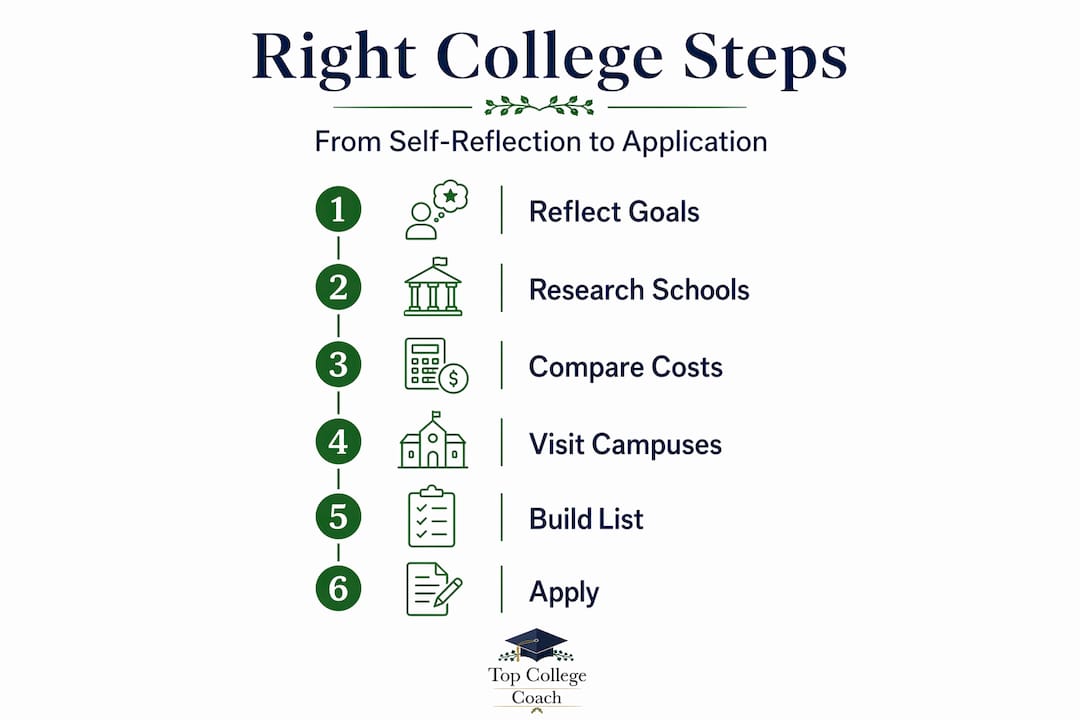
If you’re genuinely unsure about your direction, aptitude assessments and conversations with a college counselor can help clarify the picture. The goal is to enter the research phase knowing what you’re actually looking for.
Evaluating colleges on the criteria that actually matter
Once you know your priorities, you can start researching schools with real purpose. The four critical factors to evaluate are affordability, academic fit, social fit, and graduation rates. Here’s how to assess each one without wasting time.
Affordability: net cost, not sticker price
The number on a college’s website is almost never what you’ll pay. Use the net price calculator on every school’s financial aid page to get a realistic estimate based on your family’s finances. Then run this simple check: monthly loan payments should ideally stay below 10% of your expected starting salary in your chosen field. If you plan to work in social work or education, a $60,000 annual debt load at a private school may not be sustainable. If you’re heading into software engineering or finance, the math changes.

Academic fit: programs, rigor, and outcomes
Look beyond whether a school offers your major. Check whether the program is accredited, how strong the faculty research is, and what graduates actually do after finishing. A school ranked #40 overall might have a top-10 nursing or architecture program. Finding the best colleges for your specific major often means digging past the general rankings.
Social fit: what campus life really looks like
Visiting campuses and talking directly with current students gives you a far more accurate picture than any brochure or Instagram account. Ask students what they wish they had known before enrolling. Read student newspapers. Scroll through unfiltered Reddit threads about the school. These sources reveal the real culture.
Graduation rates: a signal you can’t ignore
A school’s graduation rate above 60% is a strong indicator that students are supported, engaged, and finishing what they started. Rates below that threshold should prompt serious questions about academic support, financial aid continuity, and student satisfaction.
Pro Tip: When comparing schools, build a simple spreadsheet with columns for net cost, four-year graduation rate, your major’s program strength, and one note on campus culture. Seeing those numbers side by side cuts through the noise fast.
Criteria | What to check | Where to find it |
Affordability | Net price after aid | School’s net price calculator |
Academic fit | Major accreditation, faculty, outcomes | Department pages, LinkedIn alumni data |
Social fit | Campus culture, student life | Campus visits, Reddit, student newspapers |
Graduation rate | Four-year completion rate | College Scorecard, school’s Common Data Set |
Building a balanced college list
Here’s where many students make a critical structural mistake. They either load up on reach schools and get shut out everywhere, or they play it so safe that they end up with options that don’t excite them. A balanced list of 8 to 15 schools divided by admission probability is the standard that experienced counselors recommend.
Reach schools (about 30% of your list). These are schools where your academic profile falls below the median admitted student, or where acceptance rates are simply very low. You want them on your list. You just shouldn’t bet everything on them.
Target schools (about 40% of your list). Your GPA, test scores, and extracurriculars align well with the typical admitted student. You have a realistic shot, though admission is never guaranteed.
Safety schools (about 30% of your list). Schools where your profile is clearly above the median and you feel confident about admission. These should still be schools you’d genuinely be happy attending.
Now here’s something most college selection guides skip entirely. Competitive majors within a school often have dramatically lower acceptance rates than the institution’s overall rate. A university with a 20% overall acceptance rate might admit only 4% of applicants to its Computer Science program. That “target” school just became a reach school for CS applicants. Always research the major-specific acceptance rate, not just the headline number.
There’s another hidden variable for out-of-state applicants. Public universities often have residency quotas that make admission significantly harder for non-residents, regardless of what the published acceptance rate suggests. A school that looks like a target on paper can function as a reach school if you’re applying from out of state.
Pro Tip: Track your list in a spreadsheet with columns for school name, category (reach/target/safety), application deadline, required materials, and your major’s specific acceptance rate. Reviewing it weekly keeps you organized and reduces last-minute panic.
Executing your research and application strategy
Knowing your criteria and list structure is half the battle. The other half is doing the actual research efficiently and applying strategically.
Use College Board’s Big Future or the Common Data Set for each school to filter by major, size, location, and cost. These tools let you shortlist schools based on real data rather than reputation alone.
Schedule campus visits for your top choices, ideally while school is in session. An empty campus during a holiday weekend tells you almost nothing. Sitting in on a class or grabbing lunch in the dining hall tells you a lot.
Talk to admissions counselors at college fairs and information sessions. Ask specific questions about your intended major, scholarship opportunities, and what the school values in applicants. Understanding what top colleges look for gives you a real edge when crafting your application.
Request conversations with current students or recent alumni, especially those in your intended program. Their perspective on workload, faculty relationships, and career placement is more honest than any official source.
Compare financial aid packages carefully before committing. A school with a higher sticker price may offer more merit aid and end up costing less than a cheaper-looking option.
Managing deadlines is where many otherwise prepared students stumble. Create a master calendar with every Early Decision, Early Action, and Regular Decision deadline on your list. Build in buffer time for essays, recommendations, and test score submissions.
Avoiding common mistakes before you commit
The most expensive mistake students make is choosing colleges based on rankings alone. Rankings measure institutional prestige and research output. They don’t measure whether you will thrive there, whether your specific program is strong, or whether you’ll graduate on time.
Here are the pitfalls worth actively avoiding:
Applying to schools without checking their four-year graduation and retention rates. Low retention is a warning sign.
Ignoring the debt-to-salary ratio for your intended career. A $120,000 degree in a field with a $38,000 starting salary creates real financial strain.
Underestimating how much campus culture affects your motivation and mental health. Social fit is not a luxury consideration.
Assuming that applying to an Ivy League or top-20 school with strong overall stats means you’re a target applicant for your specific major. Admission selectivity varies significantly by program within the same institution.
Once you’ve made your choice and submitted your deposit by May 1, shift your mindset completely.
“The healthiest approach after committing is to envision yourself thriving at your chosen school, not mourning the waitlists. The students who succeed are the ones who arrive ready to own their experience.”
My honest take on the college selection process
I’ve worked with hundreds of students through the college admissions process, and the single most consistent pattern I see is this: the students who struggle most are the ones who built their list around external validation rather than internal clarity.
A student who genuinely connects with a school’s culture, program, and community will outperform a student who chose a “better-ranked” school out of ego or pressure. Every time. The college you attend matters far less than what you do once you’re there, and you will do far more if you actually belong there.
I’ve also seen students get blindsided by the reach school classification problem. They apply to a school with a 15% overall acceptance rate, feel confident because their GPA and scores are strong, and then get rejected because their intended major had a 3% acceptance rate that nobody told them about. Do the major-specific research. It’s not optional.
My other strong opinion: applying to Ivy League and top-20 schools requires a fundamentally different preparation strategy than applying to most universities. The students who get in aren’t just academically strong. They have a clear narrative, a demonstrated spike in a specific area, and an authentic story that connects their past to their future. If that’s your goal, start building that story early.
The right college for you is the one where you will grow, contribute, and graduate with real skills and a manageable financial situation. That school exists. Finding it just takes honest self-assessment and disciplined research.
— Randy Pryor, Founder - Top College Coach
Work with experts who know the process
Selecting the right schools to apply to is one of the most consequential decisions a student makes, and you don’t have to figure it out alone.
At Top College Coach, we specialize in helping students build strategic, personalized college lists and craft applications that stand out at Ivy League and top-20 universities. Our counselors bring deep knowledge of program-specific admissions, merit aid strategy, and essay development that turns a stressful process into a confident one. Whether you’re just starting your college search or ready to finalize your list, a free admissions strategy session is the fastest way to get clarity on your priorities and maximize your acceptance chances. Students and parents across the country trust our 5-star track record. Yours could be the next success story.
FAQ
How many colleges should I apply to?
Most students benefit from applying to 8 to 15 schools, split across reach, target, and safety categories. This range gives you real options without spreading your application effort too thin.
What makes a college a “reach” school for me?
A reach school is one where your GPA and test scores fall below the median admitted student, or where the program you’re applying to has very low acceptance rates. Always check major-specific rates, not just the school’s overall acceptance rate.
How do I know if a college is affordable?
Use the net price calculator on the school’s financial aid page to estimate your actual cost after grants and scholarships. As a general rule, your expected monthly loan payments after graduation should stay below 10% of your projected starting salary.
Should I visit every college on my list?
Visiting your top choices while school is in session is worth the effort. For schools lower on your list, virtual tours and conversations with current students can give you enough information to make a confident decision.
Do college rankings matter when selecting schools?
Rankings can be a useful starting point, but they measure institutional metrics rather than student outcomes. Focus on graduation rates, program strength in your specific major, and net cost to get a more accurate picture of fit and value.
Recommended
Comments