How College Legacy Admissions Works: A Family Guide
- 3 days ago
- 12 min read

What is legacy admissions and how does the process work?
Legacy admissions give applicants a preference in the college admissions process based on family ties to alumni. If your parent, grandparent, or sibling attended a particular college, that school may view your application more favorably than it would an otherwise identical candidate without that connection. This preference is not a guarantee of admission, but at selective schools, it can meaningfully shift the odds in your favor.
The mechanics vary by institution. Most colleges that practice legacy admissions flag an applicant’s file early in the review process, often through a dedicated alumni relations office that communicates with the admissions team. Some schools, like Harvard University, even maintain a special category called the “Z-list,” where well-connected legacy applicants are offered deferred admission with the expectation they take a gap year before enrolling. At the University of Notre Dame and Georgetown University, legacy status is known to carry particularly heavy weight in the holistic review.

How much does legacy status actually move the needle? A 2005 analysis of 180,000 student records from nineteen selective colleges found that, within a comparable SAT score range, being a legacy raised admission chances by 19.7 percentage points. At Princeton, legacy applicants were admitted at roughly 33% compared to a 5.5% overall acceptance rate for the same class. Ivy League institutions collectively estimate that 10%–15% of each entering class arrives through legacy admissions.
Key facts about how legacy preference works in practice:
Who qualifies: Most schools extend legacy status to children of undergraduate alumni; some broaden it to grandchildren, siblings, nieces, and nephews of both undergraduate and graduate alumni.
How it enters the review: Admissions offices typically flag legacy files before committee review, and some schools employ counselors dedicated solely to legacy applicants.
Early decision advantage: Many colleges notify legacy applicants that applying early decision amplifies the preference, since yield is already high in that round.
Beyond admission: Legacy students often receive access to special advising sessions, mentorship from current legacy students, and in some cases, scholarships or in-state tuition rates even when they are out-of-state residents.
Not a free pass: Legacy status functions as one factor in a holistic review. A student with a weak academic record will not be admitted simply because a parent attended.
Understanding the college admissions process as a whole helps put legacy preference in proper context. It is a real advantage, but it sits alongside grades, test scores, essays, extracurriculars, and demonstrated interest.

Why do colleges use legacy admissions policies?
The short answer is money and loyalty, though the full picture is more layered than that. Legacy admissions have roots going back to the 1920s, when Ivy League universities introduced the practice as a way to limit the enrollment of Jewish immigrants and preserve the demographic character of historically Protestant institutions. Over time, the explicit exclusionary intent faded, but the structural preference remained and spread to hundreds of other colleges.
Today, colleges justify legacy admissions primarily through three institutional motivations:
Alumni donations: Legacy families are statistically more likely to give to the institution, and parents of legacy applicants often increase their giving during the application cycle.
Yield management: Legacy students enroll at higher rates when admitted. At Princeton, the yield rate among legacy admits was nearly 89%, compared to 69% for non-legacies. A higher yield means a college can admit fewer students overall to fill its class, which lowers the published acceptance rate and signals selectivity.
Alumni relations: Admitting the children of engaged alumni deepens the emotional and financial bond between families and the institution across generations.
Research confirms that legacy students are not necessarily more academically qualified than their non-legacy peers. They are, however, economically beneficial to universities, perceived as more likely to donate after graduation and to come from families that are already generous contributors.
The yield management argument deserves particular attention. When a college’s acceptance rate drops, its ranking in outlets like U.S. News & World Report can improve, which in turn attracts more applications, which further lowers the rate. Legacy admissions feed this cycle by reliably filling seats with students who have already demonstrated they want to attend.
How common are legacy admissions, and which schools use them?
Legacy admissions are far more common at private colleges than at public ones, and far more common at selective schools than at open-enrollment institutions. About 40% of U.S. college students attend institutions that practice legacy admissions, with 82% of private colleges using it compared to 27% of public colleges.
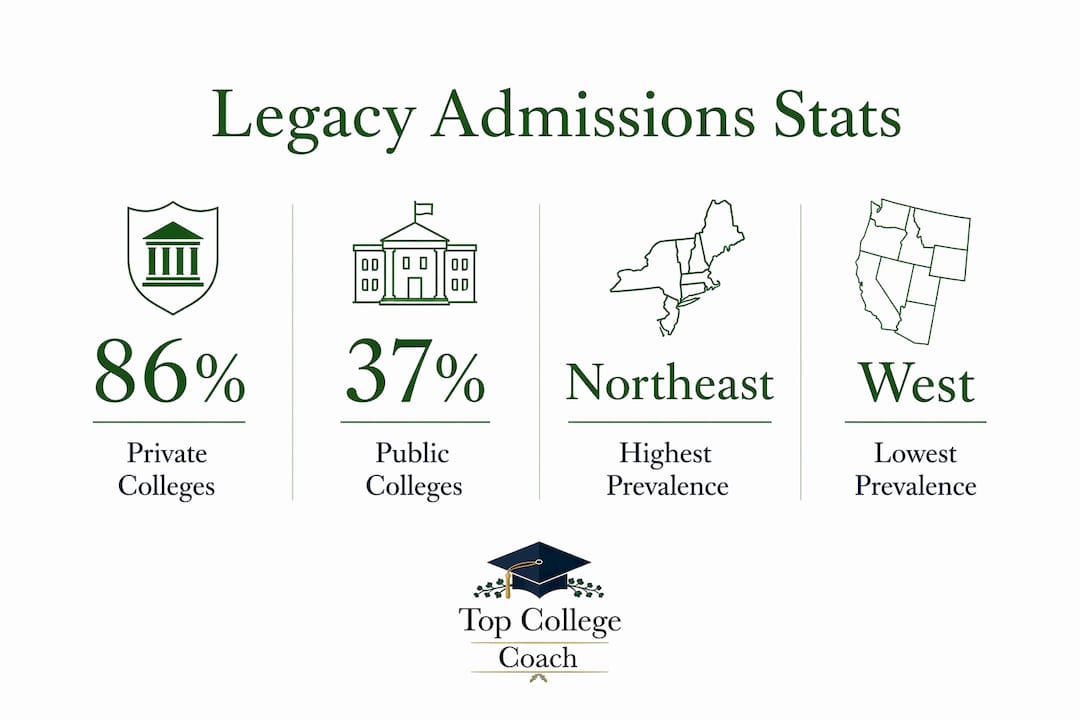
Among the most selective private colleges, 86% consider legacy status, versus 37% of the most selective public colleges. A 2018 survey of admissions directors found that 42% of private college admissions directors factor in legacy status, compared to only 6% at public colleges.
Institution type | Legacy admissions prevalence |
Most selective private colleges | 86% consider legacy status |
Private colleges overall | 82% consider legacy status |
Most selective public colleges | 37% consider legacy status |
Public colleges overall | 27% consider legacy status |
Least selective public colleges | 6% consider legacy status |
Regional patterns matter too. Legacy admissions are most common in the Northeast and South and least common in the West. The University of California system and MIT do not consider legacy status at all, prioritizing other criteria. Amherst College formally ended its legacy preference in 2021, citing a commitment to expanding access and financial aid.
Public flagships present a nuanced picture. Most state flagship universities do not formally consider legacy status in admissions, yet half of all flagships offer at least one scholarship specifically for legacy students. These scholarships range from $500 per year at the University of South Carolina to over $10,000 per year at schools like the University of Nebraska. The University of Missouri offers up to $21,500 to qualifying out-of-state legacy students. So even when a public university does not give a preference in the admissions decision itself, legacy families may still find financial benefits waiting.
Pro Tip: If you are applying to a public flagship, check its scholarship page specifically for legacy-based awards. Even schools that do not weigh legacy status in admissions decisions often have scholarship dollars set aside for alumni children.
Controversies and criticisms surrounding legacy admissions
Legacy admissions draw sharp criticism precisely because the preference flows most reliably to students who already hold structural advantages. The historical record makes the case plainly: Ivy League colleges introduced legacy preferences in the 1920s to restrict Jewish students from gaining admission, a goal achieved by favoring the children of the existing, predominantly Protestant alumni base. The mechanism was discriminatory by design.
Today’s critics argue the effect, if not the intent, remains troubling. Legacy admits tend to be less racially diverse than non-legacy students, and because alumni pools at elite schools skew white and wealthy, the preference perpetuates that demographic pattern. A recent study of a dozen highly selective “Ivy-plus” colleges found that legacy admissions are a key driver of higher admission rates among the wealthiest applicants.
The 2023 U.S. Supreme Court decision in Students for Fair Admissions v. Harvard banned race-conscious admissions, which immediately intensified scrutiny of legacy preferences. Critics pointed out the contradiction: if race cannot be considered to increase diversity, why can family wealth and alumni connections be considered in ways that decrease it? The U.S. Department of Education opened a civil rights investigation into Harvard’s legacy admissions practice in the wake of that ruling.
Arguments made by opponents and proponents break down like this:
Opponents argue:
Legacy preference is a form of nepotism that rewards birth circumstances, not merit.
It slows diversity gains and concentrates elite education among already-privileged families.
It undermines the meritocratic promise that selective colleges publicly advertise.
Historically, it was used as an explicit tool of exclusion against Jewish and, some researchers argue, Asian American applicants.
Proponents argue:
Alumni donations fund scholarships, facilities, and financial aid that benefit all students.
Legacy students show higher yield and stronger institutional loyalty.
Colleges have broad discretion in shaping their communities, and alumni relationships are a legitimate factor.
Legacy preference is one small factor in a holistic process, not a determinative one.
The debate is unlikely to resolve cleanly. Several colleges have voluntarily dropped legacy preferences since 2021, and legislative pressure is building in states like California and Colorado, where bills have been introduced to ban the practice at public institutions.
How does legacy status actually affect your admission chances?
The boost is real, and at the most selective schools, it is substantial. The 19.7 percentage point increase documented across nineteen selective colleges represents an enormous shift in probability at schools where overall acceptance rates sit in the single digits. Princeton’s numbers make the point concretely: a 33% admit rate for legacies against a 5.5% overall rate means a legacy applicant was admitted at roughly six times the rate of the general pool for that class.
Ivy League schools collectively admit legacies at two to five times their overall admission rates. The University of Pennsylvania, for example, admitted 41.7% of legacy early decision applicants and 33.9% during regular decision, compared to 29.3% and 16.4% respectively for all applicants in those rounds. Brown University admitted 33.5% of alumni children in 2006, against a 13.8% overall rate.
That said, legacy status does not operate in isolation. Here is how it fits into the broader admissions picture:
Academic floor still applies: Admissions offices at elite schools will not admit a legacy applicant whose academic profile falls far below the class median. Legacy preference operates most powerfully when a student is already competitive.
Holistic review still happens: Essays, recommendations, extracurriculars, and demonstrated interest all matter. A legacy applicant with a weak personal statement is still a weak applicant.
Early decision amplifies the effect: Many schools signal to legacy families that applying early decision, where yield is already high, strengthens the preference further.
Additional review layers: Some schools route legacy files through a separate alumni review before the main admissions committee sees them, which can add an advocacy voice to the file.
Transfer legacy status: At schools where a legacy applicant is denied, some institutions offer counseling and encourage the student to attend a less selective school for one or two years before reapplying as a transfer, since transfer admit rates are evaluated separately from freshman rates for ranking purposes.
If you are a legacy applicant, the single best thing you can do is treat your application as if the preference does not exist. Build the strongest possible academic record, write essays that reveal genuine character, and apply early if the school allows it. The preference is an advantage, not a guarantee, and the students who benefit most from it are the ones who would have been competitive anyway.
Understanding what top colleges look for beyond legacy status gives you a clearer picture of where to invest your energy.
Expert insights from a college admissions counselor on legacy admissions
At Top College Coach, we work with students and families navigating exactly this kind of complexity every application cycle. Legacy status is one of the most misunderstood factors in the process, both overestimated by families who assume it guarantees admission and underestimated by those who dismiss it as irrelevant.
The practical reality is that legacy admissions function as a tiebreaker more often than as a trump card. When two applicants are similarly qualified, legacy status can tip the decision. When one applicant is clearly stronger, the preference rarely overcomes the gap. That framing should shape how you approach your preparation.
Legacy status also interacts with other admissions factors in ways families often overlook. Standardized test scores, for instance, still matter at schools that require them, and a legacy applicant with below-median scores faces a harder path than one who meets or exceeds the class profile. The role of standardized testing in admissions has shifted in recent years, but at highly selective schools, scores remain part of the picture.
Extracurricular depth matters just as much for legacy applicants as for anyone else. Admissions readers are looking for evidence of genuine passion and impact, not a resume padded with activities. A legacy applicant who has pursued one area with real commitment stands out far more than one who coasted on the family connection.
Pro Tip: If you have legacy status at a school you genuinely love, reach out to the alumni admissions office early. Many schools have formal programs that connect legacy applicants with current students and alumni interviewers. Engaging with those programs signals authentic interest and puts a human face on your application file.
How legacy admissions compare to other preferential admissions policies
Legacy admissions are one of several preferential policies that selective colleges use alongside purely academic criteria. Comparing them to other forms of preference clarifies both what makes legacy admissions distinctive and why they attract a different kind of criticism.
Athletic recruitment is the most visible parallel. Recruited athletes at Division I schools can receive admissions preferences that dwarf what legacy status provides, with some studies showing admit rates for recruited athletes that exceed those of legacy applicants. The key difference is that athletic recruitment is tied to a demonstrated, measurable skill that the institution directly benefits from on the field or court.
First-generation and low-income preferences operate in the opposite direction from legacy admissions. Many colleges give additional consideration to applicants who would be the first in their family to attend college, or who come from low-income households. These preferences are explicitly designed to expand access, which puts them in direct philosophical tension with legacy admissions, which tend to concentrate access among families already familiar with elite higher education.
Race-conscious admissions, now banned by the Supreme Court’s 2023 ruling in Students for Fair Admissions v. Harvard, were designed to increase representation of historically underrepresented groups. The Court’s decision removed this tool while leaving legacy preferences intact, a contrast that critics found deeply inconsistent. Brookings Institution research noted substantial overlap between the colleges that practiced both legacy admissions and race-conscious admissions before the ruling, meaning that removing one preference while leaving the other in place has real demographic consequences.
Donor preferences, sometimes called “development cases,” are closely related to legacy admissions but distinct. A student whose family has made a major gift to a university, or is expected to, may receive consideration that goes beyond standard legacy status. Harvard’s Z-list functions partly in this space. These preferences are rarely disclosed publicly and operate with even less transparency than legacy admissions.
The common thread across all preferential policies is that colleges use them to serve institutional interests alongside academic ones. What makes legacy admissions politically contentious right now is the timing: they remain in place at many schools even as race-conscious policies have been eliminated, and the demographic beneficiaries of the two policies point in opposite directions.
High-profile cases where legacy admissions played a significant role
Harvard University sits at the center of the most scrutinized legacy admissions story in recent history. The Students for Fair Admissions v. Harvard litigation, which ultimately reached the U.S. Supreme Court in 2023, produced detailed internal data showing that Harvard’s admissions process gave substantial boosts to legacy applicants, donor-related applicants, children of faculty and staff, and recruited athletes. Plaintiffs’ experts argued that eliminating legacy and donor preferences at Harvard would meaningfully increase racial diversity in the admitted class. Harvard defended the practice as part of a holistic process tied to alumni engagement and fundraising. The Supreme Court’s ruling addressed race-conscious admissions but did not ban legacy preferences, leaving Harvard’s policy technically intact even as public and regulatory pressure mounted. The U.S. Department of Education subsequently opened a civil rights investigation specifically into Harvard’s legacy admissions practice.
Amherst College made national news in october 2021 when it announced it would end legacy preference entirely and redirect resources toward a $71 million expansion of financial aid. Amherst’s president framed the decision as a matter of consistency: a college committed to access and diversity could not credibly maintain a preference that systematically favored already-advantaged applicants. Amherst’s move was watched closely by peer institutions, though few liberal arts colleges followed immediately.
The University of California system offers a different kind of case study. UC schools, including UCLA and UC Berkeley, have not considered legacy status in admissions for decades, operating under a state law that prohibits preferential treatment based on family connections at public universities. The UC system’s experience is frequently cited by reformers as evidence that elite public universities can maintain prestige and strong alumni giving without formal legacy preferences.
Princeton University generated significant data points during the SFFA litigation and related research. Princeton admitted roughly 33% of legacy applicants against a 5.5% overall rate, and its legacy yield rate of nearly 89% was cited as evidence of why the university viewed the preference as a yield management tool. Princeton has not eliminated legacy preferences, though it has faced sustained pressure from student groups and faculty.
Johns Hopkins University ended legacy preferences in 2020, citing a commitment to socioeconomic diversity. Like Amherst, Hopkins found that the policy change did not damage alumni giving in the short term, a finding that directly challenges one of the central institutional justifications for maintaining legacy admissions.
These cases collectively illustrate that legacy admissions are not a fixed feature of American higher education. They are a policy choice, and institutions across the selectivity spectrum are actively reconsidering that choice in the current legal and political environment. Staying current on recent changes in college admissions helps families understand how quickly this landscape can shift.
Key Takeaways
Legacy admissions give applicants with alumni family ties a measurable advantage at selective colleges, but the preference functions as one factor in a holistic review, not a substitute for a strong application.
Point | Details |
Legacy boost is real but bounded | A 2005 study found legacy status raised admission chances by 19.7 percentage points among applicants with similar SAT scores. |
Private schools use it far more | 82% of private colleges practice legacy admissions, compared to 27% of public colleges. |
Princeton’s numbers show the gap | Princeton admitted roughly 33% of legacy applicants versus a 5.5% overall acceptance rate for the same class. |
Legal pressure is growing | The 2023 Supreme Court ruling on race-conscious admissions has intensified scrutiny of legacy preferences across the country. |
Strong applications still win | Legacy status works best as a tiebreaker; a weak academic profile or thin essays will not be saved by family connections alone. |
Recommended
Comments