Storytelling in College Admissions: Your 2026 Guide

Why storytelling is the heart of your college application
Your grades tell admissions officers you can do the work. Your story tells them who you are. That distinction is exactly why the importance of storytelling in college admissions has grown so dramatically, especially after the 2023 Supreme Court ruling that shifted even more weight onto essays and personal narratives.
Admissions officers at schools using holistic review are not processing a form when they open your application. As Rick Clark of Georgia Tech’s admissions blog puts it directly, “Stories are read. Forms are processed.” That one sentence reframes everything. When you approach your application as a story you are sharing rather than a checklist you are completing, the quality of what you submit changes.
What makes a college admissions narrative work?
Authenticity: Your real voice, not the voice you think sounds impressive
Coherence: Every part of the application, from essays to activity descriptions, reinforces a consistent picture of who you are
Personal growth: Showing how you have changed, not just what you have achieved
Connection to future goals: Linking your past experiences to where you are headed
Campus contribution: Helping officers picture what you will add to their community
A résumé lists accomplishments. A story reveals character. Admissions committees are building a class of people, and they need to see the person behind the transcript.
How to craft an authentic and compelling admissions narrative
The most common mistake students make is writing broadly. “I am passionate about science” tells an admissions officer almost nothing. “The night I stayed up until 2 AM rebuilding a broken circuit board for my robotics team, I realized I was not just solving a problem, I was thinking like an engineer” tells them everything.

Concrete details and specific moments are what separate memorable essays from forgettable ones. Ground every claim in a real scene, a real conversation, or a real decision you made. Then connect that moment to how you grew and where you are going.
Here is what a cohesive narrative strategy looks like in practice:
Avoid repeating topics across components. If your main essay covers your love of debate, your supplemental essays should open new dimensions, perhaps your curiosity about history or your role as a caregiver at home.
Use extracurriculars as supporting chapters. Your extracurricular activities are not a separate section; they are evidence that backs up the character you describe in your essays.
Write in your natural voice. Admissions officers read thousands of essays. Formal, stiff writing blends in. Honest, specific writing stands out.
Use dialogue sparingly but effectively. A line of real dialogue can bring a scene to life in a way that description alone cannot.
Vary your essay structure. The five-paragraph format works in English class. In a college essay, it can flatten your voice. Try opening in the middle of a scene, or letting a single object carry symbolic weight throughout.
Pro Tip: Before you submit, ask a trusted adult, whether a parent, counselor, or teacher, to read your entire application from beginning to end, the way an admissions officer would. Ask them to write down what they feel is missing. You will almost always be surprised by what you have left out.
Common misconceptions and best practices in college essays
Students and parents often believe the wrong things about what makes an essay work. Clearing up these myths early saves months of wasted effort.
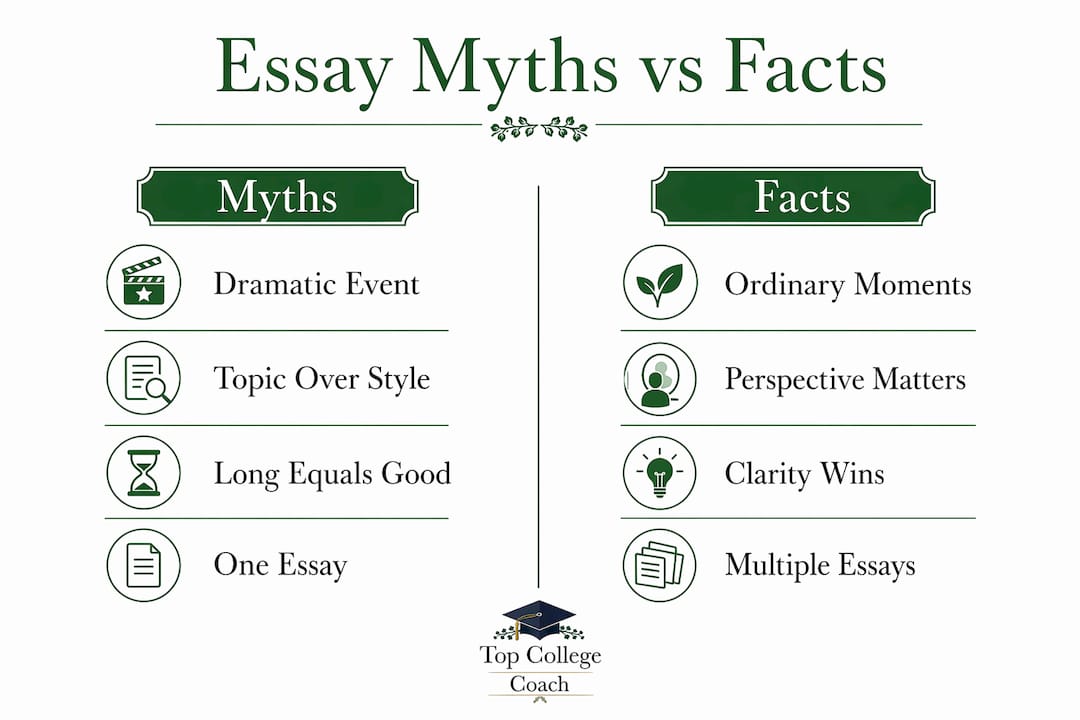
Myth 1: You need a dramatic life event.
You do not. Ordinary moments with strong reflection are often more compelling than grand achievements. An essay about learning to make your grandmother’s recipe can reveal more about your identity than an essay about winning a state championship, if the reflection is honest and specific.
Myth 2: The topic is what matters most.
The lens matters more than the event. Admissions officers are looking for qualities like resilience, curiosity, empathy, and self-awareness. Those traits come through in storytelling, not in a list of accomplishments.
Myth 3: Longer and more formal equals more impressive.
Clarity beats complexity every time. Simple, specific language that sounds like you is far more powerful than vocabulary chosen to impress.
Myth 4: One great essay is enough.
Each essay should add a new dimension to your application story. Spreading topics strategically across your personal statement and supplementals shows range and depth, and prevents the committee from feeling like they read the same essay twice.
Best practices grounded in what admissions professionals actually respond to:
Lead with a scene, not a thesis statement
Reflect more than you describe
Show growth over time, not just a single moment of triumph
Write the essay only you could write
End with insight, not a summary
Expert insights from Top College Coach and Randy Pryor
Randy Pryor, founder of Top College Coach, has built his practice around one core belief: your application is your story, and telling it well is a skill that can be learned. Based in Orlando, Florida, Top College Coach has guided students into Ivy League and Top 20 universities, earning a consistent record of five-star client reviews. Randy’s approach treats each student’s application as a narrative project, not a data entry task.
That perspective aligns directly with what institutional admissions professionals say. Dartmouth Admissions has described the relationship between data and narrative this way:
That framing captures why college application storytelling is not a soft skill. It is the mechanism through which admissions officers decide whether they want to meet you.
Randy’s guidance also emphasizes the iterative nature of strong storytelling. Just as a published book goes through multiple rounds of editing, your application deserves the same rigor. One draft is a starting point. The version that gets submitted should reflect genuine revision, outside feedback, and a clear-eyed look at whether every component reinforces the same authentic picture of who you are.
Dartmouth’s admissions team also encourages students to “fit out” rather than fit in. Stop trying to match what you imagine a top-school student looks like. Present who you actually are, because that is what admissions officers remember when they close the file.
How storytelling shapes your overall application strategy
Storytelling does not live only in your personal statement. It runs through every part of your application, and the strongest applicants treat all of it as one connected narrative.
Application component | Role in your story |
Personal statement | The central chapter: your voice, your values, your growth |
Supplemental essays | Supporting chapters that open new dimensions of your character |
Activity descriptions | Evidence that your story is backed by real action |
Letters of recommendation | Outside perspectives that confirm and deepen the picture you have drawn |
Interviews | A live performance of the character your written application introduced |
A cohesive application ties these components together without repeating the same information across them. Each piece should complement the others, not duplicate them.
Tailoring your story to specific colleges matters too. When you write a “Why Us” supplemental, connect your narrative directly to programs, professors, or campus values that genuinely excite you. Generic enthusiasm reads as generic. Specific enthusiasm reads as fit.
Checklist for a cohesive application narrative:
Does your personal statement introduce your core identity and values?
Do your supplementals each reveal something the personal statement did not?
Do your activity descriptions use specific language, not vague labels?
Have you read your full application from start to finish as a single story?
Does each “Why Us” essay connect your specific experiences to that school’s specific offerings?
Would a reader who finished your application feel they genuinely know you?
Athletes have an additional layer to consider: how sports participation fits into the broader narrative. Understanding how athletic involvement connects to your application story can open doors that purely academic narratives miss.
Top College Coach can help you tell your story with confidence
Knowing that storytelling matters and knowing how to execute it are two very different things. Top College Coach works with students and families to build application narratives that are specific, authentic, and strategically coherent across every component. Randy Pryor and the Top College Coach team bring deep expertise in what Ivy League and Top 20 admissions committees actually respond to, not what students assume they want to hear.
The process is personal. We work with each student to identify the experiences, values, and goals that form the core of their story, then help shape that story across essays, activity descriptions, and interview preparation. The result is an application that reads as one clear, compelling narrative rather than a collection of disconnected parts.
If you are ready to approach your application as the story it truly is, connect with Top College Coach and take the first step toward telling it well.
Key Takeaways
Storytelling in college admissions works because it gives admissions officers the authentic, specific, and coherent picture of a student that grades and test scores alone cannot provide.
Point | Details |
Story beats résumé | Admissions officers read for character and potential, not just accomplishments. |
Specificity wins | Concrete moments and honest reflection outperform broad claims every time. |
Coherence across components | Essays, activities, and recommendations should complement, not repeat, each other. |
Ordinary topics work | Everyday experiences with strong reflection often land harder than dramatic events. |
Top College Coach | Randy Pryor’s team helps students build authentic, strategically cohesive application narratives for Ivy League and Top 20 schools. |
Recommended
Comments