How to Improve Your College Application After Junior Year

Junior year is behind you, and the most consequential application season of your academic life is straight ahead. The good news: the months between now and your first submission deadline are genuinely enough time to sharpen every part of your profile. At Top College Coach, we’ve guided students through exactly this window, and the pattern is consistent. Students who improve their college application after junior year by focusing on academics, extracurricular depth, and early essay preparation see measurably stronger outcomes than those who wait until fall of senior year to start.
Here’s what the most prepared applicants do right now:
Audit their transcript and identify any grade trends worth addressing before senior year begins
Register for or retake the SAT or ACT with a targeted prep plan
Identify one or two extracurricular roles where they can step into leadership
Begin brainstorming and drafting personal essays before summer ends
Request letters of recommendation from teachers who know them well
Research colleges and build a balanced list of reach, match, and safety schools
Understand early action and early decision deadlines and decide which fit their timeline
Use the summer before senior year for programs, internships, or passion projects
Proofread every application component multiple times and get outside feedback
Engage authentically with admissions offices to demonstrate genuine interest
A strong college application balances academics, extracurriculars, essays, recommendations, and attention to detail. None of these elements works in isolation, and the students who treat them as a connected whole are the ones who stand out.
1. Academic strategies to strengthen your application
Your transcript is the first thing admissions officers read, and the trajectory it shows matters as much as the raw GPA. An upward trend through junior and senior year signals resilience and growth. A flat or declining trend, even from a high baseline, raises questions. The goal right now is to finish junior year strong and plan senior year courses with intention.
Take the most rigorous courses you can handle. Excelling in AP courses demonstrates academic readiness and can earn college credit before you even arrive on campus. Admissions officers notice when a student chooses rigor over the easier path.
Retake the SAT or ACT if your scores have room to grow. Many colleges maintain flexible testing policies, but a strong score still strengthens your file at most schools. Plan your prep early and give yourself at least one retake opportunity in the fall.
Pursue independent study or dual enrollment. If your school offers dual enrollment at a local college, take it. An independent study with a teacher in a subject you love shows initiative that a standard transcript cannot capture.
Plan senior year courses with admission requirements in mind. Research the specific course expectations of your target schools and make sure your senior schedule reflects that level of preparation.
Show consistency. Admissions officers read transcripts semester by semester. A strong finish to junior year followed by a rigorous senior year schedule tells a clear story about your commitment.
Pro Tip: Even a modest GPA improvement in the final semester of junior year can shift how admissions officers read your entire transcript. One strong semester is not a miracle; it’s a signal.

2. How to build a standout extracurricular profile
Colleges do not want a list of clubs. They want evidence that you committed to something, grew within it, and made a real contribution. The students who stand out in the extracurricular section of their applications are not the ones with the longest activity list. They are the ones whose involvement tells a coherent story.
Prioritize depth over breadth. Sustained commitment and leadership within one or two activities carry far more weight than brief participation in many. If you’ve been in a club for two years, now is the time to run for an officer position.
Seek leadership roles actively. President, editor-in-chief, team captain, section leader. Any title that shows you took responsibility and influenced others strengthens your profile. If a formal title isn’t available, create a project within the organization and lead it.
Develop a passion project. A self-directed project, whether it’s a podcast, a community initiative, a research paper, or an app, demonstrates the kind of independent thinking that selective colleges actively look for. It doesn’t need to be polished; it needs to be genuine.
Pursue internships or research opportunities. For students aiming toward science, technology, or business, a summer internship or a research role with a local university professor can be a genuine differentiator. Check with your school counselor and local universities for openings.
Highlight community service with measurable impact. Volunteering is common. Organizing a fundraiser that raised a specific amount, or leading a service project that reached a specific number of people, is not. Quantify your contributions wherever you can.
Connect activities to your intended direction. You don’t need a perfectly themed application, but when your activities and your intended major share a thread, the narrative becomes much easier for admissions officers to follow.
We’ve written a deeper guide on why extracurriculars matter in the admissions process if you want to think through your activity list more carefully.

3. Timing your college application process
Getting the timing right is one of the most underrated parts of the application process. Students who plan their deadlines in the spring of junior year arrive at senior year with a clear runway. Those who figure it out in October are already behind.
Understand the three main deadline types. Early Decision (ED) is binding and typically falls in early November. Early Action (EA) is non-binding and usually shares a similar window. Regular Decision deadlines typically fall between January 1 and February 15.
Consider applying early. Early applications signal preparedness and seriousness to admissions offices. At many schools, acceptance rates in the early rounds differ from regular decision, though this varies by institution.
Prepare all materials well ahead of deadlines. Transcripts, test scores, and recommendation letters all require lead time that most students underestimate. Build in buffer weeks, not buffer days.
Research colleges now, not in the fall. The earlier you understand what each school values, the more you can tailor your essays and activities section to speak directly to their community. Use the Common App college search to explore requirements, deadlines, and essay prompts by school.
Build a balanced college list. Reach schools, match schools, and safety schools each serve a different purpose. A list weighted too heavily toward reaches creates unnecessary stress and risk.
Never submit at the deadline. Technical issues, missing documents, and last-minute errors are all avoidable. Submit online materials at least a few weeks before the official deadline.
Application Type | Typical Deadline | Binding? | Key Consideration |
Early Decision (ED) | Early November | Yes | Best for your clear first choice |
Early Action (EA) | Early November | No | Demonstrates interest without commitment |
Regular Decision (RD) | January 1–February 15 | No | More time to prepare; larger applicant pool |
Rolling Admissions | Varies | No | Apply as early as possible for best odds |
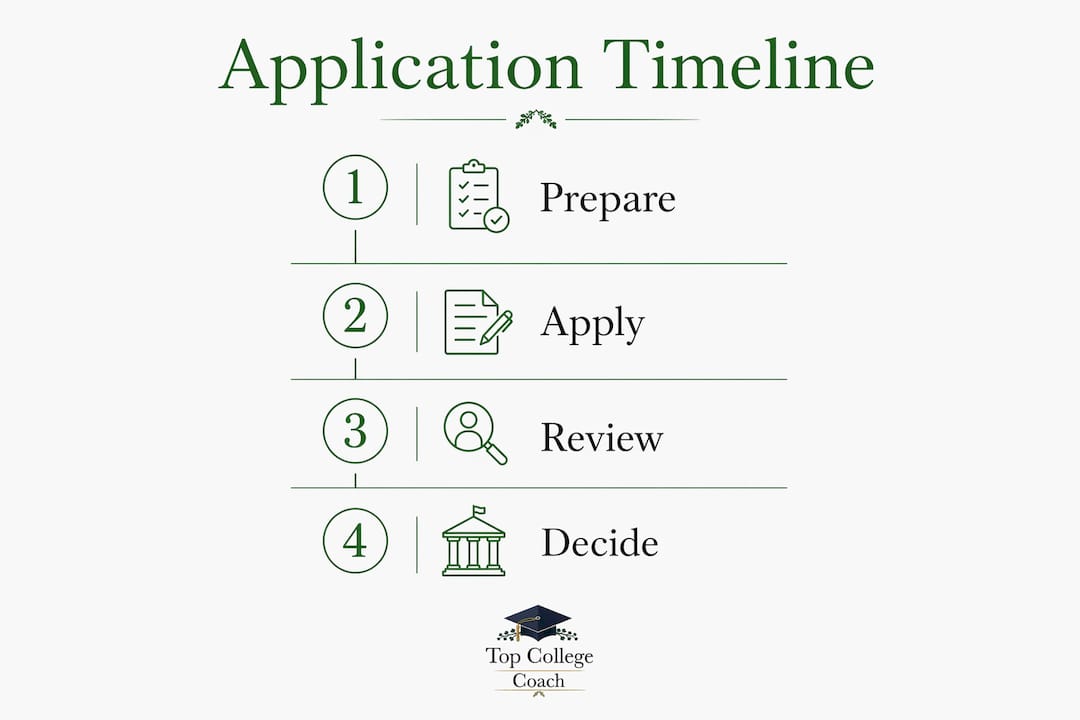
A detailed application timeline checklist can help you map every milestone from now through submission.
4. Preparing your essays, recommendation letters, and resume
The personal essay is the one part of your application you control completely. Admissions officers read thousands of essays, and the ones that stay with them are specific, honest, and written in a voice that sounds like a real person rather than a college application. Starting early is not just good advice; it’s the only way to write something genuinely good.
Begin brainstorming now. The best essay topics are rarely the first ones you think of. Give yourself time to explore, write badly, and revise. Starting essays early allows for the reflection and multiple revision rounds that separate a good essay from a great one.
Choose recommenders who know you well. A teacher who gave you an A but barely knows your name will write a generic letter. A teacher who watched you struggle with a concept and then master it will write something memorable. Ask early, ideally before the end of junior year, and give them context about your goals and achievements.
Provide your recommenders with a brag sheet. List your accomplishments, activities, and aspirations so they can write with specificity. A strong letter of recommendation comes from someone who genuinely knows you and has the details to prove it.
Build a clear, honest resume. List your activities, leadership roles, work experience, and any awards or recognition. Keep it clean and accurate. Admissions staff verify what you submit.
Proofread relentlessly. The essay is the only part of your application where carelessness is entirely your fault. Typos signal carelessness to admissions officers, and a single avoidable error can undercut an otherwise strong application. Read your essays aloud, then have at least two other people read them.
Write with authentic voice. Admissions officers can tell when an essay was written to impress rather than to communicate. Write about something that genuinely matters to you, and let the details carry the weight.
Pro Tip: Ask a teacher, school counselor, or admissions expert to review your essay before you finalize it. Fresh eyes catch errors you’ve stopped seeing, and an outside perspective often identifies where your voice is strongest.
For a complete breakdown of what makes an essay work, this college application writing checklist covers the key elements from structure to final polish.
5. Maximizing the summer before senior year
The summer between junior and senior year is the most underused asset in the college application process. Most students treat it as a break. The students who use it well arrive at senior year with stronger profiles, clearer essays, and less stress. You don’t need to fill every week, but you do need a plan.
Enroll in a pre-college program. Many universities offer summer programs that let you live on campus, take classes, and experience college life before you apply. These programs demonstrate initiative and, when the program is at a school on your list, they signal genuine interest to that admissions office.
Pursue an internship or volunteer role. A summer position related to your intended field of study gives you something concrete to write about and shows that your interest goes beyond the classroom. Even a part-time job demonstrates responsibility and reliability.
Work on your passion project. If you’ve been thinking about starting something, this is the window. A project you begin in June and develop through august gives you a real story to tell by the time applications open.
Visit colleges or attend virtual information sessions. Campus visits and admissions events are among the most direct ways to demonstrate interest, which can tip the scales in competitive admissions scenarios. If you can’t travel, virtual tours and online Q&A sessions count.
Draft your personal essay. Use the summer to write a first draft, get feedback, and revise. Arriving at senior year with a solid draft already in hand changes the entire pace of your fall semester.
Rest and protect your mental health. The application season is genuinely demanding. A summer that includes recovery, time with people you care about, and activities you enjoy is not wasted. Students who arrive at senior year burned out make worse decisions and write worse essays.
6. Expert insights from a seasoned college admissions counselor
At Top College Coach, we’ve worked with students applying to Ivy League and Top 20 universities, and the patterns in what separates admitted students from waitlisted ones are remarkably consistent. The technical parts of the application, the GPA, the test scores, the activity list, matter. But the students who get in at the most selective schools are the ones who treat every component with care and authenticity.
Here’s what we consistently see make the difference:
Authenticity in essays is not a cliché; it’s a competitive advantage. Admissions officers can identify a formulaic essay within the first paragraph. The students who write honestly about a specific experience, a real struggle, or a genuine passion are the ones whose applications stay in memory.
Multiple proofreading rounds prevent the errors that quietly damage applications. Set the essay aside for a day, then read it again. Read it aloud. Have a teacher or counselor read it. Proofreading habits built early in the process pay off at every stage.
Engaging with admissions offices builds demonstrated interest. Campus visits, emails with thoughtful questions, attendance at information sessions. These interactions are tracked at many schools, and authentic engagement with admissions offices can strengthen your candidacy in ways that grades alone cannot.
Recommenders need time and context. Asking a teacher in september for a letter due in november is asking them to rush. Asking in april or may, with a clear summary of your goals and accomplishments, produces a letter that actually advocates for you.
Interviews, when offered, are opportunities you should take. An optional interview is rarely truly optional for a competitive applicant. It transforms you from a file into a person, and that shift matters.
Balance is the foundation. Strong academics paired with meaningful extracurricular involvement and a well-crafted application tells admissions officers that you are ready for the full experience of college, not just the coursework.
Understanding why college essays matter in the admissions process can help you approach your writing with the right level of seriousness and confidence.
Work with Top College Coach to strengthen your application
The strategies in this guide work. They work even better with expert guidance tailored to your specific profile, your target schools, and your timeline. At Top College Coach, we’ve helped students gain admission to Ivy League and Top 20 universities by doing exactly what this guide describes, with the precision and personalization that makes the difference between a good application and a great one.
If you’re ready to take your application from where it is to where it needs to be, schedule a free strategy session with our team. We’ll review your profile, identify your strongest opportunities, and build a plan that fits your goals. Visit Top College Coach to learn more about how we work with students and families.
Key Takeaways
The most effective way to improve your college application after junior year is to act immediately on academics, extracurriculars, essays, and timing rather than waiting for senior year to begin.
Point | Details |
Start essays before summer ends | Early drafting allows multiple revision rounds and produces more authentic, polished writing. |
Prioritize depth in extracurriculars | Sustained commitment and leadership in fewer activities outweigh a long list of brief involvements. |
Apply early when possible | Early Action and Early Decision applications demonstrate preparedness and can improve acceptance odds. |
Request recommendation letters now | Teachers asked in spring or early summer write stronger, more personalized letters than those asked in fall. |
Proofread every component | Typos signal carelessness to admissions officers; multiple rounds of review, including by others, prevent avoidable errors. |
Recommended


Comments