How College Athletic Admissions Slots Work for Athletes
- May 26
- 9 min read

Most families assume that if a college coach wants their son or daughter, admission is practically guaranteed. That’s one of the most common and costly misconceptions in the college sports recruitment process. Understanding how college athletic admissions slots work is the real starting point for any family navigating this path. Slots are not golden tickets. They are a form of coach advocacy within a structured, competitive admissions system. Knowing the difference changes everything about how you approach recruitment, outreach, and school selection.
Table of Contents
Key takeaways
Point | Details |
Slots are coach endorsements | An athletic slot represents a coach’s formal recommendation, not a guaranteed admission offer. |
Slots vary by NCAA division | Division I, II, and III all handle coach advocacy and scholarship eligibility differently. |
Scholarships are rarely guaranteed | Most athletic scholarships are one-year renewable awards, not four-year commitments. |
D3 uses tips, not scholarships | Division III coaches can advocate for recruits in admissions without offering athletic financial aid. |
Early action wins offers | Registering with the NCAA Eligibility Center early and building a verified athletic profile dramatically improves recruitment outcomes. |
How college athletic admissions slots work across NCAA divisions
An athletic admissions slot is not a formal admissions category you will find listed on a school’s website. It is an informal but powerful mechanism. When a coach commits a slot to a recruit, they are essentially telling the admissions office: “This person is my priority. I am using one of my limited endorsements for them.” The admissions office still reviews the application, but the coach’s advocacy carries real weight.
Think of it this way. Every coach has a finite number of these endorsements to spend each cycle. Athletic slots are scarce and allocated only to recruits a coach believes are both athletic fits and realistic admission candidates. Spending a slot on someone who is unlikely to be admitted wastes a precious resource.
Here is how the mechanics differ across the three major NCAA divisions:
Division | Scholarship Type | Slot/Advocacy Mechanism | Notes |
Division I | Full or partial athletic scholarships | Roster spots tied to scholarship budget | Roster cap model effective 2025-26 |
Division II | Partial equivalency scholarships | Equivalency-based, limited per sport | Flexible scholarship distribution |
Division III | No athletic scholarships | “Athletic tips” or coach’s recommendations | Merit and need-based aid available |
Division I operates under the most structured system. As of 2025-26, the NCAA’s roster limit model replaced the old headcount and equivalency system. Schools can now offer full scholarships to every athlete on the roster, subject to their budget. This creates more flexibility but also more competition for spots, because coaches have even more incentive to be selective.
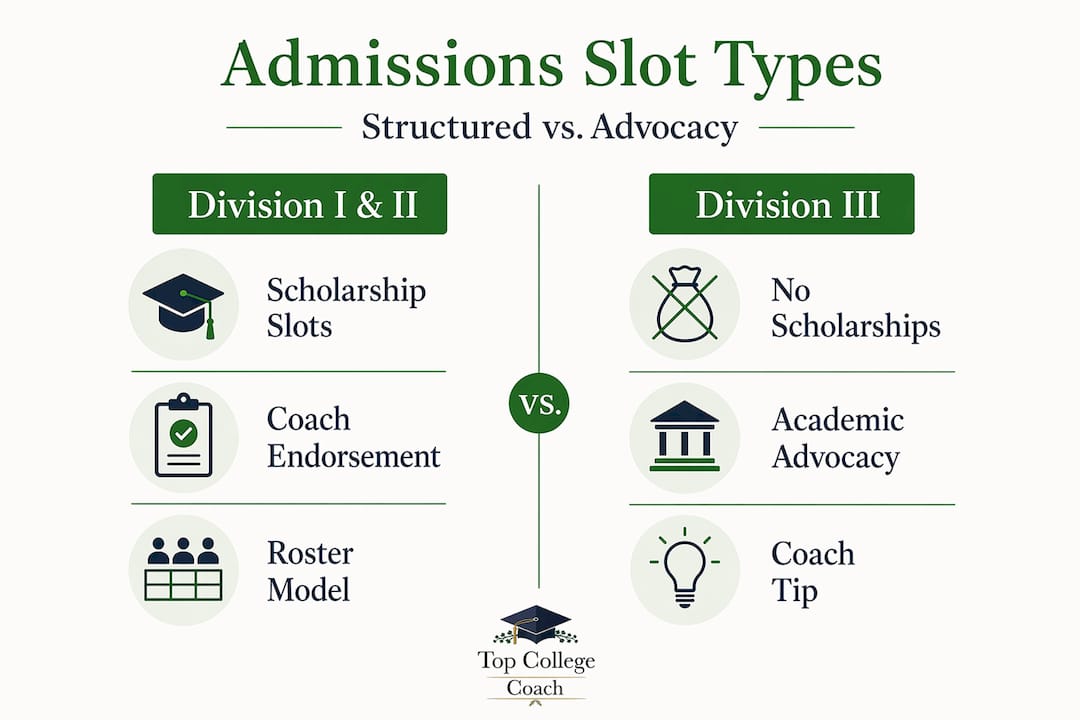
Division II schools offer partial scholarships distributed across the roster. Coaches split scholarship dollars among multiple athletes, which means few recruits receive a full ride. The advocacy process is similar to Division I but with tighter financial constraints.
Division III is where families are most often confused. There are no athletic scholarships at the D3 level at all. Instead, coaches use what are commonly called “athletic tips” or “coach’s spots” to signal the admissions office that a recruit is a priority. The student still applies and competes in the regular admissions pool, but a strong endorsement from a D3 coach can meaningfully improve their chances.
Pro Tip: When a coach expresses interest, ask directly: “Will you be submitting an athletic tip or formal admissions support for my application?” A vague answer is a signal to keep your options open.
From recruitment to admission: how coaches use slots
The college sports recruitment process does not begin when a coach calls you. It begins years before, as coaches scout, build boards, and evaluate thousands of potential recruits. Understanding the sequence helps you know where you stand.
Identification. Coaches find potential recruits through highlight reels, tournament appearances, recruiting services, and referrals. At this stage, you are one of potentially hundreds on a board.
Evaluation. Coaches narrow the list by assessing athletic performance, academic profile, and cultural fit. Coaches look beyond athletic ability to evaluate team cohesion and long-term program fit.
Target list. The coach identifies their top recruits for the cycle. Coaches manage boards of hundreds before narrowing to a small group of serious targets.
Offers and pre-reads. For selective schools, coaches submit a recruit’s academic profile to admissions before extending a formal offer. This “pre-read” tells the coach whether the admissions office would support the candidate.
Endorsement and admission. If the pre-read is positive and the coach commits a slot, the recruit receives a formal offer. The application is still reviewed, but the coach’s endorsement carries significant weight.
The admissions office is not a passive participant in this process. Admissions is a managed process where coaches advocate for athletes while the institution balances athletic priorities with academic selectivity. A slot helps, but it does not override a profile that falls well below the school’s academic floor.
This is why the concept of how sports admissions work can feel like a black box to families. The coach is working with the admissions office, not against it. The slot is a tool for collaboration, not a bypass.

Pro Tip: If a coach invites you for an official visit, that is a strong signal you are in serious consideration for a slot. Use the visit to ask about the academic profile of current roster members. It tells you exactly where your application needs to land.
Athletic scholarships explained: slots, renewals, and financial reality
Let’s address the financial picture honestly, because it surprises most families. Less than 2% of high school athletes receive any college athletic scholarship at all. For families counting on an athletic scholarship to cover college costs, this statistic is sobering.
Here is a clearer breakdown of scholarship realities under the current model:
Scholarship Type | Division | Coverage | Renewal |
Full scholarship | Division I (select sports) | Tuition, room, board, books | Annual renewal required |
Partial scholarship | Division I and II | Portion of costs | Annual renewal required |
No athletic scholarship | Division III | N/A | Merit or need-based aid only |
A few realities families consistently overlook:
Most athletic scholarships are one-year renewable awards. They are not four-year guarantees. Renewal depends on maintaining academic standing and athletic performance.
The transfer portal has changed slot dynamics. Coaches now use some scholarship slots on experienced transfers, which means fewer spots for incoming recruits in some programs.
Athletes who do not receive athletic scholarships still face annual costs of $30,000 to over $80,000, depending on the institution.
Understanding what colleges look for in applications matters here too. Academic merit, character, and fit all factor into both admission and whether a coach believes you are worth committing a scholarship slot to.
Pro Tip: Always ask a coach whether the scholarship offer is for the full four years or annually renewable. Then ask what the renewal criteria are. Get it in writing before signing anything.
Division III and non-scholarship athletic slots
Division III athletics is one of the most misunderstood categories in college sports. Families either dismiss D3 because there are no athletic scholarships or assume that playing D3 means the coach has no power in admissions. Both assumptions are wrong.
D3 coaches regularly use athletic tips to advocate for their priority recruits in the admissions process. While the school cannot offer money tied to athletic performance, a coach’s strong recommendation can be a meaningful factor in admissions decisions at competitive D3 schools.
Here is what you should know about D3 recruitment:
D3 schools often have generous merit aid and need-based financial aid packages. A recruited athlete admitted with a coach’s support may still receive a significant financial aid award, just not one labeled “athletic scholarship.”
The academic profile required to earn a D3 coach’s tip is often higher than families expect. Coaches at academically strong D3 schools are selective because their reputation with the admissions office depends on recommending students who can succeed academically.
The admissions advantage from a D3 tip varies by school selectivity. At a highly selective D3 school, the advantage may be more modest. At a less competitive D3 program, it can be significant.
Verbal interest from a D3 coach is not the same as admissions support. Always confirm whether the coach is formally advocating for you.
Pro Tip: At D3 schools, ask the coach directly: “What percentage of the athletes you recommend to admissions are ultimately admitted?” The answer reveals how much influence the coach actually carries with that institution’s admissions office.
How to navigate the slot and recruitment process effectively
Knowing how the system works is only useful if you act on it. Here are the steps that give student-athletes and their families the best chance within this framework.
Register with the NCAA Eligibility Center early. Missing academic eligibility minimums by junior year is one of the most common reasons recruits lose offers. Do not wait until senior year to sort out core course requirements and GPA thresholds.
Build a verified athletic profile. Coaches prioritize verified measurables like official combine times and game film over self-reported stats. Invest in quality film and document your performance with objective data.
Create a balanced school list. Include reach, match, and likely schools across divisions. Do not fixate on one program. Coaches receive interest from many recruits, and you need real options.
Reach out proactively and follow up. Send personalized emails to coaches at target schools starting in your freshman or sophomore year for high-demand sports. Follow up after camps, tournaments, and any communication. Coaches notice persistence paired with genuine interest.
Ask the right questions early. Clarify where you stand. Specifically ask: “Are you considering offering me an admissions slot or scholarship?” and “What does your timeline look like for commitments?” Vague answers mean you are not yet a priority.
Understand the difference between a verbal offer and a signed agreement. Verbal offers are not binding. Nothing is official until National Letter of Intent signing day or a written scholarship agreement.
Learning about college admissions counselor secrets can also help you understand how coach advocacy integrates with the broader admissions picture, giving you language and frameworks to have better conversations with both coaches and admissions offices.
You may also want to review summer preparation strategies to understand how off-season months can be used to build your academic and athletic profile simultaneously.
Pro Tip: If you use any testing accommodations during the recruitment process, confirm how they are handled across different institutions. Resources on transferring test accommodations between schools can help you avoid delays in eligibility paperwork.
My honest take on athletic admissions slots
In addition to being a college admissions counselor, I am also the parent of a child who was recruited for NCAA D1 Sports. I have worked with enough student-athletes and their families to know that the biggest mistake is not a lack of talent. It is a lack of clarity about what these slots actually represent.
Families often walk into the process believing that a coach’s interest equals admission. When a coach says “I love your film,” that feels like a promise. It is not. What I have seen repeatedly is that recruits who understand the slot system as coach advocacy within a managed admissions process perform far better in recruitment than those who treat early interest as a done deal.
The 2025 NCAA settlement and the shift to the roster cap model have changed the scholarship math, and most families are still catching up. More scholarship flexibility on paper does not mean more scholarship money available in practice. Coaches are just as selective, if not more so, about where they commit their slots.
My strongest advice is this: start early, ask direct questions, and never reduce your academic effort because a coach is interested. The students who earn the most favorable slot consideration are the ones who show up with both athletic excellence and an academic profile that makes the admissions office’s decision easy. That combination is what gets a coach to spend one of their limited endorsements on you.
— Randy Pryor, Founder - Top College Coach
Work with a counselor who understands athletic admissions
Athletic admissions is not a process most families can navigate confidently on their own. The slot system, the NCAA eligibility rules, the timing of outreach, and the scholarship distinctions are all moving parts that require strategic attention from the start.
At Top College Coach, we work with student-athletes and their families to build a clear, realistic plan for navigating every stage of the college sports recruitment process. We help you understand where your athletic profile stands, which programs are realistic fits, and how to communicate with coaches in ways that move you up their priority list.
If you are serious about pursuing college athletics, the best step you can take right now is a free admissions strategy session with our team. You will leave with a concrete understanding of your options and a plan you can act on immediately.
FAQ
What exactly is a college athletic admissions slot?
An athletic admissions slot is a coach’s formal endorsement submitted to the admissions office on behalf of a recruit. It signals that the recruit is a program priority, but it does not guarantee admission.
Do athletic slots guarantee college admission?
No. Coach advocacy helps but does not override academic requirements. The admissions office still evaluates every application, and recruits must meet the school’s academic standards.
How many slots does a coach have?
The number varies by school, sport, and division. Slots are treated as scarce resources, and coaches allocate them only to recruits they believe are both athletic fits and realistic admission candidates.
Are athletic scholarships guaranteed for four years?
No. Most scholarships are one-year renewable awards that require athletes to maintain academic and athletic standards. Families should always confirm renewal terms before committing.
Can Division III coaches help with admissions?
Yes. While D3 schools cannot offer athletic scholarships, coaches regularly use athletic tips to influence admissions decisions and help recruits access merit or need-based financial aid.
Recommended
Comments