50 Passion Project Ideas for High School Students
If you’re staring at a blank page trying to figure out where to start, here’s the answer: pick one idea that sits at the intersection of a genuine interest and a real problem, then scope it into a deliverable you can finish in six to twelve weeks. That constraint matters more than the idea itself. A project without a deadline or a defined outcome tends to drift, and drifting projects rarely make it onto a college application, let alone into a compelling essay.
If you need a starting point right now, consider one of these five high-impact directions:
A tech or AI prototype that solves a problem you’ve personally run into
A community service program with a measurable, repeatable structure
A creative portfolio project (film, writing, design, music) with a public output
A research or data study on a question nobody in your school has answered
A small business or entrepreneurial pilot, even a tiny one
Your first move: write a single sentence describing your mission and a single sentence describing what you’ll produce. Do that today.
Pro Tip: Admissions officers read hundreds of activity lists. A project with a narrow, well-defined scope and a finished product beats a sprawling, unfinished idea every time.
Key Takeaways
The most effective passion project pairs a genuine personal interest with a scoped, measurable deliverable finished within six to twelve weeks rather than left open-ended.
Point | Details |
Start narrow | Pick one problem and one deliverable rather than a broad, unscoped idea. |
Document from day one | Track metrics, photos, and progress weekly instead of reconstructing history later. |
Get a mentor | A single mentor who checks in biweekly improves both project quality and outcomes. |
Continuity beats scale | A project sustained over months reads stronger to admissions readers than a single big event. |
Get help shaping the story | Top College Coach helps students scope projects and turn them into essays and activity entries that read with genuine specificity. |
Table of Contents
What Counts as a Passion Project Idea?
A passion project is a self-directed initiative driven by genuine curiosity that produces something concrete beyond what a class or club assignment requires. It’s different from joining the robotics team or writing an essay for English class because you own every part of it: the idea, the timeline, the outcome, and the risk of it not working out.
That ownership is the whole point. A club meets because it’s scheduled. A passion project exists because you decided it should. The distinction shows up clearly in how admissions readers evaluate initiative, something Top College Coach explains in detail when breaking down what selective schools actually look for.
Some quick examples to illustrate the range: building a mobile app that helps classmates track study habits, producing a short documentary about a local historical figure nobody’s written about, or launching a free tutoring program for younger students in your neighborhood. Each one started as curiosity and ended as something tangible.
A few signals tell you whether an activity actually qualifies:
You initiated it. No teacher assigned it, no club required it.
It ran for weeks or months, not a single afternoon.
It produced something visible: a website, a report, an event, a product.
You can point to a measurable result, even a small one.
If your project checks those four boxes, you’re on solid ground. If it’s missing two or three, it’s probably still a good idea. It just needs sharper scope.
Why Passion Projects Matter for College Applications
Passion projects matter because they teach skills no classroom assignment can replicate: managing a timeline with no external deadline, researching a topic with no assigned reading list, and communicating results to people who didn’t ask for them. Those are the same muscles employers and graduate programs look for later, which is partly why admissions offices weight them so heavily now.
For applications specifically, a well-documented project does three things at once. It signals initiative, since nobody made you do it. It demonstrates continuity, showing you can sustain effort over months rather than a single weekend. And it gives you concrete material for essays and interviews that goes beyond “I care about the environment” into “I built a composting program that diverted 400 pounds of cafeteria waste.”
A student who spends a year building something real, whether it’s a nonprofit, a research paper, or a small business, gives admissions officers a story with a beginning, a struggle, and a result. That structure is far more persuasive than a list of activities with no throughline.
Curated lists of high-impact projects, including the 100 passion project ideas compiled by Immerse Education, consistently link sustained, well-executed independent work to stronger application narratives. The pattern holds across STEM, arts, and service projects alike: depth beats breadth. Reviewing what admissions committees actually weigh on the extracurricular side of an Ivy League application makes clear that one deep, well-documented project usually outperforms five shallow ones.
What Makes a Strong Passion Project vs. a Shallow One?
Depth separates the projects that get noticed from the ones that read like padding on an activity list. Five criteria decide which side of that line you land on: originality, sustained effort, a clear outcome, measurable impact, and a real connection to your interests or goals.
Run your idea through this checklist before you commit real time to it:
Does it have a documented timeline, even a simple one with dates and milestones?
Will it produce something public facing, like a website, video, publication, or event?
Do you have at least one mentor or knowledgeable adult who can give feedback along the way?
Can you name a metric, even a rough one, that shows whether it worked?
Does the topic connect to something you’d study or pursue after high school?
Scope is flexible. A student with ten hours a week and a semester can build something more ambitious than a student squeezing in two hours between practice and homework, and that’s fine. What matters is matching the size of the project to the time you actually have, then executing that smaller version completely rather than abandoning a bigger one halfway through.
Pro Tip: Watch out for what we call cardboard depth: a project that looks impressive on paper (50 flyers distributed, three events held) but has no real substance behind it. Admissions readers can tell the difference between volume and genuine engagement within two sentences of an essay.
Research on project-based learning backs this up. Structured, well-mentored self-directed work produces stronger outcomes than unsupervised sprawl, particularly for students newer to independent research, an idea sometimes called the expertise reversal effect: beginners benefit more from some guidance, while more advanced students can handle greater independence.
Passion Project Ideas by Category
Here’s a categorized bank of ideas across eight areas. Each one includes a one-line description, a two-step starting plan, and a rough time or budget estimate so you can gauge fit before committing.
Creative & arts
Short documentary film. Profile a local issue, business, or person nobody’s covered. Start: pick a subject and film a 5-minute test interview; then draft a shot list and shooting schedule. Time: 6 to 10 weeks, low cost with a smartphone camera.
Self-published book or zine. Write and illustrate a collection of stories, poems, or comics. Start: outline the collection; then draft one piece and get feedback from a teacher or writing club. Time: 8 to 12 weeks, low cost using free layout tools.
Original music EP. Write, record, and release a short set of songs. Start: write one song; then record it using free software like GarageBand or Audacity. Time: 8 weeks, low cost.
Photography exhibition. Curate and display a themed photo series at a library or school gallery. Start: shoot a 10-photo test series; then approach a local venue about wall space. Time: 6 to 8 weeks, low cost.
STEM & medicine
Independent research study. Investigate a question in biology, chemistry, or public health using data you collect or public datasets. Start: define a research question; then find a teacher or local professor willing to advise. Time: 10 to 12 weeks.
Health awareness campaign. Build a program educating peers on a specific health topic, like sleep or nutrition. Start: research the topic and draft key messages; then plan one school event or workshop. Time: 6 to 8 weeks, low cost.
Environmental monitoring project. Track local water quality, air quality, or biodiversity over a season. Start: identify a testing method and a site; then log data weekly. Time: 10 to 12 weeks, low cost with basic test kits.
Tech & AI
A working app or website. Build a tool that solves a real problem for classmates, like a study-group matcher or a volunteer-hour tracker. Start: sketch the core feature; then build a basic version using a no-code platform like Glide or Bubble. Time: 6 to 10 weeks, low cost or free.
AI-assisted data project. Use a public dataset to build a simple prediction model or visualization. Start: pick a dataset from a source like Kaggle; then build a basic analysis in Python. Time: 6 to 8 weeks, free. If AI tools are part of your process, be transparent about how you used them, since misusing AI in application materials can backfire.
Personal portfolio site. Build and host a site showcasing your other projects. Start: draft the site structure; then publish using a free tool like GitHub Pages. Time: 3 to 4 weeks, free.
Social impact & service
A recurring tutoring or mentoring program. Set up free, ongoing academic support for younger students. Start: identify a partner school or library; then recruit two or three volunteer tutors. Time: ongoing, launch in 4 weeks, low cost.
A donation or resource drive with tracked impact. Organize a structured drive (books, clothing, food) with clear before-and-after numbers. Start: pick a cause and a partner nonprofit; then set a numeric goal. Time: 6 to 8 weeks, low cost. For more structured ideas here, Top College Coach’s guide to community impact walks through building programs that last beyond a single event.
Accessibility audit and fix project. Assess a local business or public space for accessibility gaps and propose fixes. Start: research ADA basics; then walk through one site with a checklist. Time: 4 to 6 weeks, free.
Entrepreneurship & small business
A micro-business selling a real product. Design, produce, and sell something, from custom apparel to baked goods to handmade crafts. Start: build a prototype; then test-sell it at one event or online. Time: 8 to 12 weeks, low cost to start.
A service-based business. Offer a paid service like resume editing, pet sitting, or social media management for local businesses. Start: define your service and pricing; then pitch three potential clients. Time: 6 weeks to launch, free.
Competition entry. Enter a structured youth business competition to pressure-test your idea against real judges. The Blue Ocean Student Entrepreneur Competition has produced student projects that became genuine, sellable products by focusing on new value instead of copying an existing idea.
Academic and research
A local history project. Research and document an overlooked piece of your town’s history through interviews and archives. Start: identify a topic; then interview one primary source. Time: 8 to 10 weeks, free.
A policy analysis or advocacy paper. Research a local policy issue and propose a solution, then present it to a school board or city council. Start: pick an issue; then read three primary sources on it. Time: 8 to 10 weeks, free.
A language-learning or cultural exchange initiative. Build a peer language-exchange program or resource guide. Start: recruit participants; then set a weekly meeting structure. Time: ongoing, launch in 4 weeks.
Community & advocacy
A youth advisory board or student union initiative. Organize students to formally advise school leadership on a specific issue. Start: draft a proposal; then present it to an administrator. Time: 8 to 12 weeks.
A civic engagement campaign. Register young voters or run a public awareness push on a local ballot issue. Start: research the issue; then design one informational handout. Time: 6 to 8 weeks, low cost.
Low-cost or at-home options
A blog or newsletter on a niche topic. Publish consistent writing on something you’re genuinely into, from astrophysics to sneaker culture. Start: pick a publishing platform; then commit to a schedule. Time: ongoing, free.
A skill-mastery challenge with public documentation. Learn a skill (coding, a language, an instrument) over a set period and document weekly progress publicly. Start: define your end goal; then set up a public log, like a blog or video series. Time: 8 to 12 weeks, free.
A podcast series. Interview people in a field you’re curious about, whether that’s local entrepreneurs or scientists. Start: outline five episode topics; then record a pilot with free software. Time: 8 weeks, free.
Most of these scale. A tutoring program can start with two students and grow into a formal nonprofit. A blog can become a research portfolio. Start small, prove the concept works, then expand only once the first version is running well.
How Do You Plan and Launch a Passion Project?
Every strong project follows roughly the same sequence, regardless of category. Here’s the template:
Define your mission in one sentence. What problem are you solving, or what are you exploring, and for whom?
Pick a measurable deliverable. A website, a report, an event, a product. Something you can point to when it’s done.
Set three to five milestones. Break the project into checkpoints with rough dates attached.
Identify one mentor. A teacher, a parent’s professional contact, or a local expert who can give feedback twice a month.
Choose your tools. Pick the simplest option that gets the job done, not the most impressive one.
Schedule regular checkpoints. Weekly or biweekly check-ins with yourself (or your mentor) keep momentum from stalling.
A sample 10-week timeline breaks cleanly into four phases:
Weeks 1 to 2 (Plan): Finalize your mission, deliverable, and milestones. Reach out to a potential mentor.
Weeks 3 to 6 (Build): Do the core work: research, prototyping, filming, coding, or organizing.
Weeks 7 to 8 (Test): Get feedback from your mentor or peers, and revise based on what you learn.
Weeks 9 to 10 (Share): Publish, present, or launch your final deliverable publicly.
Finding a mentor is often the step students skip, but it’s the one that separates guided, effective work from unsupervised sprawl. Keep your outreach short: introduce yourself, describe the project in two sentences, and ask for 20 minutes of their time. Adults say yes to specific, low-commitment requests far more often than vague ones.
On tools: no-code builders like Glide or Bubble work for apps, GitHub Pages hosts a free portfolio or research site, Audacity and GarageBand cover audio editing, and many local labs or maker spaces offer free or discounted access to students with a teacher referral. If your project has a natural summer runway, Top College Coach’s summer planning guide walks through how to structure that stretch of unscheduled time effectively.

How to Present a Passion Project on College Applications
Documentation is what turns a good project into believable proof of one. Start collecting evidence from week one, not the week before applications are due: save metrics (people reached, dollars raised, downloads, attendees), gather testimonials from anyone you worked with, take photos, keep code repositories or drafts, and log your progress in a simple running document.
For the Common App activity list, keep entries specific and outcome-focused. Two templates to adapt:
“Founded and led [project name], a [one-line description]; grew to [specific metric] over [timeframe].”
“Independently researched and produced [deliverable], resulting in [specific outcome or recognition].”
Essay hooks work best when they follow a simple arc: problem, your effort, impact or learning. Three examples of that structure in action:
A student noticed cafeteria food waste, built a composting partnership with a local farm, and opened with the exact pound of waste diverted in year one.
A student struggled to find affordable tutoring for younger siblings, built a free peer-tutoring network, and opened with the moment a student they’d never met thanked them.
A student got frustrated with inaccessible public transit info, built a simple app, and opened with the bus schedule confusion that started the whole idea.
The best essay hooks don’t start with the accomplishment. They start with the small, specific moment of friction that made the student care enough to act.
Keep your files organized in one shared folder or a simple personal website, with clear naming and version control so you’re not hunting for the right draft in April of senior year. Top College Coach’s guide to storytelling in admissions breaks down how to shape these details into a coherent essay narrative rather than a list of accomplishments.
How Do Admissions Officers Actually Evaluate These Projects?
Admissions officers aren’t grading your project on ambition alone. They’re reading for five things: depth of engagement, originality, evidence of impact, continuity over time, and clarity about what you personally learned.
A project that ran for six months with clear milestones reads as far more credible than a single weekend event, even if the weekend event drew a bigger crowd. Continuity is the signal readers trust most.
Practical cues that separate a “check the box” listing from one that lands: specific numbers over vague claims, a defined role (“I coded the backend” beats “I helped with the app”), and language that reflects genuine reflection rather than a resume-style list of duties.
A common misconception: students assume a project needs to solve a huge problem to count. It doesn’t. A tutoring program for three neighborhood kids that ran consistently for a year often reads stronger than an ambitious idea that fizzled after one event. For interviews and recommendation letters, ask the adult writing your letter to speak to your process, not just your results. Reviewing what selective admissions committees weigh across the full application reinforces this: consistency beats scale almost every time.
Common Pitfalls (and How to Fix Them)
Five mistakes account for most floundering projects: scope that’s too broad, no measurable outcome defined up front, over-reliance on AI or other people to do the actual work, poor documentation, and unsafe or unsupervised experiments involving people or lab materials.
The fixes are straightforward:
Too broad: Narrow it to one specific problem, one specific audience, one specific deliverable.
No measurable outcome: Pick a number before you start, even a rough target, so you have something to report later.
Over-reliance on AI or others: Use tools to support your work, not replace it, and be ready to explain every part of your process in an interview.
Poor documentation: Set a recurring calendar reminder to log progress weekly, not retroactively in March.
Unsafe or unsupervised work: Any project involving human subjects, sensitive data, or lab chemicals needs adult and, where applicable, institutional review before you proceed.
If your project stalls, run this quick checklist: 1) Reread your one-sentence mission, does it still make sense? 2) Cut the deliverable in half if it feels too big. 3) Reach out to your mentor for a gut-check conversation. 4) Set one small task you can finish this week to rebuild momentum.
Pro Tip: The projects that fail almost always failed at step one: an undefined deliverable. Fix that first before touching anything else.
Where to Find Competitions, Tools, and Mentors
A handful of outlets exist specifically for the kind of work covered above. Science and research fairs, regional entrepreneurship competitions like the Blue Ocean Student Entrepreneur Competition, documentary and short-film festivals, and local community foundation grants all give students a concrete deadline and outside validation to work toward.
On tools: no-code app builders (Glide, Bubble), free publishing and hosting (GitHub Pages, WordPress), free data and survey tools (Google Forms, Kaggle), and student-discounted video editing software (Adobe Creative Cloud, DaVinci Resolve) cover most categories above without real cost.
For mentorship and community partners, start local: public libraries often run maker spaces and host community events, local nonprofits usually welcome volunteer partnerships and offer built-in mentorship, and youth-focused co-learning programs and vocational partnerships, like those run by organizations such as SAVE Institute, show how structured, mentor-supported models can push a small idea into something with real-world traction.
Every option above has a free or near-free path in. Budget should never be the reason a strong idea doesn’t happen.
What Admissions Counselors Notice About the Best Projects
I’ve reviewed enough applications to know the difference between a project a student built and a project a student’s parents built for them, and it usually shows up in the details, the ones that are too specific or too personal to have been coached. One student I remember described the exact moment she realized her neighborhood had no accessible playground equipment. That one sentence did more work than a paragraph of statistics could have.
My checklist for picking a project: does it connect to an academic interest you can point to elsewhere in your application? Does it show progression, meaning did you get better or go deeper over time? And can you point to one number, however small, that proves it mattered?
Use the project to shape your essay themes early, not as an afterthought in November of senior year. The story you tell about why you started matters just as much as what you finished.
How Top College Coach Helps Students Build and Present Their Projects
Picking the right project is only half the challenge. Turning it into a credible, well-told part of your application, one that holds up in an essay and an interview, is where most students need real guidance. Top College Coach works with students on exactly that: scoping a project idea down to something achievable, coaching the essay that grows out of it, editing activity list entries so they read with specificity instead of vague enthusiasm, and running mock interviews so you can talk about your work with confidence.
Unlike generic project idea lists you’ll find scattered across the internet, Top College Coach pairs you with counselors who’ve reviewed thousands of applications and know exactly what separates a project that reads as filler from one that becomes the anchor of a student’s entire narrative. If you’re not sure whether your idea has legs, or you’ve already started something and need help shaping it into application-ready material, schedule an introductory consultation with Top College Coach to talk through your options.
Sources
A few resources worth bookmarking if you want to go deeper on any part of this process:
FAQ
What should I do my passion project on?
Choose a topic where a genuine personal interest overlaps with a problem you can actually address in six to twelve weeks. If you’re stuck, start with the category list above and pick whichever section made you want to keep reading.
What are some examples of passion project ideas?
Examples span building an app that solves a real problem, producing a short documentary, launching a recurring tutoring program, running an independent research study, or starting a small business around a product you’ve designed yourself.
What are some interesting project ideas for high schoolers specifically?
Beyond the standard options, consider an accessibility audit of local businesses, a podcast interviewing professionals in a field you’re curious about, or an environmental monitoring project tracking water or air quality over a season. Each produces a concrete, public-facing result.
What are some passionate topics students commonly pursue?
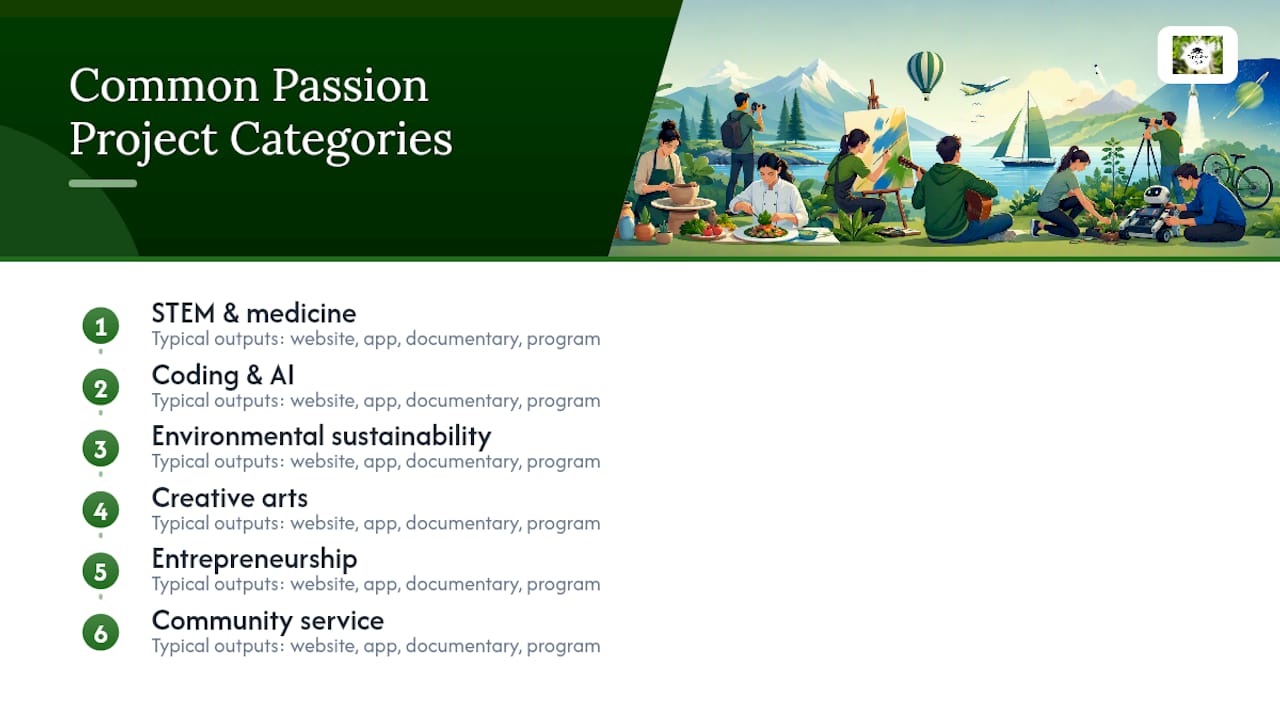
Common areas include STEM and medicine, coding and AI, environmental sustainability, creative arts, entrepreneurship, and community service. The strongest projects in any of these areas typically produce something tangible, like a website, app, documentary, or ongoing program, rather than a one-time event.
How do I make my passion project stand out on a college application?
Focus on documentation and specificity: track metrics from the start, get feedback from a mentor, and write about the exact moment that sparked your interest rather than a general statement of passion. Working with a counselor at Top College Coach can help you translate the project into an application-ready narrative.
Recommended
Comments