Do College Visits Matter for Admissions? Here's the Truth

Yes and no: campus visits rarely change an admissions decision at the most selective schools, but at many mid-tier and regional colleges, they can genuinely tip the scale. The bigger reason to visit has nothing to do with admissions at all. It’s about finding out whether a school actually fits your student before you commit four years and a mountain of tuition to it.
Here’s the quick breakdown:
Visits can influence admissions at colleges that formally track “demonstrated interest,” which tends to be mid-size and regional private schools competing hard for enrollment.
Visits typically don’t move the needle at highly selective privates and most large public flagships, where academic strength carries almost all the weight.
The real payoff is information. You learn things about fit, culture, and daily life that no website or virtual tour will tell you.
If you do visit a school that tracks interest, register through the admissions office before you arrive, save any confirmation email or receipt, and send a short thank-you note afterward. That’s what makes a visit count.
Key Takeaways
Campus visits rarely change admissions outcomes at highly selective schools, but they remain the most reliable way to test fit before committing years and tuition to a college.
Point | Details |
Check if a school tracks interest | Look for “demonstrated interest” language on the admissions site before assuming a visit helps your odds. |
Register every official visit | Sign up through the admissions office so there’s a documented record if it’s ever weighed. |
Prioritize visits for finalists | Save travel budget for the late-stage decision between acceptances rather than early exploration. |
Use virtual tours to screen | Reserve in-person visits for schools that survive the first round of virtual research. |
Table of Contents
Why College Visit Matters Admissions: Demonstrated Interest Explained
“Demonstrated interest” is the term admissions offices use for the ways applicants show they’re serious about attending, and schools track it because it feeds directly into yield, the percentage of admitted students who actually enroll. A college with a shaky yield rate has an incentive to admit students it believes will say yes, so a campus visit, an email exchange, or an interview request can nudge an applicant up that list.
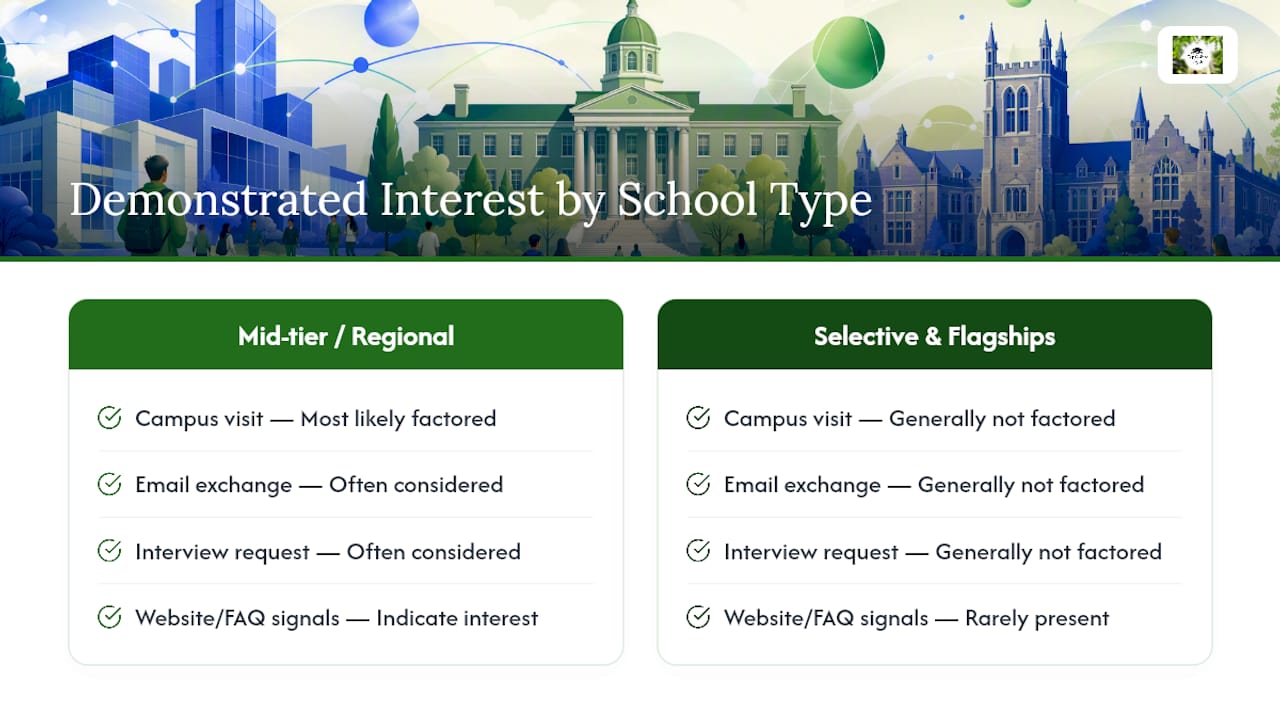
The pattern is fairly predictable once you know what to look for. Regional private colleges and mid-size institutions competing for a specific type of student are the ones most likely to log a visit and factor it into decisions. Highly selective private universities and most large public flagships generally don’t bother, because they have far more qualified applicants than seats and no need to worry about who will enroll.
You can usually tell which camp a school falls into by checking its admissions website or FAQ page for language about “demonstrated interest,” “level of interest,” or “why us” essay prompts, all of which signal that the school is paying attention.
Reporting on this topic has found that many highly selective schools, including several Ivy League and top-15 institutions, generally do not factor demonstrated interest into admissions decisions, while it’s more likely to matter at mid-tier and regional colleges.
Treat demonstrated interest as a tiebreaker, never a substitute. If your student’s transcript and test scores don’t already put them in a competitive range, a campus visit won’t rescue the application.
Why Campus Visits Matter Beyond the Admissions Office
A brochure can tell you a school has “vibrant student life.” It can’t tell you that the dorms smell like a gym or that the dining hall closes absurdly early on weekends. This is where a campus visit earns its keep, regardless of whether the school tracks it.
Walking a campus in person reveals details that rarely survive translation into marketing copy:
What the dorms actually look like, not just the model room used in photos
Whether the vibe in a real class matches the school’s promised teaching style
How accessible professors seem outside of scheduled office hours
The commute time between dorms, classrooms, and any off-campus jobs or internships
Dining quality, variety, and hours
Neighborhood safety, walkability, and what’s nearby for weekends
One classic mismatch: a student picks a school assuming a short walk to a part-time job downtown, then discovers during a visit that the “nearby” neighborhood is a 40-minute bus ride away. Another common surprise is a campus that photographs as quiet and studious but feels loud and social the moment you’re standing in the quad on a Friday afternoon.
Admissions offices themselves point out that in-person visits give prospective students a feel for campus life that no virtual tour replicates. That accuracy matters for more than comfort. Students who land somewhere that doesn’t fit their expectations are more likely to struggle with adjustment, and fit has a real relationship with retention and long-term satisfaction.

Are Virtual Tours Enough, or Should You Visit In Person?
Virtual tours solve a real problem: distance, cost, and time. They let a family screen a dozen schools before committing to travel for the three or four that matter most. What they can’t do is replicate the atmosphere of a real quad on a real Tuesday, or let you eavesdrop on how students actually talk to each other between classes.
Virtual visits work well for early-stage research, for schools that are financial or academic long shots, and for any situation where travel costs outweigh the likely benefit. Colleges leaned heavily on virtual options during the pandemic, and while the tools stuck around and improved, they still fall short of the in-person experience when it’s time to judge fit and atmosphere.
To get more out of a virtual visit:
Watch live Q&A sessions instead of pre-recorded tours, since spontaneous answers reveal more than scripted ones
Request a meeting with a specific academic department, not just the admissions office
Ask to sit in on a live virtual class session if the school offers it
Follow current students on social media for an unfiltered look at daily life
Schedule a short call with an admissions rep or current student to ask direct questions
Making the Visit Count: A Before, During, and After Checklist
A campus visit without a plan is just a walk with a tour guide. A campus visit with a plan produces comparable notes, a documented signal of interest where it matters, and material you can use later in essays and interviews.
Before you go:
Register the visit through the admissions office so there’s an official record, as CollegeBoard’s BigFuture recommends.
Prepare specific questions for admissions, academics, and current students ahead of time.
Plan logistics: timing, travel budget, and whether you can bundle multiple schools into one trip using tools built for organizing college application logistics.
During the visit:
Arrive early and walk the campus independently, beyond the official tour route
Sit in on a real class if the school allows it
Take photos or notes you can compare later across schools
Introduce yourself briefly to the admissions rep assigned to your region
Watch for genuine signals: how students interact, whether the energy in a classroom feels real
After the visit:
Send a short, specific thank-you email to any admissions rep or staff member you met.
Log your impressions immediately, while details are fresh, so you can compare schools fairly later.
Keep any documentation of the visit in case a supplemental essay or interview asks about demonstrated interest.
Sample questions worth asking: What does academic advising actually look like in the first year? How accessible are professors outside class? What’s the average class size in my intended major? How does financial aid handle outside scholarships? What support exists for first-year adjustment? How competitive is registration for popular courses? What percentage of students study abroad? How does the school support internship placement? What’s retention like from first to second year? What do students wish they’d known before enrolling?
Pro Tip: A canned answer sounds like a brochure read aloud. A genuine one includes a specific example, invites a follow-up question, or offers to connect you with someone in a specific department. If a rep can’t get more specific than “our students love it here,” push a little further before you move on.
When to Visit and How to Keep Costs Down
Timing your visits to the application cycle saves both money and stress. Early in high school, casual visits to nearby schools help calibrate what your student actually wants, regardless of whether those schools end up on the final list. Once applications are submitted, focus visits on finalists rather than every school that sent a glossy mailer.
The highest value moment to visit in person is late in the process, when you’re narrowing to two or three schools or deciding between acceptance offers. That’s when a visit functions as verification rather than exploration, and it’s worth prioritizing travel budget accordingly.
To keep costs manageable:
Route multiple nearby schools into a single trip instead of separate flights
Watch for admitted-student days, which many schools subsidize or host with travel stipends
Look into diversity fly-in programs, which cover travel costs for eligible applicants
Use school breaks or long weekends to avoid missing class time
What Admissions Officers Actually Do With Your Visit
Admissions offices don’t remember every visitor’s name, but they do log attendance at official events, and that record can surface later if a school weighs demonstrated interest. Counselors who’ve worked inside the process consistently note that specificity is what makes a visit memorable, not just showing up.
A visit that generates a specific anecdote, a named professor, or a detail about a particular program tends to carry more weight in an application than a generic “I loved the campus” line.
At Top College Coach, counselors regularly help students translate a single campus conversation into something usable, whether that’s an essay anecdote, an interview talking point, or a targeted email to a department contact. A few habits make the difference:
Write down the name and title of everyone you meet, not just impressions
Connect a visit detail to something specific you plan to reference in a supplemental essay
Follow up quickly, while your contact still remembers the conversation
A Counselor’s Quick Note to Families
If you take one thing from this: register every visit through the admissions office before you go, even if you’re not sure the school tracks interest. It costs nothing, and it means the visit is documented if it ever matters. For more on building a strategy around your visits and applications, see our college admissions guidance.
Ready to Turn Campus Visits Into a Real Admissions Strategy?
Knowing which schools reward a visit and which ones don’t is only half the battle. The other half is turning what you learn on campus into stronger essays, sharper interview answers, and a smarter final list. Top College Coach works with families throughout the process, from early planning through application review by former admissions officers, to make sure every visit, every essay, and every interview works toward the same goal. If you want a strategy built around your student’s actual list, not a generic checklist, start with Top College Coach.
Sources
FAQ
Do College Visits Help Admissions?
At schools that track demonstrated interest, mostly mid-tier and regional colleges, a visit can help. At most highly selective privates and large public flagships, it typically has little to no effect on the decision.
What Is the 90/10 Rule for Colleges?
There’s no single agreed-upon “90/10 rule” in college admissions; the phrase gets used inconsistently across advice sites, so it’s best treated as informal shorthand rather than an official admissions standard.
What Matters Most in College Admissions?
Academic strength, meaning grades, rigor, and test scores where required, carries the most weight almost everywhere. Demonstrated interest and campus visits function as marginal factors at best, never a replacement for a strong transcript.
Do Parents Usually Go on College Visits?
Yes, parents commonly attend campus visits alongside their student, and many admissions offices structure information sessions to address both audiences directly.
Recommended
Comments