Harvard University Application: Your 2026 Complete Guide

The Harvard University application is a structured process requiring specific documents, strategic timing, and a clear demonstration of your fit with one of the world’s most selective universities. Harvard uses a holistic admissions process that evaluates academics, extracurriculars, athletic achievement, and personal qualities together. Two key deadlines define the 2026 cycle: Restrictive Early Action on November 1, 2025, and Regular Decision on January 1, 2026. Understanding how these pieces fit together is the difference between a reactive application and a purposeful one.
What are the Harvard University application requirements?
Harvard accepts applications through the Common Application or the Coalition Application. Both platforms connect directly to the Harvard application portal, where you create an account, upload documents, and track your admission status. Choosing between the two platforms does not affect your chances. Pick the one you are most comfortable using.
Every applicant must submit the following core documents:
High school transcript showing your full academic record and course rigor
School counselor recommendation providing context about your school and your standing within it
Two teacher recommendations from instructors in core academic subjects
Standardized test scores (SAT or ACT): Harvard’s test policy for 2026 allows students to apply without scores, but submitting strong scores strengthens your file
Harvard supplemental essays addressing your intellectual interests and personal background
Application fee of $85, or a fee waiver if you qualify based on financial need
The application fee waiver is available to students who demonstrate financial hardship. You can request it directly through your chosen application platform. No student should skip applying because of the cost.
Here is a quick reference for the core application components:
Component | Details |
Application platform | Common Application or Coalition Application |
Transcript | Full high school record required |
Recommendations | 1 counselor + 2 teacher letters |
Standardized tests | Optional but recommended for 2026 |
Supplemental essays | Required; focus on authenticity and intellectual curiosity |
Application fee | $85, or fee waiver for eligible students |
Pro Tip: Request your teacher recommendations at the start of your senior year, or even in the spring of junior year. Teachers who know you well and have time to write thoughtfully produce far stronger letters than those asked at the last minute.

How does the Harvard admission process work?
Harvard’s admissions committee rates every applicant across four categories: Academic, Extracurricular, Athletic, and Personal. Each category uses a 1–6 rating scale, where lower numbers indicate stronger performance. No single category automatically determines your outcome.
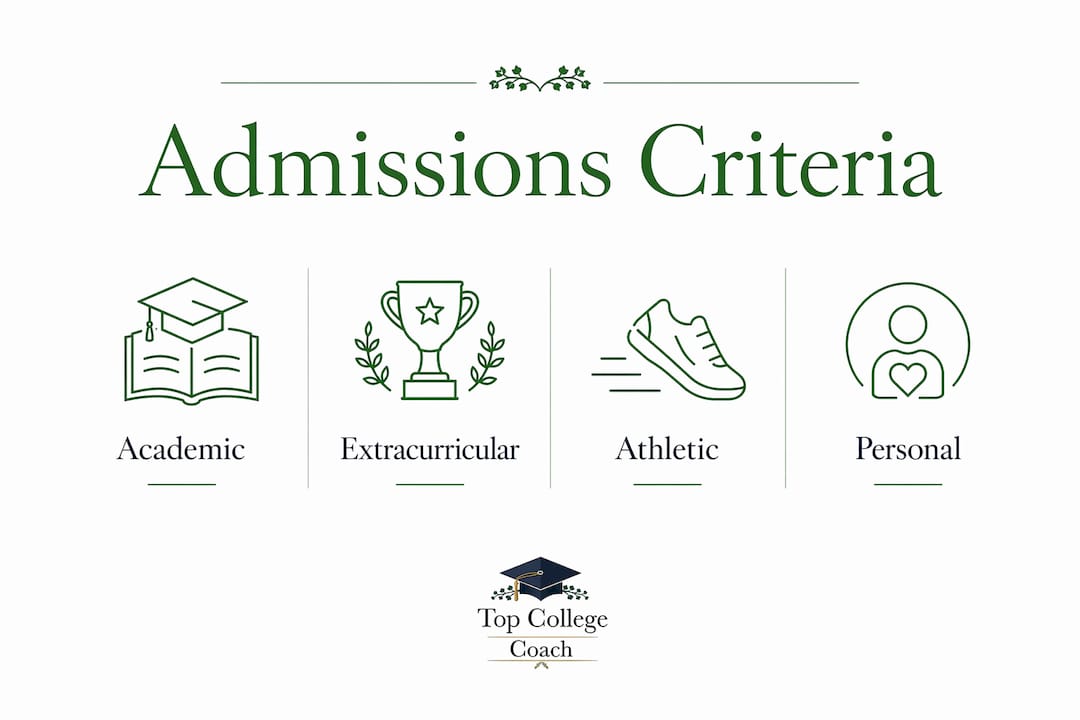
The Academic rating reflects GPA, course rigor, class rank, and test scores in context. “In context” matters more than most students realize. Harvard compares your record against what your school offers, not against every student in the country. A student from a rural school with limited AP access is evaluated differently than one from a prep school with 30 AP courses available.
The Extracurricular and Personal ratings are where many strong applications separate themselves. Harvard’s admissions committee prioritizes contribution over accomplishment. The question they ask is not “What has this student achieved?” but “What will this student bring to Harvard?” That shift in framing changes how you should present every activity and essay.
Geographic diversity also plays a real role. Students from underrepresented states like Wyoming or North Dakota compete in a smaller applicant pool than those from Massachusetts or California. If you are from a less represented state, that context works in your favor.
What Harvard looks for, specifically:
Depth over breadth: A few meaningful commitments beat a long list of surface-level activities
Intellectual curiosity: Evidence that you pursue ideas beyond what class requires
Leadership with impact: Not just holding a title, but changing something
Personal character: Integrity, empathy, and how you treat others
Pro Tip: Think of your extracurricular profile as a “spike,” not a spread. One or two areas where you have gone unusually deep tell a more compelling story than ten clubs where you showed up occasionally.
Restrictive Early Action vs. Regular Decision: which should you choose?
The timing of your application carries real strategic weight. Harvard’s Restrictive Early Action (REA) program has a November 1, 2025 deadline. Regular Decision closes on January 1, 2026. The difference is not just timing. It is a fundamentally different competitive environment.
Early Action acceptance rates are roughly three times higher than Regular Decision rates. That advantage is real, but it comes with a condition: your application must be as strong as it will ever be by November 1. Applying early with weaker senior year grades or unfinished test prep wastes the advantage entirely.
REA also carries restrictions. You cannot apply Early Decision or Early Action to any other private university while your Harvard REA application is pending. You can still apply to public universities under their early programs. Read the REA rules carefully before committing.
Here is how to decide which path fits your situation:
Choose REA if: Your junior year GPA is strong, your test scores are where you want them, and your essays are ready. You have nothing meaningful left to add by January.
Choose Regular Decision if: You are retaking the SAT or ACT in the fall, your first semester senior grades will show significant improvement, or your essays need more development.
Consider your full list: REA restricts your early options at other private schools. If another school is a stronger fit or a better financial match, weigh that before committing to REA.
Do not rush readiness: An application submitted in January that reflects your best work outperforms an early application that does not.
Pro Tip: If you are on the fence about REA, ask yourself: “Will anything about my application be meaningfully stronger in January?” If the answer is yes, wait.
How to write strong Harvard essays and prepare for interviews
Harvard’s supplemental essays require specific personal stories that highlight leadership, intellectual passion, and initiative. Generic achievement lists do not work here. The committee reads thousands of applications from students with perfect grades and impressive resumes. What they remember is a student whose writing made them feel something.
Strong Harvard essays share three qualities. First, they are specific. Not “I love science” but “I spent three summers mapping invasive plant species in my county and presented findings to the local conservation board.” Second, they connect your experience to how you think. Third, they align your story with Harvard’s mission of producing leaders who contribute to society.
For the personal statement on the Common Application, use the Ivy League personal statement as a vehicle to show who you are, not what you have done. The supplemental essays then build on that foundation by adding dimension to your academic interests and community contributions.
Harvard alumni interviews are offered to most applicants after the application is submitted. They are conducted by Harvard alumni volunteers in your area and are conversational, not interrogative. Prepare by knowing your application well, having two or three genuine questions about Harvard ready, and being able to speak naturally about your intellectual interests. The interview rarely makes or breaks an admission, but a strong one adds a positive data point to your file.
Key essay and interview preparation steps:
Draft early: Start your personal statement in the summer before senior year
Avoid the “brag sheet” trap: Essays that list accomplishments read as resumes, not stories
Revise for voice: Your essay should sound like you, not a college counselor
Prepare for the interview: Review your application and practice speaking about your interests out loud
Follow up: Send a brief thank-you note to your interviewer within 24 hours
What financial aid options are available with a Harvard application?
Harvard meets 100% of demonstrated financial need for all admitted U.S. students. Harvard is also need-blind for domestic applicants, meaning your financial situation does not affect your admission decision. These two policies together make Harvard genuinely affordable for families across the income spectrum.
To apply for aid, you must submit the FAFSA, the CSS Profile, and any additional documents Harvard requests. Submitting these forms on time is non-negotiable. Missing the financial aid deadline can cost you aid even if you are admitted.
Financial Aid Step | Details |
FAFSA | Submit as early as possible after October 1 |
CSS Profile | Required for Harvard aid calculation |
Additional documents | Tax returns and other records may be requested |
Fee waiver | Available through Common App or Coalition App for eligible students |
Key takeaways
A successful Harvard application requires academic strength in context, a focused extracurricular narrative, strategic timing between REA and Regular Decision, and essays that tell a specific, authentic story aligned with Harvard’s mission.
Point | Details |
Holistic review matters | Harvard rates Academic, Extracurricular, Athletic, and Personal qualities on a 1–6 scale. |
Timing is a strategy | REA acceptance rates are roughly three times higher, but only apply early if your application is fully ready. |
Essays decide close calls | Specific, personal stories outperform generic achievement lists among equally qualified applicants. |
Geography affects competition | Applicants from underrepresented states face smaller applicant pools and stronger relative odds. |
Financial aid is accessible | Harvard meets 100% of demonstrated need; submit FAFSA and CSS Profile on time to qualify. |
What I have learned after years of watching Harvard applications succeed and fail
Here is the uncomfortable truth most students and parents do not want to hear: perfect grades do not guarantee admission. Harvard rejects roughly 19 out of 20 valedictorians. I have seen students with 4.0 GPAs and 1600 SAT scores get denied while students with slightly lower numbers got in. The difference was almost always narrative clarity and selective judgment.
The students who get in are not the ones who did everything. They are the ones who did a few things with unusual depth and could explain why those things mattered to them. The admissions committee is not building a class of high achievers. They are building a community of future contributors. Those are different things, and most applicants never make that mental shift.
I also see families underestimate the role of geography. If you are applying from a state that sends very few students to Harvard each year, that is an asset, not a liability. Harvard actively seeks geographic representation. A strong student from a less represented state competes in a smaller pool. That is a real advantage, and it should factor into how you frame your background in your essays.
My honest advice: do not apply early unless your application is genuinely ready. The Ivy League admissions process rewards readiness, not speed. Rushing to meet the November 1 deadline with an unfinished application is one of the most common and most avoidable mistakes I see. Wait until January if waiting makes your application stronger.
— Randy Pryor
How Top College Coach can help with your Harvard application
Navigating the Harvard admission process takes more than a checklist. It takes a clear strategy built around your specific profile, your timeline, and Harvard’s expectations for the 2026 cycle.
Top College Coach works with students and families across the country to build applications that reflect genuine fit with Ivy League and Top 20 universities. From essay development to REA versus Regular Decision strategy, every recommendation is grounded in what actually works at schools like Harvard. If you are ready to build an application with real direction, connect with Top College Coach and get the personalized guidance your application deserves. You can also review our full Ivy League application guide to understand exactly what the 2026 process requires.
FAQ
What is the Harvard application deadline for 2026?
Harvard has two deadlines for the 2026 cycle: Restrictive Early Action on November 1, 2025, and Regular Decision on January 1, 2026. Choose based on how strong your application is at each point, not just which deadline comes first.
Does Harvard require SAT or ACT scores?
Harvard’s 2026 policy makes standardized tests optional, but submitting strong scores strengthens your application. Students who choose not to submit scores are still considered, but competitive scores add a positive data point to your file.
How does Harvard evaluate applications?
Harvard uses a holistic review process that rates applicants across four categories: Academic, Extracurricular, Athletic, and Personal, each on a 1–6 scale. No single category determines admission; the committee looks at the full picture of who you are and what you will contribute.
Is Harvard affordable for middle-income families?
Harvard meets 100% of demonstrated financial need for all admitted U.S. students and is need-blind in its admissions decisions. Families across a wide range of incomes receive aid packages that can make Harvard cost less than many state universities.
What makes a Harvard supplemental essay stand out?
Strong Harvard essays tell specific personal stories that reveal intellectual curiosity, leadership, and genuine impact. Generic achievement summaries do not work; the committee remembers applicants whose writing showed them something real and specific about who that person is.
Recommended
Comments