Design Transfer Student Admissions Process: 2026 Guide

Transferring into a design program is not like transferring into most majors. The design transfer student admissions process adds a creative layer on top of standard academic requirements, and that combination catches a lot of students off guard. You are not just submitting transcripts and essays. You are also building a portfolio, tracking separate deadlines, and navigating credit evaluation policies that vary widely from school to school. This guide walks you through every stage of that process so you and your family can approach it with clarity, confidence, and a real plan.
Table of Contents
Key takeaways
Point | Details |
Portfolios have strict specs | Most design programs require 12 to 20 curated works with specific file size and format rules. |
Portfolio deadlines come first | Portfolio submission deadlines often fall a full month before the main application deadline. |
Credits transfer selectively | Schools like SAIC accept up to 60 transfer credits, but studio credit decisions depend on portfolio review. |
Early prep wins scholarships | Submitting early often affects scholarship eligibility, not just admission decisions. |
Credit evaluations shape your path | Transfer credit outcomes directly determine which courses you place into and how long your degree takes. |
What the design transfer student admissions process actually requires
Most students assume transferring into a design program follows the same path as any other major. It does not. Design programs run a two-track admissions system: one track evaluates your academic record, and the other evaluates your creative work. Both tracks carry real weight, and neglecting either one can end your application before it gets a fair review.
Here is what you typically need to gather before you apply:
Academic materials:
Official transcripts from every college or university you have attended
Minimum GPA requirements (often 2.5 to 3.0, though competitive programs set the bar higher)
Proof of completed prerequisite courses in studio art, design foundations, or art history
Letters of recommendation, usually one to two from instructors who can speak to your creative ability
A personal statement or essay explaining your transfer motivation and design goals
English proficiency scores if you are an international applicant
Portfolio requirements:
This is where the design school application process diverges sharply from general transfers. Transfer portfolios require 12 to 16 artworks, which is actually more than the 10 to 12 pieces required from first-year applicants. Programs want to see that you have grown beyond foundational skills.
School | Portfolio Size | Format | File Limits |
JMU School of Art, Design, and Art History | 12 to 16 works | Images, PDF, video | Images up to 5MB, PDFs up to 10MB |
UC DAAP | 12 to 20 works (last 2 years) | Single consolidated PDF | Under 10MB preferred |
Ringling College of Art and Design | Varies by major | Common App portfolio tool | Specified per program |
Your portfolio should demonstrate technical skill, inventiveness, expressiveness, and strong design composition. Those are the four criteria JMU uses explicitly, and they reflect what most programs look for across the board. Including observational drawing is especially important because foundational drawing demonstrates studio readiness and helps programs place you in the right courses.
Pro Tip: Do not treat your portfolio as a greatest hits collection. Admissions reviewers want to see range and process, not just finished pieces. Include at least two or three works that show different media or techniques.
Step-by-step walkthrough of the application
Once you have your materials ready, the actual submission process moves through a clear sequence. Here is how to work through it without losing track of anything.
Create your application accounts early. Many design programs use the Common App, but some schools like Ringling College use Common App while others run entirely through their own portals. Set up accounts at least six to eight weeks before your target deadline.
Complete the main transfer application. Fill out personal information, academic history, and upload your transcripts. If you have attended multiple institutions, every transcript must be official and sent directly from the registrar.
Submit your portfolio through the designated platform. Some schools use Slideroom, others use their own upload systems, and some accept portfolios through the Common App media section. Label every piece with the title, medium, dimensions, and year created. UC DAAP requires labels per piece and consolidates everything into a single PDF.
Schedule any required portfolio review appointments. Some programs include a live review as part of the process. Ringling offers video portfolio reviews for transfer applicants, and this is not optional. Missing this step can disqualify an otherwise strong application.
Submit supplemental materials. Upload letters of recommendation, your personal essay, and any additional program-specific forms. Note that UC DAAP applicants with different statuses (transfer, change-of-major, readmission) each require different forms, so confirm which category applies to you.
Track your application status and respond to requests. Most portals have a checklist showing what has been received. Check it every few days after submission. University of Rochester reviews transfer applications within two to five weeks, which is a useful benchmark for how long you might wait.
Prepare for the credit evaluation. After admission, your transcripts go through a formal review. SAIC accepts up to 60 transfer credits with grades of C or better, and studio credits are evaluated alongside your portfolio. Knowing this in advance helps you plan your first semester.
Pro Tip: Download and save every confirmation email and submission receipt. If a document gets lost in the system, having timestamped proof of submission gives you a strong case with the admissions office.
Managing your transfer application timeline
Timing is where many strong applicants stumble. The design school application process has layered deadlines, and missing the portfolio deadline is a fatal mistake even if your main application is on time.
Here is what the typical transfer student application timeline looks like for fall admission:
October to November: Research programs, request transcripts, and begin curating your portfolio
December to January: Attend portfolio feedback days or virtual info sessions if offered
February to early March: Portfolio submission deadlines (often the first week of March)
Early to mid-March: Main application deadlines
April to May: Admissions decisions released; scholarship notifications follow
JMU’s Fall 2026 portfolio deadline falls on March 2, while the application deadline comes shortly after. UC DAAP’s fall priority deadline lands on March 1, with decisions released by late May. These are not outliers. They represent the standard pattern across most competitive design programs.
Why does this matter beyond just staying organized? Because scholarship eligibility often ties directly to submission timing. Students who submit portfolios after the priority deadline may still gain admission but lose access to merit-based aid. That is a financial consequence that can affect your entire degree.
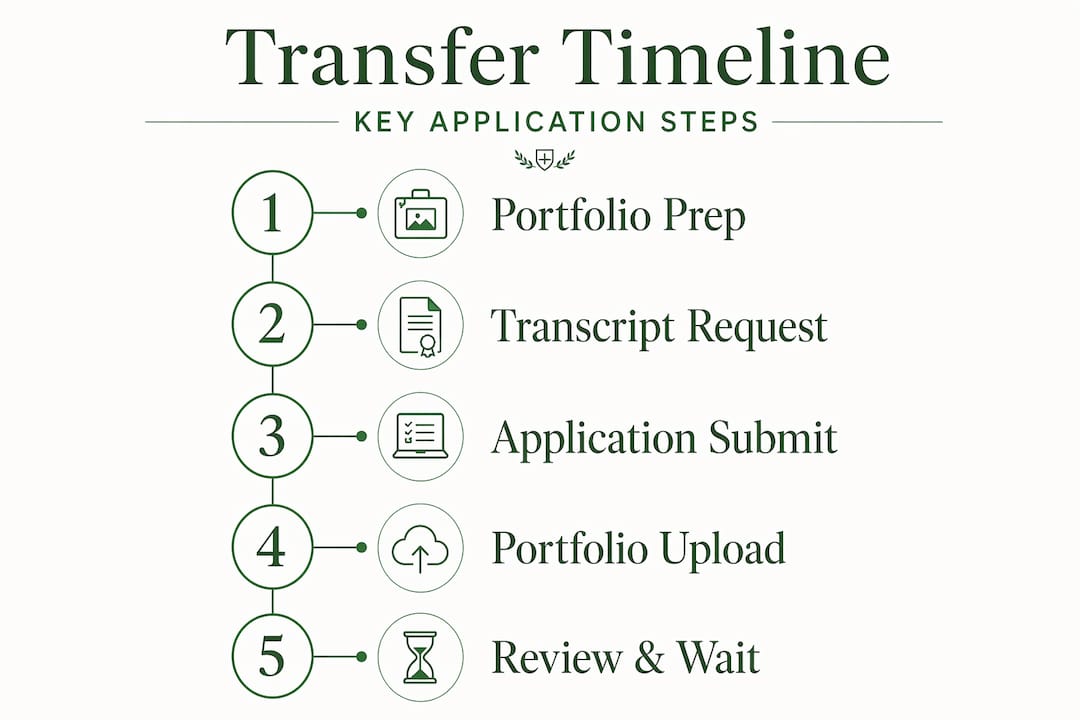
Knowing the typical review window reduces anxiety and helps you plan what to do while you wait. Use that time to research course sequences, connect with current students, and finalize your financial aid applications.
Common mistakes and how to avoid them
Even well-prepared applicants make avoidable errors during the creative arts transfer admissions process. Most of them fall into three categories: technical failures, portfolio curation missteps, and credit transfer confusion.
Technical upload problems are the most common and the most frustrating because they are entirely preventable. Exceeding file size limits, using improper formats, and inadequate labeling can delay processing or cause outright rejection of your portfolio. Always export images at the correct resolution, convert files to the required format before uploading, and test your files in the submission portal before the deadline.
Portfolio curation errors usually come from trying to show too much rather than too little. Portfolio review focuses on quality over quantity, specifically on technical skill, inventiveness, expressiveness, and design principles. Including weak pieces to pad the count actually hurts your score. Be ruthless in your selection.
Credit transfer confusion is a longer-term mistake that affects your academic trajectory after admission. Many students assume that passing a course means the credit will transfer cleanly. That is not how design programs work.
“Transfer credit evaluation is complex and requires substantiation of prior coursework content and outcomes, beyond transcript grading alone.” — SAIC Transfer Admissions
Request detailed credit transfer policies from each school before you apply. Ask specifically whether studio courses transfer as direct equivalents or as elective credit. That distinction can mean the difference between graduating on time and adding an extra semester.
What happens after you are admitted
Admission is not the finish line. For design transfer students, the post-admission phase shapes the entire arc of your degree. Here is what to expect and how to prepare for it.

Post-Admission Step | What to Expect | Timeline |
Transfer credit evaluation | Transcripts reviewed; credits assigned or waived | 2 to 6 weeks after admission |
Portfolio-based placement | Studio courses adjusted based on creative review | Concurrent with credit eval |
Academic advising appointment | Course sequence planned with your advisor | Before registration opens |
Orientation | Program-specific orientation for design transfers | 1 to 2 weeks before classes |
Registration | Enroll based on placement and credit outcomes | After advising appointment |
Studio-core requirements can be waived or adjusted based on your portfolio and prior coursework. This is genuinely good news, but it requires you to be proactive. Keep copies of every syllabus, course description, and graded project from your previous design courses. Admissions counselors and registrars use this documentation to make credit decisions, and having it ready speeds up the entire process.
Transfer credit decisions may result in waivers of some core requirements, but advanced studio placements often come with higher expectations. Plan your first semester conservatively so you have room to adjust without overwhelming yourself.
My honest take on what actually matters
I have worked with students and families navigating the admissions guide for design transfer students, and the pattern I see most often is this: students spend enormous energy on the quantity of their portfolio and almost no time thinking about the story it tells.
Admissions reviewers at design schools are not counting pieces. They are asking one question: does this student have the instincts and the foundation to succeed in our program? A portfolio with 14 technically polished pieces that all look the same answers that question with a quiet “maybe.” A portfolio with 13 pieces that show genuine range, including some observational drawing, some experimental work, and at least one piece that clearly pushed the student outside their comfort zone, answers it with a confident “yes.”
The second thing I tell every family is to treat the credit evaluation as a negotiation, not a verdict. Bring documentation. Ask specific questions. If a course you took covers the same outcomes as a required design foundations course, make that case clearly and early. Schools want to place you correctly, and they respond well to students who engage the process thoughtfully.
Finally, do not wait until December to start your portfolio. The students who get into their top-choice design programs almost always started curating and refining their work the previous spring. That is not luck. That is strategy. Understanding what admissions officers look for gives you a real edge when you know it early enough to act on it.
— Randy Pryor, Founder, Top College Coach
How Top College Coach can help you get in
Navigating the design transfer student admissions process on your own is possible. Doing it with expert guidance is faster, less stressful, and significantly more effective.
At Top College Coach, we work with transfer applicants targeting design programs at top universities across the country. We help you build a portfolio strategy that speaks directly to what admissions reviewers want to see, manage your transfer student application timeline so nothing falls through the cracks, and advocate for the strongest possible credit transfer outcome. Our counselors have a proven track record helping students gain admission to Ivy League and Top 20 schools, and we bring that same rigor to every design transfer application we support. Start with a free strategy session and let us build your plan together. Visit Topcollegecoach.com to learn more.
FAQ
What makes design transfer admissions different from other majors?
Design programs require a separate portfolio submission evaluated on creative criteria like technical skill, inventiveness, and design composition, in addition to standard academic materials like transcripts and essays.
How many pieces should a design transfer portfolio include?
Most programs require between 12 and 20 pieces from the last two years, with transfer applicants typically expected to submit more work than first-year applicants to demonstrate creative growth.
When should I start preparing my transfer application for a design program?
Start curating your portfolio and requesting transcripts the fall or winter before your target admission term, since portfolio deadlines often fall a full month before the main application deadline.
How do transfer credits work for design programs?
Schools like SAIC accept up to 60 transfer credits with grades of C or better, but studio credit decisions are made by evaluating your transcripts alongside your portfolio, not by grades alone.
Does submitting my application early improve my chances?
Yes. Submitting before the priority deadline often affects scholarship eligibility and can result in faster admissions decisions, giving you more time to plan your enrollment and financial aid.
Recommended
Comments