The Role of Counselor Recommendation Letter in College Admissions
Updated: May 25

Few parts of the college application carry as much quiet weight as the counselor recommendation letter. Students spend months polishing essays and chasing test scores, yet the role of counselor recommendation letter often gets treated as an afterthought. That’s a costly mistake. Admissions committees at selective colleges use these letters to understand who you are beyond your transcript, and a well-written one can genuinely shift how a reader perceives your entire application. This guide breaks down exactly what these letters do, what makes them powerful, and how you can position yourself to receive the strongest one possible.
Table of Contents
Key takeaways
Point | Details |
Counselor letters reveal your full story | They give admissions officers context about your character, challenges, and community role that grades alone cannot show. |
Timing is everything | Request your letter in junior spring, giving your counselor at least three weeks and a detailed brag sheet. |
Quality depends on your relationship | Students who meet with counselors and share their goals receive far more personalized and persuasive letters. |
Not every college requires one | Requirements vary by school, but most selective colleges do ask for a counselor letter through the Common App. |
Preparation is a shared responsibility | You cannot control what your counselor writes, but you can control how much useful information you give them to work with. |
The role of counselor recommendation letter in admissions
Think of the college application as a puzzle. Your transcript shows academic trajectory. Your essays show personality and voice. Your test scores show aptitude. The counselor letter is the piece that pulls all of those together and places them in context.
Counselor letters give admissions committees insight into the applicant as both a student and a community member, going well beyond test scores and grades. That framing matters. An admissions officer reading your file doesn’t know your school, your neighborhood, your family situation, or the challenges your graduating class faced. Your counselor does. And a thoughtful letter translates all of that into language that helps the committee see you clearly.
Here is what counselor letters specifically accomplish that other parts of your application cannot:
Contextualize your grades. If your GPA dipped junior year because of a family illness, your counselor can explain that. Without that context, a reader might assume you simply stopped trying.
Verify your character. Teachers see you in class. Counselors see you across your entire school career. They can speak to your growth, your resilience, and how you treat others.
Describe your school environment. A 3.8 GPA at a school with few AP offerings reads differently than a 3.8 at a school with 30 AP courses. Counselors explain that gap.
Confirm your role in the community. Leadership in student government, peer mentoring, or community service often carries more weight when a counselor independently confirms it.
“This recommendation provides insight into the applicant as both a student and community member beyond test scores and grades.” — Providence College Office of Admission
Unlike teacher recommendation letters, which focus on your performance in a specific subject, the counselor letter takes a panoramic view. It’s the one voice in your application that speaks to your whole high school experience. Admissions officers at selective colleges know this and read counselor letters with that lens in mind. At schools that use holistic review, counselor letters influence outcomes more than most students realize.
Why timing and preparation matter
Here is a truth that surprises many families: your counselor’s letter quality is partly your responsibility. Not because you write it, but because the information you give your counselor directly shapes what they can say about you.
High school counselors help students with academic planning, college exploration, and recommendation letters, but they are doing this for dozens or even hundreds of students at the same time. The more specific and organized you make it for them, the better your letter will be.
Follow these steps to set your counselor up for success:
Request in junior spring. The best practice is to ask your counselor for a letter before the end of your junior year. This gives them the summer to reflect and draft before the fall rush begins. Initiating requests in junior spring with at least three weeks’ notice is the standard recommendation from admissions professionals.
Ask in person. A face-to-face conversation signals that you take this seriously. It also gives your counselor a chance to ask questions and get a feel for your personality, which makes the letter more authentic.
Submit a detailed brag sheet. This is a one-to-two page document listing your achievements, awards, activities, leadership roles, challenges you’ve overcome, and your goals. Providing a brag sheet helps counselors write specific, impactful letters rather than generic ones.
Share your college list and essay themes. When your counselor knows what story you’re trying to tell, they can write a letter that complements rather than repeats your other materials.
Follow up professionally. A brief, polite check-in two weeks before your deadline is appropriate and appreciated. It’s not nagging. It’s good communication.
Pro Tip: Schedule a one-on-one meeting with your counselor at the start of senior year to walk them through your college list and application narrative. This 20-minute conversation can be the difference between a generic letter and one that genuinely advocates for you.
Building a real relationship with your counselor pays off beyond the letter, too. Counselors who know you well can advocate for you during waitlist reviews, write additional letters for scholarships, and give you more tailored college advice throughout the process.

What goes into a strong counselor letter
Understanding what counselors actually include in their letters helps you recognize what information to share with them. Strong letters are not just summaries of your transcript. They are narratives.
Letters commonly highlight academic rigor, leadership roles, personal qualities, and hardship contexts that strengthen the application narrative. A counselor who knows you well might describe how you took the hardest available courses while working a part-time job, or how you mentored younger students after struggling yourself freshman year. Those details are what make a letter memorable.
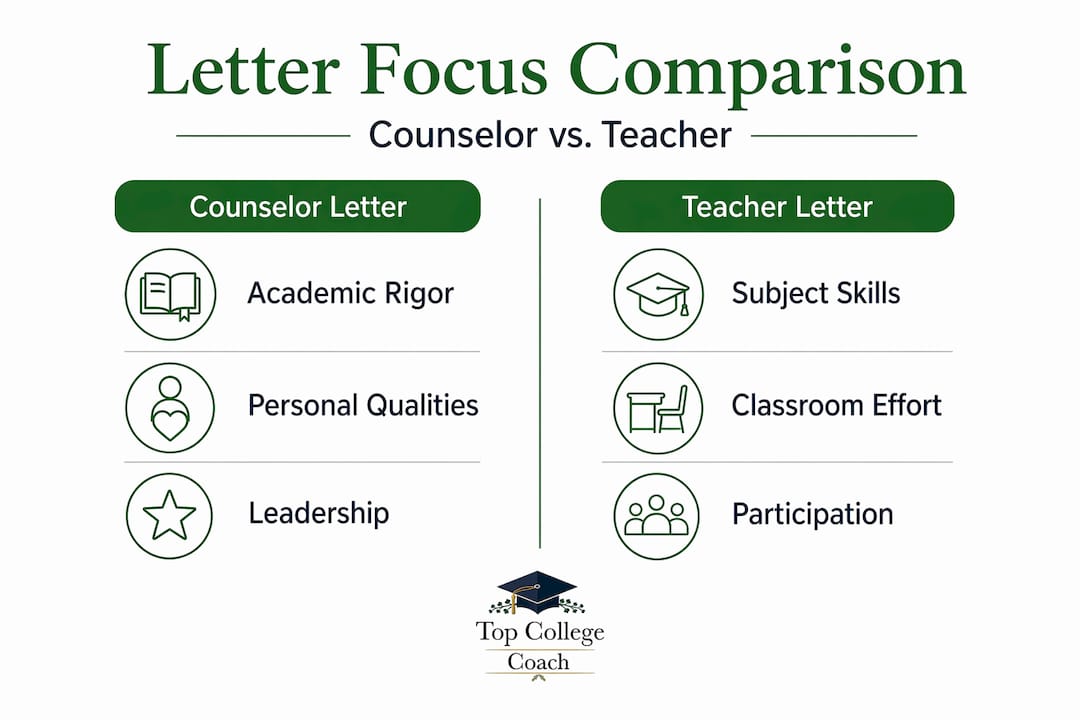
Here is a comparison of what counselor letters cover versus what teacher letters typically address:
Focus Area | Counselor letter | Teacher letter |
Academic performance | Whole transcript, course rigor, grade trends | Performance in one specific class |
Personal character | School-wide reputation, growth over four years | Classroom behavior and intellectual curiosity |
Challenges and context | Family, school environment, personal hardships | Specific academic struggles or breakthroughs |
Extracurriculars | Breadth of involvement across all years | Rarely included unless directly relevant |
Community role | Leadership, peer relationships, school culture | Limited to classroom dynamics |
The most persuasive counselor letters include specific anecdotes. Not “she is a leader” but “when the student council budget was cut in half, she reorganized the entire fundraising calendar and raised 40% more than the previous year.” Specificity is what separates a letter that gets skimmed from one that gets remembered.
Bullet points your counselor might address in a strong letter include:
Your academic growth and any upward grade trends
The rigor of your course selection relative to what your school offers
Personal qualities like integrity, curiosity, or perseverance
How you contribute to your school’s culture and community
Any significant personal circumstances that affected your record
Common challenges with counselor letters
Many students and parents have real concerns about counselor letters, and those concerns deserve honest answers.
Do all colleges require counselor letters? Not every college does. Counselor letters are not universally required, but most selective colleges and universities request one through the Common App or Coalition App. Always check each school’s specific requirements.
How long should a counselor letter be? Counselor recommendations are typically one to two pages in length. That’s enough space for a thorough, meaningful evaluation without overwhelming the reader.
What if your counselor barely knows you? This is the most common concern, and it’s valid. The ASCA recommends a 250:1 student-to-counselor ratio, but many schools far exceed that number, which means your counselor may be managing hundreds of students with limited time for each one. The solution is proactive engagement. Schedule meetings. Introduce yourself early. Don’t wait for your counselor to come to you.
Here are practical ways to overcome a thin counselor relationship:
Visit your counselor’s office at least twice before senior year, once to discuss your course plan and once to discuss college goals.
Write a personal statement summary or short bio to share with your counselor so they understand your story.
Ask a teacher or mentor who knows you well to speak with your counselor informally about your strengths.
Pro Tip: If your school has a high student-to-counselor ratio, consider working with an admissions counseling service that can help you prepare the materials your school counselor needs to write the most effective letter possible.
My take on why counselor letters are underestimated
I’ve worked with hundreds of students through the college admissions process, and one pattern I keep seeing is this: students put enormous energy into their essays and almost none into their counselor relationship. They treat the counselor letter as something that just happens to them rather than something they can meaningfully influence.
In my experience, the counselor letter is one of the highest-leverage documents in the entire application. Here’s why. When an admissions officer is on the fence about a candidate, they often go back to the counselor letter to settle the question. It’s the one voice that speaks with institutional authority about who you are as a person and as a student in your specific environment. A teacher can say you’re brilliant in chemistry. Your counselor can say you’re the kind of person who lifts everyone around you. That second statement is harder to find and harder to fake.
What I’ve learned from working closely with school counselors is that they genuinely want to write great letters. They’re not holding back. They’re working with limited time and limited information. When a student hands them a thoughtful brag sheet, sits down for a real conversation, and gives them enough lead time to actually think, the quality of the letter reflects that investment.
The students I’ve seen make the biggest mistakes are the ones who email their counselor a form request the week before the deadline and attach nothing. The counselor does their best, but “their best” under those conditions is a generic letter that confirms your GPA and says you’re a good student. That’s not advocacy. That’s a formality.
My advice: treat your counselor like a collaborator. Give them the raw material to tell your story well. The letter they write will be better, and your application will be stronger for it.
— Randy Pryor
How Top College Coach can strengthen your application
At Top College Coach, we’ve helped students gain admission to Ivy League and Top 20 universities, and we know that a strong counselor letter doesn’t happen by accident. It happens when students are prepared, proactive, and strategic.
If you’re unsure how to approach your counselor, what to include in your brag sheet, or how to position your application for maximum impact, we can help. Our free admissions strategy session is designed to give you a clear, personalized plan that covers every part of your application, including how to work with your counselor effectively. Whether you’re just starting junior year or deep into senior fall, our team at Top College Coach is here to make sure no part of your application is left to chance.
FAQ
What is the role of a counselor recommendation letter?
A counselor recommendation letter gives admissions committees a full-picture view of a student’s character, academic record, and community role. It contextualizes grades, confirms achievements, and provides insight that no other application document can offer.
When should students request a counselor letter?
Students should request letters in junior spring to give counselors adequate time for a thoughtful, detailed letter before senior year application deadlines arrive.
How long is a typical counselor recommendation letter?
Most counselor letters run one to two pages in length, which gives enough space for a thorough evaluation without being excessive.
What if my counselor doesn’t know me well?
Schedule a meeting, share a detailed brag sheet, and give your counselor context about your goals and story. Proactive engagement is the most reliable way to get a more personalized and persuasive letter even when the relationship is limited.
Do all colleges require a counselor recommendation letter?
Not all colleges require one, but most selective institutions do. Always check each school’s specific requirements through the Common App or the college’s admissions page to confirm what is needed.
Recommended
Comments