College Application Essays: Award-Winning Writer Guidance

Writing college applications with guidance from an award-winning writer is the single most effective way to transform a student’s raw story into an essay that admissions officers remember. The personal statement is not a resume in paragraph form. It is the one place in your application where your voice, your values, and your character can speak directly to a reader. At Top College Coach, we have seen students with near-perfect GPAs lose ground to applicants who wrote with honesty and specificity. Expert coaching, grounded in real writing craft, closes that gap. Our founder wrote for Disney for more than three decades, and is a master at storytelling. This guide gives you the strategies, the pitfalls to avoid, and the process that produces winning essays.
What are the key strategies an award-winning writer uses for college essays?
Expert essay coaching starts with a conversation, not a blank page. Award-winning coaches use interview-based brainstorming to pull out stories students would never think to write about on their own. A student might dismiss the summer they spent repairing bikes in their garage as “nothing special.” A skilled coach recognizes that story as a window into problem-solving, patience, and identity.
The second strategy is storyboarding and outlining. Before a student writes a single sentence of prose, storyboarding narratives maps the arc of the essay: where it opens, where it turns, and what the reader feels at the end. This planning step prevents the most common structural failure in student essays, which is a story that wanders without a clear point.

The third strategy is “show, don’t tell.” Admissions officers read thousands of essays that claim the student is “passionate,” “hardworking,” or “a natural leader.” Those words mean nothing without a scene. Concrete examples linked to goals differentiate applicants far more than any adjective. A student who describes the exact moment they realized chemistry was their calling, with sensory detail and a specific experiment, will always outperform one who simply states a love of science.
The fourth strategy involves risk and vulnerability. Vulnerability and risk-taking in essays turn ordinary moments into extraordinary narratives. Students fear that writing about something small or imperfect will hurt their chances. The opposite is true. Admissions officers are drawn to honesty. The essay about failing a driving test and what it revealed about perfectionism will resonate more than a polished account of winning a national competition.
Interview-driven brainstorming: Uncovers stories the student overlooks as too ordinary.
Storyboarding & Outlining: Creates a clear narrative arc before any prose is written.
Show, don’t tell: Replaces vague claims with vivid, specific scenes.
Vulnerability: Honest, imperfect storytelling builds genuine connection with readers.
Multiple drafts: No strong essay emerges from a single sitting.
Pro Tip: Record yourself answering the question “What do you want the admissions officer to know about you that isn’t anywhere else in your application?” Play it back. The answer you give out loud, unscripted, is often the essay you should write.
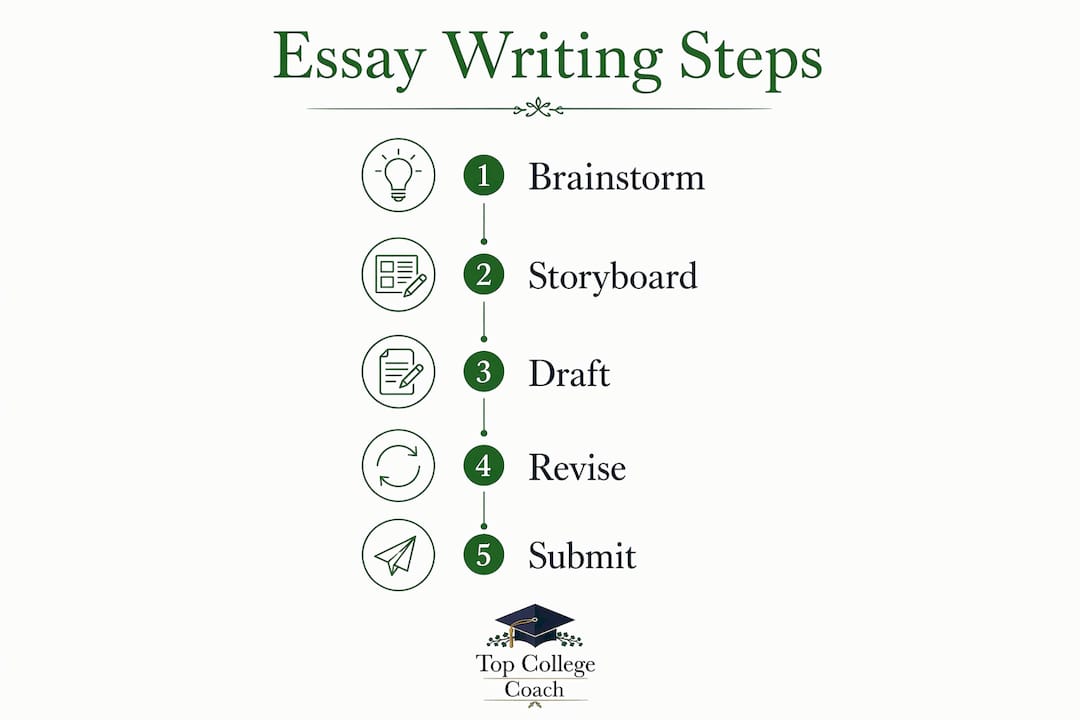
For Common App applicants, the 650-word limit has not changed. Tight limits reward students who know exactly what they want to say. Draft your essay in a separate document first. Refine it there. Only paste the final version into the application portal. This protects your work and gives you room to revise without the pressure of a live submission interface.
What common pitfalls do students face when writing college essays?
The most damaging pitfall is over-polishing language until the essay no longer sounds like the student. When a 17-year-old’s essay reads like a legal brief, admissions officers notice. They are not impressed. They are suspicious.
The second pitfall is perfectionism paralysis. First drafts are supposed to be messy. The goal of a first draft is to get ideas on paper, not to produce a finished product. Students who wait until the draft feels “ready” before writing it often run out of time for the revision cycles that actually improve the essay.
The third pitfall is relying on dramatic stories. Students assume admissions officers want to read about life-changing tragedies or extraordinary achievements. They do not. They want to read about genuine reflection. A student who writes about learning to cook their grandmother’s recipe and connects it to cultural identity and future goals will outperform a student who writes a generic account of winning a championship without any real self-examination.
Over-polished language: Strips the student’s authentic voice from the essay.
Perfectionism on early drafts: Delays the revision cycles that produce quality.
Dramatic story dependency: Substitutes spectacle for genuine self-reflection.
Drafting inside application portals: Risks losing work and limits revision flexibility.
Skipping expert review: Leaves blind spots that only an outside reader can catch.
Pro Tip: Draft your essay outside the Common App or any application portal. Use Google Docs. Save versions as you go. Pasting a finished draft into the portal is far safer than writing directly inside it.
How can students and parents make the essay process collaborative?
The essay belongs to the student. Parents, teachers, or counselors who rewrite sentences, correct every word, or push their own story ideas undermine the authenticity that admissions officers are trained to detect. The parent’s role is to listen, encourage, and ask questions, not to edit for style.
A productive collaborative process follows a clear sequence:
Start early. Students who begin essay writing early and plan multiple drafts reduce stress and produce stronger final essays. Aim to have a working draft by the end of junior year or early in the summer before senior year.
Brainstorm together. Parents can ask open-ended questions: “What moment this year surprised you most?” or “What would your closest friend say is your most unusual quality?” These conversations surface material the student would not generate alone.
Read the draft aloud. Have the student read their essay out loud to a parent. If a sentence sounds awkward when spoken, it needs revision. This simple technique catches unnatural language faster than any editing tool.
Bring in an outside reader. A trusted teacher, school counselor, or professional coach provides the perspective that family members cannot. They read the essay as a stranger, which is exactly how an admissions officer will read it.
Respect the student’s voice. If a parent suggests a change and the student resists it, the student is usually right. The essay must sound like a 17-year-old with something real to say, not a polished adult.
For students working with Top College Coach, the personal statement guidance process integrates all of these steps with professional coaching at each stage. The result is an essay that is genuinely the student’s own work, shaped by expert feedback into its strongest possible form.
Key Takeaways
Expert-guided college essay writing combines authentic storytelling, structured narrative planning, and iterative feedback to produce personal statements that admissions officers remember.
Point | Details |
Start with brainstorming | Interview-driven conversations uncover the specific stories that make essays memorable. |
Storyboard before writing | Planning the narrative arc before drafting prevents unfocused, wandering essays. |
Embrace vulnerability | Honest, imperfect stories resonate more with admissions officers than polished achievements. |
Draft outside portals | Writing in Google Docs or Word protects your work and enables real revision control. |
Start early and revise often | Multiple drafts with outside feedback consistently produce stronger final essays. |
What I have learned coaching hundreds of college essays
After working with students from all backgrounds and academic profiles, the pattern that surprises most families is this: the students who write the best essays are rarely the ones with the most impressive résumés. They are the ones willing to be honest on the page.
Parents often arrive at our first session convinced their student needs a dramatic story. A medical mission trip. A national award. A hardship overcome. What I have found is that the essay about a student’s obsession with competitive crossword puzzles, or the one about the summer they spent learning to fail at pottery, lands harder with admissions readers than a polished account of a service trip. The reason is simple. Specificity signals authenticity. Generic signals effort to impress.
The other lesson I keep relearning is that the essay process itself changes students. By the time a student has gone through four or five drafts with real feedback, they understand themselves better. They can articulate their values, their trajectory, and their goals with a clarity they did not have at the start. That clarity shows up not just in the essay but in interviews, in supplemental responses, and in the confidence they carry into the rest of the application. The essay writing process is not just a task to complete. It is one of the most useful exercises in self-knowledge a student will do before college.
— Randy Pryor, Founder of Top College Coach
How Top College Coach helps students write essays that get results
Top College Coach works with students applying to Ivy League and Top 20 universities, guiding them through every stage of the essay process from brainstorming to final draft.
Our counselors bring deep expertise in personal statement guidance, supplemental essays, and the full Common App strategy. We help students find the story worth telling, shape it into a compelling narrative, and refine it through structured feedback cycles. Every student we work with produces an essay that sounds like them at their best. If you are ready to give your application the attention it deserves, schedule a free admissions strategy session with Top College Coach today. We are based in Orlando, Florida, and we work with students nationwide.
FAQ
What makes a college essay stand out to admissions officers?
Admissions officers value genuine intellectual curiosity and personal growth over dramatic stories. Specific, honest details tied to the student’s goals consistently outperform vague claims of passion or leadership.
How many drafts should a student write for their college essay?
Most strong essays go through four to six drafts. Multiple drafting and outside feedback cycles improve both clarity and authenticity in ways a single draft never can.
Can students use AI tools to write their college essays?
Absolutely not. We detailed the dangers of using AI, like ChatGPT, Claude, and Grammarly, in a recent article.
Keep in mind that many top schools are now using AI detectors in normal coursework, and we believe that most colleges are now using it throughout the admissions process. The use of AI by a student is seen as academic dishonesty, and an AI-aided essay will almost certainly result in an automatic rejection.
Recommended
Comments