Tips to Improve Your College Application in 2026

The most impactful tips to improve your college application come down to five fundamentals: strong academics, meaningful extracurriculars, authentic essays, organized planning, and confident self-presentation. You don’t need a perfect GPA or a trophy shelf. You need a clear, cohesive story that shows admissions officers exactly who you are and what you’ll bring to their campus.
Here’s where to start right now:
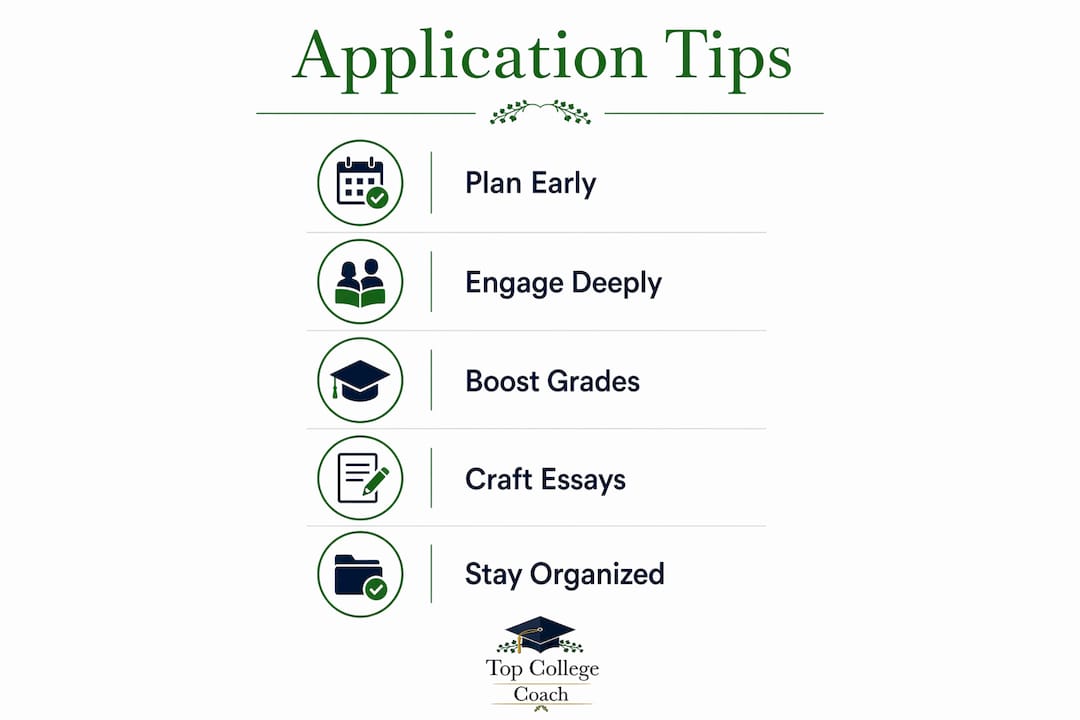
Build an upward academic trajectory. Admissions officers read transcripts like stock charts. A rising trend signals resilience and growth.
Go deep, not wide, in your activities. Two or three commitments with real leadership and impact outweigh a list of ten clubs you attended twice.
Write essays that reveal, not impress. Specific, personal moments beat generic achievement summaries every time.
Choose recommenders who actually know you. A detailed letter from a teacher who watched you struggle and grow beats a glowing form letter from a principal.
Start early and stay organized. A reverse-calendar spreadsheet built from your deadlines keeps everything on track and reduces last-minute panic.
Use every optional section. The additional information section is your chance to add context, explain a hard semester, or share something the rest of your application couldn’t capture.
These are not abstract ideals. They are the concrete moves that shape strong college applications year after year.
Table of Contents
1. Summer activities that will boost your college application
3. Why depth in extracurricular activities matters more than breadth
4. How to write essays and recommendations that actually work
5. How to handle college admissions interviews with confidence
6. Staying organized through the college application process
1. Summer activities that will boost your college application
Summer is one of the most underused opportunities in the college admissions process. While your classmates are scrolling through their phones, you can be building the kind of experiences that make an admissions officer pause and take notice.

The most effective summer activities share one quality: they connect to something you genuinely care about. A student passionate about medicine who volunteers at a hospital, shadows a physician, or participates in a research program at a local university creates a narrative thread that runs through their entire application. That coherence is what admissions officers at selective schools are looking for.
Here are the summer activities that carry the most weight:
College-level coursework. Programs like Harvard Summer School or local community college dual-enrollment courses demonstrate academic readiness. Earning a strong grade in a college class tells admissions officers you can handle the rigor ahead.
Research internships and STEM programs. University-sponsored research opportunities, science fairs, and programs like Research Science Institute (RSI) show intellectual initiative beyond the classroom.
Meaningful community service. Volunteering consistently with one organization, especially in a leadership capacity, carries far more weight than a one-day service event. Track your hours and document your impact.
Paid work or family responsibilities. A summer job or caring for younger siblings demonstrates maturity and real-world responsibility. Admissions officers respect students who contribute to their households.
Study abroad or language immersion. Spending a summer in a language immersion program or studying abroad shows cultural curiosity and independence, qualities that resonate strongly in college essays.
Passion projects. Starting a small business, launching a podcast, building an app, or creating an art portfolio can be just as compelling as a formal program, especially when you can speak to what you learned.
Pro Tip: Don’t chase prestige for its own sake. A summer spent genuinely engaged in your community or developing a real skill will produce better essay material than an expensive program you attended just to list it.
For a deeper breakdown of how to maximize your summer for admissions purposes, Top College Coach has a dedicated guide worth reading before you make any plans.
2. How your grades and test scores shape your application
Academics are the foundation. Everything else you do in your application sits on top of this base, and a shaky foundation makes the whole structure harder to sell.
Admissions officers read transcripts like stock charts, looking for upward trends in both grades and course difficulty. A student who earned a 3.4 GPA freshman year and a 3.9 senior year, while steadily adding AP and honors courses, tells a more compelling story than a student who coasted at a flat 3.7 in standard classes throughout high school.
Prioritize course rigor. Taking AP, IB, honors, or dual-enrollment classes signals that you’re challenging yourself. Selective colleges want to see you pushing past the minimum.
Understand the test-optional landscape. Many four-year colleges are test-optional as of the current application cycle, but some selective schools have reinstated testing requirements. Research each school’s policy individually.
Submit scores strategically. If your SAT or ACT score falls within or above a school’s middle 50% range, submit it. If it falls below, withholding it is usually the right call at test-optional schools.
Prepare with focus. Targeted prep using official College Board or ACT materials, combined with timed practice tests, produces better results than passive review. Set a realistic score goal and work backward from it.
Pro Tip: If a difficult semester dragged your GPA down, use the “Additional Information” section of the Common App to explain it briefly and factually. A one-paragraph note showing self-awareness and growth can reframe a weak transcript moment entirely.
3. Why depth in extracurricular activities matters more than breadth
A list of fifteen clubs looks busy. What admissions officers actually want to see is evidence that you showed up, took responsibility, and made something happen.
Sustained commitment to a few activities with measurable impact consistently outperforms a scattered list of short-term involvements. The student who joined the robotics team freshman year, became team captain junior year, and led the team to a regional competition has a story. The student who joined eight clubs and held no leadership role in any of them does not.
Show a progression. Admissions officers notice when your involvement in an activity deepens over time. Moving from member to officer to founder is a trajectory that speaks for itself.
Quantify your impact. “Increased club membership from 12 to 40 students” is more powerful than “helped grow the club.” Numbers give context and credibility.
Include non-traditional activities. A part-time job, caring for a sibling, or managing a family business counts. These responsibilities often demonstrate more maturity than a school club.
Highlight leadership through initiative. Starting something, whether a tutoring program, a fundraiser, or a community event, shows you don’t wait to be asked. That quality stands out.
Avoid overloading your schedule. Joining activities just to fill your application reads as exactly that. Focus on what genuinely interests you and commit to it fully.
The qualities colleges look for in extracurricular involvement center on initiative, responsibility, and personal growth, not the number of lines on your activity list.
4. How to write essays and recommendations that actually work
Your essay is the one place in the application where you control the narrative completely. Use it.
Strong essays demonstrate self-awareness and reflect genuine experiences rather than polished achievements. The student who writes about failing a chemistry test and what that taught them about asking for help will be remembered far longer than the student who writes a summary of their volunteer trip abroad.
Choose a specific moment, not a theme. “The time I burned dinner trying to cook for my family” beats “how cooking taught me about culture.” Specificity creates connection.
Use sensory details and dialogue. Put the reader in the room with you. What did it smell like? What did someone say? These details make an essay feel lived-in rather than written.
Avoid the trophy essay. If your essay is mostly a list of your accomplishments with some reflection bolted on, start over. The essay should reveal character, not repeat your resume.
Read it aloud before you submit. If it doesn’t sound like you talking, it needs another draft.
For a full walkthrough of the Common App essay, Top College Coach’s 2026 guide covers every prompt with concrete examples.
Recommendations work the same way. Effective letters come from teachers who know you well and can cite specific examples of your intellectual engagement and growth. A letter that says “she was one of my best students” is forgettable. A letter that describes the specific argument you made in class that changed the discussion is not.
Give your recommenders a “brag sheet.” A one-page summary of your accomplishments, goals, and the stories you want your application to tell helps them write something specific and personal.
Ask early. Giving recommenders at least six weeks, ideally more, shows respect for their time and produces better letters.
Coordinate your narrative. Your recommendations should reinforce the themes in your essays, not repeat the same anecdotes. Brief your recommenders on what you’re highlighting elsewhere.
The role of essays in admissions goes well beyond demonstrating writing ability. A well-crafted essay is often the deciding factor between two otherwise equal applicants.
5. How to handle college admissions interviews with confidence
Not every school requires an interview, but when one is offered, treat it as an opportunity, not an obligation. An interview done well can tip a borderline decision in your favor.
Admissions interviewers want authentic conversation. They’re not looking for a rehearsed sales pitch. They want to meet the person behind the application and get a sense of whether you’d thrive on their campus.
Research the school before you walk in. Know specific programs, professors, or initiatives that genuinely interest you. Vague enthusiasm (“I love the campus culture”) is less convincing than a specific reference.
Prepare three or four thoughtful questions. Asking good questions signals curiosity and preparation. “What do students here wish they’d known before arriving?” is more interesting than “What’s the acceptance rate?”
Dress appropriately and arrive early. Business casual is the right call for most interviews. Arriving five minutes early shows respect; arriving late shows the opposite.
Be honest about what you don’t know. If you’re unsure about your major or career path, say so. Admissions officers appreciate intellectual honesty far more than a polished but hollow answer.
Listen actively. An interview is a two-way conversation. Responding to what the interviewer actually says, rather than pivoting to your next prepared point, makes the exchange feel genuine.
Practice with a mock interview. Run through common questions with a parent, teacher, or counselor. The goal isn’t to memorize answers but to get comfortable thinking out loud about yourself.
6. Staying organized through the college application process
The college application process is, at its core, a project management challenge. Starting early and building a reverse-calendar from your deadlines is one of the most effective things you can do to protect your application quality.
When you’re managing multiple schools, each with different requirements, deadlines, and supplemental essays, organization isn’t optional. It’s what separates students who submit polished applications from those who scramble at the last minute and miss something.
Build a master spreadsheet. Track every school, its deadline, required materials, and the status of each component. Update it weekly.
Work backward from deadlines. If an Early Decision deadline is November 1, your essays should be done by October 15, your recommendations requested by September 1, and your test scores sent by mid-October.
Use consistent legal names. Your name, address, and identifying information must match exactly across the Common App, CSS Profile, and every school’s portal. Inconsistencies create processing delays.
Set calendar reminders. Digital reminders for every major deadline, including transcript requests and test score sends, prevent the kind of avoidable errors that cost students their preferred schools.
Confirm receipt of materials. After submitting transcripts, test scores, and recommendations, log into each school’s portal to verify everything arrived. Don’t assume.
Pro Tip: Build your application timeline checklist in late spring of junior year, not the fall of senior year. Students who start planning 12 to 18 months before their deadlines consistently produce stronger, less stressful applications.
A detailed application timeline checklist from Top College Coach can help you map out every step from junior year through submission.
7. Building a college application resume that stands out
A college resume is not the same as a job resume, but the principles of clarity and specificity apply to both. Think of it as a one-page snapshot of your academic and personal achievements that supplements your application.
Your resume should be clean, easy to scan, and free of filler. Admissions officers spend limited time on each application, and a cluttered or padded resume wastes that time.
Structure your resume with these sections:
Academic achievements. GPA, class rank if available, AP or IB courses, academic awards, and any dual-enrollment coursework.
Extracurricular activities. List in order of importance to you, not chronologically. Include your role, the organization, and the years of involvement.
Work experience and responsibilities. Paid jobs, internships, and significant family responsibilities all belong here. Include a brief description of your duties and any measurable outcomes.
Community service and volunteer work. Specify the organization, your role, and the approximate number of hours contributed. Admissions officers notice when students quantify their service.
Skills and interests. Languages spoken, instruments played, software proficiencies, or certifications. Keep this section tight and honest.
A few formatting rules that matter: use consistent fonts and spacing, keep it to one page, and proofread it at least twice. A typo on a resume signals carelessness, which is the last impression you want to leave.
The college application writing checklist from David TC Tutoring Services is a practical tool for making sure your resume and other written materials are complete and polished before you submit.
Top College Coach gives you a real edge in admissions
Getting into an Ivy League or Top 20 university takes more than good grades. It takes a strategy, and that’s exactly what Top College Coach delivers.
Top College Coach, based in Orlando, Florida, specializes in helping students build the kind of focused, authentic applications that get results at the most selective schools in the country. With a track record of Ivy League and Top 20 admissions and a consistent record of 5-star client reviews, the approach here is personal and specific to you, not a generic template handed to every student. From essay coaching and activity strategy to interview prep and deadline management, every piece of your application gets the attention it deserves. If you’re ready to stop guessing and start building a real plan, book a free strategy session with Top College Coach today.
Key takeaways
A focused, intentional application strategy combining strong academics, meaningful activities, and authentic storytelling consistently outperforms last-minute, reactive efforts.
Point | Details |
Academic trajectory matters | Admissions officers look for upward grade trends and increasing course rigor, not just a high GPA. |
Depth beats breadth in activities | Sustained commitment with measurable leadership impact carries more weight than a long list of brief involvements. |
Essays reveal character | Specific, personal stories with vivid details create memorable applications; achievement summaries do not. |
Organize early with a reverse calendar | Building your timeline from deadlines in junior year reduces errors and produces stronger final submissions. |
Top College Coach provides expert guidance | Personalized admissions strategy from Top College Coach helps students at every stage, from essay coaching to interview prep. |
Recommended
Comments