Under $100,000: Ivy League Financial Aid Leaves Families Paying $0

Ivy League financial aid is far more generous than most families assume: every Ivy meets 100% of demonstrated need with grants, and families earning under roughly $100,000 typically pay little to nothing at several schools. The catch is that income thresholds and coverage details differ school to school, so the only way to know your real number is to file the FAFSA and CSS Profile early. Below, we break down what each Ivy actually offers and how to read your award letter once it arrives.
Table of Contents
How Does Ivy League Financial Aid Compare Across Schools?
Every Ivy League school promises to meet full demonstrated need, but “full need” doesn’t mean the same dollar amount at each one. The differences show up in three places: where the zero-contribution income line sits, whether loans appear in a standard package, and what extras (travel money, health insurance, start-up grants) get bundled in.
A few patterns jump out once you line these up side by side:
Every single Ivy has dropped loans from standard aid packages, a shift that happened gradually over the past two decades and accelerated recently.
The zero-contribution income line varies notably across the eight schools, meaning a family earning around $140,000 might pay full freight at one school and close to nothing at another.
All eight require the same three-form combination: FAFSA, CSS Profile, and IDOC. Skipping any one of them can delay or reduce your award.
What Does Each Ivy League School Actually Offer in Aid?
Reading eight separate financial aid pages is not how most parents want to spend a Saturday, so here’s the condensed version of what each school’s website actually promises.
Harvard. Families with $100,000 or less in typical income and assets generally pay $0, and Harvard layers on a start-up grant plus health insurance coverage for admitted students who qualify. Harvard reports that a significant share of its students receive institutional scholarship aid, and no loans are part of the standard package.
Yale. Yale is need-blind in admissions and meets 100% of demonstrated need through grants, with initial offers typically excluding loans entirely. Families near the $100,000 income mark commonly see a $0 parent contribution once assets are factored in.
Princeton. Princeton publishes its own formula: families generally contribute 25% of income above $100,000 and 5% of assets above $150,000. That transparency around family contribution makes Princeton one of the easier schools to estimate before you even apply, and the university states an average grant figure for admitted students each year.
Columbia. Columbia meets full need for all four years and generally covers tuition, room, and board for families under roughly $150,000, adjusted for assets and household size. Loans are not included in the base package.
Cornell. Cornell’s aid formula gets more complicated because the university includes both endowed colleges and state-supported statutory colleges, each with slightly different aid pools. Most students at endowed colleges see zero parent contribution under about $75,000 in income.
Dartmouth. Dartmouth eliminated loans from every aid package regardless of income level, a policy that predates similar moves at several peer schools. Families under $125,000 in typical income and assets generally owe nothing toward tuition.
Penn. Penn moved to a no-loan model in 2022 and now meets full need with grants and work-study alone. Families earning $75,000 or less typically see a $0 parent contribution.
Brown. Brown recently joined the no-loan cohort, replacing loans in standard packages with grants. The zero-contribution line sits around $125,000 for typical family circumstances.
How Do Schools Decide What Your Family Can Pay?
Three forms drive nearly every Ivy League aid decision, and each does a different job. The FAFSA (Free Application for Federal Student Aid) calculates your Student Aid Index, which determines eligibility for federal grants, work-study, and loans. Filing FAFSA is mandatory for federal aid, and there’s no fixed income cutoff, so families sometimes skip it assuming they won’t qualify, then miss out on aid they were actually eligible for.
The CSS Profile goes deeper. It asks about home equity, small business assets, medical expenses, and sibling college enrollment, giving institutions a fuller financial picture than FAFSA alone provides. Nearly every Ivy requires it alongside IDOC (College Board’s Institutional Documentation Service), which collects your actual tax returns and W-2s for verification.
Here’s what most families don’t expect: several Ivies exclude retirement account balances and equity in your primary home from the aid formula entirely, a policy Harvard and Princeton both spell out clearly in their guidance.
FAFSA determines federal eligibility and your Student Aid Index.
CSS Profile captures a more detailed financial picture, including assets FAFSA ignores.
IDOC verifies everything with actual tax documents.
Retirement savings and primary home equity are commonly excluded from institutional formulas.
Pro Tip: Always file both FAFSA and CSS Profile, even if you assume your income disqualifies you. Formulas favor certain asset types, and families who self-select out of applying often would have qualified for meaningful aid.
Which Families Actually Pay $0 at an Ivy League School?
The dollar thresholds vary, but the pattern holds across all eight schools: households earning under roughly $100,000 with typical assets generally see a $0 parent contribution, and that threshold has been climbing. Harvard and Yale both recently expanded their free-attendance income bands, while Princeton’s guidance extends meaningful aid up to about $150,000 in income for typical asset levels.
Families earning in the hundreds of thousands are not automatically excluded either. Having two children enrolled in college simultaneously, facing high medical expenses, or carrying above-average housing costs in a high cost-of-living area can all lower the expected contribution well below what a simple income snapshot would suggest.
A large share of students at Ivy League campuses receive institutional scholarship aid, not because they’re low-income, but because the formulas account for real household complexity beyond the headline salary number.
Under $100,000 income: $0 parent contribution is common at most Ivies.
$100,000 to $150,000: partial aid is typical, varying by school and assets.
$200,000 to $300,000: aid is possible with multiple children in college or documented financial strain.
What Does “No-Loan” Actually Mean for Your Award Letter?
A no-loan policy means the school meets your full demonstrated need using grants and, in some cases, campus work rather than requiring you to borrow. Princeton and Yale both frame it this way: the initial offer contains no loan obligation unless your family chooses to borrow for a car, a laptop, or other discretionary costs.
When your award letter arrives, separate it into three buckets: grant aid, work-study, and any loan component. Subtract grants and expected work-study earnings from the total cost to find your real out-of-pocket number, and check whether the award is renewable at the same level for four years.
Grants reduce your bill directly and never get repaid.
Work-study covers part of the remaining cost through a campus job.
Any loan listed is optional unless your school’s policy differs from the no-loan norm.
If a package includes loans you weren’t expecting, that’s often a sign to call the aid office before accepting anything.
How Do You Apply, Document, and Appeal an Aid Offer?
Submit the FAFSA and CSS Profile by each school’s posted deadline, which can differ for early decision versus regular decision applicants.
Upload tax returns, W-2s, and asset statements through IDOC once requested.
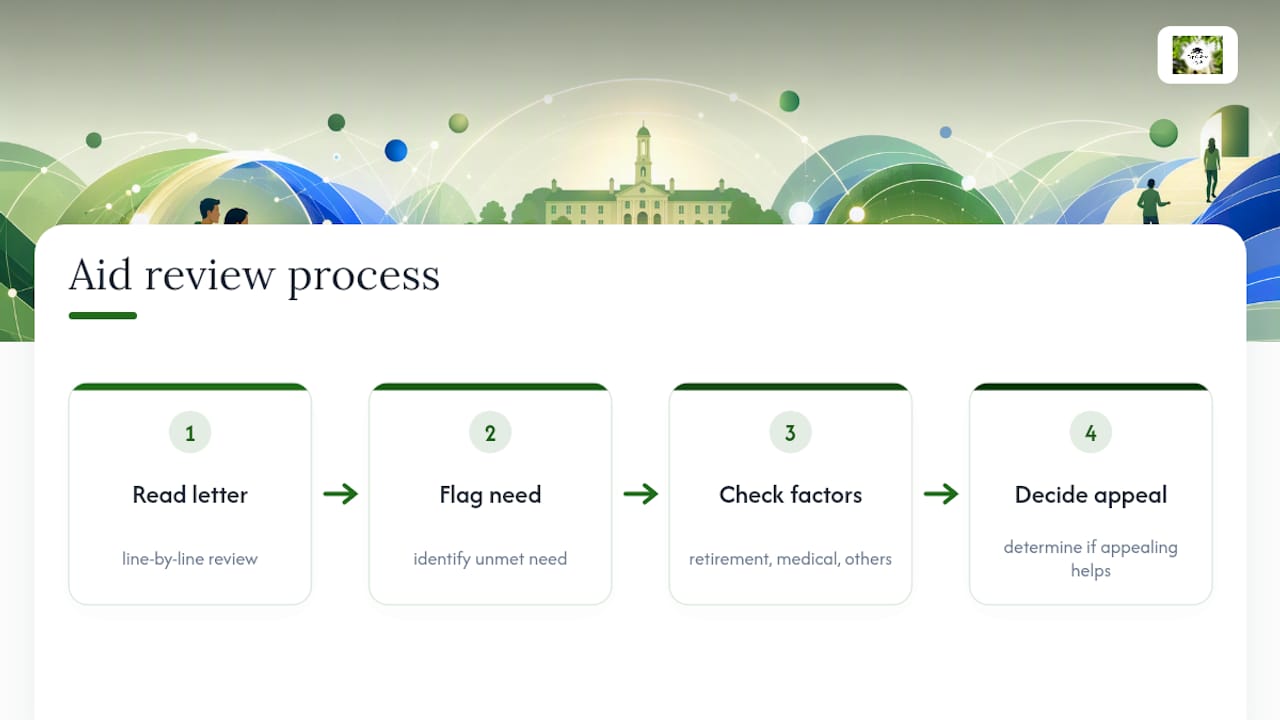
Review your award letter line by line and verify the income and asset figures match what you submitted.
Contact the financial aid office with updated documentation if your circumstances have changed, and file a formal appeal if the numbers still look off.
Early-decision applicants often receive aid estimates sooner but with less time to compare offers against other schools, so start gathering documents the summer before senior year.
Pro Tip: Request a fee waiver for the CSS Profile if your family qualifies. Many families never ask, and most Ivies grant it automatically once you check the right box on your FAFSA.
How Can Families Interpret and Appeal an Aid Award?
Reading an award letter accurately means isolating your true net cost: total cost of attendance minus grants, minus expected work-study earnings, before any loan is even considered. Appeals tend to work best when tied to a specific, recent, and documented change.
Gather proof of a recent job loss, income drop, or major medical expense before requesting a review.
Compare your offer against another Ivy’s award for the same student, since schools sometimes adjust when shown a competing offer.
Ask the aid office directly what documentation strengthens an appeal rather than guessing.
For families juggling multiple applications, resources like the Ivy League admission guide walk through how timing affects both admission and aid decisions.
A Practitioner’s View on Ivy League Aid Generosity
Experienced college admissions counselors work with families through exactly this process: reading award letters line by line, flagging unmet need, and helping parents decide whether an appeal is worth pursuing. That kind of review often catches details, like an excluded retirement account or an underreported medical expense, that change the outcome. A paid consultation isn’t required to benefit from these schools’ aid, but for complex financial situations, it can clarify options families would otherwise miss.
Why the “Ivy League Is Only for the Rich” Myth Persists
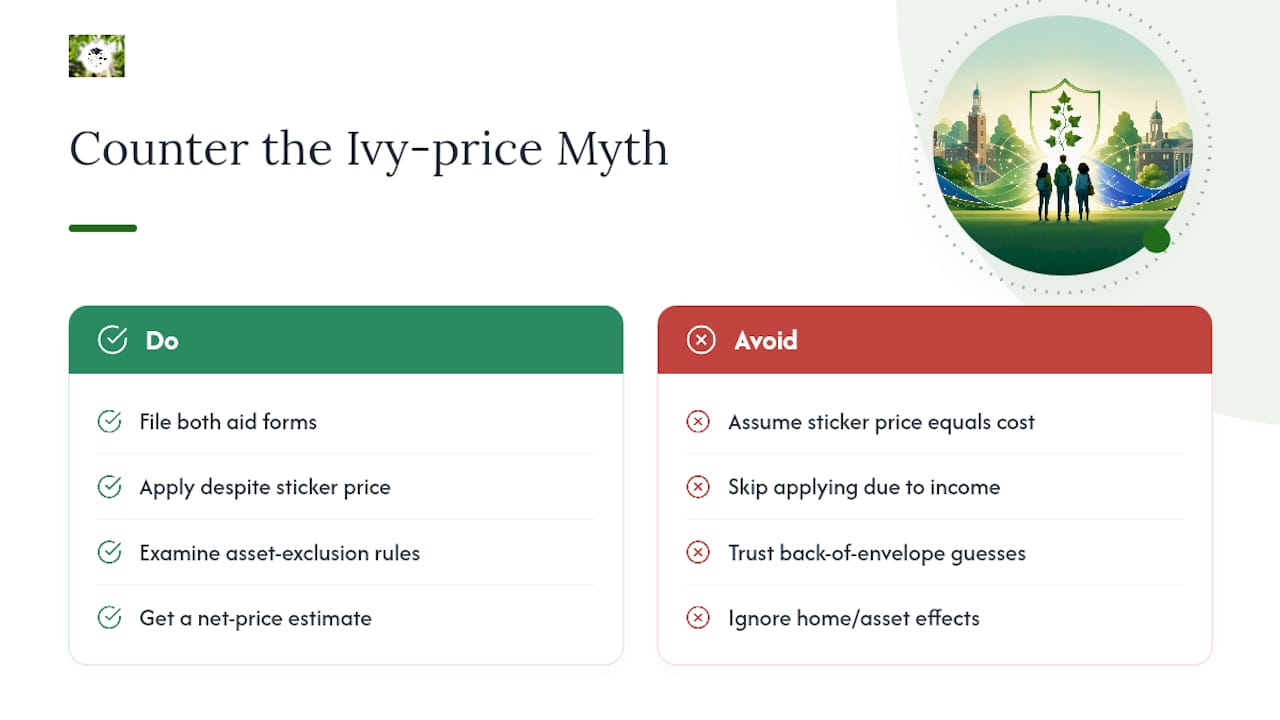
The persistent myth that Ivy League schools are financially out of reach for anyone but wealthy families is, frankly, backwards, and it costs real students real opportunities. Every year, qualified applicants skip applying to Harvard, Yale, or Princeton because they assume the sticker price is the real price. It isn’t. The sticker price is what you’d pay with zero aid, a scenario that applies to a shrinking share of admitted students as these schools keep raising their zero-contribution thresholds.
What’s underappreciated is how much the asset-exclusion rules matter for middle-class families who assume they make “too much” to qualify. A family with a $180,000 income, two kids in college, and a mortgaged home can end up paying less than a family earning $120,000 with no other children and a paid-off house. Income alone tells you almost nothing about your actual number. That’s precisely why we push every family we talk to toward filing both forms rather than trusting a back-of-envelope guess, and it’s why understanding Ivy League requirements matters as much as understanding the aid formulas themselves. The families who get burned aren’t the ones who apply and get a disappointing offer. They’re the ones who never applied at all.
— Randy Pryor
Get Help Reviewing Your Ivy League Aid Offer
Once an award letter lands in your inbox, the hardest part isn’t the paperwork. It’s knowing whether the number in front of you is actually the best offer your family can get, or whether there’s room to appeal. Some college admissions counselors offer free admissions strategy sessions that include a walk-through of your award letter and a clear next-step plan tailored to your situation.
Unlike generic financial aid calculators that only estimate a range, this session looks at your specific numbers alongside your application strategy, since aid outcomes and admission strategy are more connected than most families realize. If you’re still building your college list, a tool like the 529 savings calculator can help you see how current savings stack up against likely net costs before you even apply. When you’re ready to get specific answers about your own award or your application strategy, book a free admissions strategy session and bring your latest offer letter or your list of target schools.
This article is general information, not a substitute for advice from a qualified financial advisor. Consult a qualified financial professional about your own circumstances before acting on anything here.
Sources
FAQ
Can you go to Harvard for free if your family makes under $200,000?
Not automatically, but families earning under $100,000 with typical assets generally pay $0, and Harvard extends meaningful aid well into six-figure incomes depending on assets, household size, and number of children in college.
Do Ivy League schools give good financial aid?
Yes.
Will I get financial aid if my parents make over $300,000?
It’s possible but less common; aid at that income level usually depends on special circumstances like multiple children in college simultaneously, high medical costs, or unusually high housing expenses in an expensive area.
Is a 1400 SAT good enough for the Ivy League?
Admission and financial aid are separate processes. Test scores affect your chances of admission, not the size of your need-based aid award, which is determined entirely by your FAFSA and CSS Profile data.
Recommended
Comments