US Families: Ivy League Summer Programs Are Tools Not Tickets

The most recognizable Ivy League summer programs are Harvard’s Pre-College Program, Brown’s Pre-College and Summer@Brown offerings, Dartmouth’s Precollege Summer Scholars, Yale Summer Session, Penn SAS High School Programs, Columbia’s pre-college courses, Cornell Pre-College Studies, and Princeton’s summer offerings. They range from two-week non-credit exploration to six-week credit-bearing coursework. The honest takeaway: pick based on academic fit and depth, not brand name. These programs build skills and confidence, but none of them guarantees admission anywhere, including the school hosting it.
Table of Contents
What Are the Best Ivy League Summer Programs to Consider?
Every Ivy campus now runs some version of a summer offering for high schoolers, and the differences between them matter more than the shared “Ivy League” label suggests. Here’s a working shortlist to start your research.
Harvard Pre-College Program: a two-week, non-credit residential or commuter experience open to rising juniors and seniors. It runs alongside Harvard’s longer Secondary School Program, which offers 4- and 7-week credit-bearing courses for students who want a transcript, not just exposure.
Brown Summer@Brown / Pre-College Programs: non-credit and hybrid offerings running one to six weeks, with more than 230 course options covering everything from bioethics to game design. Brown enrolls over 6,000 students annually, which means broader access than some peer schools but less exclusivity as a credential.
Dartmouth Precollege Summer Scholars: a competitive, application-based program for students ages 15 to 18, built around intensive, non-credit college-level coursework rather than a survey of electives.
Yale Summer Session: pre-college coursework taught directly by Yale faculty, with both residential and commuter formats and small, seminar-style classes.
University of Pennsylvania (Penn SAS) High School Programs: two-, three-, or six-week accelerated sessions that let students choose intensity based on how much time and money they want to commit.
Columbia Pre-College / Columbia Experience: multi-week academic sessions in New York City, popular for students drawn to urban, interdisciplinary study alongside undergraduate-style seminars.
Cornell Pre-College Studies: hands-on courses spanning engineering, veterinary science, and the humanities, often appealing to students who already know their intended major.
Princeton University summer offerings: smaller and more selective than most peer programs, with limited seats and a narrower academic focus each cycle.
Costs typically run from a few hundred dollars for short online modules to several thousand for residential sessions. Deadlines are usually posted on each program’s official page between December and March for the following summer.
What Types of Ivy Pre-College Programs Exist?
Not every “summer program” delivers the same thing, and confusing the categories is the most common planning mistake families make.
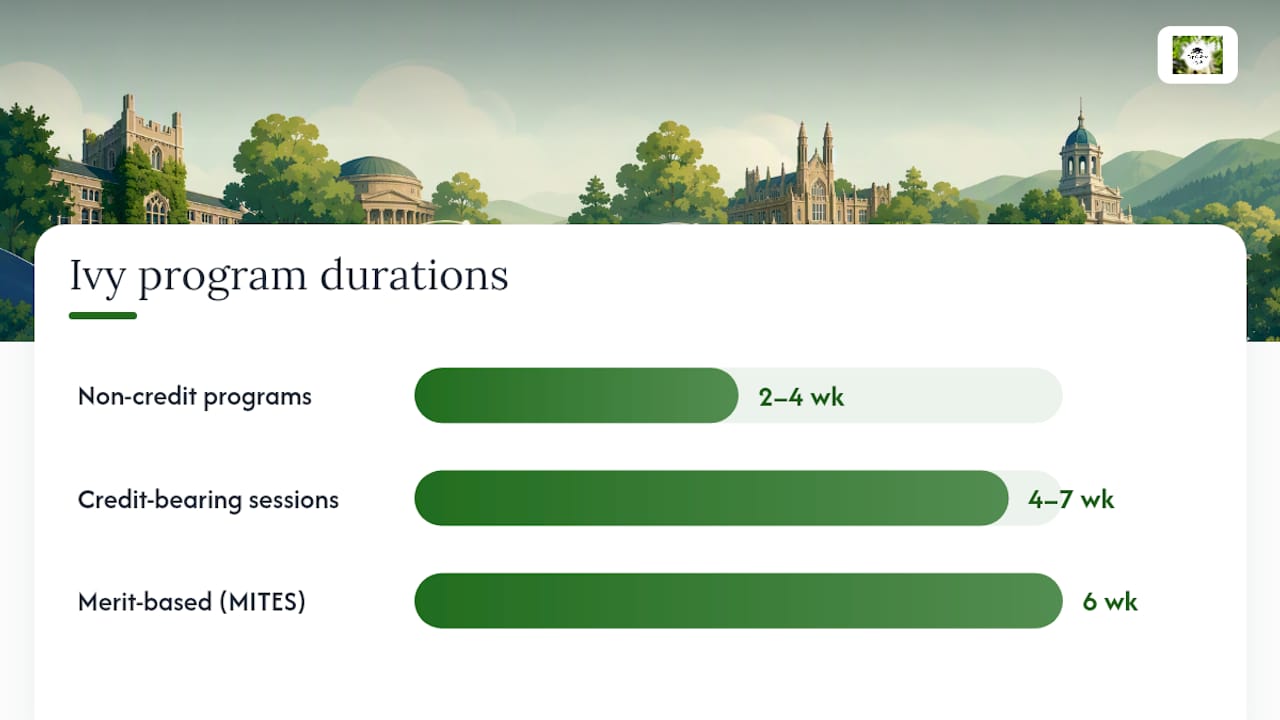
Non-credit pre-college programs run two to four weeks and focus on exploration: sampling a subject, meeting professors, and living briefly on a college campus. Harvard’s two-week track is the clearest example.
Credit-bearing secondary school sessions run longer, typically four or seven weeks, and function like real college courses with grades and transcripts. Harvard’s Secondary School Program and Penn’s six-week track fall into this category.
Hybrid and online options let students take Ivy-taught coursework without travel or housing costs, which matters for families balancing budgets or scheduling conflicts with other commitments. Brown and Yale both offer versions of this format.
Highly selective, merit-based national programs sit outside the Ivy fee-based model entirely. MITES Summer at MIT is a six-week, free STEM immersion program built on need and merit rather than tuition, and it offers a useful contrast: rigorous access without the price tag, though seats are far more limited.
Choose non-credit if you want exploration without academic risk.
Choose credit-bearing if you want a transcript and a grade.
Choose hybrid/online if cost or distance is the limiting factor.
Choose merit-based programs like MITES if you qualify and want a research-heavy alternative.
How Much Do Ivy League Summer Programs Cost?
Costs vary widely by session length, housing, and institution, but the pattern is consistent: two-week programs run in the thousands, and longer credit-bearing sessions cost more.
What tuition and fees actually cover
Program fees generally bundle tuition, housing, a meal plan, campus activities, and accident or sickness insurance. Most programs also charge a separate, non-refundable application fee before you’re even admitted.
Harvard’s two-week Pre-College Program listed a 2026 fee of $6,100, plus a $75 non-refundable application fee, covering tuition, room, meals, activities, and insurance. That figure is a useful benchmark, but it’s not universal. Longer sessions at other schools, or six-week formats like Penn’s, often run higher once housing and multiple weeks of meals are factored in.
Here’s a realistic planning sequence:
Winter (December to January): Research programs, compare formats, and note each school’s specific deadline.
Early spring (February to March): Narrow your list to two or three programs and start applications, since some competitive tracks like Dartmouth’s close early.
Spring (March to April): Submit financial aid or scholarship requests where offered. Not every program has aid, so ask directly.
Late spring (April to May): Pay deposits and confirm housing before slots fill, especially for high-demand two-week sessions.
Pro Tip: Call the admissions office before you assume a program is unaffordable. Several Ivy pre-college programs offer partial need-based aid that isn’t advertised prominently on the main pricing page.
Who Can Apply and What Do Applications Require?
Eligibility rules differ by school, but most Ivy summer programs share a similar shape: age and grade minimums, a short set of application components, and, for the more competitive tracks, real selectivity.
Age and grade requirements: Dartmouth’s Precollege Summer Scholars program is open to students ages 15 to 18, a fairly typical window across Ivy offerings.
Competitive vs. open enrollment: Dartmouth and Princeton use selective, application-based review. Brown and Harvard’s non-credit tracks tend towards open enrollment, with capacity rather than selectivity being the main factor.
Standard application components: a short essay or two, a current transcript, at least one teacher or counselor recommendation, and sometimes a resume of activities.
Arts and specialized tracks: programs tied to studio art, music, or design may require a portfolio or work sample in addition to standard materials.
Write a focused essay about one specific interest rather than a broad personal statement.
Choose coursework or a program track that connects to something you’ve already pursued, not something you’re trying out cold.
Ask a recommender who can speak to a specific project or class, not just general character.
Pro Tip: Admissions readers for these programs are looking for coherence, not breadth. A student who has spent two years building robots and applies to an engineering-focused summer track reads as more credible than one who lists five unrelated interests.
Do Ivy League Summer Programs Actually Help College Admissions?
They help, but not the way most families assume, and the programs themselves are careful about how they frame it. Program materials, including Brown’s own guidance, describe the goal as skill-building and exploration rather than an admissions shortcut, and they stop well short of implying attendance improves your odds at the host school.
Here’s what actually moves the needle:
A finished project beats a completed course. Turning a two-week experience into a research paper, a portfolio piece, or a continued independent study gives admissions officers something concrete to evaluate.
A specific recommendation letter matters more than the program’s name. A professor who can describe your actual work in a seminar carries more weight than “attended Harvard summer program” on a resume line.
Continuity signals seriousness. Colleges notice when a student’s summer experience connects to a multi-year pattern of interest, not a one-off credential grab.
Treating a single summer session as a guaranteed edge is the single biggest misread of how these programs function.
How Should You Choose the Right Program?
Start with fit, not prestige. A smaller, less famous program that matches your academic interest will usually serve you better than a big-name session in a subject you’re only mildly curious about.
Academic depth: Does the syllabus involve sustained work on one topic, or is it a survey of introductory lectures?
Faculty and class size: Ask who actually teaches the course. Some programs use graduate instructors rather than the named faculty on the marketing page.
Credit vs. non-credit: Decide upfront whether you want a transcript entry or simply the experience.
Cost and available aid: Confirm what the fee includes and whether partial scholarships exist before ruling a program out.
Supervision and student support: For residential programs, ask directly about housing supervision ratios and mental health resources on campus.
Post-program output: Ask whether the program supports continued projects, mentorship, or a final presentation you can reference later.
Pro Tip: Before you commit, ask three direct questions: what is the refund policy if plans change, who supervises housing overnight, and can I see a sample syllabus from last year’s session? Vague answers to any of these are a red flag.
If cost is the barrier, look at free or need-based alternatives like MITES Summer, or explore summer options built for younger or budget-conscious students that still emphasize depth over a brand name.
What Does Top College Coach Recommend for Using Summer Programs Well?
Randy Pryor’s guidance to families starts with a simple reframe: treat the summer program as raw material, not a finished credential. A two-week course only becomes an application asset once a student does something with it afterward.
Plan before the summer starts. Choose a program that connects to a subject the student has already shown interest in, so the experience reads as continuation, not a detour.
Build something during or right after. A short independent project, a write-up, or a continued experiment gives you material for essays that a certificate alone never will.
Request a specific letter. Ask an instructor to reference the actual work you did, not a generic evaluation.
Have a backup plan. Students who can’t afford a fee-based Ivy program can pursue local research, community projects, or merit-based national programs that carry comparable weight when documented well.
Where to Research Program Details and Deadlines
Start with the official pages for Harvard, Brown, Dartmouth, Yale, and Penn for current costs and deadlines. For application strategy, Top College Coach’s Ivy League admissions guide walks through how summer choices fit a broader timeline.
Our Take: Programs Are Development Tools, Not Admission Tickets
The research here points to a conclusion many families resist: the Ivy name on a summer program matters far less than what a student produces because of it. Conventional advice treats “getting into a Harvard summer program” as an achievement in itself. It isn’t. Selectivity for these programs is nowhere near college admissions selectivity, and admissions officers reading applications know that.
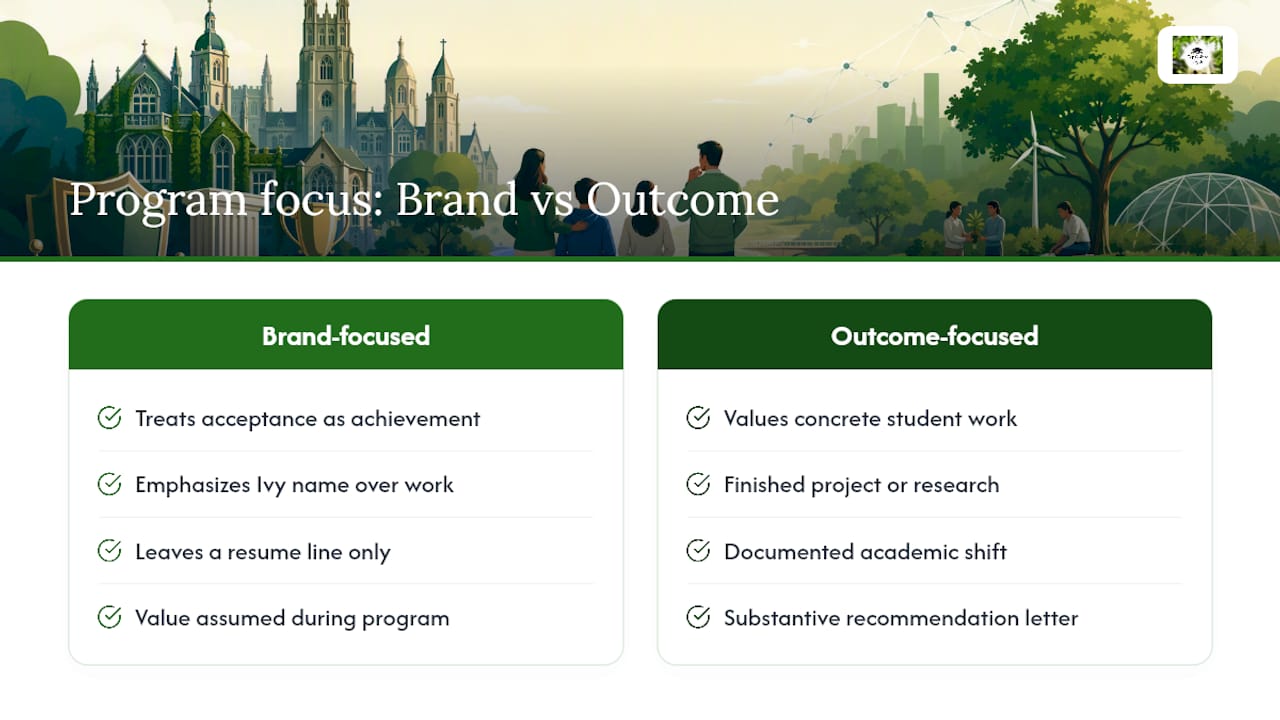
What actually matters is whether a student can point to something specific that came out of the experience. A finished project, a documented shift in academic direction, a recommendation letter with real substance behind it. That’s the difference between a summer that shows up as a resume line and one that shows up as an essay worth reading.
Families should prioritize fit and depth over brand recognition, then invest the real effort in the weeks after the program ends. That’s where the actual admissions value gets built, not during the two weeks on campus.
— Randy Pryor
Sources
FAQ
What Is the Most Prestigious Summer Program?
There’s no single “most prestigious” program, since prestige depends on selectivity, subject depth, and goals. Highly selective options like Dartmouth’s Precollege Summer Scholars or merit-based programs like MITES Summer are considered more competitive than open-enrollment tracks at other schools.
Is a 3.7 GPA Bad for the Ivy League?
A GPA is solid but not automatically competitive for Ivy League admissions, since successful applicants usually have very high academic performance alongside rigorous coursework. Course difficulty, upward trends, and context matter as much as the raw number.
Do Ivy League Summer Programs Help College Admissions?
They build skills, exploration, and campus familiarity, but institutions are explicit that attendance does not guarantee admission, including at the school hosting the program. The real value comes from what a student does with the experience afterward, such as a project or a specific recommendation letter.
What Are the 63 Hidden Ivies?
The term refers to a list of academically rigorous colleges outside the eight formal Ivy League schools, popularized by the book The Hidden Ivies. Definitions of the exact list vary by edition and source, so treat any specific count as approximate rather than official.
Recommended
Comments