Application Essay Help for High School Seniors: 2026 Guide

Application essay help is defined as structured guidance through brainstorming, drafting, and refining your college personal statement to reflect your authentic story and maximize your admissions impact. The personal statement is the one place in your application where grades and test scores step aside and you speak directly to an admissions officer. At Top College Coach, we have watched students with identical GPAs receive wildly different outcomes based solely on the strength of their essays. This guide gives you the exact framework we use with students targeting Ivy League and Top 20 universities.
What application essay help actually requires before you write a word
The most common mistake students make is opening a blank document and starting to type. Strong essays are built on preparation, not inspiration. Starting essay work in junior year gives you the time to draft, reflect, and revise without the pressure of looming deadlines compressing your thinking.
Before writing, build what we call a personal story inventory. This is a list of 15 to 20 moments, relationships, challenges, or realizations that shaped who you are. You are not choosing your topic yet. You are mapping the raw material. Reflection prompts like “When did I change my mind about something important?” or “What would my closest friend say is my most defining quality?” surface stories that feel ordinary to you but read as genuinely revealing to admissions officers.

Understanding the platform requirements matters just as much as the story itself. The Common App enforces a hard word limit of 650 words maximum and 250 words minimum, with no warning when your essay is cut off above the limit. Knowing this before you write shapes how you plan your word budget from the first draft.
Gather your supporting materials in parallel. Request recommendation letters early, finalize your activities list, and review your transcript with fresh eyes. These documents reveal what your application already says about you, which directly informs what your essay needs to add.
Pro Tip: Create a shared folder with your essay drafts, brainstorming notes, and a copy of your activities list side by side. Seeing all three together helps you spot the story your application is missing before you commit to a topic.
Here is a preparation checklist to keep you organized:
Complete your personal story inventory (15 to 20 moments minimum)
Review all seven Common App 2026 prompts before selecting a topic
Request recommendation letters at least six weeks before deadlines
Draft your activities list and identify any unexplained gaps
Set a target draft date at least eight weeks before your first deadline
How to brainstorm and choose the right essay topic
The prompt matters far less than most students think. A well-reflected narrative will naturally fit multiple prompts, which means your job is to find the story first and match the prompt second. This single shift in approach eliminates the paralysis that comes from staring at seven prompts and trying to reverse-engineer a story from each one.
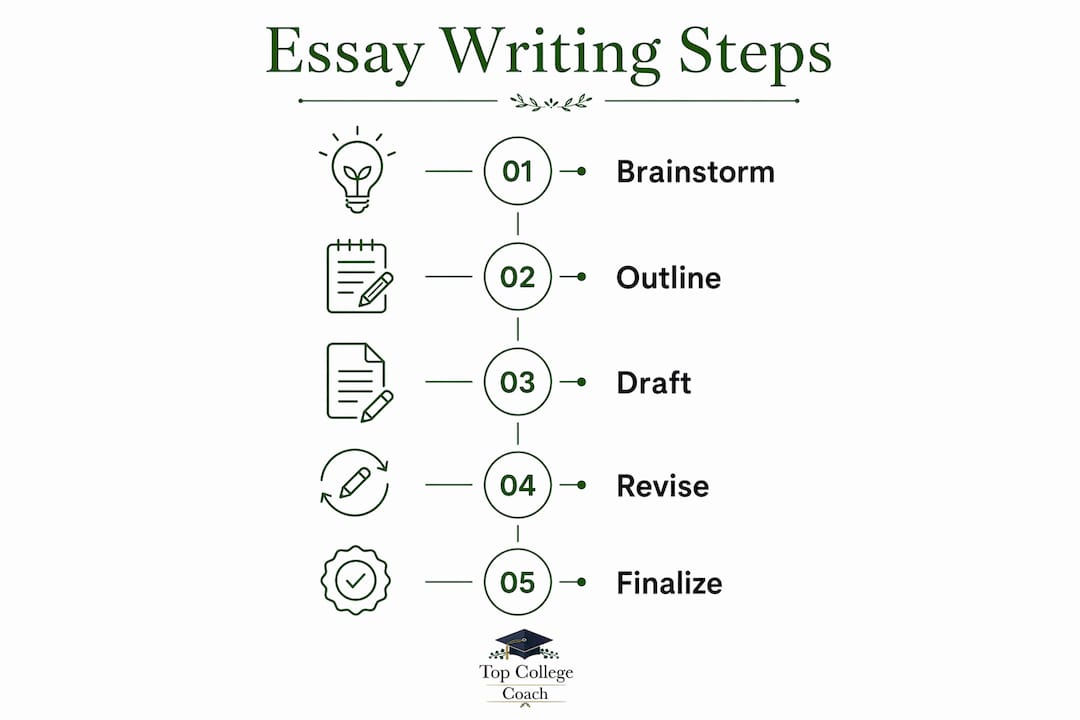
The seven Common App prompts for 2026 remain unchanged and cover background, challenges, beliefs, gratitude, growth, intellectual curiosity, and a free-choice option. Prompt 7, the open topic, is underused and underrated. It is the right choice when your story does not fit neatly into the other six or when a conventional framing would flatten what makes your narrative distinctive.
One of the most effective brainstorming exercises is the “small moments list.” Write down ten specific scenes from your life, each described in one sentence. Not themes or traits, but actual scenes. “The afternoon I taught my grandmother to use FaceTime” beats “my relationship with technology” every time. Specificity is what makes an admissions officer lean forward.
Effective essay help also identifies what we call application gaps: story elements that fill what transcripts and activities do not explain. If your grades dipped sophomore year, your essay can contextualize that without making it the centerpiece. If your most meaningful activity never appears on your activities list because it happened informally, your essay is the place to surface it.
Comparing the three main essay structures
Structure | Best for | Watch out for |
Narrative arc | Single defining moment with clear before and after | Spending too many words on backstory, not enough on reflection |
Montage | Students whose identity is built from many small threads | Feeling scattered if transitions are weak |
Unconventional format | Highly distinctive voices with a clear creative rationale | Confusing admissions officers if the format obscures the message |
Experienced essay writers recommend separating the brainstorming and outlining phases completely before drafting. Write your story inventory, run a “reflection test” on your top three candidates by asking what each story reveals about your values and trajectory, then select the one with the richest answer.
What steps produce a polished, high-impact essay draft
Once you have your topic and structure, drafting follows a clear sequence. Open with a scene, not a thesis. Drop the reader into a specific moment with sensory detail. A recommended pacing for narrative arc essays is roughly 100 to 150 words of opening scene, 300 to 350 words of story development, and 150 to 200 words of reflection woven throughout rather than saved for the end.
The optimal personal statement length is 620 to 650 words. Essays shorter than 580 words often signal underdeveloped reflection. Essays that exceed 650 words are silently truncated inside the Common App platform, meaning an admissions officer reads an essay that simply stops mid-thought. Neither outcome serves you.
Here is the revision sequence we recommend at Top College Coach:
Draft 1: Write without editing. Get the full story on the page, even if it runs long.
Draft 2: Cut background and setup. Every sentence that does not reveal character or advance the story comes out.
Draft 3: Deepen reflection. For every event you describe, add one sentence explaining what it changed in how you think or act.
Draft 4: Read aloud. If a sentence sounds like a college brochure rather than your actual voice, rewrite it.
Draft 5: Verify word count inside the Common App platform, not just your word processor.
That last step is critical and almost universally skipped. Platform word counts differ from word processor counts because of how contractions, punctuation, and formatting are handled. Students who check only in Google Docs or Microsoft Word regularly discover their essay is over the limit only after submission.
Pro Tip: Paste your essay into the Common App text field at least two weeks before your deadline. This gives you time to make cuts without rushing and lets you see exactly how the formatting renders for the reader.
Feedback is part of the process, but it requires boundaries. Ask one or two trusted readers, ideally a teacher and a parent, to respond to two specific questions: “Where did you lose interest?” and “What do you know about me after reading this that you did not know before?” Vague feedback like “it’s good” or “make it more exciting” produces vague revisions.
How to stay authentic and use outside help ethically
Admissions officers read the personal essay specifically to see the applicant beyond grades and test scores. Essay authenticity strongly influences admissions decisions, and experienced readers can identify when a voice does not belong to the student writing it.
The Common App’s 2026 AI fraud policy is explicit. Submitting AI-generated substantive content as your own work is considered misrepresentation, which carries consequences ranging from application withdrawal to rescinded offers. Tools like Grammarly are appropriate for grammar and spelling checks. They are not appropriate for generating sentences, restructuring arguments, or rewriting paragraphs.
“Professional essay coaching supports strategy, brainstorming, and feedback. It does not write the essay for the student. The student’s original voice and ideas must drive every draft from start to finish.”
Professional tutoring and coaching operates within clear ethical boundaries: helping you identify your strongest story, outlining your structure, and giving targeted feedback on drafts you wrote. This is exactly the model Top College Coach follows. The goal is to make your authentic voice clearer and more confident, not to replace it.
Self-reflection is not a soft skill in this context. It is the technical requirement. Admissions officers at schools like Harvard, Yale, and Stanford describe authenticity as the quality that separates memorable essays from forgettable ones. The student who writes honestly about a small, specific moment of growth will consistently outperform the student who writes a polished but hollow account of a mission trip or a sports championship.
Key takeaways
A compelling college application essay requires an authentic story, disciplined structure, and strict adherence to the Common App’s 650-word limit to reach the readers who make admissions decisions.
Point | Details |
Start in junior year | Early drafting allows multiple revisions and reduces deadline pressure significantly. |
Find the story before the prompt | Choose your most reflective narrative first, then match it to the best-fitting prompt. |
Target 620 to 650 words | Essays below 580 feel underdeveloped; essays above 650 are silently cut off in the platform. |
Verify word count in Common App | Word processors count differently than the platform, so always check inside the actual application. |
Keep AI use limited to grammar checks | Submitting AI-generated content violates the 2026 Common App fraud policy and risks your application. |
Why the essay is where I have seen students win or lose their dream school
I have worked with hundreds of students over the years, and the pattern is consistent. The students who struggle most with their essays are the ones treating it as a task to complete rather than a story to tell. They chase “impressive” topics, write about the most dramatic event of their life, and produce essays that feel like highlight reels. Admissions officers are not moved by highlight reels. They are moved by honesty.
The students who write the most memorable essays are often the ones who initially say, “I don’t think my story is interesting enough.” A student who wrote about learning to make her grandmother’s tamale recipe produced one of the most powerful essays I have ever read. It was specific, reflective, and entirely hers. No AI could have written it. No formula produced it.
For parents reading this: your role is to encourage, not to edit. The moment a parent’s voice enters the essay, the student’s voice exits. Ask your student questions. Listen to their answers. Trust that their story, told in their words, is exactly what an admissions officer wants to read. The qualities top colleges look for are authenticity, self-awareness, and genuine reflection. None of those qualities can be borrowed.
Start early. Write badly at first. Revise with intention. And trust the process.
— Randy Pryor, Founder - Top College Coach
How Top College Coach helps you write an essay that gets noticed
At Top College Coach, our college admissions counseling pairs students with experienced counselors who guide every stage of the essay process, from personal story inventory to final polish, while keeping your authentic voice at the center of every draft. We help you identify your application gaps, select the right prompt, and structure a narrative that admissions officers at Ivy League and Top 20 universities remember. Our approach is fully compliant with 2026 Common App requirements, and we never write essays for students. We make yours better. Schedule your free admissions strategy session today and get a clear plan for your essay before the pressure of senior year arrives.
FAQ
What is application essay help?
Application essay help is structured guidance through brainstorming, drafting, and revising your college personal statement to reflect your authentic story. It includes coaching on topic selection, narrative structure, and feedback on drafts you write yourself.
How long should a Common App essay be?
The Common App requires a minimum of 250 words and a maximum of 650 words, with essays over 650 words silently truncated. The optimal target is 620 to 650 words to demonstrate thorough reflection without risking cutoff.
Can I use AI to write my college application essay?
Using AI to generate substantive essay content violates the Common App’s 2026 fraud policy and is considered misrepresentation. Grammar tools like Grammarly are acceptable, but the ideas, voice, and writing must be entirely your own.
Which Common App prompt should I choose?
Choose the prompt that best fits the story you have already identified as your strongest, not the other way around. If no prompt fits naturally, Prompt 7 (topic of your choice) is a legitimate and often underused option.
When should I start writing my college application essay?
Starting in junior year is the most effective approach, giving you time for multiple drafts and thoughtful revisions. Students who begin in the summer before senior year consistently produce stronger essays than those who start in October.
Recommended
Comments