Your Complete Guide to the Common App Essay 2026–2027

The Common App essay, formally called the personal statement, is the single essay that travels with your application to every college on your Common App list. Admissions officers use it to hear your voice, understand who you are beyond grades and test scores, and decide among applicants who look nearly identical on paper. For the 2026–2027 cycle, Common App offers seven standard prompts, unchanged from the prior year, and students choose one. The official word limit is 650 words, and most strong essays land between 500 and 650 words.
What you need to do right now:
Visit Common App to create or log into your account and view the official prompts inside your application.
Read all seven prompts before committing to one — the best prompt is the one that fits your best story, not the one that sounds easiest.
Identify the one experience, identity, or insight that is not captured anywhere else in your application, because that is what your essay should reveal.
Set a first-draft deadline at least eight weeks before your earliest application deadline.
Key Takeaways
The Common App essay is your single most powerful opportunity to show admissions officers who you are beyond grades and test scores — choose a specific, authentic story, show your thinking, and revise until the voice is unmistakably yours.
Point | Details |
Seven prompts, one choice | The 2026–2027 cycle offers seven standard prompts; pick the one that fits your best, most specific story. |
Word limit: 650 words | Most strong essays land between 500 and 650 words; never pad to hit the ceiling. |
Specificity over drama | Admissions officers respond to concrete detail and clear reflection, not the most dramatic topic. |
Voice is the line | Over-editing until the essay no longer sounds like you is one of the most common and damaging mistakes. |
Top College Coach support | Personalized essay coaching from Top College Coach combines expert feedback with admissions strategy to strengthen your personal statement. |
Table of Contents
What are the official 2026–2027 Common App essay prompts?
The seven prompts for 2026–2027 are listed below exactly as issued. Read each one carefully before deciding which fits your story.
Prompt 1: Some students have a background, identity, interest, or talent that is so meaningful they believe their application would be incomplete without it. If this sounds like you, then please share your story. Best for: Students whose cultural background, family history, or defining identity shapes how they see the world.
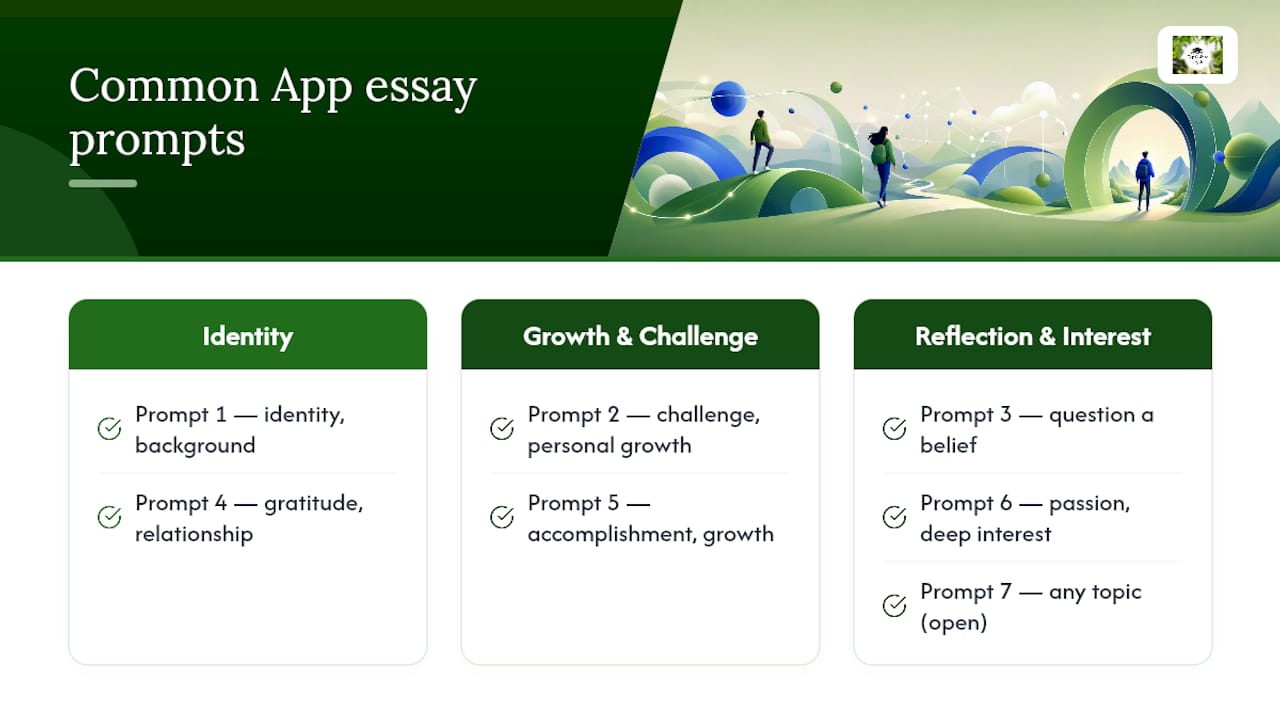
Prompt 2: The lessons we take from obstacles we encounter can be fundamental to our intellectual and personal growth. Reflect on a time when you faced a challenge, setback, or failure. How did it affect you, and what did you learn or gain from the experience? Best for: Students with a clear before-and-after story where the growth is the point, not the obstacle itself.
Prompt 3: Reflect on a time when you questioned or challenged a belief or idea. What prompted your thinking? What was the outcome? Best for: Students who have genuinely changed their mind about something important, or who pushed back on a norm in their community or field.
Prompt 4: Reflect on something that someone has done for you that has made you happy or thankful in a surprising way. How has this gratitude affected or motivated you? Best for: Students whose story centers on a relationship, mentor, or unexpected act of kindness that shifted their perspective.
Prompt 5: Discuss an accomplishment, event, or realization that sparked a period of personal growth and a new understanding of yourself or others. Best for: Students with a specific turning-point moment — a competition, a discovery, a conversation — that changed how they operate.
Prompt 6: Describe a topic, idea, or concept you find so engaging that it makes you lose track of time. Why does it captivate you? What or who do you turn to when you want to learn more? Best for: Students with a deep intellectual passion or creative obsession that drives them outside the classroom.
Prompt 7: Share an essay on any topic of your choice — it can be one you’ve already written, one that responds to a different prompt, or one of your own design. Best for: Students with a story that genuinely does not fit the other six prompts. Treat this as a last resort, not a shortcut — the open format requires the most self-direction.
A note on Prompt 7: The freedom of the open prompt is also its challenge. Without a frame, many students write essays that drift. If you choose Prompt 7, apply the same discipline you would to any other prompt: one central idea, one clear arc, one specific insight. The Common App essay resource PDF encourages students to choose personal, particular topics that reveal information not found elsewhere in the application — that principle applies here more than anywhere.
How do you pick the right prompt for your story?
Choosing a prompt is not about finding the one that sounds impressive. It is about finding the one that gives your best story the most room to breathe. Follow this short decision process:
Start with your story, not the prompt. Write down the two or three experiences, identities, or moments that feel most central to who you are right now. Do not look at the prompts yet.
Ask what new information this story adds. Your essay should tell admissions officers something they cannot learn from your transcript, activity list, or recommendations. If your story duplicates what is already visible, find a different angle.
Map your story to the prompts. Once you have your story, read the prompts and find the one that fits most naturally. The table below gives a quick mapping.
Story category | Prompts that typically fit |
Identity, background, or culture | Prompt 1 |
Overcoming a challenge or failure | Prompt 2 |
Changing your mind or challenging a belief | Prompt 3 |
Gratitude and relationships | Prompt 4 |
A turning-point accomplishment or realization | Prompt 5 |
Intellectual passion or creative obsession | Prompt 6 |
Story that defies the above categories | Prompt 7 |
Test for specificity. If two prompts fit equally well, choose the one that allows you to write the most concrete, scene-based essay. Vague essays fail regardless of which prompt they answer.
Check for emotional resonance. Read your story idea aloud. If it feels flat or generic to you, it will feel flat to a reader. The right prompt unlocks energy in your writing.
When multiple stories compete for your attention, apply three filters: novelty (does this story reveal something surprising?), specificity (can you write a scene, not a summary?), and reflection (does the story show how you think, not just what happened?). The story that passes all three filters wins.
What admissions officers actually look for in your essay
The short answer: authentic voice, a clear window into who you are, specificity, and evidence that you can reflect on your own experience. Grades and scores tell admissions officers what you have achieved. The essay tells them how you think.

When two applicants have similar academic profiles, the essay often becomes the deciding factor. Readers move through hundreds of files, and an essay that sounds like every other essay about volunteering, sports injuries, or immigrant grandparents will not move the needle. What stops a reader is a specific detail, an unexpected angle, or a voice that is unmistakably the student’s own. That is why counselor guidance from College Board stresses authentic student voice above all else and warns that reviewers should offer feedback without rewriting.
Appropriate reviewer help means asking a teacher, counselor, or parent to flag unclear passages, point out where the story loses momentum, and note where the voice shifts. It does not mean having someone rewrite your sentences. A good reviewer asks questions; they do not answer them for you. We recommend sharing your draft with one trusted adult reviewer after your second self-revision, not before, so the voice is already yours before anyone else touches it. For more on why essays matter in admissions, the stakes are real and worth understanding before you draft.
Concrete writing techniques that make your essay work
The most effective college application essays center on a compact, specific story and demonstrate a moment of change or insight. That is the formula. Everything else is craft.
How to open strong:
Drop the reader into a scene. Start mid-action, mid-conversation, or mid-thought. Do not begin with a dictionary definition, a sweeping statement about the world, or your name.
Use sensory detail in the first two sentences. What did you see, hear, or feel? Concrete detail signals to the reader that this essay will be specific.
Avoid the “I have always been passionate about…” opener. It is the most common first sentence in the Common App and the least memorable.
How to build the body:
Show, do not tell. Instead of writing “I learned to be resilient,” write the moment when you kept going despite wanting to quit — and let the reader draw the conclusion.
Use active verbs. “I rebuilt the engine” is stronger than “The engine was rebuilt by me.”
Resist the urge to list accomplishments. The essay is not a second activity list. One specific moment, explored deeply, outperforms five achievements named in passing.
Three structure templates to consider:
Narrative arc works best when you have a clear beginning, middle, and end: a problem, an action, and a reflection. Use this when your story has a turning point.
Montage or episodic works when a single theme connects three short scenes from different moments in your life. Use this when no single event captures the full picture of who you are.
Reflective pivot opens with a present-tense observation or question, flashes back to the story that explains it, then returns to the present with new understanding. Use this when the insight is more interesting than the event itself.
Before/after micro-examples:
✗ Before: “I am a hard worker who never gives up.” ✓ After: “At 11 PM on the night before the regional science fair, my circuit board shorted out for the third time. I soldered the last connection by the light of my phone.”
✗ Before: “Volunteering at the hospital taught me empathy.” ✓ After: “Mr. Reyes did not want to talk. He wanted someone to sit with him. I learned to stop filling silence.”
Drafting checklist:
Does your opening drop the reader into a specific scene or moment?
Is there a clear stake — something that matters to you and shows why?
Does the action or story move forward, or does it stall in description?
Is there a moment of reflection where you show what you understood differently?
Does the closing tie back to the insight without restating it word-for-word?
For more on storytelling techniques in college admissions, narrative craft is one of the most underused tools in a student’s essay toolkit.
What to avoid in your Common App essay
The biggest mistakes are not grammatical errors. They are strategic ones: being too vague, choosing a cliché topic without a unique angle, over-editing until the voice disappears, and failing to reflect on what the story actually means.
Do:
Write about something small and specific rather than something large and generic. A single dinner conversation can reveal more than a mission trip to three countries.
Let your personality show through word choice, rhythm, and the details you notice.
Reflect explicitly. Do not assume the reader will infer your growth — show your thinking.
Do not:
Turn the essay into a resume. Listing achievements without reflection is the most common structural mistake.
Write about a topic that is entirely about another person (a coach, a grandparent) without making clear what it reveals about you.
Use excessive lists of activities or accomplishments inside the essay itself.
Submit a first draft. The essay almost always improves significantly between draft one and draft three.
Red flags that your essay has been over-edited:
The diction suddenly shifts to a more formal or sophisticated register than your other writing samples.
Sentences that sound like they belong in a college professor’s lecture, not a 17-year-old’s voice.
Transitions that feel mechanical rather than natural.
College Board’s counselor guidance notes that reviewers can often detect heavy rewriting by adults, and that the counselor’s role is to offer feedback, not to rewrite. If your essay no longer sounds like you, it has been over-edited.
On sensitive topics: College Board’s BigFuture guidance recommends caution with overly graphic or highly controversial material. If your story involves trauma, mental health, family conflict, or other sensitive experiences, consult your school counselor before finalizing the framing. The topic itself is rarely the problem; the framing and the degree of resolution you demonstrate are what matter.
Short annotated essay excerpts that show strong technique
Examples teach craft more efficiently than rules. Each excerpt below is two to four sentences, followed by a brief analysis of what makes it work and one specific edit to push it further.
Excerpt 1 — Strong scene-based opening:“The first thing I noticed about the beehive was the sound — a low, collective hum that I felt in my sternum before I heard it with my ears. My grandfather handed me the smoker without a word. He had been keeping bees for forty years and had never once been stung.”
Analysis: The opening uses auditory and physical sensory detail (“felt in my sternum”) before visual description, which is unusual and memorable. The grandfather’s detail (“forty years, never stung”) does double work: it characterizes him and raises a quiet question about what the student will learn. The restraint — no explanation yet — creates forward momentum.
One edit to try: Add one specific physical action the student takes in the next sentence to keep the scene moving rather than shifting immediately to reflection.
Excerpt 2 — Effective pivot sentence:“I had spent three years building a robotics team from eleven members to forty-two. What I had not built was a way to disagree with my co-captain without it becoming a referendum on who was really in charge.”
Analysis: The first sentence establishes accomplishment efficiently. The second sentence pivots with “What I had not built” — a structural reversal that signals self-awareness without announcing it. The phrase “referendum on who was really in charge” is specific and slightly wry, which gives the voice personality.
One edit to try: Replace “really in charge” with the exact phrase you and your co-captain actually used in an argument — specificity will sharpen the voice further.
Excerpt 3 — Concise, earned reflection:“I used to think fluency meant speaking without an accent. Now I think it means knowing which version of yourself to bring into a room — and being comfortable with the answer.”
Analysis: This two-sentence reflection works because it shows a before-and-after shift in thinking without over-explaining. The phrase “which version of yourself to bring into a room” is concrete and original. The closing clause (“being comfortable with the answer”) adds emotional honesty without sentimentality.
One edit to try: Ground this reflection by placing it immediately after a specific scene where the student had to make that choice — the abstract insight lands harder when it follows a concrete moment.
For more standout college application essay techniques, including how to develop the Core Four reflection questions, we have a dedicated guide worth reading before your second draft.
Your editing checklist and timeline for the Common App essay
A reliable revision schedule is: first draft, two self-revisions, one peer or teacher review, counselor review, and final polish. Rushing any step compresses the time your brain needs to see the essay fresh.
Numbered revision checklist:
Content clarity: Does the essay answer the prompt? Is the central insight stated or clearly implied?
Narrative arc: Is there a beginning, a middle, and a moment of change or realization?
Specificity: Replace every vague adjective (“difficult,” “amazing,” “meaningful”) with a concrete detail or scene.
Voice consistency: Read the essay aloud. Does it sound like you from the first sentence to the last?
Word count: Are you within 500–650 words? Cut any sentence that does not advance the story or the reflection.
Grammar and mechanics: Check subject-verb agreement, punctuation, and paragraph breaks.
Opening and closing: Does the first sentence earn attention? Does the last sentence land without restating the obvious?
Suggested timeline (working backward from a November 1 Early Decision deadline):
August 1: Complete your first full draft.
August 10: Complete first self-revision (content and structure).
August 20: Share with a peer or teacher for feedback.
September 1: Complete second self-revision incorporating useful feedback.
September 10: Counselor or coach review.
September 20: Final polish and proofread.
October 25: Submit — one week before the deadline, not the night before.
For students applying Regular Decision (January 1), shift each date forward by approximately eight weeks, but keep the same sequence and spacing.
Pro Tip: When you share your draft for feedback, give your reviewer two specific questions rather than asking “What do you think?” Try: “Does my voice sound consistent throughout?” and “Is there a moment where the story loses momentum?” Focused questions produce useful answers. Open-ended ones produce vague encouragement.
For a broader view of where the essay fits in the full application process, including supplemental essays and deadlines, our 2026 application guide covers the complete timeline.
A counselor’s honest note on what really matters
Authenticity is not a buzzword. It is the single quality that separates a memorable essay from a forgettable one, and no amount of polished prose can manufacture it if the story underneath is not genuinely yours.
Students often arrive at the essay stage convinced they have nothing interesting to say. That is almost never true. What they usually mean is that their story does not feel dramatic enough, or that they compare it unfavorably to what they imagine other students are writing. The comparison is a trap. Admissions officers are not looking for the most dramatic story in the pile. They are looking for the most specific one — the essay where they can see a real person thinking in real time.
Realistic effort matters here. A strong Common App essay typically takes four to six weeks of active drafting and revision. That does not mean four to six weeks of daily writing; it means enough time for the essay to sit, for you to return to it with fresh eyes, and for the reflection to deepen. Counseling helps most not by generating ideas for you, but by asking the questions that help you find the right story and the right angle. The voice stays yours. The clarity improves.
If you are not sure where to start, begin with a brainstorm: answer the Core Four questions in writing, and learn how to use AI for essay research to help refine your ideas. Who are you? Why are you here? What is unique about you? What matters to you? The answers will point you toward your essay. You can also explore our Common Application essay guide for a structured prompt-by-prompt brainstorm.
How Top College Coach can help you write your best essay
Writing a strong personal statement is one of the highest-leverage things you can do for your college application, and it is also one of the hardest to do alone. Top College Coach offers personalized essay coaching that combines expert feedback with admissions strategy — so your essay reflects your voice and your story, not a template.
Here is what working with Top College Coach on your Common App essay looks like:
Brainstorming sessions to identify the story that is most compelling and most distinctly yours.
Draft reviews that give you specific, line-level feedback on structure, voice, and narrative arc.
Revision guidance from counselors who know what Ivy League and Top 20 admissions officers are actually looking for.
Interview preparation so your essay story and your in-person presence reinforce each other.
Randy Pryor and the Top College Coach team have helped students gain admission to Ivy League and Top 20 universities, and the essay is central to that work. Free resources, including blog posts and sample guides, are available on the site for students who want to start independently.
Ready to get focused, expert feedback on your personal statement? Book a consultation with Top College Coach and start with a strategy session built around your specific story and target schools.
Sources
These are the primary and most trusted sources for Common App essay guidance. Verify all prompt wording directly from Common App’s official pages before finalizing your essay.
Recommended
Comments