Yale Admissions 2026: Guide for Students and Parents

Yale is one of the most selective universities in the country, and the numbers confirm it: Yale admitted just 4.2% of applicants to the Class of 2030, accepting 2,328 students from a pool of 54,919. That figure is sobering, but it is not the whole story. Students who bring genuine intellectual curiosity, a rigorous academic record, and a clear sense of who they are can absolutely build a competitive application. The first thing you should do right now is confirm which application timeline fits your situation and check whether you can meet the earliest deadline.
Here are your immediate action items:
Check the deadlines: Single-Choice Early Action is due November 1; Regular Decision closes January 2.
Activate your Yale status portal after submitting so you can track materials and receive updates.
Run the MyinTuition Quick Cost Estimator on Yale’s financial-aid site before you assume Yale is out of reach financially.
Visit Yale’s official admissions site at admissions.yale.edu for the most current forms, requirements, and policy updates.
Yale’s holistic review means your transcript is the foundation, but your essays, recommendations, and demonstrated impact are often what separate admitted students from equally qualified ones who were not.
Table of Contents
Yale admissions at a glance: stats, scores, and deadlines
Admitted-class statistics
Yale’s overall acceptance rate for the Class of 2030 was approximately 4.2%, with 2,328 students admitted from 54,919 applicants. That pool was the second-largest in Yale’s history. Regular Decision admit rates run lower than the overall figure because Early Action and QuestBridge matches are included in the combined total.
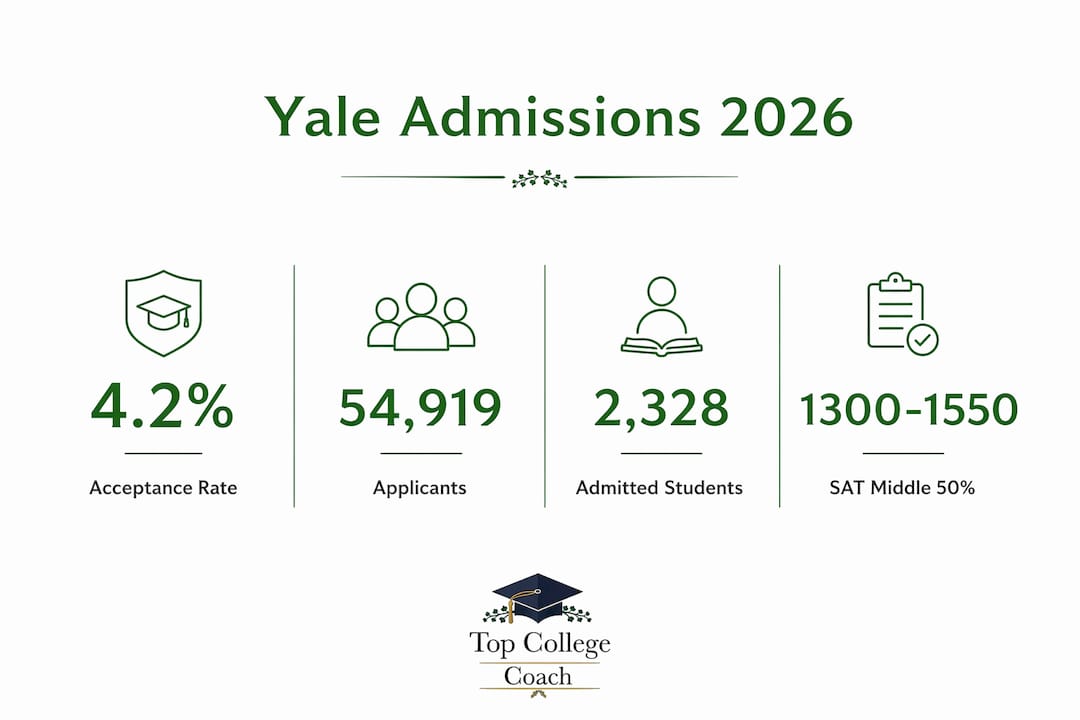
Typical score ranges (middle 50%)
Yale does not publish a single cutoff, but admitted students typically fall within these middle-50% ranges:
SAT: roughly 1500–1580
ACT: roughly 34–36
Scores outside these bands do not automatically disqualify an applicant, but scores well below them require exceptionally strong qualitative materials to compensate.
Application deadlines and decision timeline
Application path | Deadline | Decision notification | Reply deadline |
Single-Choice Early Action | November 1 | Mid-December | May 1 |
QuestBridge National College Match | November 1 | Mid-December | Binding if matched |
Regular Decision | January 2 | Late March | May 1 |
A few important notes on these paths:
Single-Choice Early Action is non-binding. You are not committed to attend if admitted.
QuestBridge Match is binding. If Yale matches you through QuestBridge, you are expected to enroll.
The May 1 reply deadline is the national standard for admitted students choosing Regular Decision.
What Yale values: academic record, curiosity, and community
Yale’s admissions philosophy centers on identifying students with “a sharp and inquiring mind” who will contribute meaningfully to the university community. There is no single profile of an admitted Yale student, and that is deliberate.

The transcript comes first. Course rigor and grade trajectory over four years provide the most reliable longitudinal evidence of academic drive. An upward trend in a demanding curriculum tells a more compelling story than a flat record of easy A’s. Yale wants to see that you have pushed yourself in the most challenging courses available at your school.
Beyond grades, the qualitative elements are where applications are won or lost:
Essays that reveal genuine intellectual curiosity and personal character, not just accomplishments
Extracurricular impact measured by depth and leadership, not the number of clubs listed
Recommendation letters that speak to how you think and engage, not just what you achieved
Character and community contribution, including how you treat others and what you bring to a room
Yale describes its ideal applicant through what it calls the “spirit of and”: students who are both academically exceptional and deeply human, both driven and collaborative. That framing should guide every part of your application.
Pro Tip: Ask your recommenders to describe a specific moment when you showed intellectual curiosity or changed your thinking based on new evidence. Generic praise is forgettable; a precise anecdote is not.
Choose your two teacher recommenders from core academic subjects, ideally teachers who have seen you wrestle with difficult material. A teacher from a performing-arts or leadership context can be a supplementary recommender, but should not replace a core-academic voice.
Your application checklist: what to submit and how to prepare each piece
Yale accepts three application platforms. You submit exactly one per cycle.
The Common Application
The Coalition Application on SCOIR
The QuestBridge Application (for eligible low-income students)
Required materials
Completed application through one of the three platforms above
Yale-specific supplement (included within whichever platform you use)
Two teacher recommendation letters from core academic subjects
One counselor recommendation and the School Report with official transcript
Standardized test scores (ACT or SAT required; see Section 5)
Mid-Year School Report submitted by your counselor after first-semester senior grades are available
Optional supplementary materials
Yale allows applicants to submit supplementary materials in Visual Art, Dance, Music, Film, or STEM research. These are reviewed by faculty evaluators in the relevant department. Submit them only if the work is genuinely strong; a mediocre portfolio can hurt more than it helps.
Essay strategy
The Yale supplement asks several short-answer questions in addition to the main personal statement. The questions change slightly year to year, but they consistently probe intellectual interests, why Yale specifically, and what you will contribute. For the “Why Yale” response, go beyond campus beauty and rankings. Name specific programs, professors, residential college traditions, or research opportunities that connect to your actual interests.

For your personal statement, the goal is to show who you are, not just what you have done. Read our guide on Ivy League personal statement tips before you draft.
Pro Tip: Finalize your essay drafts by October 1 if you are applying Early Action. That gives you four weeks for revision and peer review before the November 1 deadline, and it means you are not rushing recommendations at the last minute.
Ask teachers for recommendations in late spring of junior year, before summer break. Waiting until September of senior year puts unnecessary pressure on both you and your recommenders.
Yale’s testing policy and how to decide whether to submit scores
Yale requires ACT or SAT scores for all first-year and transfer applicants. This policy was reinstated after the pandemic test-optional period, and it applies to the current admissions cycle. Yale’s testing requirement is now firm.
How score reporting works
Self-reported scores are accepted during the review process. You do not need to send official scores to apply.
Official scores must be submitted prior to enrollment. Yale requires that official scores match what you self-reported. Discrepancies can result in offer withdrawal.
Super-scoring is permitted. Yale will consider your highest section scores across multiple test dates for both the SAT and ACT.
Practical guidance on scores
The middle-50% SAT range for admitted students is roughly 1500–1580, and the ACT range is roughly 34–36. If your scores fall within or above those bands, submit them. If your scores fall meaningfully below, you still must submit them because Yale requires scores. In that case, your qualitative materials need to be exceptionally strong, and you should address any context (illness, learning differences, limited test-prep access) in the additional information section.
For non-native English speakers applying from schools where instruction is not in English, Yale may require an English-proficiency test such as the TOEFL or IELTS in addition to the ACT or SAT. Check Yale’s requirements page for the current threshold.
Late test dates (October SAT, October/November ACT) are accepted for Regular Decision but not for Early Action or QuestBridge.
If you are retesting, plan your final attempt no later than September for November deadlines.
A month-by-month prep plan for junior and senior year
Getting into Yale is a multi-year project. Here is how to structure your time.
Junior year priorities
September–December: Take the most rigorous courses available (AP, IB, or dual enrollment). Grades in junior year carry significant weight because they are the most recent full-year record admissions officers see.
January–March: Register for the SAT or ACT. Aim for a spring test date so you have time to retake in the fall if needed.
March–May: Begin researching Yale specifically. Visit campus if possible, or attend virtual information sessions. Identify two core-academic teachers you will ask for recommendations.
May: Ask your chosen teachers for recommendations before school ends. Give them a brief note about your goals and what you hope they will speak to.
Summer between junior and senior year
Draft your personal statement. Write three to five different opening paragraphs and choose the strongest.
Complete meaningful activities: research, internships, community leadership, or creative projects that deepen your existing commitments.
Draft your Yale supplement responses. Research specific Yale programs, faculty, and traditions you want to reference.
Retake the SAT or ACT if your spring scores were below your target range.
Senior year calendar
August–September: Finalize all essay drafts. Share with a trusted reader for feedback.
October 1: Target date for completing all Early Action materials.
November 1: Submit Early Action or QuestBridge application.
Mid-December: Early Action decisions released. If deferred, prepare an update letter.
January 2: Regular Decision deadline.
January–February: Submit Mid-Year School Report through your counselor once first-semester grades are available.
Late March: Regular Decision notifications.
May 1: National reply deadline for admitted students.
What international and transfer applicants need to know
International applicants
Yale offers financial aid to international students on the same terms as U.S. students, which is a meaningful distinction from many peer institutions. The application process is largely the same, with a few additional requirements:
English-proficiency testing: If your secondary school instruction was not primarily in English, Yale requires a TOEFL, IELTS, or Duolingo English Test score. Check Yale’s requirements page for current minimums.
Official translations: All transcripts and school documents not in English must be accompanied by certified translations.
School reports: Your counselor or school official must complete Yale’s School Report form, which may require coordination across time zones. Build in extra lead time.
Demonstrating fit: International applicants benefit from being specific about why Yale’s residential college system, research opportunities, or particular academic programs align with their goals. Generic “world-class education” framing does not differentiate you.
Transfer applicants
Yale’s transfer program is small and highly selective. Transfer applicants must submit ACT or SAT scores under the same policy as first-year applicants. Key considerations:
Yale evaluates transfer applicants on college-level academic performance, not just high school records. Strong grades in rigorous college coursework are the primary signal.
Credit transfer is evaluated on a course-by-course basis after admission; Yale does not guarantee credit for prior coursework.
The transfer application deadline and timeline differ from first-year deadlines. Check Yale’s transfer admissions page for the current cycle’s dates.
Transfer applicants should address clearly why their current institution is not the right fit and why Yale specifically meets their academic and personal goals.
How Yale’s financial aid works and how to estimate your cost
Yale’s financial aid program is one of the most generous in higher education, and the 2026 updates made it more accessible than ever.
The 2026 thresholds: Families with typical assets and incomes below $100,000 will have no expected parent contribution. Families with incomes below $200,000 will receive scholarships that meet or exceed tuition costs. Yale estimates that nearly half of American households with school-age children would qualify for zero parent share under these thresholds.
All Yale financial aid is need-based. Yale does not offer merit scholarships. Aid packages typically cover tuition, room, board, and fees, and may include travel grants and startup grants for lower-income students.
Pro Tip: Run Yale’s MyinTuition Quick Cost Estimator before you decide whether to apply. It takes about three minutes and gives you a personalized cost estimate based on your family’s income and assets. Many families are surprised to find Yale costs less than their state flagship.
Financial-aid application checklist
FAFSA: Complete as early as possible after October 1 of senior year.
CSS Profile: Yale requires the CSS Profile for need-based aid consideration. Submit it by the application deadline for your chosen round.
Non-custodial parent waiver (if applicable): Yale has a process for students in non-traditional family situations.
Financial documents: Be prepared to upload tax returns and other verification documents through Yale’s financial-aid portal.
Deadlines align with application rounds: Early Action applicants should submit financial-aid materials by November 1; Regular Decision applicants by January 2.
What admissions officers wish you knew
The single most common mistake Yale applicants make is treating the application as a résumé rather than a portrait. Admissions officers read thousands of applications from students with near-perfect grades and impressive activity lists. What they remember are the applications that reveal a specific, authentic person.
Here is what actually moves the needle, based on how admissions officers describe their process:
Transcript narrative matters as much as GPA. An upward trajectory in a demanding curriculum signals resilience and drive. A flat record of easy courses, even with a 4.0, raises questions.
Depth beats breadth in activities. One or two areas where you have shown genuine leadership and measurable impact outweigh a list of ten clubs where you attended meetings.
Essays should reveal character, not credentials. Write about something that changed how you think, not something that looks impressive on paper.
Recommendations should speak to how you engage intellectually. Coach your recommenders by sharing specific examples of moments in class that you want them to reference.
Pro Tip: Listen to the Inside the Yale Admissions Office podcast before you write a single word of your application. Admissions officers explain exactly how they read essays and recommendations, and it will reframe how you approach every component.
One myth worth discarding: applying Early Action does not give you a statistical advantage. Yale evaluates applications with the same criteria regardless of the round. Apply early only if your application is genuinely ready by November 1. A polished Regular Decision application will always outperform a rushed Early Action one.
For a deeper look at how extracurricular impact is evaluated, see our guide on why extracurriculars matter in selective admissions.
What happens after you submit your application
Decision timelines
Early Action: Decisions released mid-December.
Regular Decision: Decisions released late March.
Understanding each possible outcome
Admitted: You will receive your decision through Yale’s applicant portal. Review your financial-aid award alongside your admission letter. You have until May 1 to reply.
Deferred (Early Action only): Your application moves to the Regular Decision pool for reconsideration. This is not a rejection. Send a brief, respectful update letter in January or February that adds new information (a significant achievement, a grade update, a new development in your activities) without restating what is already in your file.
Waitlisted: Yale’s waitlist is unranked. If you are waitlisted and wish to remain under consideration, submit a letter of continued interest that is specific and concise. One page maximum. Add only genuinely new information.
Denied: This outcome is final. There is no appeal process for Yale undergraduate admissions.
Post-admission checklist for admitted students
Review your financial-aid award carefully and contact Yale’s financial-aid office with any questions.
Attend Yale’s Bulldog Days (admitted-student visit program) if possible.
Submit your enrollment deposit and housing forms by May 1.
Notify all other colleges of your decision promptly.
Submit your final transcript after graduation. Yale can rescind admission for a significant drop in grades or conduct issues.
Key Takeaways
Yale’s 4.2% acceptance rate makes academic rigor and authentic qualitative materials the two non-negotiable pillars of any competitive application.
Point | Details |
Academic rigor is the foundation | Course difficulty and grade trajectory matter more than GPA alone; take the hardest courses available. |
Qualitative elements are decisive | Essays, recommendations, and demonstrated extracurricular impact separate finalists from the rest of the pool. |
Testing is required | Yale requires ACT or SAT for all applicants; self-report scores to apply, then submit official scores before enrollment. |
Financial aid is more accessible than most families expect | Families earning below $100,000 face no expected parent contribution under Yale’s 2026 aid policy. |
Top College Coach | Personalized strategy, essay coaching, and former-officer reviews help applicants present their strongest possible application. |
A counselor’s perspective on applying to Yale
Yale applicants often come to us with the same anxiety: “My grades are strong, but is that enough?” The honest answer is that strong grades are necessary but rarely sufficient. What I tell every student I work with is this: Yale is not selecting a transcript. It is selecting a person who will contribute something real to one of the most intellectually alive communities in the world.
The three things I emphasize most are these. First, start your transcript story early. Junior year grades and course choices are the last full data point admissions officers have before they read your application, so that year carries disproportionate weight. Second, write essays that only you could write. The moment a reader thinks “this could be anyone,” the essay has failed. Third, treat your recommenders as partners. Give them the context they need to write something specific and memorable.
On interviews: Yale’s alumni interviews are conversational, not interrogative. The interviewer is not trying to catch you out. They want to understand what excites you intellectually and how you think. Prepare by identifying two or three ideas, books, or experiences that genuinely changed how you see something, and be ready to talk about them naturally. Rehearsed answers land flat; genuine enthusiasm does not.
For a full breakdown of Yale’s application requirements, including document-by-document guidance, our team has put together a detailed resource worth bookmarking.
Top College Coach can help you build a stronger Yale application
Getting into Yale takes more than a strong GPA. It takes a strategy, and that is exactly what Top College Coach provides. We work with students and families who are serious about Ivy League and Top 20 admissions, offering personalized counseling packages built around your specific timeline, academic profile, and goals.
Our services for Yale applicants include essay coaching with former admissions officers, month-by-month application strategy, mock interviews with detailed feedback, and full application review before you submit. What sets us apart is that our reviewers have sat on the other side of the table. They know what a Yale admissions committee is actually looking for, and they will tell you honestly where your application is strong and where it needs work.
Ready to put a real plan in place? Schedule a consultation with Top College Coach and get personalized guidance from a team that has helped students gain admission to Yale and other Ivy League universities.
Useful sources and official Yale links
Use these directly to verify deadlines, requirements, and policy updates before you submit anything.
Yale Undergraduate Admissions homepage: Starting point for all application information, including the Inside the Yale Admissions Office podcast.
Apply to Yale as a First-Year Student: Platform options, deadlines, and supplementary-material guidance.
Timelines | Yale Undergraduate Admissions: Official calendar for Early Action, QuestBridge, and Regular Decision, including notification and reply dates.
Requirements | Yale Undergraduate Admissions: Complete list of required and optional application materials.
Standardized Testing | Yale Undergraduate Admissions: Current ACT/SAT policy, self-reporting rules, and super-score guidance.
What Yale Looks For | Yale Undergraduate Admissions: Yale’s official description of its holistic review criteria.
Yale Financial Aid: MyinTuition Quick Cost Estimator and CSS Profile guidance.
Yale admits 2,328 applicants to Class of 2030 | Yale News: Official admitted-class statistics and 2026 financial-aid policy updates.
Yale’s policies and deadlines can change between cycles. Always confirm current requirements directly on Yale’s official admissions site before submitting your application. This article provides general information and is not a substitute for personalized guidance from a qualified admissions counselor for your specific situation.
Recommended
Comments